On Constitution Day, best wishes to our Norwegian friends!
This JL Daeschler photo was taken in Stavanger harbor in 2003. JL’s wife Debra, a Petrodata Marine editor, is pictured in the foreground. The rig in the background is the Maersk (now Noble) Innovator, a large jackup capable of operating in water depths to 492 ft. The legs are 674 ft (Washington Monument = 555 ft).
As summarized below and explained in the attachment, the more realistic independent estimates were 2-3 times higher than the operators’ “high end” estimates.
BOEM’s “Rule to Streamline and Modernize Offshore Renewable Energy Development” is intended to “make offshore renewable energy development more efficient, [and] save billions of dollars. Unfortunately, the savings associated with relaxed decommissioning financial assurance requirements translates to increased risk for customers and taxpayers.
BOEM signaled their intentions on offshore wind (OSW) decommissioning three years ago when they granted a precedent setting financial assurance waiver to Vineyard Wind. Despite compelling concerns raised by commenters, the “streamlining” regulations have codified this decision.
Cape May County, New Jersey, was among the commenters objecting to BOEM’s departure from the prudent “pay as you build” financial assurance requirement. The County commented as follows (full comment letter attached):
“[e]nergy-utility projects are in essence traditional public-private partnerships where technical and financial risks are transferred to the private sector in exchange for the opportunity to generate revenues and profit. Under the proposed rule, the Federal government is instead transferring risks associated with decommissioning to the consumer rather than to the private sector.”
Cape May added:
“[w]hile BOEM believes that if a developer becomes insolvent during commercial activity that a solvent entity would assume or purchase control, the County believes this is a risky assumption as the most likely reason for default is that a constructed wind farm developer is unable to meet its contractual obligations set forth under a Power Purchase Agreement (PPA) because its energy production revenues are not in excess of its operating costs. A change of hands would not remove these circumstances or make the project profitable.”
Cape May and others also commented on the threat of premature decommissioning as a result of storm damage. In response, BOEM asserts that these risks have been addressed in the latest standard for North American offshore wind turbines (Offshore Compliance Recommended Practices: 2022 Edition (OCRP-1-2022)). However, design standards, particularly those for offshore facilities, are not static. The recommended practice for OSW is likely to change multiple times in the coming years as storm, operating, and turbine performance data are updated and analyzed. The design standard for Gulf of Mexico platforms has been repeatedly refined and improved and is now in its 22nd edition.
In their response to public comments on the decommissioning risks, BOEM repeatedly asserts that they can adjust the amount and timing of required financial assurance as they monitor a lessee’s financial health. Unfortunately, a company’s finances can change quickly and BOEM’s options will be limited when it does. Increasing the financial burden on a struggling company that is providing power to a regional power grid will not be a simple proposition.
BSEE has a very good Safety Alert program that merits close attention. However, this amusing entry doesn’t qualify. Perhaps this alert was issued in response to a government-wide anti-scamming directive.
Scam Alert: Suspicious Requests for Payment The Bureau of Safety and Environmental Enforcement (BSEE) is issuing this Safety Alert to inform users about possible scams requesting payment of fines for violations. Be aware the documents you receive may appear to be printed on official government letterhead and could be used to justify requests for payments or loans. BSEE does require payment of fines for certain violations, but BSEE will never:
Request payment via phone or through any social media platforms.
Require a payment from an individual to exit an offshore facility. (Huh? How would this work? Would a BSEE inspector stand at the helideck and require payment before a worker boarded the helicopter? Seriously?)
Request any payment using a gift card. (“You violated an OCS safety regulation. Please make payment with a Target gift card.” 😀)
Demand any payment without prior notification.
Send letters containing spelling, grammar, and punctuation errors. (Yes, all regulations, notices, and other correspondence are in “plain English” and perfectly understandable. 😀 😀 😀)
Should BSEE require a payment for a civil penalty or a fine, the fine will be paid by the operator, not by an individual. BSEE will always send an initial notice to the operator and provide them the opportunity to engage with the BSEE Civil Penalty team.
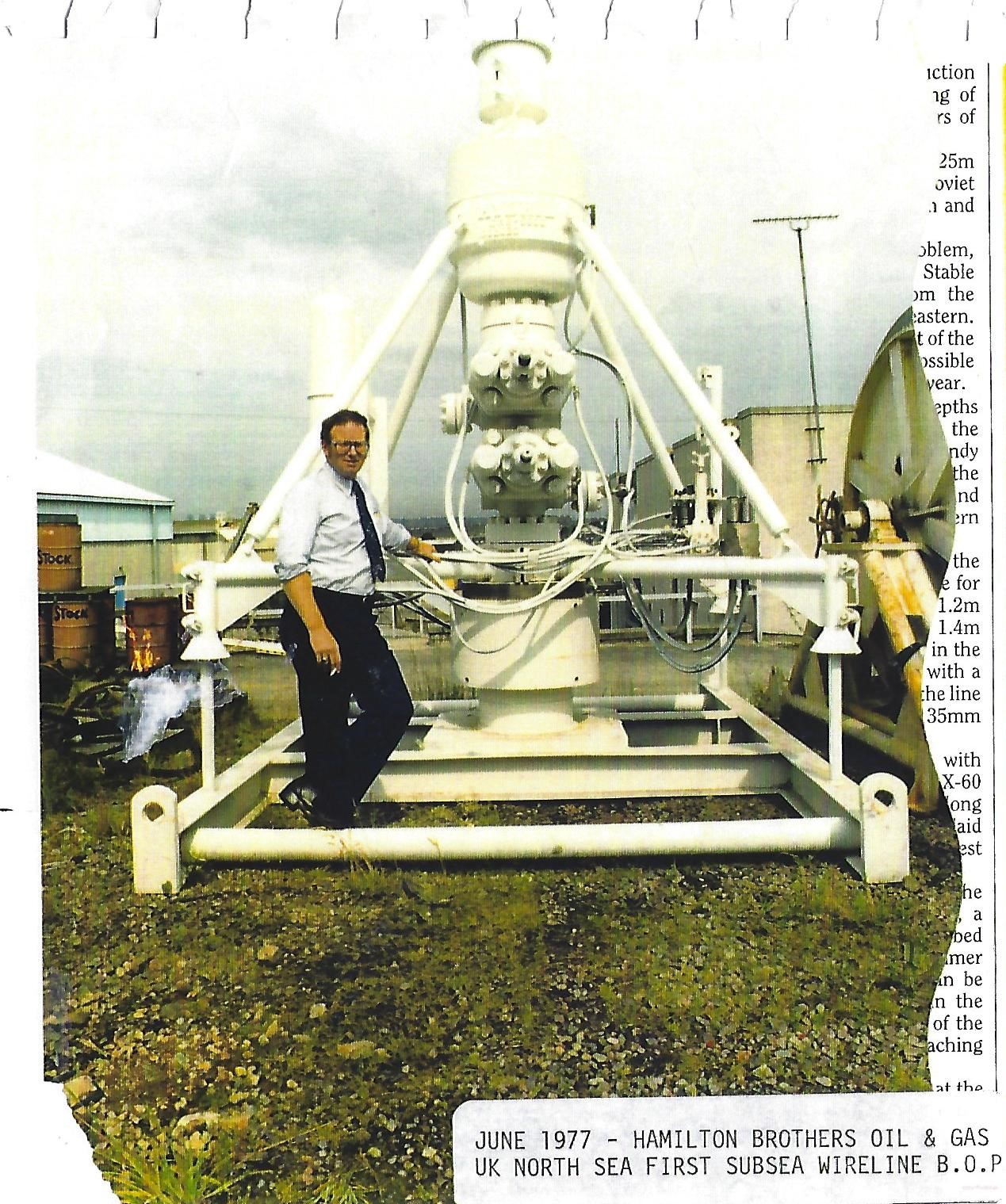
JL Daeschler, pioneering subsea engineer and BOE contributor, recounted a frightening incident in 1976, a year after UK North Sea production began:
We found ourselves in a drastic situation. While working on a subsea well, the wireline retrievable tubing safety valve got tangled up in the tree area. We had an open well situation and couldn’t cut the wire in the subsea tree. Further, the weather was bad, and keeping on location was difficult. The riser hydraulic release was faulty, so there was an imminent high risk of a “jammed ” subsea tree, bent/damaged riser, and uncontrollable well flow.
We got through this, but recognized that improved well control capabilities were needed during workover operations. Management decided that any future workover operations on a subsea tree/well would require a small diameter workover BOP with shearing capability immediately above the Xmas tree. A year later, we had the hybrid kit pictured below (with JL). Note that the guide funnels are slim to run on guide lines and not overshoot the guide base posts.
JL’s story reminds us once again that safety achievement is dependent on continuous improvement driven by experience, research, and technological advances.
When I was a young engineer with the US Geological Survey, the OCS safety regulator at the time, my boss and mentor Richard Krahl (known as “Mr. OCS” for his commitment to offshore safety) slammed😀 a copy of the first edition of API RP 14C (Analysis, Design, Installation, and Testing of Safety Systems for Offshore Production Facilities) on my desk and told me to read it carefully. That pioneering process safety document has grown with the offshore industry and is now in its 8th edition.
Similarly, API RP 2A-WSD (Planning, Designing, and Constructing Fixed Offshore Platforms— Working Stress Design) is now in its 22nd edition and API STD 53 (Well Control Equipment Systems for Drilling Wells) is in its 5th edition. There are countless other examples of the progression in safety equipment and practices.
As individuals, companies, agencies, and collectively as an industry, there can be no standing still. Nothing is routine and the challenges continue to grow: deeper wells, more complex geology, higher temperature and pressure, deeper water, harsher environments, remote locations, new security risks, and more. We get better or we get worse, and the latter is not an option. Onward!
“Deepwater is back in vogue.” (Pablo Medina, Welligence)
“Newer deepwater projects have the attributes oil and gas companies are looking for: longer-term production, lower breakeven costs, big resource potentials and lower carbon emissions.” (Medina)
Capital spending on all-new deepwater drilling is poised to hit a 12-year high next year (Rystad)
Investment in all-new and existing deepwater fields could hit $130.7 billion in 2027, a 30% jump over 2023 (Rystad)
Deepwater resources offer lower carbon emissions intensity than shale and other tight oils, averaging 2kg of carbon dioxide per barrel less than shale. (Rystad)
“The return of offshore and deepwater operations is going to be a big topic at OTC, and Namibia is going to be talk of the show.” (James West, Evercore)
Enthusiasm for offshore has climbed with discoveries and technology breakthroughs. Namibia’s Mopane is forecast to hold as much as 10 billion barrels of oil. (Portuguese oil company Galp Energia)
Rates for some rigs have surpassed $500,000 a day and contract durations are lengthening as supply dwindles.
The government’s decision to require that a capping stack be located in Guyanais prudent. Although the need for a capping stack is dependent on multiple barrier failures and is thus extremely low, the environmental and economic consequences of a prolonged well blowout warrant timely access to this tertiary well control option.
A capping stack must be properly maintained and deployable without delay. In that regard, BSEE has a good program for testing Gulf of Mexico capping stack readiness. Capping stack drills are an important post-Macondo addition to the unannounced oil spill response program that dates back to 1981.
“Troy Naquin, BSEE New Orleans District, observes as a capping stack is carefully lowered onto the deck of ship to be transported more than 100 miles offshore for a drill designed to test industry’s ability to successfully deploy it in case of an emergency, May 8, 2023.” BSEE photo/Bobby Nash
Havtil prioritizes risk assessment and publishes their comprehensive annual analysis of safety trends in a timely manner. The 2023 RNNP was posted in Norwegian earlier this year and the summary report is already available in English. RNNP reports are an important safety resource that should be reviewed and discussed wherever oil and gas operations are conducted.
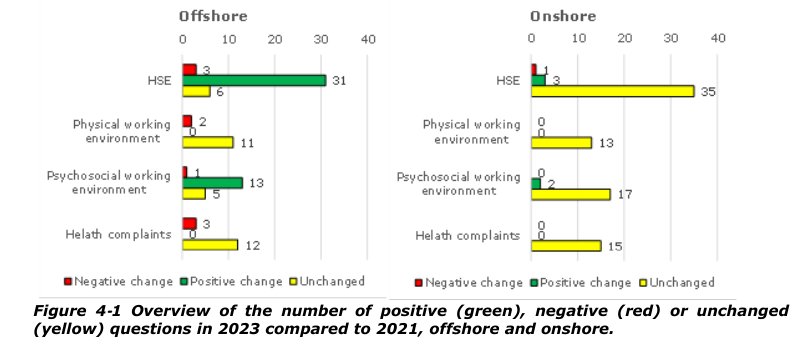
As an example of the breadth of these reviews, the two sets of charts below convey data that are not typically documented by offshore safety regulators. The first set documents near-misses that did not result in injuries, but did expose workers to that risk.
The second set of charts is a summary of worker responses to a survey, a means of assessing the safety culture. The big jump in favorable responses to the HSE questions is encouraging. In particular, the report notes (p. 14) that responses to a question about being pressured not to report incidents has moved in a positive direction in the last two surveys. Hopefully, this is an industry-wide trend.





 Bud's Offshore Energy (BOE)