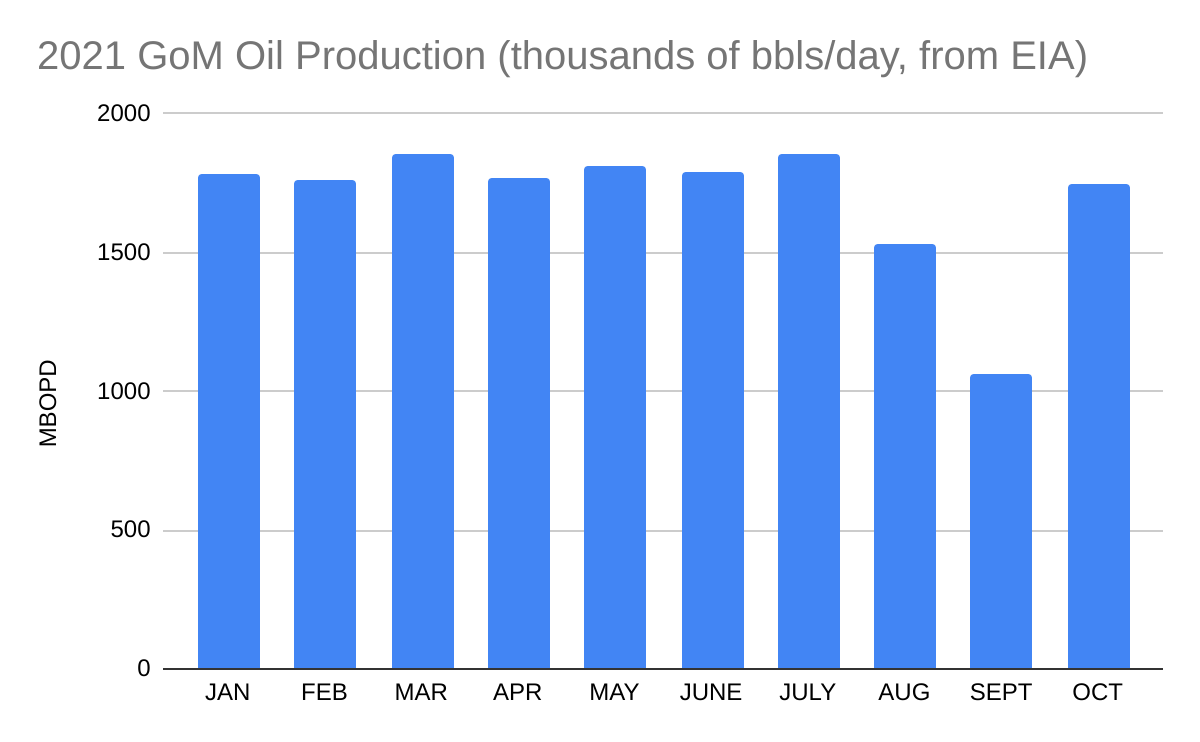
October production rebounded to 1.744 million BOPD from the 2021 low of 1.064 million BOPD in September (Hurricane Ida). November and December production should exceed 1.8 million BOPD.
Posted in Gulf of Mexico, hurricanes, Offshore Energy - General, oil, tagged Gulf of Mexico, Hurricane Ida, October, production on January 3, 2022| Leave a Comment »
October production rebounded to 1.744 million BOPD from the 2021 low of 1.064 million BOPD in September (Hurricane Ida). November and December production should exceed 1.8 million BOPD.
Posted in Offshore Energy - General, Uncategorized, tagged offshore safety regulators on January 1, 2022| Leave a Comment »
As we enter 2022, BOE salutes the outstanding Minerals Management Service (MMS) professionals who retired from the successor bureaus in 2021:
With very few exceptions, the career staff in the US offshore program are highly competent and dedicated to their safety, environmental, and resource management missions. I have also found this to be true for the professionals occupying similar positions elsewhere in the offshore world. Cultures, legislation, policies, and practices differ, but the objectives and commitment are similar.
Posted in offshore, Offshore Energy - General, Uncategorized, tagged Happy New Year 2022, masterpiece, Rig at Sunset on December 30, 2021| 2 Comments »
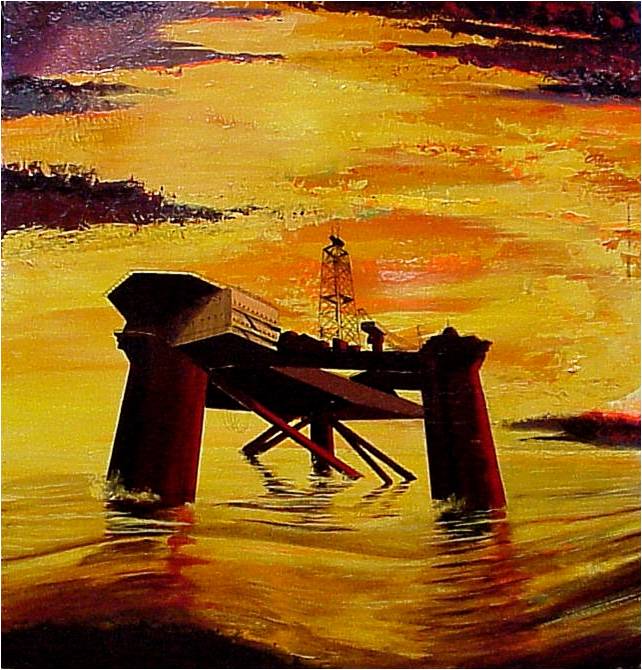
I’m sharing this photo of the masterpiece Rig at Sunset. Next year, BOE will explore the painting’s symbolism and cultural significance.
May the glow of Rig at Sunset guide, comfort, and inspire you in 2022! 😃
Posted in California, Offshore Energy - General, pipelines, tagged California, pipeline spill, Platform Eva on December 27, 2021| 2 Comments »
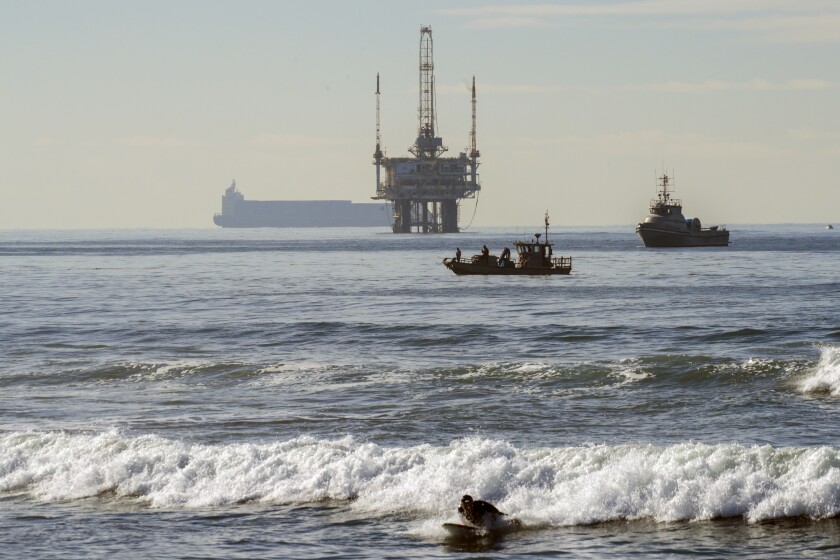

Per the LA Times, a DCOR pipeline has been identified as the source of a sheen in California State waters near Bolsa Chica State Beach. The pipeline transports oil from Platform Eva. All platform and pipeline operations in the vicinity have ceased.
Posted in accidents, decommissioning, Gulf of Mexico, Offshore Energy - General, tagged consent decree, Hurricane Ivan, Mississippi Canyon, mudslide, Taylor Energy on December 27, 2021| Leave a Comment »
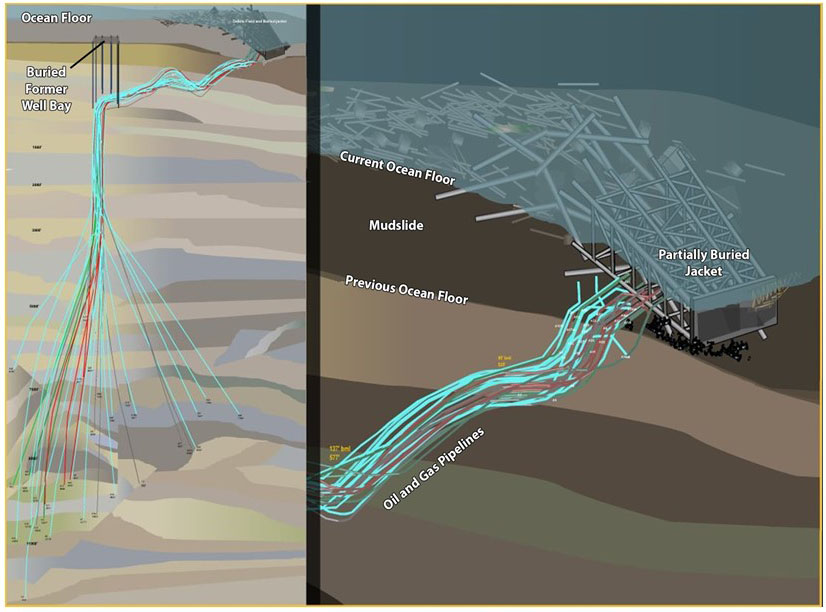
Taylor Energy’s Mississippi Canyon Block 20 “A” platform was destroyed by a massive mudslide during Hurricane Ivan in 2004 (see illustrations below). Per Naval Research Laboratory sensors, “Ivan the Terrible” generated freak waves as high as 91 feet, and NRL computer models suggest that wave heights may have exceeded 130 feet. The changes in pressure resulting from the motion of the huge waves triggered the flow of the unstable Mississippi delta sediments. The platform was swept 500 feet downslope and the wells were severed and buried under a deep layer of sediment. That was essentially the end for Taylor Energy, as the company would spend the next 17 years locating and plugging wells, decommissioning piping, collecting seepage, and mitigating pollution. Since 2008, when Taylor sold its remaining oil and gas assets, the company has been solely engaged in the MC-20 response.
Last week, Taylor and the Justice Department signed a consent degree that transfers the company’s remaining assets and control of the decommissioning trust fund to the Federal government. Questions remain as to whether the platform and wells could have been better designed to withstand the mudslide (note that the platform was installed and operated by BP prior to being sold to Taylor), and whether more should have been done to mitigate the seepage. Taylor does a good job of making its case at their response website.
Few offshore operators would argue that what happened to Taylor couldn’t happen to them. That would be brash and foolish. Hopefully, the companies that remain have absorbed the lessons of MC-20 and are applying them to their operations and management programs.
Posted in decommissioning, energy policy, Gulf of Mexico, Offshore Energy - General, rigs-to-reefs, tagged aquaculture, GORI, Innovasea, rigs-to-reefs, rigs-to-roe on December 22, 2021| Leave a Comment »
An old offshore platform in the U.S. Gulf of Mexico is set to be converted into a working fish farm, creating a blueprint for future aquaculture re-use projects and providing repurposing options for old oil and gas assets.
offshore-energy.biz

Congratulations to the Gulf Offshore Research Institute (GORI) and Innovasea on their plans to transform an offshore Texas gas platform into a working fish farm.
For the complete list of alternative uses for offshore oil and gas platforms, see our Rigs-to-Reefs+++ page.
Posted in Offshore Energy - General, Uncategorized, tagged Northern Lights, Norway, offshore platform on December 21, 2021| Leave a Comment »

Posted in CCS, climate, energy policy, Gulf of Mexico, Norway, Offshore Energy - General, tagged CCS, Exxon, Lease Sale 257, Norway, NPD on December 20, 2021| Leave a Comment »
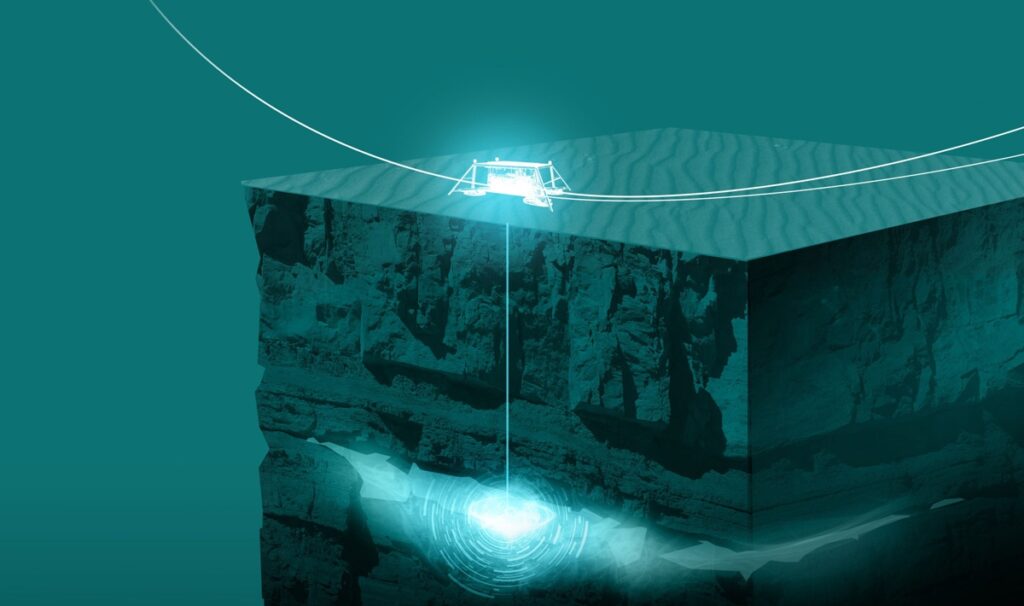
Several actors have approached the ministry with a desire to be allocated two specific areas for storage of CO 2 . One area in the North Sea and one in the Barents Sea were therefore announced on 10 September in accordance with the storage regulations.
By the application deadline of 9 December, the ministry had received applications from five companies. The Ministry will process the received applications and allocate area in accordance with the storage regulations during the first half of 2022.
Ministry of Petroleum and Energy, Norway
Contrast the situation in Norway with Exxon’s apparent attempt to acquire 94 Gulf of Mexico leases at Oil and Gas Lease Sale 257 solely for CCS purposes. BOEM’s Notice of Sale made no mention of CCS, and there had been no environmental or economic assessment of CCS activity.
And how much will the public pay for grand CCS ventures that (although interim measures) will take years to initiate, add new safety and environmental risks, and may never achieve their objectives? The public burden will no doubt include direct subsidies, tax credits, increased petrochemical prices, and the erosion of purchasing power associated with the resulting inflation pressures.
Posted in drilling, energy policy, Offshore Energy - General, tagged Atlantic drilling, Build Back Better, Joe Manchin, offshore drilling, Pacific drilling on December 17, 2021| Leave a Comment »
Sen. Joe Manchin III (D-W.Va.), a critical swing vote, has rejected a provision (in the “Build Back Better Bill”) that would prohibit all future drilling off the Atlantic and Pacific Coasts, as well as the eastern Gulf of Mexico, according to three people familiar with the matter
Washington Post
New oil and gas leasing is unlikely in these areas, but broad permanent bans are never a good idea.
Posted in climate, energy policy, gas, Gulf of Mexico, natural gas, Offshore Energy - General, tagged CCS, natural gas, nonassociated gas, offshore gas production on December 16, 2021| Leave a Comment »
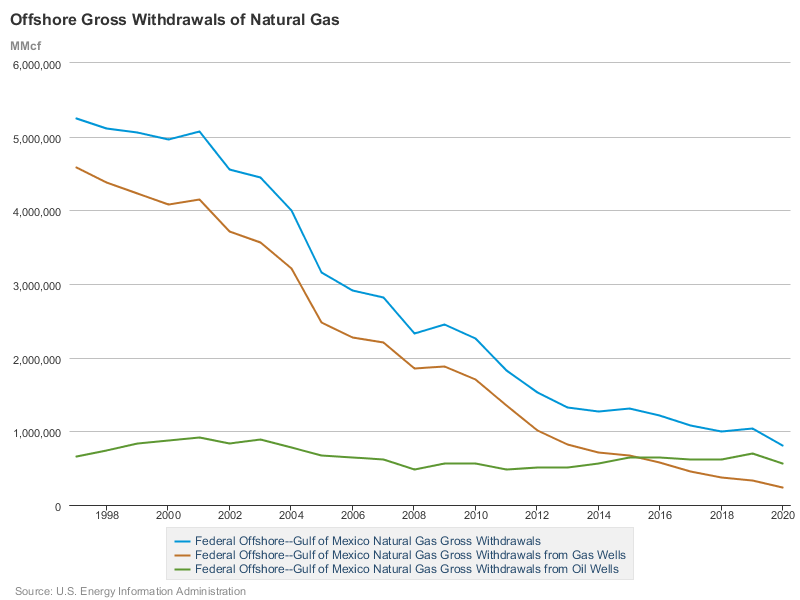
Offshore gas production (see chart below) has declined for the past 20 years and now accounts for only 4% of total US gas production, down from 20% in 2005 and 25% in the 1990s. Associated gas production (oil-well gas) has remained relatively constant owing to the strength in deepwater GoM oil production. 73% of 2020 gas production was from deepwater wells, and was mostly oil-well gas. Associated gas production surpassed nonassociated gas production (gas-well gas) in 2016 and the latter has continued to decline.
The case for natural gas has been well documented (see the EQT letter linked below). Recent natural gas advocacy has emphasized the carbon/GHG advantages given that methane (CH4) is essentially a hydrogen transporter that emits far less CO2 than other fossil fuels when burned. However, natural gas’s other important air quality advantages – low NOx. SO2, and particulate emissions – have greater local significance from a human health standpoint. Those who have ridden a bike behind a natural gas powered bus have no doubt experienced the natural gas advantage firsthand. These buses are literally a breath of fresh air!
Other environmental advantages of offshore natural gas, particularly nonassociated gas, receive less attention but are nonetheless significant. Advantages of nonassociated offshore gas include the following:
Low natural gas prices and competition from nimble and efficient shale operations have constrained offshore gas exploration. Ultradeep (subsurface) drilling has shown promise from a gas resource perspective but has proven to be expensive and operationally challenging. Some independent producers are still acquiring gas prone shelf tracts and that needs to be encouraged. Consideration should be given to incentives such as making nonassociated gas production royalty free. That would certainly seem preferable to subsidizing complex, expensive, and uncertain carbon disposal operations on offshore leases.
 Bud's Offshore Energy (BOE)