Feeds:
Posts
Comments

Archive for the ‘Offshore Energy – General’ Category

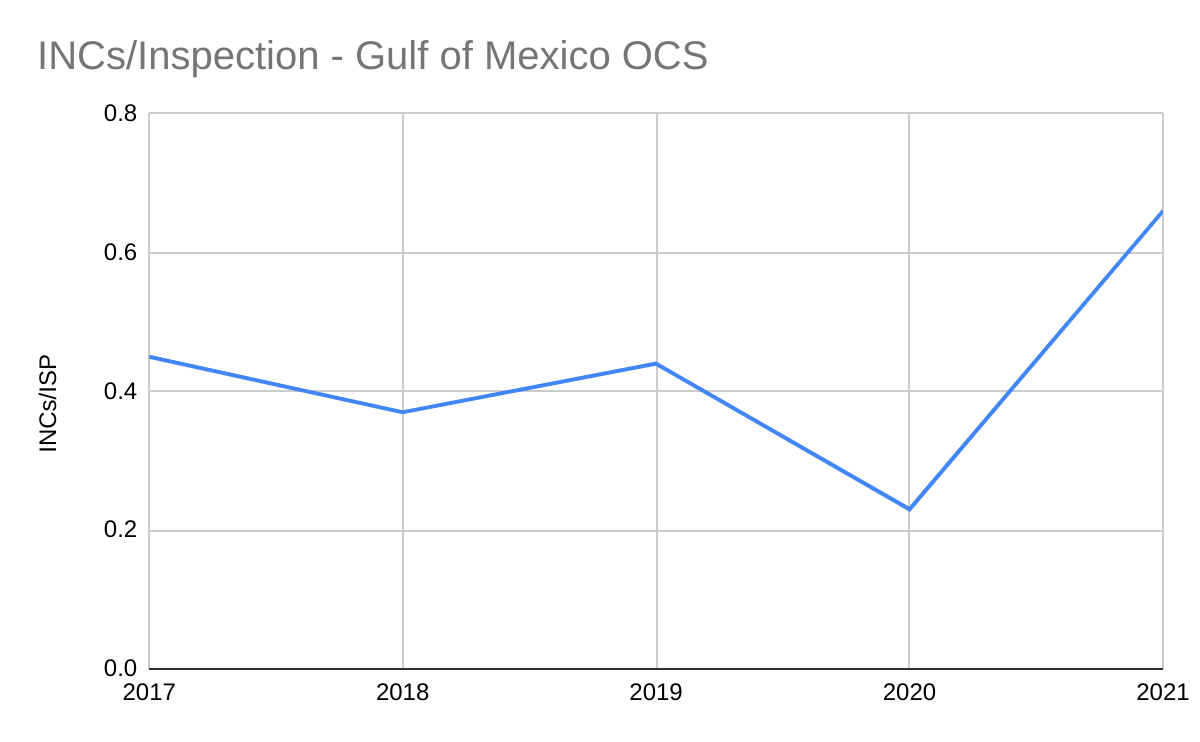
Per BSEE’s Incidents of Non-Compliance (INC) data base, the number of violations surged in 2021, both in terms of the total number of INCs and the INCs/inspection ratio (see chart below). Remarkably, a single company – Fieldwood Energy – was responsible for 845 INCs or 44% of the total number issued. Normalizing for the number of inspections, Fieldwood facilities were cited for 1.46 INCs/inspection versus 0.46 INCs/inspection for all other companies. An unprecedented 61 of Fieldwood’s 2021 INCs called for facility shut-ins, many times more than any other operator. Through the first 17 days of 2022, Fieldwood has already been cited for 21 INCs, 5 of which required facilities to be shut-in.
Fieldwood and its affiliates have experienced multiple bankruptcies and the company has once again been reorganized with the blessing of the courts. Chevron’s comprehensive objection to the reorganization plan asserted that Fieldwood has $9 billion in current and anticipated decommissioning obligations. These enormous decommissioning liabilities and their implications for predecessor lessees (former facility owners) and the Federal government were the main issue in these proceedings, and the bankruptcy plan includes settlements with predecessor companies and the government.

Even more significant than the financial matters and INCs are the following:

While BSEE regulations provide for the removal of operating rights for poor safety performance, companies can reorganize and problem managers can reappear elsewhere. As a result, marginally financed and ineffective operating companies are a major challenge for BSEE as evidenced by the INCs, civil penalties, and investigations. (See the related saga of Platforms Hogan and Houchin in the Pacific Region.)

Poor safety performers drag down the entire industry. The costs of mega-disasters like the Santa Barbara and Macondo blowouts have been widely discussed. However, chronic poor performance and the associated incidents also weaken the industry and damage the integrity of the offshore oil and gas program. These performance issues can’t be left entirely to BSEE and the Coast Guard to resolve. The industry needs to do a better job of self-evaluation, calling out poor performers, and exercising judgement in the assignment of offshore properties.

Read Full Post »

BP and Equinor have quit Nova Scotia’s upstream sector in Canada, leaving the once-alluring region without an active exploration licence, potentially putting a final nail in the coffin of the province’s E&P scene which is already been on its death bed.

Upstream
Discoverer Seven Seas

Some of us remember the record water depth well (4876′) drilled by the Discoverer Seven Seas offshore Nova Scotia in 1979. (Correction: The record water depth well was actually offshore Newfoundland. Many thanks to Howard Pike for the reminder.)

Some notable achievements offshore Nova Scotia:

  • Cohasset Panuke provided Canada’s first offshore oil production (1992), and the first for the Atlantic waters of North America.
  • The Sable Offshore Energy Project was responsible for Canada’s first offshore gas production (1999)
  • A novel jackup platform produced gas from the Deep Panuke field from 2013 to 2018.

The only remaining exploration and production operations in the Atlantic offshore North America are in Newfoundland waters (link to map).

Read Full Post »

Oil and gas workers’ union, Unite Scotland, has demanded intervention by the Scottish government in response to Canadian Natural Resources (CNR) International introducing mandatory vaccinations, calling these measures “draconian.”

offshore-energy.biz

As previously reported, a Norwegian union criticized the absence of consultation before Aker BP imposed vaccine requirements at their facilities.

Read Full Post »

Deb Haaland, U.S. Secretary of the Interior
Deb Haaland, US Secretary of the Interior
Haaland Leeds
Erling Braut Haaland

As a result of her mother’s heritage, Deb Haaland is the first Native American to serve as a US cabinet secretary. However, her father, a decorated Marine Corps officer was a Norwegian American. She thus has the same surname as Erling Braut Haaland, the star striker for Norway and BVB Dortmund in the German Bundesliga.

Although most Americans cannot name the Secretary of the Interior (James Watt was an exception thanks to his attempt to ban the Beach Boys from the 4th of July concert in Washington😃), Deb Haaland is probably slightly better known in the US than Erling Haaland. However, thanks to the popularity of football/fussball/futbol/soccer, Erling is much better known internationally.

What does this have to do with offshore energy? Well Norway, which just announced record oil and gas revenues, has managed to sustain leasing, exploration, and production throughout the pandemic without compromising safety and environmental objectives. They also wisely eased the petroleum tax burden during the pandemic with favorable results.

The temporary change in the petroleum tax has most likely led to an increase in project activity. The projects would most likely have been carried out even without the tax package, but some of them would have been postponed.

NPD

Regardless of her heritage and any connections she might have with Norway, this would be a good time for Secretary Haaland to put the MOU between the Dept. of the Interior and the Ministry of Petroleum and Energy (Norway) to good use by learning more about resource management on the Norwegian continental shelf and discussing how to best sustain US offshore production.

Read Full Post »

This should not surprise experienced OSHA regulators given the absence of clear legislative authority.

Offshore regulators in the US have used “work-arounds” in the form of Notices to Lessees, Conditions of Approval, and other types of guidance documents. However, there was a general understanding that requirements imposed by these methods would not survive legal challenges unless they were clearly authorized by legislation or regulations. Most work-arounds aren’t challenged because the regulatory authority is reasonably clear, their issuance is at least minimally acceptable to the regulated industry, or the perceived cost of challenges exceeds the cost of compliance.

Read Full Post »

See the video below. The size and durability of the bladders could be issues at locations where there are other seafloor activities (e.g. trawling), but this and other pumped hydro-storage concepts are promising. Onshore testing of this concept is scheduled for 2023 in the Netherlands. Energy storage and stable, reliable power supply will be critical to the long-term success of offshore wind projects.

Read Full Post »

Vineyard Wind false start?

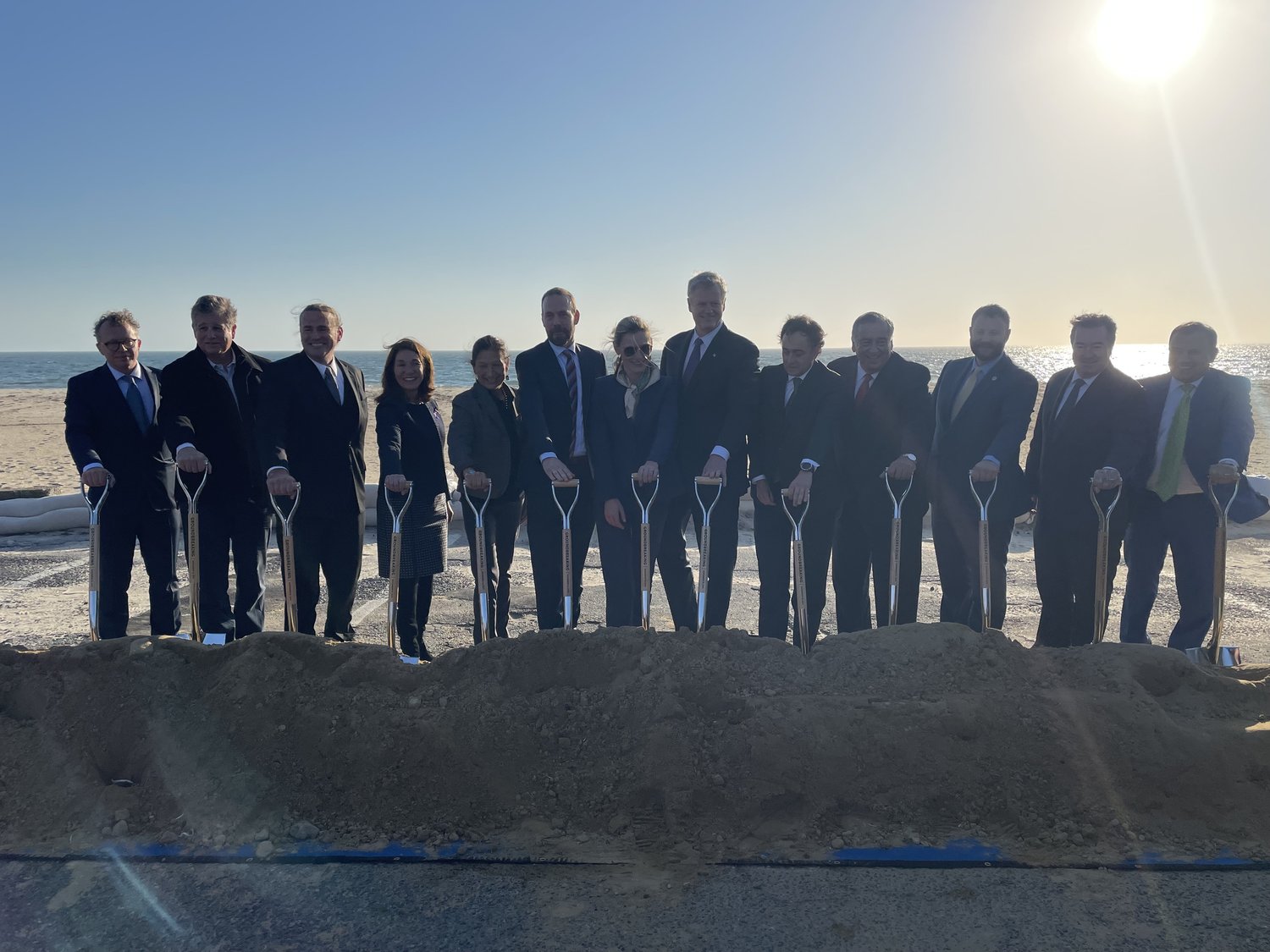
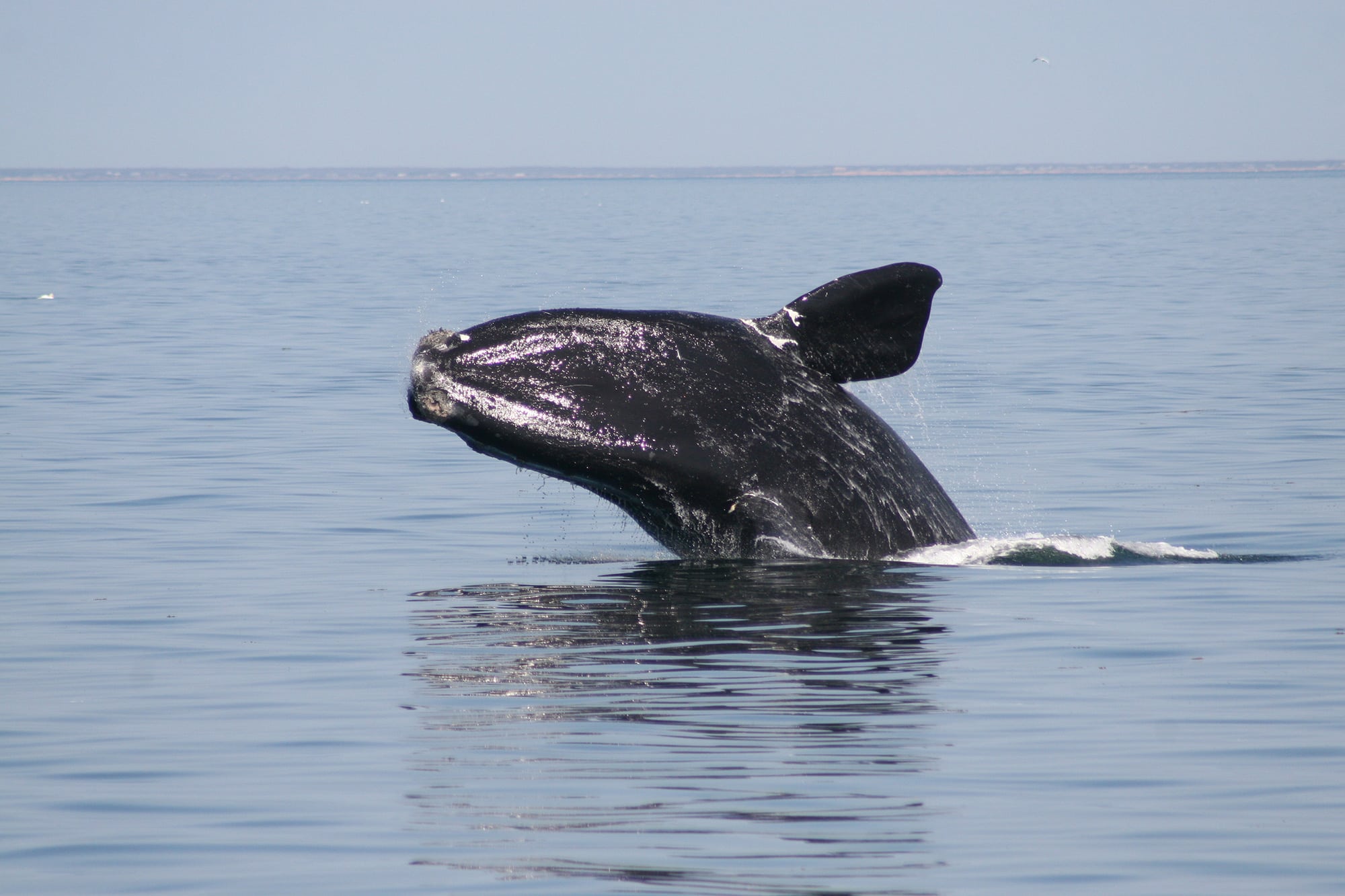
Nearly 17 years after the Energy Policy Act of 2005 (incorporating language drafted by Minerals Management Service staff) authorized wind energy projects in Federal offshore waters, commercial offshore wind power is not imminent. Despite enthusiastic political support and promised State and Federal subsidies, no commercial scale offshore wind development has commenced. The groundbreaking ceremony for Vineyard Wind I (pictured above), the first project approved by BOEM, may prove to have been premature. The project faces multiple lawsuits from commercial fishing organizations and an organization concerned about possible impacts to the endangered right whale.

North Atlantic right whale - Whale & Dolphin Conservation USA
North Atlantic Right Whale

Read Full Post »

Read Full Post »

Last month (12/2021), BSEE finally posted the 2020 incident statistics. Unfortunately, no details or incident summaries are provided for the 6 fatalities. The fatalities are simply classified as “occupational” (4) or “non-occupational” (2). As a result, we still know very little about these fatal incidents 13 – 24 months after they occurred.

The BSEE spreadsheet advises that 3 of the 4 “non-occupational” fatalities are being investigated, but the reports are still “pending.” Why the long delay? The National Commission, BOEMRE-CG, and NAE investigations of the Macondo tragedy were completed (and reports published) in less time.

No explanation is provided as to why the 4th occupational fatality is not being investigated.

Also, investigations of the preparedness and response aspects of the 2 non-occupational fatalities would have been beneficial. What was the cause of death? What medical screening procedures were in place? What treatment capabilities were available at the facility? How much time was required to transport the workers to hospitals? These are important considerations for the offshore community.

Below is a summary of the publicly available information for the 6 fatalities:

  • 1/14/2020: A worker died on a Diamond drillship on a lease (Mississippi Canyon 822) operated by BP. According to BSEE this was a non-occupational fatality. Per the listing of investigations, no investigation was conducted.
  • 5/16/2020: A worker died on a Fieldwood platform (Ewing Bank 826 A). Per BSEE, this was an occupational fatality and the investigation is still pending. There were no media reports or company announcements.
  • 6/2/2020: A worker died on the Valaris DS-18 drillship working for EnVen Energy at Green Canyon 767. Per BSEE, this was a non-occupational fatality and no investigation was conducted.
  • 6/20/2020: A worker died on at the Green Canyon 18 A platform operated by Talos. Per BSEE, this was an occupational fatality but no investigation is indicated for this incident. No media reports or company announcements could be found.
  • 8/23/2020: A worker died on the Pacific Khamsin drillship working for Total at Garden Banks 1003. A month later, at an Investors’ Day presentation, Total announced that the incident occurred while the crew was preparing to move the rig to avoid Tropical Storm Laura. Total’s statement included this defensive statement: “This is a routine operation that was executed with no time pressure as the rig disconnection had been decided well in advance.” Per Total, the findings of their investigation were shared with the regulators in Sept. 2020, but BSEE advises that their investigation is still pending.
  • 12/2/2020: A worker died on DCOR’s Platform Gilda in the Santa Barbara Channel offshore California. The BSEE investigations update provides no information on the status of the investigation. Per local media, 3 men fell from the platform and others jumped into the water to assist. No information is provided on the reason why the 3 men fell.

The number of US OCS fatalities remains unacceptably high, and timely data sharing and investigations are needed to better assess causes and trends. In that regard, this recommendation from the 2016 National Academies report entitled “Strengthening the Safety Culture of the Offshore Oil and Gas Industry” merits further industry/government attention and action:

Recommendation 4.2.2: Because accident, incident, and inspection data all are needed to identify and understand safety risks and corrective actions, the committee recommends full transparency such that regulators make all these data readily available to the public in a timely way, taking into consideration applicable confidentiality requirements.

Read Full Post »

Declines in drilling activity and discoveries suggest that higher real oil prices are on the horizon. We may be fortunate enough to escape significant price hikes and supply disruptions over the next couple of years, but they are coming.

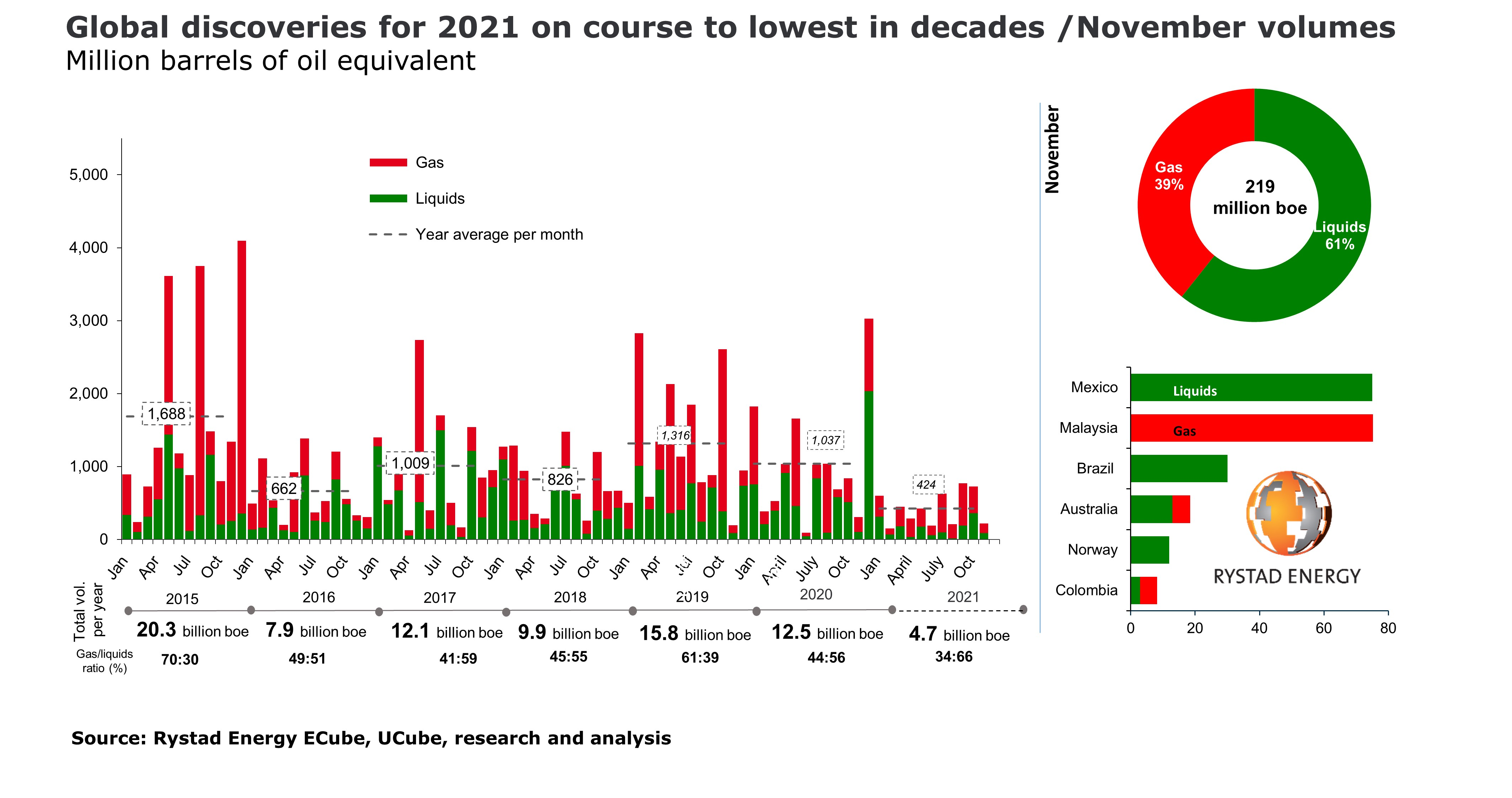
Rystad’s not-so-cheery pre-Christmas press release reported that, on a volume basis, 2021 oil and gas discoveries had sunk to the lowest level in 75 years.

20211220 OG global discoveries PR chart.png
Rystad Energy

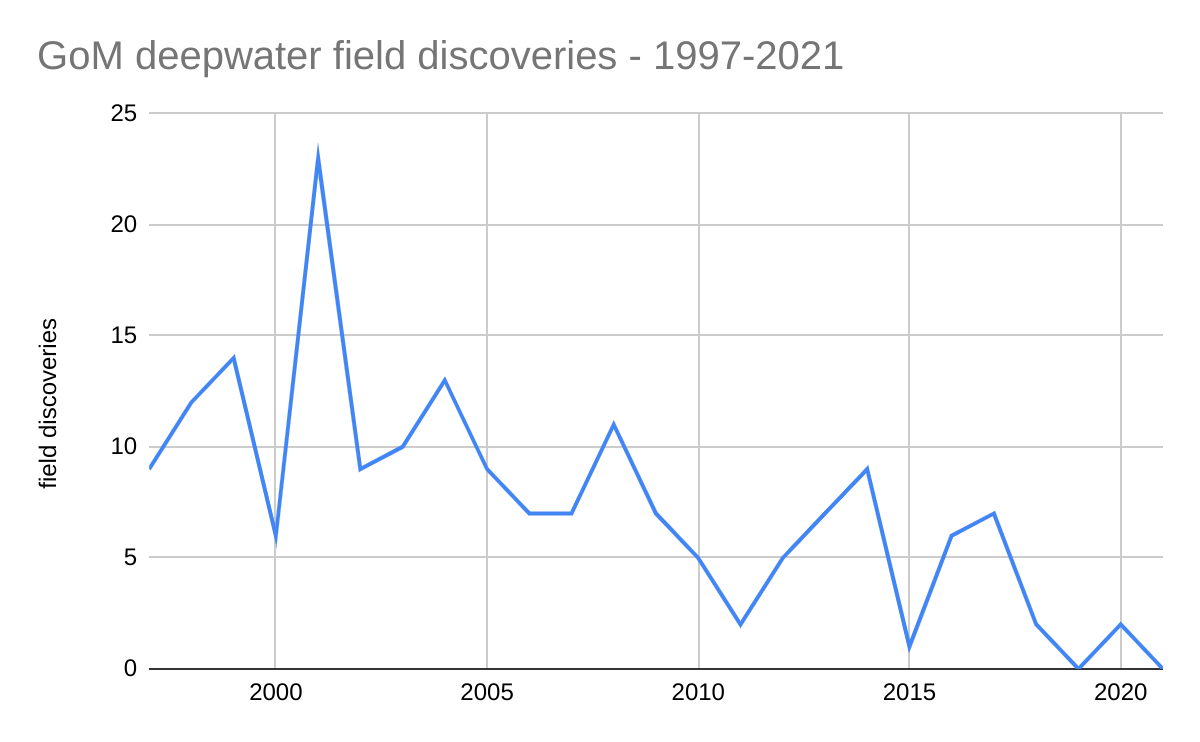
US offshore trends are even more troubling. Per BOEM’s database, no deepwater fields were discovered in 2021 and there were only 2 discoveries in the past 3 years (see chart below). HartEnergy reports 5 announced discoveries in 2021, none of which has been determined by BOEM to be commercially producible. Regardless of the status of those 2021 determinations, recent discoveries have not been sufficient to reach and sustain GoM production volumes at the 2019 peak (August) of 2.044 million BOPD. 2019 was the first year since 1982 without a confirmed deepwater discovery and the trend (below) is not encouraging. Schlumberger data through 2016 indicated GoM depletion rates greater than 20%, and the subsequent low discovery rates do not bode well for future production trends.

from BOEM data

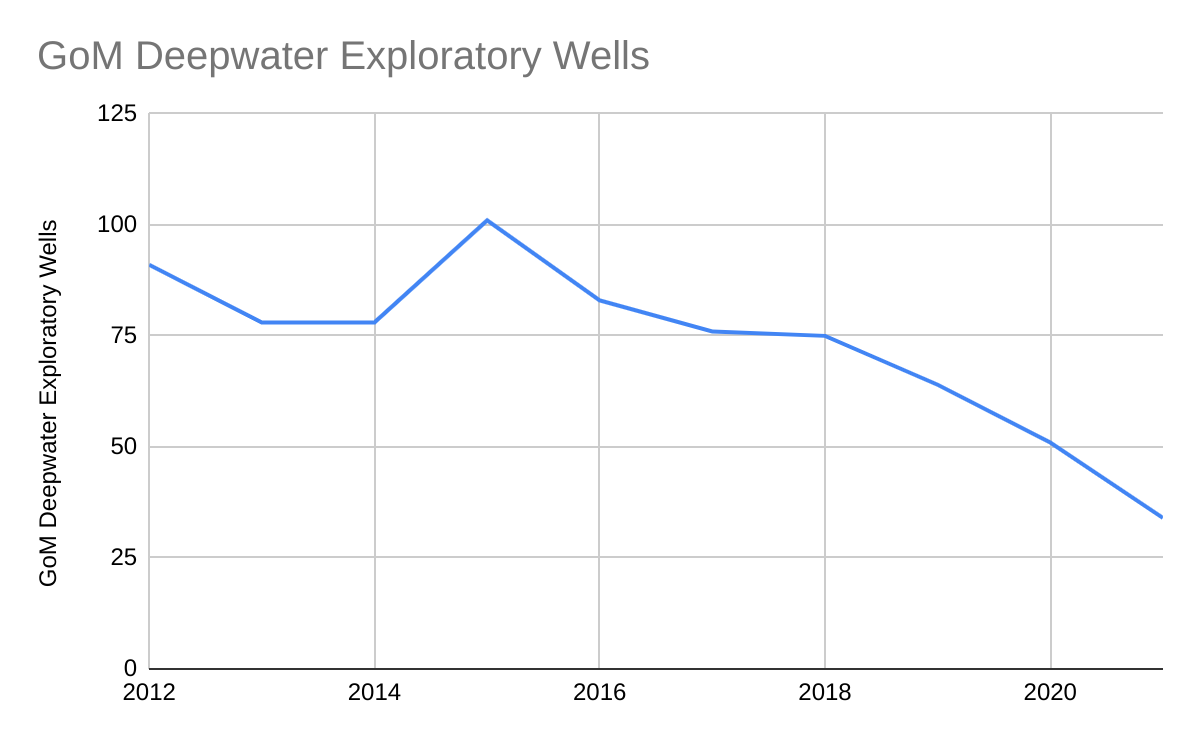
You can’t make discoveries without drilling and only 9 companies drilled deepwater GoM exploratory wells in 2021 (34 wells total). With the Pacific in decommissioning mode, the Atlantic and Eastern GoM off-limits, limited options offshore Alaska, and the decline of the GoM shelf, the deepwater GoM is the only important US offshore production option. The exploration numbers below are therefore concerning.

The shale revolution made the US a net oil exporter, but skepticism about shale production forecasts suggests the need for other supply sources. Given the shale uncertainty and the unrealistic expectations regarding the energy transition, greater US dependence on imported oil is on the horizon. This bodes well for OPEC, but not so well for US and international consumers.

Meanwhile, the US Dept. of Energy shows no evidence of concern about oil and gas production. Although oil and gas account for about 70% of our energy consumption, there has been no mention of either on the DOE homepage for months. DOE does express a strong interest in “energy justice.” Perhaps they can explain how increased imports and higher energy prices benefit the poor. They should also explain how oil imports are environmentally and economically superior to domestic oil and gas production, when the reality is exactly the opposite.

Read Full Post »

« Newer Posts - Older Posts »