A Norwegian union representing offshore oil and gas workers has criticized Aker BP’s process to introduce a Covid-19 vaccine mandate for its offshore employees.
“We agree that we must protect our employees and our suppliers in the best possible way, but it also requires that we are involved in how it should happen and how our employees and suppliers are taken care of in this process.”
Seems like a reasonable position on the part of the workers. As previously reported, many US oilfield workers are skeptical of the vaccine mandate and have warned that they will quit.
Several actors have approached the ministry with a desire to be allocated two specific areas for storage of CO 2 . One area in the North Sea and one in the Barents Sea were therefore announced on 10 September in accordance with the storage regulations.
By the application deadline of 9 December, the ministry had received applications from five companies. The Ministry will process the received applications and allocate area in accordance with the storage regulations during the first half of 2022.
Contrast the situation in Norway with Exxon’s apparent attempt to acquire 94 Gulf of Mexico leases at Oil and Gas Lease Sale 257 solely for CCS purposes. BOEM’s Notice of Sale made no mention of CCS, and there had been no environmental or economic assessment of CCS activity.
And how much will the public pay for grand CCS ventures that (although interim measures) will take years to initiate, add new safety and environmental risks, and may never achieve their objectives? The public burden will no doubt include direct subsidies, tax credits, increased petrochemical prices, and the erosion of purchasing power associated with the resulting inflation pressures.
European power prices have spiraled to multi-year highs on a variety of factors in recent weeks, ranging from extremely strong commodity and carbon prices to low wind output.
Equinor and its partners have received permission to increase gas exports from two fields on the the Norwegian continental shelf to supply the tight European market. Production permits for the Oseberg and Troll fields have each been increased by 1 billion cubic meters (bcm) for the gas year starting 1 October.
15 Sept 2021: The Ministry of Petroleum and Energy received applications from 31 companies in connection with the announcement of Allocation in Predefined Areas (APA) 2021. The Ministry’s announcement includes some good lessons on resource management:
It is gratifying that the oil companies still see good opportunities on the Norwegian shelf. Exploration is important for maintaining activity and good resource management, and it lays the foundation for value creation and safe jobs throughout the country, says Minister of Petroleum and Energy Tina Bru.
Predictability about which areas it is possible to apply for in APA and regular replenishment of new area is important to achieve an effective exploration. APA rounds are therefore conducted annually.
While Conservative Party leader Erna Solberg will no longer be Prime Minister, her likely replacement, Labor leader Jonas Gahr Støre, seems to be a moderate on energy issues:
“I believe that calling time on our oil and gas industry is the wrong industrial policy and the wrong climate policy,” Stoere told reporters.
In light of energy security and price considerations, rebounding oil demand, uncertainty about the long-term viability of non-conventional onshore production, and the elimination of most other offshore options, sustaining deepwater GoM production should be a high-priority U.S. policy objective. The deepwater GoM also offers significant environmental advantages in that approximately 1.6 million BOPD are produced from only 58 widely dispersed surface facilities that are well maintained, closely monitored and inspected, and distant from shore. Another advantage of US deepwater production is the low carbon intensity relative to other sources of petroleum (more on this in a later post).
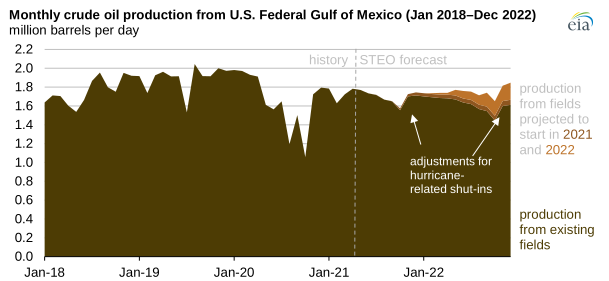
EIA (Chart 1) projects relatively stable GoM production over the next 2 years. Platt’s (Chart 2) is forecasting a slight decline in 2021 production primarily because of COVID-related delays in the initiation of production at Shell’s VIto and PowerNap and BP’s Mad Dog 2 and Thunder Horse South 2 facilities. Based on the latest available EIA data, current stabilized GoM oil production appears to be in the 1.7-1.8 million BOPD range.
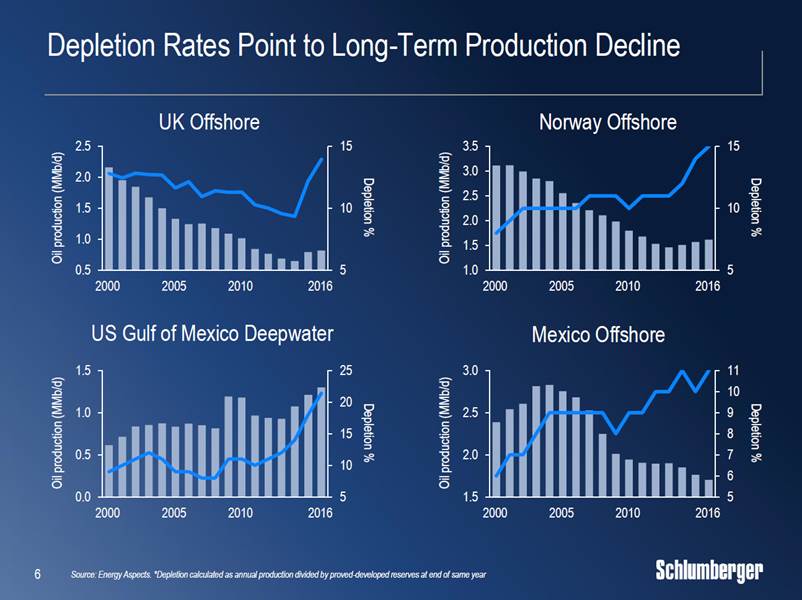
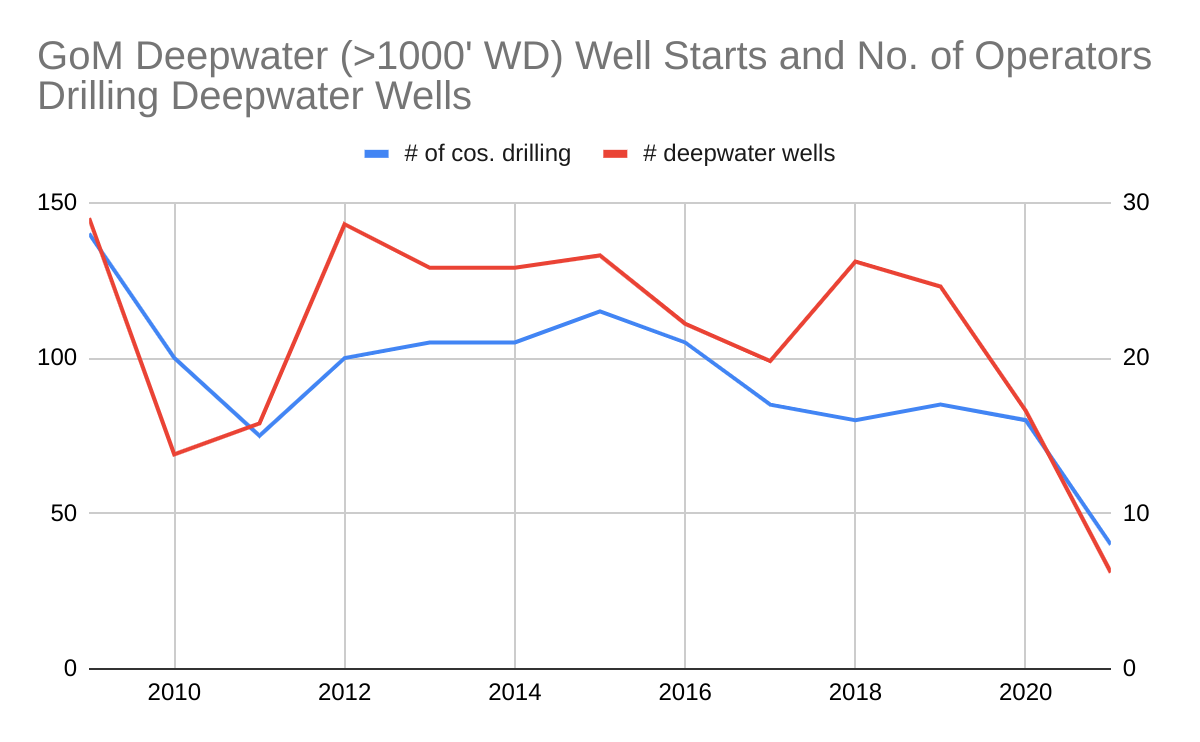
Going forward, the concern is the high rate of reserve depletion and the absence of drilling activity needed to replace reserves. Schlumberger data through 2016 (Chart 3) show depletion rates rising to above 20%, the highest (by far) of the offshore regions analyzed. I was unable to find more recent data, but unless this trend line has made a sharp turn, production declines are likely in the next 3-5 years. Further, drilling trends do not suggest the likelihood of significant reserve growth. Data from BSEE’s Borehole File (Chart 4) indicate deepwater well start activity that is comparable to the moratorium years of 2010 and 2011. Even more concerning is the absence of exploratory drilling (chart 5) and the very few operating companies that are drilling deepwater wells. Only five operators have spudded deepwater exploratory wells in 2021 YTD. One US supermajor hasn’t started a well since 2019, and another US major has essentially exited the Gulf.
Deepwater production trends are not easily reversed, so dialogue is urgently needed to assess the implications of declines in drilling, reserves, and industry interest. As the resource manager on behalf of the public, BOEM is the logical choice for initiating these discussions. BOEM’s Norwegian equivalent, the Norwegian Petroleum Directorate (NPD) demonstrates the importance of pro-active land management. The NPD has done an outstanding job of sustaining exploration activity and production consistent with Norwegian safety and environmental values, which are among the highest in the world. On their website, NPD provides ongoing updates on exploration, production, and reserve depletion parameters. Their competency and commitment to sustaining production on the Norwegian shelf is underscored in this news release, an excerpt from which is pasted below:
Exploration is of great importance for the long-term value creation on the shelf. The supply of oil and gas resources from new discoveries, as we have seen so far this year, is necessary so that activity in the petroleum industry does not fall sharply after 2030. Without new discoveries, production can fall by more than 70 percent in 2040 compared to 2020, says Torgeir Stordal, director of Technology and coexistence in the Norwegian Petroleum Directorate.
A fire at BP’s Valhall oil platform off Norway in the southern part of the North Sea forced the UK supermajor to halt production and evacuate the facility today.
Because of recent involvement with products and systems that have Safety Integrity Level (SIL) ratings, I read the comment (below) in the PSA Deepwater Horizon review with interest. While administrative and effectiveness issues must be carefully assessed, the application of SIL should be part of the BOP performance dialogue. SIL ratings may also be appropriate for entire well control or well integrity systems.
Today’s requirements stipulate a risk analysis for the control system of a drilling BOP, with specified minimum requirements for its safety integrity level (SIL). As a result of the DwH incident and of the fact that blowouts are not confined to drilling operations, the question is whether such an analysis, with a specified minimum SIL level, should also apply to all types of BOPs, including well-intervention models. In addition, consideration should be given in this context to whether other control and management systems related to well integrity/control exist which should be subject to such requirements.
From the standpoint of post-Macondo safety and regulatory issues, this concise summary is the most comprehensive and useful report that I have read since the blowout.
I have pasted (below) comments about information management – one of the many important topics considered in the report – and hope you take time to read the entire summary. It is only 12 pages.
Conducting a critical review of the information used to manage major accident risk is one of the measures relevant for the companies. This work could include an assessment of the relevance, reliability and modernity of the indicators used to follow up risk trends inappropriate use of indicators, incentives and reward systems the need for better indicators and other information about the business which can be used to secure an early warning about a weakening in safety-critical barrier elements. The PSA is of the opinion that the quality of information applied in managing major accident risk is also a question of what overview the players have of their own business, and thereby a question of the players’ own control. The PSA assumes that managing major accident risk cannot be outsourced. In light of the DwH accident, it could be relevant for the companies to review the processes intended to provide the necessary information about the business, assess in part how these processes support a culture ofaccountability and how various management and audit functions, third-party verifications and so forth contribute in this connection.
Children's Parade in Oslo, Stortinget (Parliament) in Background
This is the second Syttende Mai for the BOE blog. Best wishes to our many Norwegian friends on their National Day, which celebrates the signing of their Constitution on May 17, 1814.