The combination of high production of oil and gas from a total of 94 fields, significant demand and high commodity prices led to a historically high level on the State’s revenues from petroleum.
Production in 2021 came to 102 million standard cubic metres of oil (642 million barrels) and 113 billion standard cubic metres of gas. This corresponds to about four million barrels of oil equivalent per day, a minor increase from the previous year.
Norway wisely eased the petroleum tax burden during the pandemic with favorable results.
The temporary change in the petroleum tax has most likely led to an increase in project activity. The projects would most likely have been carried out even without the tax package, but some of them would have been postponed.
An aspect of Norwegian offshore policy that is confusing to this outside observer is the emphasis on transmitting electric power from shore to offshore platforms (see quote below). In most cases, offshore platforms produce sufficient gas to support their power demands. Should platforms be powered from shore, gas that is not used for platform operations would presumably be marketed for consumption elsewhere or reinjected. If the gas is marketed and consumed elsewhere, there is essentially no net (global) CO2 emissions reduction benefit. Gas that is reinjected is wasted unless there is an enhanced oil recovery benefit. So it would seem that importing electric power from shore would only make sense if the net reduction in offshore gas consumption increased ultimate oil production (which could be viewed as undesirable if you take carbon management to the extreme).
While production remains high, CO2 emissions are dropping. The most important reason for this is the use of power from shore. The objective is to cut emissions in half by 2030 compared with the level in 2005.
In a separate article, NPD notes that power from shore increases the cost of platform operations and will also lead to an increase in electricity prices in Norway. Given these considerations, the very small net global reduction in CO2 emissions seems costly.
Platform electrification no doubt helps Norway achieve domestic emission reduction commitments. However, from a global perspective, how important is it for a minor CO2 emitter like Norway to achieve further reductions? Also, isn’t it somewhat contradictory for a major oil and gas exporter to take such extreme measures to reduce the emissions associated with the production of these resources?
That’s right – a leasing plan with no leasing, a program that is about nothing.
Unfortunately for the proponents, this creative proposal would seem to have some significant legal obstacles, most notably its inconsistency with the statute and the legislative history. The idea was to have an organized approach to leasing, not to eliminate it. Per OCSLA:
The leasing program shall consist of a schedule of proposed lease sales indicating, as precisely as possible, the size, timing, and location of leasing activity which he determines will best meet national energy needs for the five-year period following its approval or reapproval.
How does zero leasing help meet national energy needs? Security? Price stability? Supply chain? Are these groups funded by OPEC+ members and nations that hate us the most? If not, they should be, because they are certainly doing their bidding.
As Daniel Yergin’s excellent Atlantic piece explained, the energy transition will take time and be enormously complex. He quoted French economist Jean Pisani-Ferry who warned that “going into overdrive on transitioning away from fossil fuels would lead to major economic shocks similar to the oil crises that rocked the global economy in the 1970s.”
Empty five year leasing programs are not an option for a diverse nation of 330+ million people that will continue to need oil and gas well into the future. We should and are adding new energy alternatives to the mix, and many of us were involved in developing the framework for these alternatives, but eliminating important sources of oil and gas at this time would be sheer folly.
By the end of 2022, Germany will have switched off its last 8.1 GW of nuclear power. Another 6.4 GW of coal capacity are scheduled for shuttering by 2023. Recent events and publications have given ammunition to those who fear a collapse of the system.
In 2018, Germany’s influential energy industry association BDEWsaid that Germany would run into a “shortfall in secured capacity by 2023 at the latest”, and that the country shouldn’t rely on its neighbors to make up the difference. Three years later and a lot closer to the nuclear phase-out, BDEW head Kerstin Andreae says: “For a secure energy supply, we also need new gas-fired power plants, as this is the only way to obtain the required controllable power.”
Germany will need back-up and supplemental power from gas plants, but the EU has excluded gas-fired energy generation from the list of sustainable investments and the associated incentives. Per Kerstin Andreae of the BDEW:
“We need to build these new power plant capacities now. Although they will initially run on natural gas, they are already capable of using hydrogen as an energy source in the future and will thus ultimately become climate neutral,” she said. But without a clear decision from the Commission „ important energy transition investments are at risk”
Meanwhile, oilprice.com reports that “UK peak-hour power prices for Monday evening through 6 p.m. surged to the highest level in a month due to low wind power generation during the weekend.” In what is becoming a familiar story:
Coal closures and no immediate replacements for nuclear power have exposed the UK’s vulnerabilities to the whims of the weather, with cold winters stoking natural gas demand and still weather lowering wind power generation.
Daniel Yergin reminded us that energy transitions take time. Countries that ignore those realities are likely to suffer the consequences, both economically and environmentally. Per Aissatou Sophie Gladima, the energy minister of Senegal:
Restricting lending for oil and gas development, she said, “is like removing the ladder and asking us to jump or fly.”
Deb Haaland, US Secretary of the InteriorErling Braut Haaland
As a result of her mother’s heritage, Deb Haaland is the first Native American to serve as a US cabinet secretary. However, her father, a decorated Marine Corps officer was a Norwegian American. She thus has the same surname as Erling Braut Haaland, the star striker for Norway and BVB Dortmund in the German Bundesliga.
Although most Americans cannot name the Secretary of the Interior (James Watt was an exception thanks to his attempt to ban the Beach Boys from the 4th of July concert in Washington😃), Deb Haaland is probably slightly better known in the US than Erling Haaland. However, thanks to the popularity of football/fussball/futbol/soccer, Erling is much better known internationally.
What does this have to do with offshore energy? Well Norway, which just announced record oil and gas revenues, has managed to sustain leasing, exploration, and production throughout the pandemic without compromising safety and environmental objectives. They also wisely eased the petroleum tax burden during the pandemic with favorable results.
The temporary change in the petroleum tax has most likely led to an increase in project activity. The projects would most likely have been carried out even without the tax package, but some of them would have been postponed.
This should not surprise experienced OSHA regulators given the absence of clear legislative authority.
Offshore regulators in the US have used “work-arounds” in the form of Notices to Lessees, Conditions of Approval, and other types of guidance documents. However, there was a general understanding that requirements imposed by these methods would not survive legal challenges unless they were clearly authorized by legislation or regulations. Most work-arounds aren’t challenged because the regulatory authority is reasonably clear, their issuance is at least minimally acceptable to the regulated industry, or the perceived cost of challenges exceeds the cost of compliance.
Platforms Hogan and Houchin, Santa Barbara Channel: When will we learn more about the Inspector General’s findings regarding the improper use of decommissioning funds? Why was the lessee, Signal Hill, allowed to withdraw funds from those accounts for purposes unrelated to decommissioning? How does this affect the liability of predecessor lessees?
Globetrotter 2 incident during Hurricane Ida: When will the Coast Guard issue their report on the delayed relocation of the Noble Globetrotter 2 drillship during Hurricane Ida? In light of this incident, the fatality on the Pacific Khamsin prior to Tropical Storm Laura (2020), and similar incidents, further attention to the timely relocation of dynamically positioned drillships would seem to be in order.
Germany has a very strong Green lobby that has now become part of the ruling coalition. Despite an anti-fossil fuel discourse, the Greens have now apparently accepted the necessity of at least one fossil fuel, perhaps not least because Germany has plans to shut down all of its nuclear power plants by the end of this year.
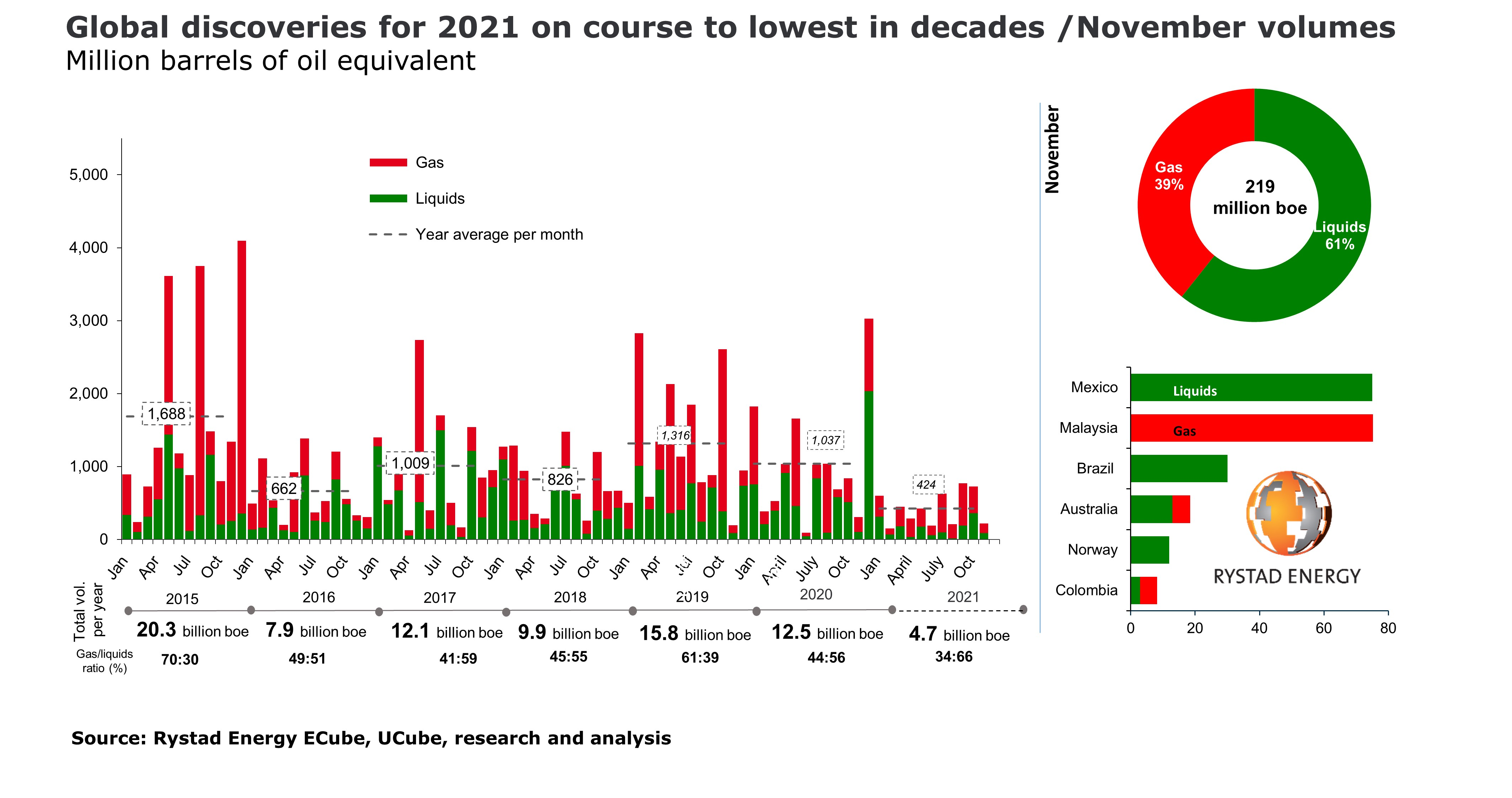
Declines in drilling activity and discoveries suggest that higher real oil prices are on the horizon. We may be fortunate enough to escape significant price hikes and supply disruptions over the next couple of years, but they are coming.
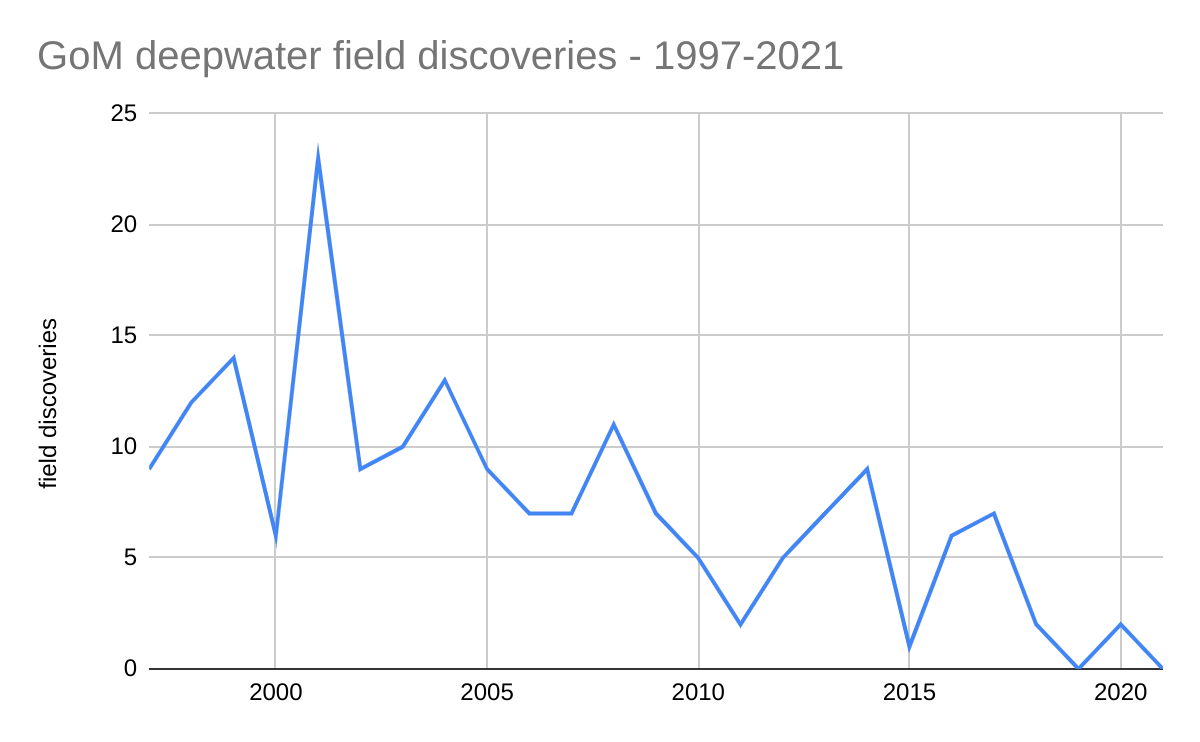
US offshore trends are even more troubling. Per BOEM’s database, no deepwater fields were discovered in 2021 and there were only 2 discoveries in the past 3 years (see chart below). HartEnergy reports 5 announced discoveries in 2021, none of which has been determined by BOEM to be commercially producible. Regardless of the status of those 2021 determinations, recent discoveries have not been sufficient to reach and sustain GoM production volumes at the 2019 peak (August) of 2.044 million BOPD. 2019 was the first year since 1982 without a confirmed deepwater discovery and the trend (below) is not encouraging. Schlumberger data through 2016 indicated GoM depletion rates greater than 20%, and the subsequent low discovery rates do not bode well for future production trends.
from BOEM data
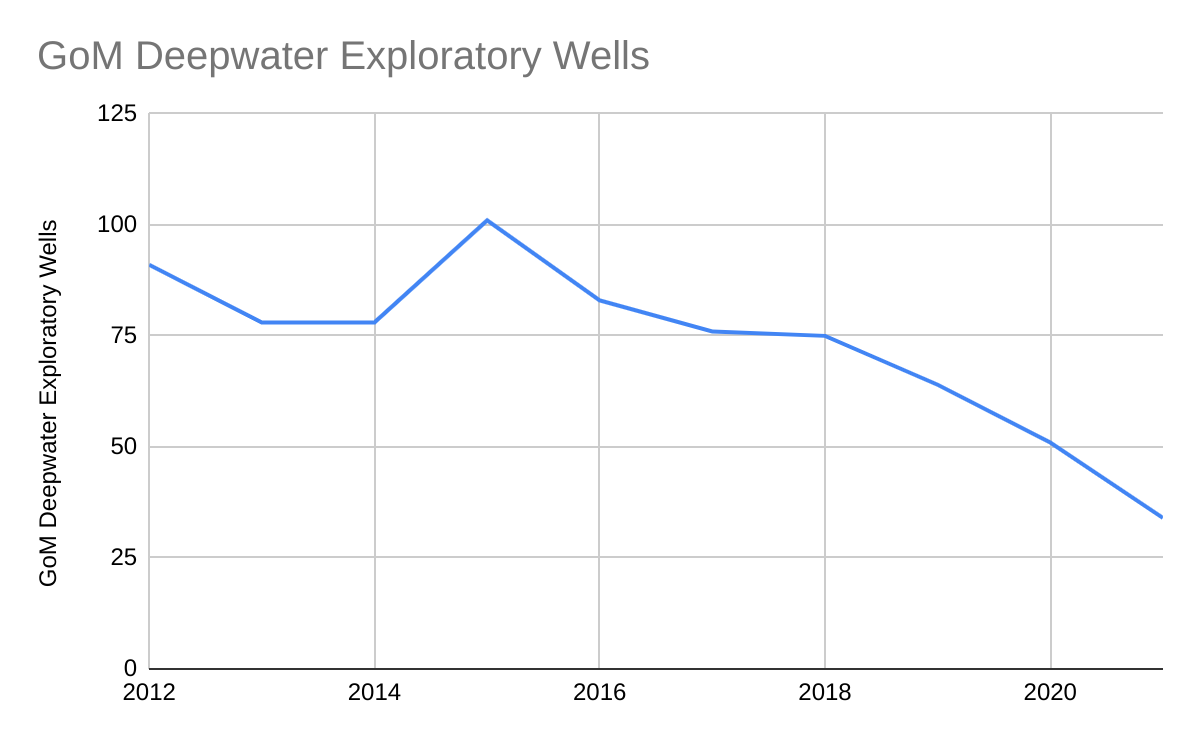
You can’t make discoveries without drilling and only 9 companies drilled deepwater GoM exploratory wells in 2021 (34 wells total). With the Pacific in decommissioning mode, the Atlantic and Eastern GoM off-limits, limited options offshore Alaska, and the decline of the GoM shelf, the deepwater GoM is the only important US offshore production option. The exploration numbers below are therefore concerning.
The shale revolution made the US a net oil exporter, but skepticism about shale production forecasts suggests the need for other supply sources. Given the shale uncertainty and the unrealistic expectations regarding the energy transition, greater US dependence on imported oil is on the horizon. This bodes well for OPEC, but not so well for US and international consumers.
Meanwhile, the US Dept. of Energy shows no evidence of concern about oil and gas production. Although oil and gas account for about 70% of our energy consumption, there has been no mention of either on the DOE homepage for months. DOE does express a strong interest in “energy justice.” Perhaps they can explain how increased imports and higher energy prices benefit the poor. They should also explain how oil imports are environmentally and economically superior to domestic oil and gas production, when the reality is exactly the opposite.
DOE provided nearly $684 million to eight coal projects, resulting in one operational facility. Three projects were withdrawn—two prior to receiving funding—and one was built and entered operations, but halted operations in 2020 due to changing economic conditions. DOE terminated funding agreements with the other four projects prior to construction.
DOE provided approximately $438 million to three projects designed to capture and store carbon from industrial facilities, two of which were constructed and entered operations. The third project was withdrawn when the facility onto which the project was to be incorporated was canceled.
So DOE’s actual success ratio was 0.182 (2 for 11) – not very compelling.
With regard to proposals for offshore carbon sequestration, who will be liable for future cost overruns, operating losses, infrastructure failures including pipeline and well leaks, and decommissioning costs? Who ensures that there will never be any leakage from CO2 disposal reservoirs? Does all of this fall on the Federal government?
Corporations that want to engage in carbon sequestration for commercial or other purposes should fund the projects with their own revenues or fees charged to the companies whose emissions they are collecting. The Outer Continental Shelf is publicly owned and those wishing to dispose of substances should pay a usage fee, be responsible for all costs, and be liable for pollution and damages.