Feeds:
Posts
Comments

Archive for the ‘energy policy’ Category

BOEM diminishes the credibility of their important (and generally excellent) scientific, lease administration, and regulatory work with over-the-top wind energy promotion. The tweet below is a recent example.

This is not a good look for the bureau that is expected to objectively evaluate offshore wind projects. Leave the hype to the wind industry and its NGO supporters.

Read Full Post »

Huh? Since 9/1/2023, the SPR has increased from 350.34 million bbls to 351.9 million bbs, a total of only 1.56 million bbls. From the historic low of 346.76 bbls on 7/7/2023, the SPR has increased by just 5.14 million bbls, and remains at only 48% full. The total refill since the 2023 low amounts to only 0.7% of capacity.

DOE knew that refilling the SPR would be a very slow process given the significant acquisition, operational, and maintenance challenges. Nonetheless, political concerns about oil prices were prioritized and the reserve was recklessly depleted.

Prediction: The SPR will still be <400 million bbls at the end of 2024.

Read Full Post »

The quote and graphic are from Jens Christiansen, a Danish physicist and nuclear power advocate.

Energy reality on display (vs. COP theater):

Read Full Post »

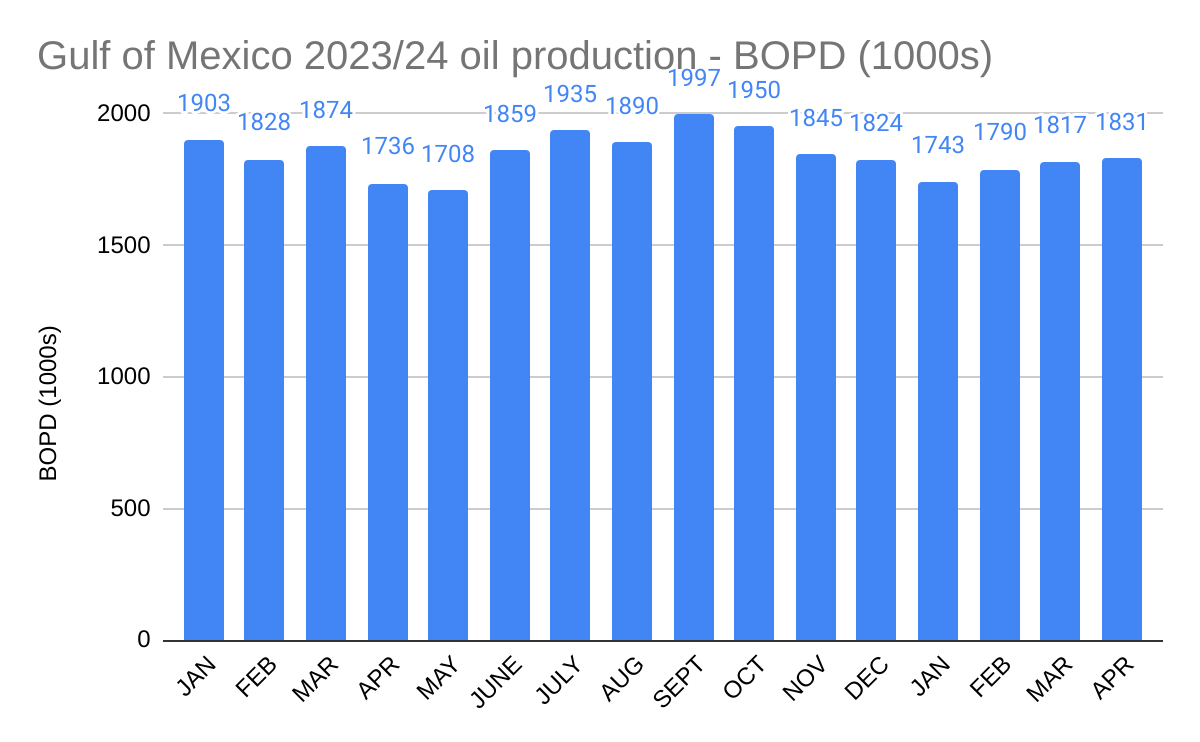
Per EIA, September Gulf of Mexico production averaged 2 million bopd on the button! New production from Vito and Argos were no doubt contributors, as production reached the 2 million bopd mark for only the third month in the history of the OCS program. The other 2 months were in 2019.

Imagine what US offshore production might be if the OCS oil and gas program was actually managed to succeed!

Also, as the official hurricane season comes to a close today, we are fortunate in that there have been no production shut-ins from tropical storms in 2023.

Vito

Read Full Post »

This interesting Scientific American article ends with a short paragraph that our regulatory scholars may want to ponder:

Mining’s larger future will rest largely on how ISA (the International Seabed Authority) finalizes its rule book amid the rush to scour the seafloor. ISA has a rare chance to regulate an industry before the industry has begun.

Thoughts:

  • Deep sea mining is not an entirely new industry. The technology and procedures evolved from other industries, most notably deepwater drilling, and from decades of ocean exploration. Keep in mind that the Hidden Gem mining vessel is a converted deepwater drillship.
  • The offshore oil and gas industry’s risk assessment and safety management practices can be adapted to deep-sea mining.  
  • Effective regulations are not static. The deep-sea mining regulations should not be considered “final” when they are blessed by ISA and the governing body.
  • Before permits are issued, ISA can establish general safety and environmental management requirements, and should specify planning, monitoring, reporting, and liability requirements. (ISA appears to have made an extensive effort on these elements of the regulatory program.)
  • The more prescriptive elements of regulations are dependent on operational experience, observations, and performance data. These must evolve over time.
  • Timely revisions to equipment and procedural requirements through updates to operator management systems and industry standards are critical. In most cases, formally revising regulations takes much too long and is an ineffective means of mitigating emerging risks.
  • Long, detailed regulations are indicative of a weak regulatory regime, not a strong one.  Optimal regulations specify goals, not methods, and are implemented by focused regulators who inquire, challenge, analyze, and where necessary penalize.
  • The respective roles of the operating companies and the regulating authority must be clearly articulated.
  • With continuous improvement as the primary objective, the regulator should develop a strategy for measuring safety and environmental performance.


Read Full Post »

Whale FPU; Source: Boskalis

Lars Herbst noted another endangered whale sighting by the US Coast Guard. Unlike their erroneous Rice’s whale report in September (still waiting for their mea culpa), the Coast Guard has gotten this one right. The 25,000 ton Whale is pictured above.

Whale’s species is indeed endangered with the most serious threats coming from a faraway place on the Potomac River. The “newborn” Whale is one of only 15 of its species in the Gulf of Mexico. The entire platformus deepis genus numbers only 59, but their importance to society is enormous (read more).

Perhaps the wise people who control our offshore lands will do more to encourage and support these floating behemoths. Unfortunately, their 5 year management plan is not encouraging in that regard.

More about Whale

Read Full Post »

As a result of the order issued by the United States Court of Appeals for the Fifth Circuit on Nov. 14, 2023, the Bureau of Ocean Energy Management (BOEM) has scheduled Lease Sale 261 for Dec. 20, 2023.

The Gulf of Mexico oil and gas lease sale was originally scheduled for Sept. 27, 2023, and later scheduled for Nov. 8, 2023, in response to judicial orders.

Pursuant to direction from the Court, BOEM will include lease blocks that were previously excluded due to concerns regarding potential impacts to the Rice’s whale population in the Gulf of Mexico. BOEM will also remove portions of a related stipulation meant to address those potential impacts from the lease terms for any leases that may result from Lease Sale 261.

A Final Notice of Sale will be published in the Federal Register on Nov. 20, 2023, and will be available for public inspection on Nov. 17, 2023. 

BOEM will live stream the opening of bids at 9 am CDT on Dec. 20, 2023. All terms and conditions of the lease sale are listed in the FNOS. For more information, go to: www.boem.gov/sale-261.  

BOEM

Read Full Post »

The sale could be held sooner. However, since BOEM asked for 37 days, I’m assuming that the sale will be on December 21.

In the 70 year history of the oil and gas leasing program, this will be the sale date that is closest to Christmas. Yet another major milestone for the offshore program! 😀

Read Full Post »

Order is pasted below and attached.

IT IS ORDERED and ADJUDGED that the Intervenors’ appeal is DISMISSED. As for BOEM’s limited appeal as to the timing of the sale, we hereby AMEND the district court’s preliminary injunction only to the extent that the deadline for conducting Lease Sale 261 shall now be thirtyseven days from the date of the issuance of the mandate in this appeal.
IT IS FURTHER ORDERED that each party bear its own costs on appeal.

Background information and related posts.

Read Full Post »

Each annual licensing round will only take place if key tests are met that support the transition to net zero. The first test is that the UK must be projected to import more oil and gas from other countries than it produces at home. 

The second is that the carbon emissions associated with the production of UK gas are lower than the equivalent emissions from imported liquefied natural gas. 

If both these tests are met, the NSTA will be required to invite applications for new licences annually.

GOV.UK

The “key tests” would seem to ensure annual licensing rounds for the foreseeable future. The charts below are from UK EiTi. The first chart illustrates the sharp decline in UK production over the past 20 years. The second and third charts illustrate the large projected gaps between supply and demand, particularly for natural gas.

In 2050, total production of oil and gas is estimated at ~10 million tonnes of oil equivalent. The projected 2050 demand is estimated at ~35 tonnes. For domestic production to exceed imports over the next 20-30 years, resource licensing and field development would have to be very successful and efficient.

Projections of UK Gas Demand and Production

With regard to the second test, carbon emissions from the production of UK gas should maintain their advantage over imported LNG given the energy required to liquefy and transport that gas.

It would have perhaps been more transparent to simply stipulate annual licensing rounds, but that would probably not have been politically acceptable.

Read Full Post »

« Newer Posts - Older Posts »