Feeds:
Posts
Comments

Archive for the ‘energy policy’ Category

In the wake of the decision to “pause” LNG export approvals, it’s important for us to also pause and reflect on the natural gas revolution.

Gas now accounts for 40% of our power generation.
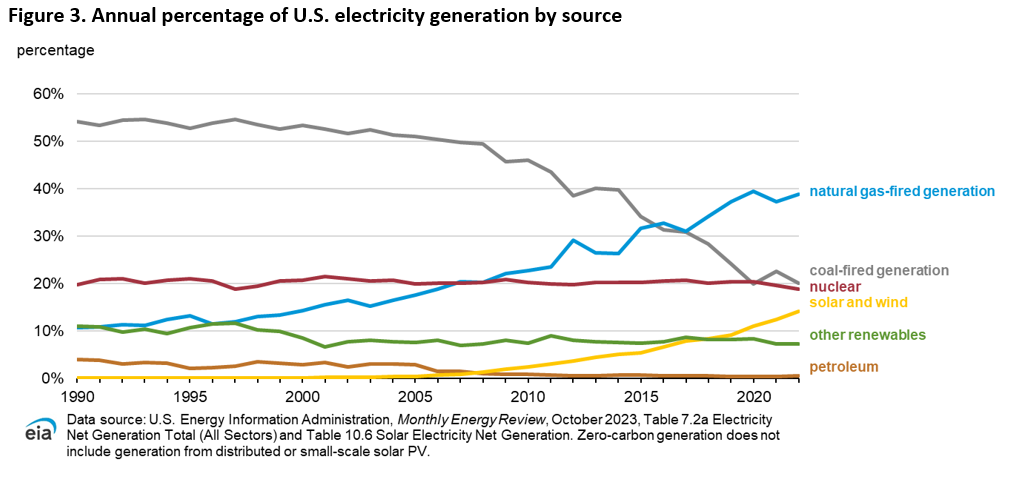
The gas boom’s economic and environmental benefits are compelling. Greenhouse gas emissions currently get most of the attention. In that regard, methane (CH4) is a hydrogen transporter that emits far less CO2 than other fossil fuels when burned.

Less attention has been given to natural gas’s other important air quality advantages – low NOx. SO2, and particulate emissions. These emissions have greater local significance from a human health standpoint. Those who have ridden a bike behind a natural gas powered bus have no doubt experienced the natural gas advantage firsthand.

Other environmental considerations particularly favor offshore natural gas when compared to energy alternatives. These include low well and facility density, no groundwater pollution risk, and minimal risk to wildlife.

Compiled below are links to BOE posts on natural gas issues and advantages.

Read Full Post »

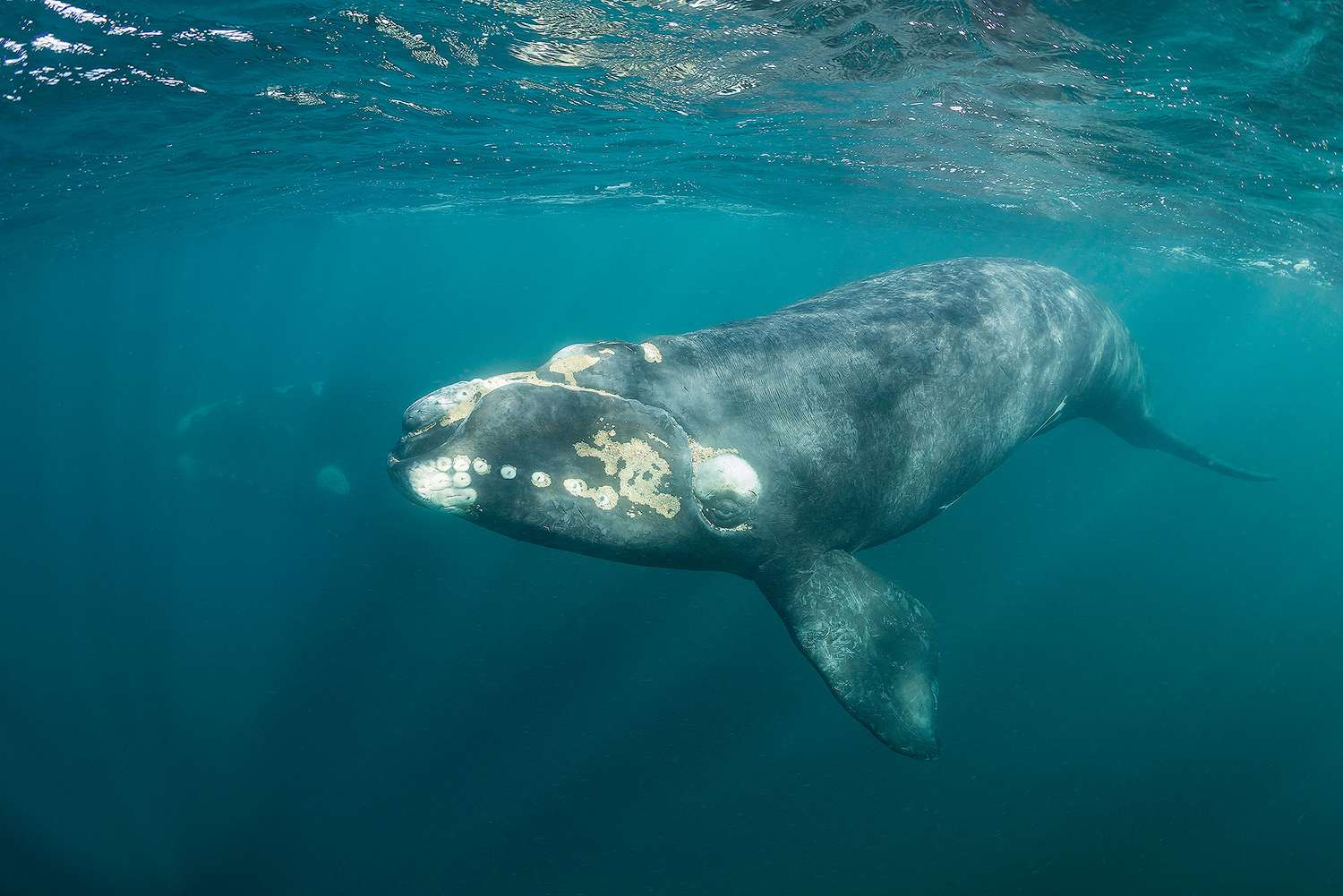
North Atlantic Right Whale

Key takeaways after reviewing the BOEM/NOAA strategy document:

NARW status (pages 7-14):

  • Roughly 237 NARWs have died since the population peaked at 481 in 2011, exceeding the potential biological removal (PBR) level on average by more than 40 times for the past 5 years (Pace III et al. 2021).
  • Human-caused mortality is so high that no adult NARW has been confirmed to have died from natural causes in several decades (Hayes et al. 2023).
  • Most NARWs have a low probability of surviving past 40 years even though the NARW can live up to a century.
  • There were no first-time mothers in 2022.
  • About 42% of the population is known to be in reduced health (Hamilton et al. 2021)
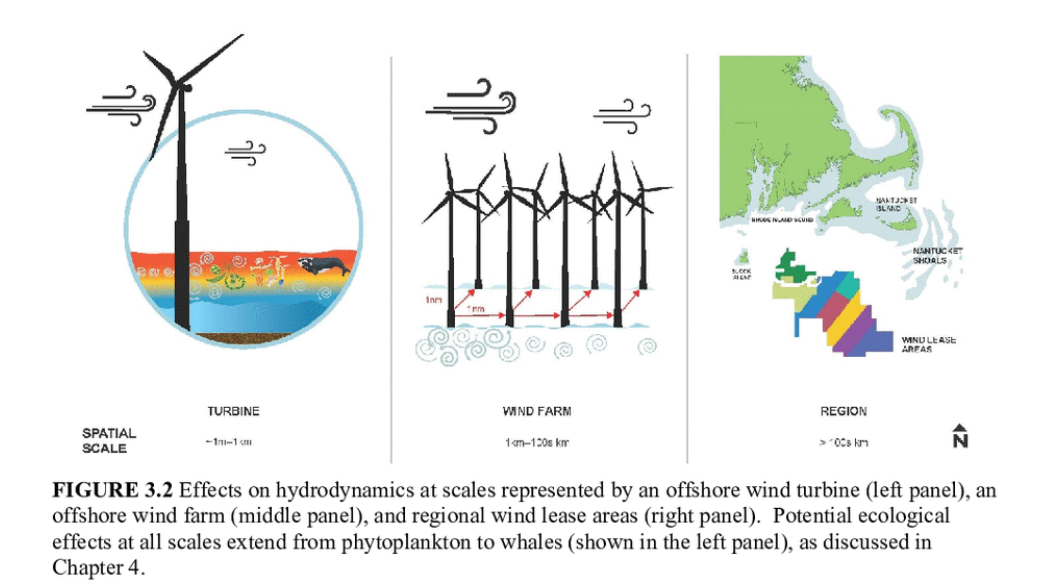
  • A NASEM study confirmed that offshore wind has the potential to alter local and regional hydrodynamics
  • “Effects to NARWs could result from stressors generated from a single project; there is potential for these effects to be compounded by exposure to multiple projects.” (p. 14)

BOEM/NOAA strategy:

  • No new mitigation is recommended pending further study.
  • “BOEM and NOAA Fisheries will work together alongside our partners (including the OSW industry) to further develop the information and science the agencies will use to inform their decisions to responsibly develop OSW while protecting and recovering NARWs.” (Comment: While regulator-industry collaboration is essential for effective offshore development, be it wind or oil and gas, regulators and operating companies have distinctly different missions and responsibilities and should not be viewed as partners.)
  • (p. 15): “As the OSW industry continues to grow and as projects begin construction, BOEM and NOAA Fisheries will continue to work with our partners to evaluate existing strategies and to further collect and apply newly available information to inform future decisions. This Strategy is an integral step to organize BOEM, NOAA Fisheries, and their partners around a shared vision and clear path to effectively study and manage this issue moving forward.” (???)
  • (p.17): BOEM will “attempt to avoid issuing new leases in areas that may impact potential high-value habitat and/or high use areas for important life history functions such as NARW foraging, migrating, mating, or calving. For areas that are leased, permitting activities should minimize any known or potential threat to NARWs and their habitats, and developers and BOEM should support research and monitoring.”

Questions:

Pictured below: density of NARWs near wind leases and hydrodynamic effects of turbines

Read Full Post »

Read Full Post »

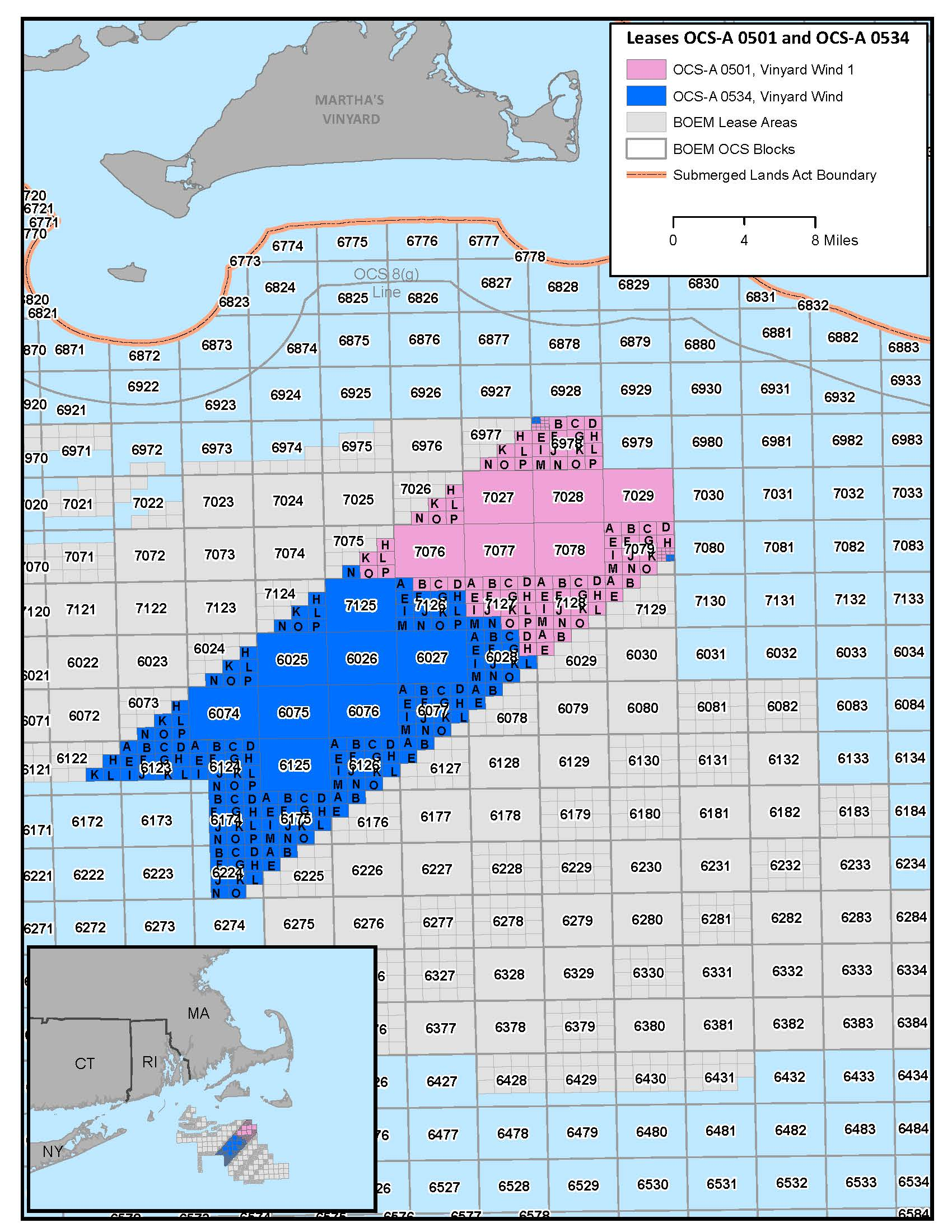
Vineyard Wind project

BOEM is charged with protecting the public from financial risks associated with the decommissioning of offshore facilities. Previous posts have addressed oil and gas facility decommissioning issues and proposed revisions to BOEM’s financial assurance regulations for those operations.

Recent disclosures indicate that BOEM, which very publicly promotes the offshore wind projects that it regulates, has waived a fundamental financial assurance requirement at the request of Vineyard Wind (approval letter attached). Given its broad applicability, this precedential waiver could have the effect of revising a significant provision of the offshore wind decommissioning regulations without public review and comment.

The issue is the “pay as you build” financial assurance requirement at 30 CFR § 585.516, which was waived by BOEM. This requirement, which is intended to project the public from decommissioning liability, is fair and reasonable given that wind developers must only provide financial assurance “in accordance with the number of facilities installed or being installed.” Companies that don’t have sufficient financial strength to comply with this requirement should not be installing and operating offshore wind turbines.

Vineyard Wind was either unable or unwilling to comply with the requirement. They instead requested to defer providing the full amount of the required financial assurance until year 15 of actual operations. The waiver changes “provide assurance when you install” to provide assurance 15 years after installation if everything goes as planned (hoped?).

After their waiver request was denied in 2017, Vineyard Wind resubmitted the request in 2021 seeking a favorable decision from an administration concerned that project cancellation or delay might tarnish the program that they were enthusiastically promoting.

BOEM (as directed from above?) granted the waiver, citing the general departure authority at 30 CFR § 585.103. However, that authority is intended for special situations, not for broadly applicable waivers that have the effect of revising the regulations without the public review required by the Administrative Procedures Act and Executive Orders 12866 and 13563.

There are no criteria in the Vineyard Wind waiver approval that could not apply to other wind developers. Vineyard Wind has simply committed to the same “risk-reduction factors” that apply to all offshore wind projects: damage insurance, the “use of proven turbine technology,” and long-term power purchase agreements. How could BOEM deny the same request from other companies?

It’s noteworthy that the regulations specific to financial assurance at 30 CFR § 585.516 provide no criteria for waiving the assurance requirements; nor do the regulations provide for the 15-year payment plan approved by BOEM. Given the precedential nature of the BOEM action and its enormous financial implications, a revision to the decommissioning regulations that provides criteria for such payment schemes should be promulgating before any similar departures are approved.

In light of the waiver, the public will likely incur substantial costs if Vineyard Wind fails, walks away, doesn’t fully fund their decommissioning account in a timely manner, or seeks new concessions after some or all of the 62 turbines have been installed.

Given the decommissioning obligations, what company would want to step in and assume responsibility for a failing project 10-15 years from now? What happens if Vineyard Wind’s project revenues don’t meet expectations and contributions to their decommissioning account are insufficient or used improperly? More concessions? We’ve seen this dance before.

Whether the project is for oil, gas, or wind energy, protecting the public from decommissioning liabilities should always be prioritized over facilitating development.

Read Full Post »

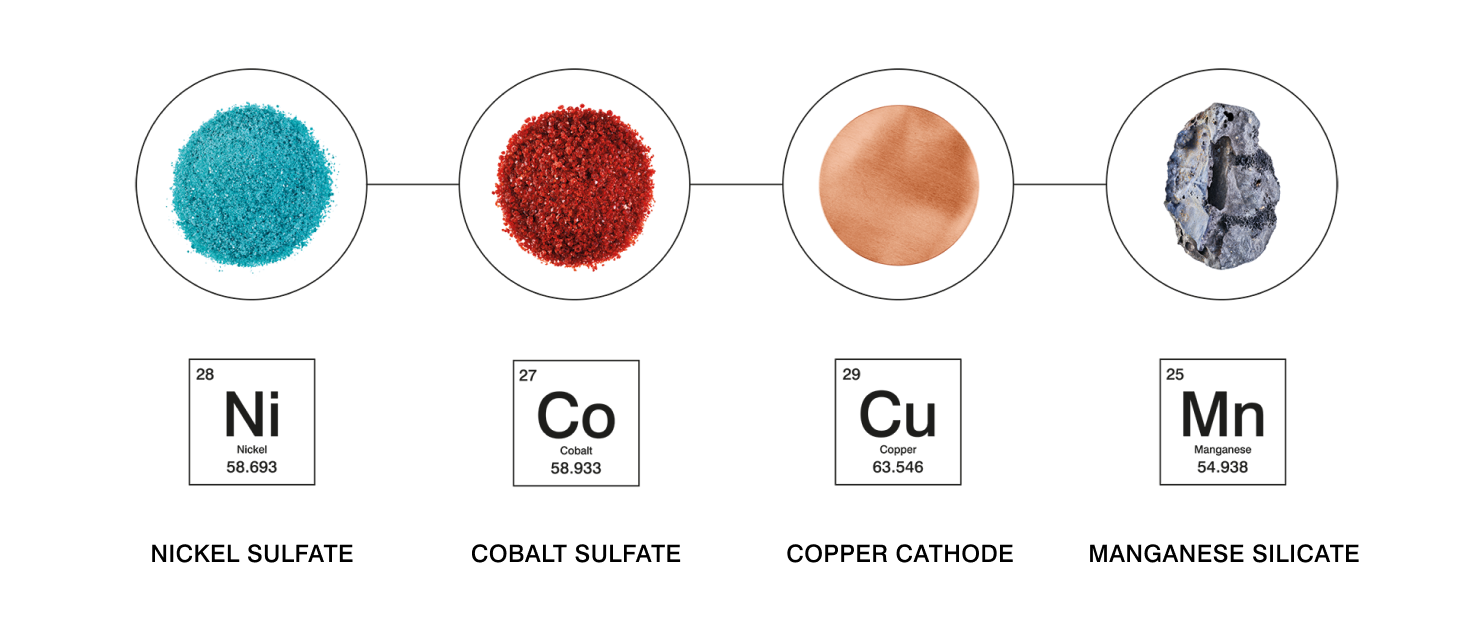
Polymetallic nodules contain critical metals (TMC images)

“the committee directs the Assistant Secretary of Defense for Industrial Base Policy shall, by March 1, 2024, submit a report to the House Armed Services Committee assessing the processing of seabed resources of polymetallic nodules domestically. The report shall include, at a minimum, the following:
(1) a review of current resources and controlling parties in securing seabed resources of polymetallic nodules;
(2) an assessment of current domestic deep-sea mining and material processing capabilities; and
(3) a roadmap recommending how the United States can have the ability to source and/or process critical minerals in innovative arenas, such as deep-sea mining, to decrease reliance on sources from foreign adversaries and bolster domestic competencies.

NDAA, p. 230

Read Full Post »

Keathley Canyon and Walker Ridge bids at Sale 259: blue=1 bid, red=2 bids, green=3 bids

Based solely on a comparison of the bids (Sale 261 vs. Sale 259), the Sale 259 rejections were, on balance, to the benefit of the public (table below). On the plus side:

  • Assuming all of the high Sale 261 bids are accepted, the net gain to the US Treasury is $8,749,365
  • Of the 14 tracts with rejected high bids at Sale 259, 8 received bids at Sale 261
  • Seven of those 8 bids were higher than the Sale 259 high bids, and 5 of those 7 were more than $1 million higher.
  • The Sale 259 bid rejections in the Keathley Canyon and Walker Ridge areas proved to be 100% beneficial. All 6 of those tracts received much higher bids at Sale 261.
  • The best BOEM decisions were the rejections of the Sale 259 bids for AT 5 and WR 795 and 796. The Sale 261 high bids on these 3 tracts were $10.8 million higher than the Sale 259 bids.
  • WR 795 and 796 were single bid tracts at Sale 259.
  • AT 5 received 3 bids at Sale 259. BOEM rejected the high bid despite the competitive bidding. That proved to be the right call given that the Sale 261 high bid was $3.5 million higher.

On the other hand:

  • None of the 5 Green Canyon rejections received any bids at Sale 261.
  • The high bid for GC 777 was rejected twice (Sales 257 and 259) at a cost of $1.8 million, the BP/Talos high bid at Sale 257. At sale 259, BP was the sole bidder for GC 777, and their bid was only $583,000, less than 1/3 of their Sale 257 bid. GC 777 received no bids at Sale 261.
  • The worst BOEM Sale 259 decisions were the rejections of the DC 622, GC 547, and GC 591 bids at a cost of $4.6 million ($5.2 if the Sale 261 bid for DC 622 is rejected).
  • This is not to say that the tracts with rejected bids will not ultimately be leased. However, the uncertainty regarding future sales changes the historic GoM leasing dynamic. The next opportunity for purchasing unleased tracts is a troubling unknown. Absent leasing and exploration, their resource and revenue potential will never be known.
area and blockSale 259 high bid – companySale 261 high bidgovt gain (loss)
DC 6222,101,836 – Shell615,628* – Shell(1,486,208)
GC 173307,107 – Woodsideno bid(307,107)
GC 5471,783,498 – Chevronno bid(1,783,498)
GC 5911,291,993 – Chevronno bid(1,291,993)
GC 642605,505 – Anadarkono bid(605,505)
GC 777583,103 – bpno bid(583,103)
AT 51,551,130 – Anadarko5,215,628* – Shell3,664,498
AT 133607,107 – Woodsideno bid(607,107)
KC 745707,777 – Beacon2,422,222 – Beacon1,714,445
KC 789707,777 – Beacon2,143,299 – Beacon1,435,522
WR 794724,744 – Beacon1,487,624 – Beacon762,880
WR 795774,242 – Beacon5,301,107 – Woodside4,526,865
WR 796774,242 – Beacon3,310,107 – Woodside2,535,865
WR 750724,744 – Beacon1,498,555 – Beacon773,811
*The BOEM sale 261 bid summary misidentifies the DC 622 and AT 5 bids as being for MC 622 and GC 5 respectively. The corrected identification above is based on the “Blocks Receiving Bids” file correlated with the block number and company code.

Read Full Post »

Foreground (L to R) Lucy Querques Denett, Carolita Kallaur (RIP), Carole Hartgen, Vicki Agnew (RIP); Rear (L ro R) David Sutfin, Willie Taylor; photo credit: Keith Good

As we await Lease Sale 261, Carol Hartgen, my long-time colleague and founder of the 5 year OCS leasing program, voiced astonishment that the new 5 year plan was only for the purpose of scheduling 3 lease sales required by Congress as prerequisites to offshore wind lease auctions.  Carol provides some historical context:

I couldn’t believe the release of the final Five Year Program as just a necessity to hold offshore wind sales.  Back in 1969, Carolita Kallaur, Joan Davenport and I worked on a 5-year schedule based on the supply and demand needs of the nation. That approach, which developed into the elaborate process in the OCS Lands Act and the passage of the National Environmental Policy Act, is a thing of the past. Over.those 50 plus years, politics from both sides of the aisle always drove the changes

Related: How NOT to manage our oil and gas leasing program

Read Full Post »

The announcement boasts about “the fewest oil and gas lease sales in history” while seemingly apologizing for holding any sales at all.

Consistent with the requirements of the Inflation Reduction Act (IRA) concerning offshore conventional and renewable energy leasing, the Department of the Interior today published the final 2024–2029 National Outer Continental Shelf Oil and Gas Leasing Program (Program) with the fewest oil and gas lease sales in history.

These three lease sales are the minimum number that will enable the Interior Department’s offshore wind energy program to continue issuing leases in a way that will ensure continued progress towards the Administration’s goal of 30 gigawatts of offshore wind by 2030.  

DOI

Read Full Post »

This impressive NOAA study confirms the importance of Nantucket Shoals as a feeding ground for right whales and implies a need for protective measures in months (October through December) when the existing restrictions do not apply.

The importance of Nantucket Shoals as a feeding ground for the critically endangered North Atlantic right whales within the southern New England wind energy is well understood (Leiter et al., 2017; Quintana-Rizzo et al., 2021; Estabrook et al., 2022). Similarly, year round presence of this species has been demonstrated since as early as 2011 (Quintana-Rizzo et al., 2021; Estabrook et al., 2022), showing that North Atlantic right whales have consistently used this region for well over a decade. Currently, the National Marine Fisheries Services and Bureau of Ocean Energy Managements policy is to exclude pile driving during the months of January through April in the southern New England wind energy area. Evaluation of the need for further management protections are needed for North Atlantic right whales especially in October through December, along with further assessment of risk to this species (Southall et al., 2023).

A map of the southern New England planned offshore wind energy lease areas off the East Coast of the United States (insert). Passive acoustic recorders (SoundTrap and F-POD recorders) were deployed for varying time periods (see Table 1) between January 2020 and November 2022 at seven sites surrounding the wind energy areas.

Note (below) the acoustic presence of the North Atlantic Right Whale (NARW) from Oct. through April.

Weekly acoustic presence summary of eight cetacean species (harbour porpoise, sperm whale, humpback whale, minke whale, North Atlantic right whale (NARW), sei whale, fin whale, blue whale) and one family (Delphinid sp.). The boxplots represent the median number of days of acoustic presence per calendar week across all data at four recording sites, in the southern New England offshore wind energy area. Only recorders with 2 or more years of data (NS01, NS02, COX01, and COX02) were used. Horizontal lines within the boxes indicate the median, box boundaries indicate the 25th (lower quartile) and 75th (upper quartile) percentiles, vertical lines indicate the largest (upper whisker) and smallest (lower whisker) values no further than 1.5 times the interquartile range, and black dots represent outliers.

Read Full Post »

BlockOperatorPartnerswater depth (m)area (sq km)
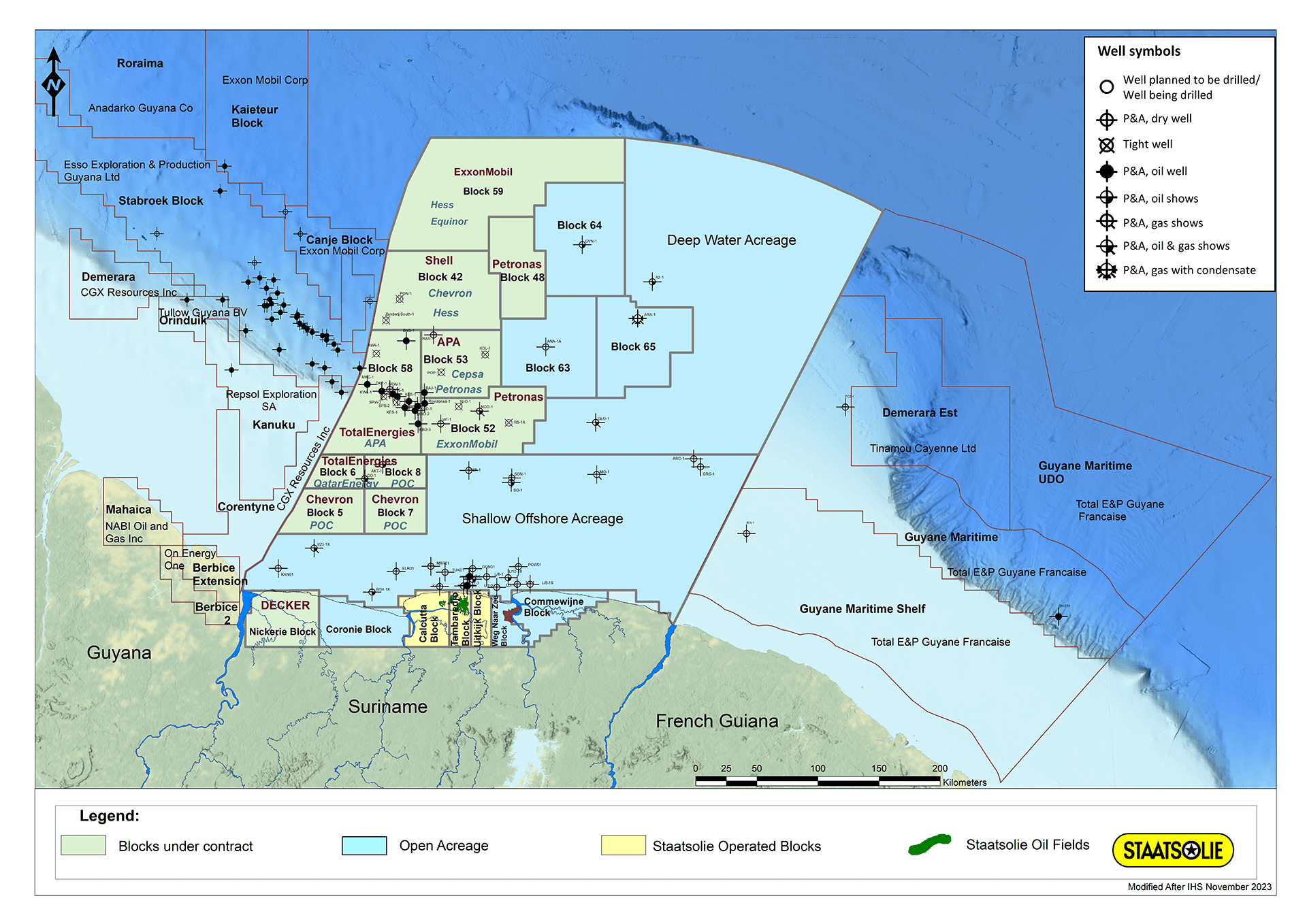
63Petronas (100%)<13005425
64Total (40%)Qatar Energy (30%)
Petronas (30%)
1300-17006262
65Shell (60%)Qatar Energy (40%)1300-17005000+

Through the PSCs, Staatsolie extends the rights for exploration, development and production to these companies. The costs and risks during the exploration period are fully covered by the latter. The exploration period consists of three phases and will last seven years. An exploration well will be drilled in both Block 64 and Block 65 in the first phase, which will last three years. In Block 63 the first exploration well follows in the second phase of the exploration period. In the event of an oil or gas discovery that is declared commercial, Staatsolie has the right to participate in all three blocks for a maximum of twenty percent from the development period

Staatsolie

Read Full Post »

« Newer Posts - Older Posts »