Feeds:
Posts
Comments

Archive for the ‘climate’ Category

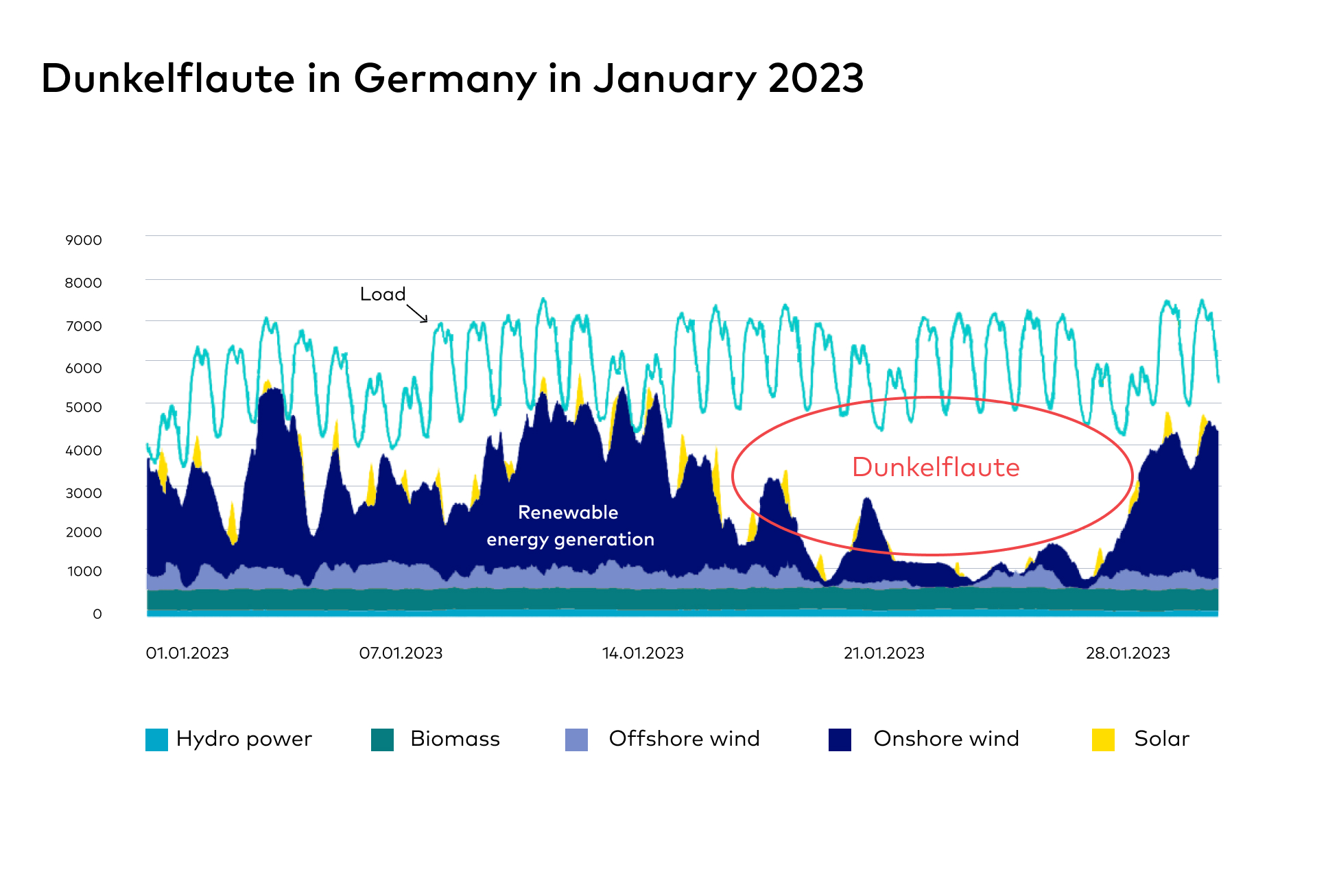
Add Dunkelflaute to the list of interesting and expressive compound German words. Die Dunkelflaute is a dark lull, a period of time in which minimal energy can be generated by the sun or wind. More specifically in German:

Die Dunkelflaute als sogenanntes Kofferwort beschreibt das gleichzeitige Auftreten von Dunkelheit und Windflaute. Diese Wetterlage entsteht typischerweise im Winter und sorgt für geringe Erträge aus Solar- und Windenergie bei gleichzeitig saisonal hohem Strombedarf. Eine Dunkelflaute kann mehrere Tage andauern. Kommen zu Dunkelheit und Windflaute noch niedrige Temperaturen hinzu, die für gewöhnlich den Strombedarf weiter ansteigen lassen, spricht man auch von “kalter Dunkelflaute.”

Note the prolonged Dunkelflaute (below) during which renewables provided minimal power in the middle of winter.
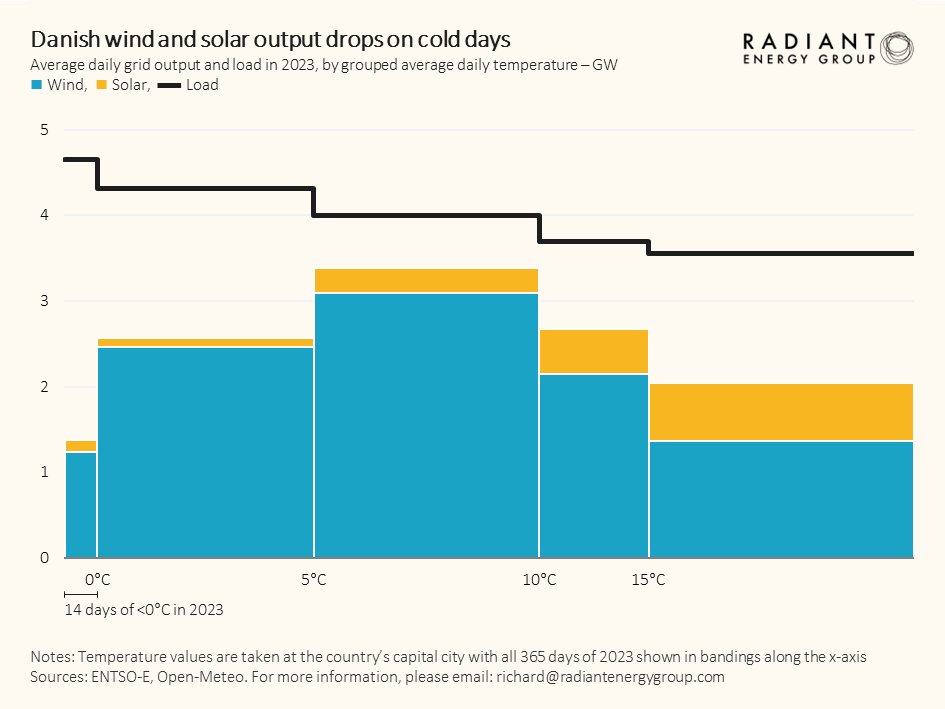
Unsurprisingly, wind and solar output are the lowest when the temperatures are the coldest. See the Danish summary for 2023 below. Note that wind output was also low when temperatures were above 15 deg. C.
Regional wind energy grids are not always an effective solution as Danish physicist Jens Christiansen, a nuclear energy advocate, has illustrated:

‘The wind always blows somewhere.’ Is that really true though? Here I’ve looked at the capacity factors of wind from five northern European countries in August The winds seem highly correlated, and there is almost a week-long period without significant wind anywhere.

Christiansen illustrates Denmark’s reliance on imported electricity:
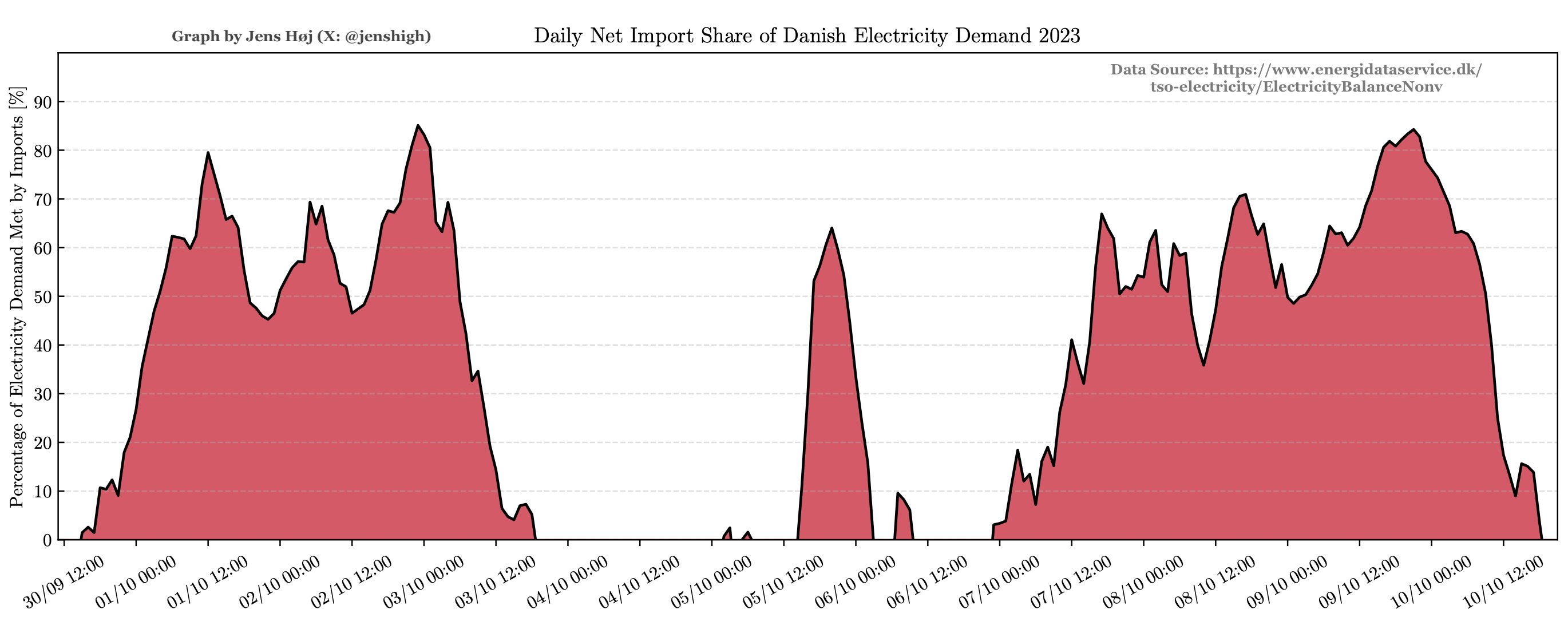
Paraphrasing Margaret Thatcher: “The problem with electricity imports is that you eventually run out of other people’s electricity.” In the U.S., California imports more electricity than any other state and typically receives between one-fifth and one-third of its electricity supply from outside of the state.

Given that massive battery storage is well beyond current capabilities and restrictions on electricity consumption and economic growth are undesirable, redundant or complementary power sources are essential for a reliable grid. Natural gas power generation is most responsive to variable demand, and is thus a good complement to variable sources like wind turbines and solar panels.

Read Full Post »

…. and gets slammed. 😁

Read Full Post »

I’m posting Sunday’s 60 Minutes segment that focused on deep sea mining and the failure of the US to ratify the UN Convention on the Law of the Sea (UNCLOS). Supplementary comments:

  • Most Federal employees involved with ocean energy policy, past and present, have supported US government ratification of UNCLOS.
  • The offshore industry has long supported UNCLOS. Industry trade associations, including API, IADC, and NOIA, are on the record as favoring ratification.
  • While concerns about UN management of deep sea mining access are understandable, some coordinated administrative structure is needed.
  • The Metals Company and other companies pursuing deep sea mining opportunities clearly disagree with the assertion that ocean floor mineral harvesting is not economically viable.
  • While it’s too soon to draw firm conclusions, there are reasons to believe that deep sea mining is environmentally preferable to onshore mining.

Read Full Post »

Unsurprisingly, the winner is natural gas.

A new report ranks eight key energy industry sectors based on their ability to meet the growing demand for affordable, reliable, and clean electric power generation.

As governments around the nation attempt to impose a transition from traditional energy resources to energy sources open referred to as renewables, natural gas is the energy source that is best suited to integrate with the intermittency inherent in the use of wind and solar. Gas provides a reliable, affordable, and increasingly clean source of energy in both traditional and “carbon-constrained” applications.

Gas faces headwinds in the form of increasingly extreme net zero energy policies that will constrict supplies if implemented as proposed. Gas could also improve overall reliability if onsite storage was prioritized to help avoid supply disruptions that can occur in just-in-time pipeline deliveries during periods of extreme weather and demand.

MCPP-NWU Report Card

This blog has been saluting natural gas for years, most recently in this post. From an environmental standpoint, offshore natural gas production is particularly attractive, especially nonassociated gas-well gas.

Read Full Post »

Pictured: pig for cleaning gas pipelines. Will Nord Stream’s suit against the insurers unplug investigation findings?

Nord Stream AG has sued insurers Lloyds and Arch in the English High Court for failing to pay for pipeline damage incurred during the Sept. 2022 Baltic Sea explosions. The estimated pipeline repair costs range from €1.2 to €1.35 billion, and Nord Stream is seeking €400 million from the insurers.

Could this litigation help us learn more about the findings of the official Nord Stream investigations? After 17 months of investigation, Denmark recently concluded that “there are not sufficient grounds to pursue a criminal case in Denmark.” Only nineteen days before Sweden had announced that “Swedish jurisdiction does not apply and that the investigation therefore should be closed.” These weak announcements at the end of lengthy investigations seem too convenient, and may lend credence to Hersh’s Nord Stream account or a recent variation that implicates the UK. Germany is presumably still investigating, and it remains to be seen whether they will release findings.

Could the parties in the Nord Stream case pursue documents or testimony from the Swedish, Danish, or German investigation teams? Both sides in this case, Nord Stream AG and the insurers, would benefit from details that could help identify the responsible parties.

It’s more than a little hypocritical for Western governments and their NGO partners to rail against offshore oil and gas operations while quietly accepting (without investigation) the economic and environmental consequences of the Nord Stream sabotage. Compare the Nord Stream methane emissions with those associated with Gulf of Mexico operations.

Read Full Post »

Bayou Bend CCS LLC commenced drilling an offshore (Texas State waters) and an onshore stratigraphic well for carbon sequestration in the first quarter 2024.

Talos

Is offshore carbon disposal ocean dumping? One of the provisions that was slipped into the “2021 Infrastructure Bill” exempted carbon sequestration from the Marine Protection, Research, and Sanctuaries Act of 1972 (Ocean Dumping Act). This exemption revises the OCS Lands Act and thus does not apply to State offshore lands. The Texas offshore wells must therefore be permitted by EPA as “Class VI wells,” as is the case for onshore disposal wells. However, Texas and Louisiana have asked the EPA for “primacy,” which would allow state agencies to approve and oversee these operations.

Meanwhile, the regulations for carbon disposal on the OCS, which the Infrastructure Bill mandated by November 2022, have yet to be published for comment. The latest Federal regulatory agenda indicates a publication date of 12/00/2023 for these regulations. Presumably the staff work has been completed and the rule is stalled in the review process.

Despite the absence of a regulatory framework, BOEM has accepted sequestration bids at the last three oil and gas lease sales. These bids were evaluated as if the leases were being acquired for oil and gas exploration and production, even though the bidders’ intentions were widely known. Why was BOEM a willing participant in this charade, not just at one sale, but at three sales in succession?

Given that the perceived carbon disposal bonanza is dependent on mandates and subsidies, one has to wonder about the massive revenue projections for this industry and raise concerns about the associated public and private financial risks. What is the long term business plan for this industry? Who will be monitoring the offshore wells (in perpetuity)? How will the public be protected from financial assurance and leakage risks? We will see how the myriad of carbon sequestration issues are addressed in the proposed regulations.

Read Full Post »

Given the intermittency, space preemption, aesthetic, and wildlife issues associated with wind and solar power, more attention has been shifting to geothermal energy. Quaise’s plan to tap ultradeep heat resources has been on our radar for several years and has been attracting private funding and a bit of media buzz.

Quaise is exciting not only because of the unlimited energy potential, but because of the fascinating gyrotron technology that vaporizes hard rock and could enable wells to be drilled to depths of 20-30 km and temperatures of >1000° C. Nabors, a leading drilling contractor, is one of the Quaise investors, and will be involved with the test drilling.

Demonstrating the gyrotron technology in the field is a big step up from doing so in the lab. Those of us in the “peanut gallery” are awaiting more definitive information on the lab tests that have been conducted to date and the important field tests, which are scheduled for this year.

Read Full Post »

Either the investigators were incompetent (unlikely) or the political pressure was too great (likely).

“The investigation has led the authorities to conclude that there was deliberate sabotage of the gas pipelines. However, the assessment is that there are not sufficient grounds to pursue a criminal case in Denmark,” a Copenhagen police statement said.

Reuters

After 17 months of investigation, that’s a pretty lame statement. Will we see their report?

The ball is now in Germany’s court. Should we expect more of the same?

Our June 2023 summary remains unchanged.

Read Full Post »

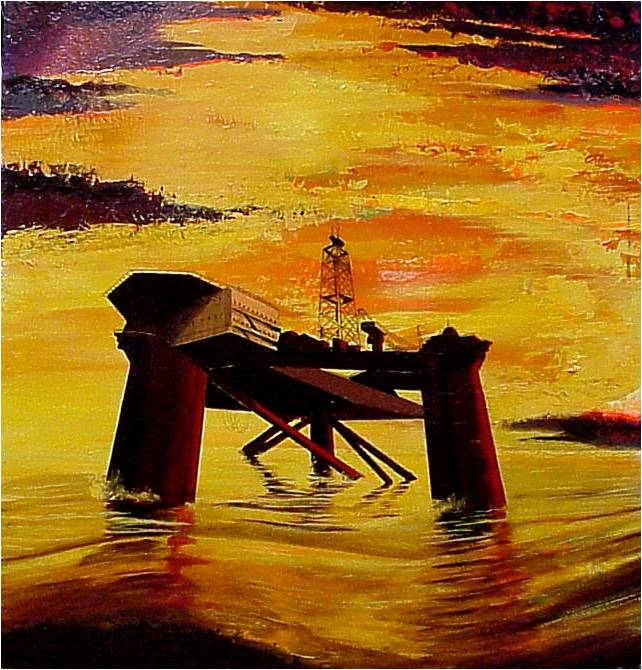
In light of the surge in art vandalism, admirers of “Rig at Sunset” have expressed concern about this priceless and symbolic masterpiece.😉

“Rig at Sunset”

Rest assured that “Rig at Sunset” is not being targeted. Climate activists believe the painting is disturbingly visionary and is thus socially important. Even those who are less appreciative of great artwork are reluctant to damage “Rig at Sunset,” fearing that their vandalism might actually improve its quality. So friends of this beloved masterpiece have nothing to fear! 😉

If you are unfamiliar with “Rig at Sunset,” here is a brief summary of the history:

“Rig at Sunset” was painted nearly 50 years ago by a US Geological Survey (USGS) employee who chose to remain anonymous. Initially, the masterpiece was presented to USGS (later MMS) engineers and scientists who had made important contributions to the offshore oil and gas program. Understandably, the intended recipients were so humbled by the magnificence of the painting that they could not accept it. As the painting grew in value and international prominence, framed copies were presented to retirees and the original painting was kept at a secure, undisclosed location.

Read Full Post »

As concerns about wind leasing mount, it is becoming increasingly apparent that the rush to hold auctions may not be in the best long-term interest of the wind program. The primary objective should be cost-effective and responsible development, not gigawatt deadlines. The administration’s vision for wind energy capacity, particularly the 15 GW goal for floating turbines by 2035, is unlikely to be achieved and rushing the process is not helpful.

The current wind program is reminiscent of James Watt’s ill-fated approach to oil and gas leasing. Watt’s “lease-everything now” agenda had the opposite effect of that which was intended, the result being that 96.3% of our offshore land is now off-limits to oil and gas leasing.

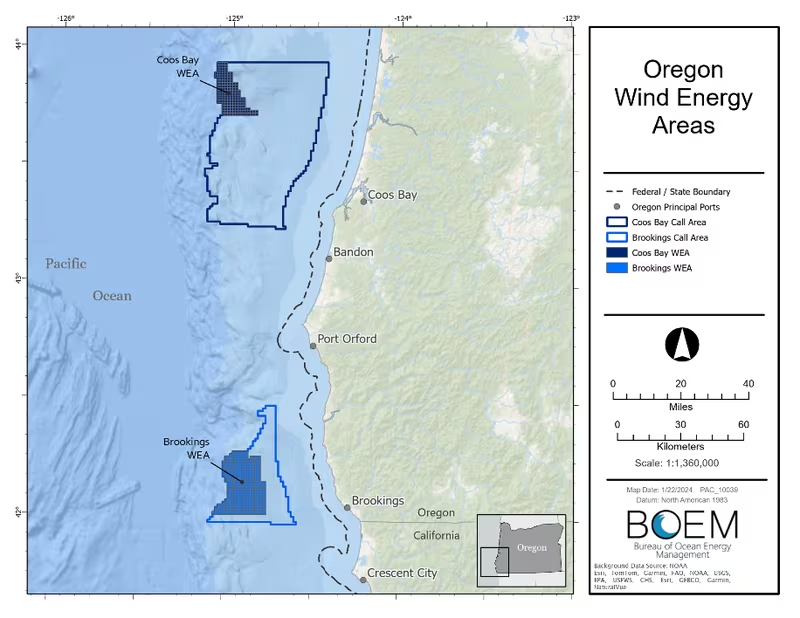
Affected parties in Oregon have not held back in voicing their displeasure with BOEM’s wind energy announcement.

BOEM wants offshore wind come hell or high water and they don’t care who they harm to get it.

Heather Mann, executive director of Midwater Trawlers Cooperative

The Confederated Tribes of Coos, Lower Umpqua and Siuslaw tribal council unanimously passed a resolution opposing offshore wind energy development off the Oregon coast.

The federal government states that it has ‘engaged’ with the Tribe, but that engagement has amounted to listening to the Tribe’s concerns and ignoring them and providing promises that they may be dealt with at some later stage of the process. The Tribe will not stand by while a project is developed that causes it more harm than good – this is simply green colonialism.

Coos, Lower Umpqua and Siuslaw tribal council Chair Brad Kneaper

Read Full Post »

« Newer Posts - Older Posts »