Summit Entertainment, Participant Media and Imagenation Abu Dhabi, have announced that they’ve acquired the film rights to a 2010 New York Times article on the BP oil spill.Forbes
This is the excellent New York Times piece referenced in the quote.
Posted in accidents, Uncategorized, well control incidents, tagged accidents, blowouts, Deepwater Horizon, drilling, Gulf of Mexico, macondo, offshore oil, oil spill, safety, well control on March 17, 2011| Leave a Comment »
Summit Entertainment, Participant Media and Imagenation Abu Dhabi, have announced that they’ve acquired the film rights to a 2010 New York Times article on the BP oil spill.Forbes
This is the excellent New York Times piece referenced in the quote.
Posted in accidents, well control incidents, tagged accidents, blowouts, Deepwater Horizon, drilling, Gulf of Mexico, macondo, oil spill, safety, well control on March 15, 2011| Leave a Comment »
Jason Anderson, Dale Burkeen, Donald Clark, Stephen Curtis, Gordon Jones, Roy Wyatt Kemp, Karl Kleppinger, Blair Manuel, Dewey Revette, Shane Roshto and Adam Weise.
They are the 11 workers who died when the Deepwater Horizon burned and sank in the Gulf of Mexico last year.
Their names need to be stated, to be remembered, because they were clearly forgotten as the industry gathered for the CERAWeek conference in Houston this week. Houston Chronicle
Comment: The sad truth is that the Macondo tragedy would have received very little attention if the fatalities were not followed by a major oil spill. There would have been no moratorium, no National Commission, no Chemical Safety Board review, and no Justice Department investigation. The last major multi-fatality accident in the Gulf, the South Pass 60 B fire that killed seven workers in 1989, received almost no national attention. A minor spill offshore California receives more coverage than a multi-fatality event in the Gulf.
When every casualty, every gas release, every well control incident, and every structural failure is fully and publicly reviewed, we will be well on our way toward preventing not only injuries and fatalities, but also spills and environmental damage.
Posted in accidents, cuba, drilling, energy, Uncategorized, tagged Australia, Brazil, deepwater drilling, drilling, energy, ISO TC 67, Japan, macondo, Mexico, Montara, Ningaloo Reef, nuclear, offshore energy, offshore safety institute, Petrobras, standards on March 12, 2011| Leave a Comment »
Japan will likely need more imported oil and natural gas due to closures of nuclear reactors caused by Friday’s earthquake and tsunami, but volumes can’t be calculated accurately as it is unclear how much industrial output has been affected by the disaster and how long power nuclear and thermal power plants will remain closed. Wall Street Journal
The CEOs of major oil and gascompanies will meet March 18 to decide how to proceed with the formation of a US offshore drilling safety institute, William Reilly, the co-chair of the National Oil Spill Commission, said March 8. Platts Oilgram News
Marco Aurelio Garcia, foreign policy adviser to President Dilma Rousseff, told reporters in Havana exploratory work off Cuba’s northern coast had not shown good results and that Brazil wanted to concentrate on its own oil fields.
Since BP’s disastrous Deepwater Horizon accident in the Gulf of Mexico last April, the risks of offshore oil drilling have been a hot topic. One place it isn’t questioned much is Brazil, whose oil production industry is one of the fastest-growing in the world because of vast new deepwater oil reservoirs discovered in the past five years.
Pemex has just begun to explore in Mexico’s Gulf of Mexico waters deeper than 1,000 feet, but 28 billion undiscovered barrels of oilequivalent are thought to exist in that area, some of which borders US territorial waters. Pemex officials said the company is forging a development plan for its first deepwater field, Lakach, located northeast of the state of Veracruz in about 3,200 feet of water. First production is expected in 2015.
Environmentalists are furious at a proposal by the petroleum company Shell to start exploration drilling off one of Western Australia’s most treasured reefs. Ningaloo Reef off the north-west coast, has been nominated for World Heritage listing.
Posted in accidents, tagged accidents, blowouts, Gulf of Mexico, macondo, MMS, offshore oil, ohmsett, oil spill, Valdez on March 5, 2011| Leave a Comment »
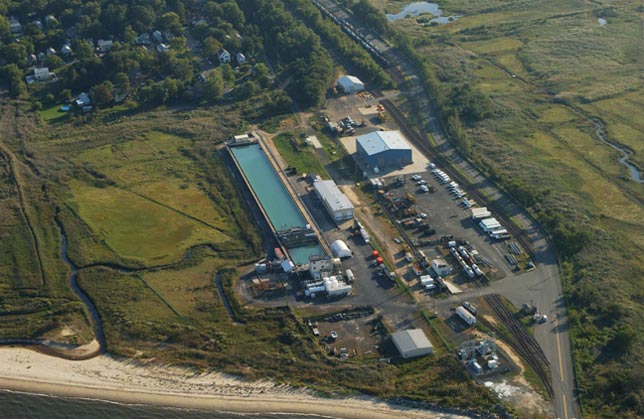
Ohmsett
The seemingly endless crowing about the absence of improvements in spill response capabilities is a story by itself. This topic warrants a full discussion when time permits, but for now I’ll offer a few comments and observations:
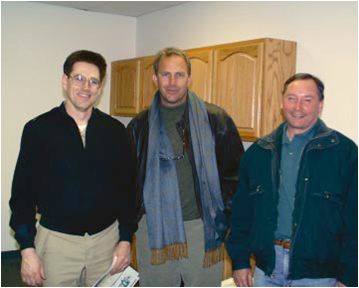
NWS Earle Executive Officer Claudill, Kevin Costner, and Ohmsett Manager Bill Schmidt (1999 photo at Ohmsett)
Posted in accidents, tagged aban pearl, Petrosaudi Discover, venezuela on March 4, 2011| 1 Comment »
This is not the best translation (from Spanish by Google), but I think you get the gist:
A report is in the hands of the Federation of Petroleum Workers of Venezuela (FUTPV) shows the “precarious” state that is the drill ship PetroSaudi Discover, which operates in the Gulf of Paria in the Gran Mariscal gas project Sucre. This platform, as declared by the executive secretary and coordinator of health and safety of FUTPV, Eudis Girot, bear the same fate as his partner Aban Pearl, black on 13 May 2009 in the same coasts, if not halted operations and taken to Trinidad and Tobago for repair.
“We already knew it was a scrap, just like Aban Pearl,” said a source.
Posted in accidents, well control incidents, tagged accidents, blowouts, BOP, chemical safety board, Deepwater Horizon, drilling, Gulf of Mexico, macondo, offshore oil, safety, well control on March 3, 2011| 2 Comments »
From Platts Oilgram News article by Gary Gentile:
The team examining the BOP in Louisiana conducted tests in January and February of this year that showed that with the proper amount of hydraulic fluid pressure, the rams on the BOP would close, according to Dan Tillema, an investigator with the US Chemical Safety Board.
Portions of drill pipe were found in the BOP and the pipe was cut, Tillema said—a sign that the rams did close at some point during the incident.
But Tillema cautions against making any assumptions based on the test results sofar. Some reports have suggested that rubber gaskets around the rams were worn awayby the massive flow of oil and gas gushing from the Macondo well, overcoming the BOP’s capacity. That is just one of several possibilities, Tillema said. “We haven’t made any conclusions yet,” he said.
Posted in accidents, Norway, tagged Gullfaks, lifting, Norway, safety, safety culture on March 2, 2011| 1 Comment »
The Petroleum Safety Authority Norway (PSA) has initiated an investigation following an incident in connection with a lifting operation on the Gullfaks A facility on 28 February 2011.
Posted in accidents, well control incidents, tagged accidents, blowouts, BOP, Deepwater Horizon, Gulf of Mexico, macondo, offshore oil, transocean, well control on February 28, 2011| Leave a Comment »
Transocean Ltd., the world’s largest offshore oil driller, may attempt to recover some or all of the Deepwater Horizon rig that exploded and sank during last year’s Macondo well disaster. Bloomberg
U.S. Attorney Steve Overholt told District Judge Carl Barbier that testing of the failed blowout preventor (BOP) that led to the Deepwater Horizon oilrig explosion should be done by the end of this week. Louisiana Record
Posted in accidents, Uncategorized, well control incidents, tagged accidents, blowouts, capping and containment, drilling, Gulf of Mexico, Helix, macondo, Marine Well Containment Company, Montara, offshore oil, oil spill, well control on February 28, 2011| 2 Comments »

Good Nola.com article on the well containment systems
Comments on well capping and containment:
Posted in accidents, well control incidents, tagged accidents, blowouts, Deepwater Horizon, Gulf of Mexico, macondo, offshore oil, oil spill, safety, well control on February 26, 2011| Leave a Comment »
These hearings should be interesting:
The JIT expects to hold another set of public hearings the week of April 4 to focus specifically on the BOP and findings from the forensic examination. BOEMRE and the USCG expect to issue a joint release regarding the investigation by mid-April.
 Bud's Offshore Energy (BOE)