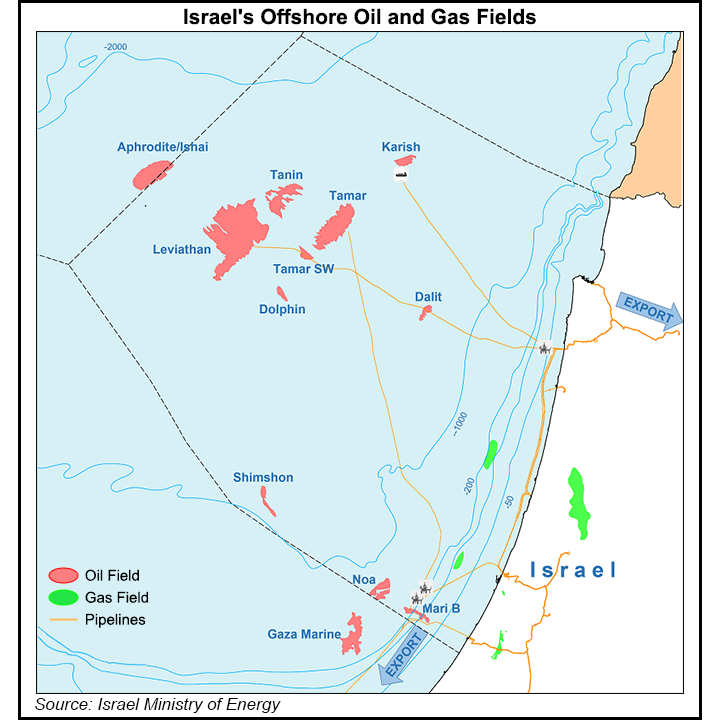
Below is IDF video of a drone intercept by an Israeli naval vessel offshore northern Israel.
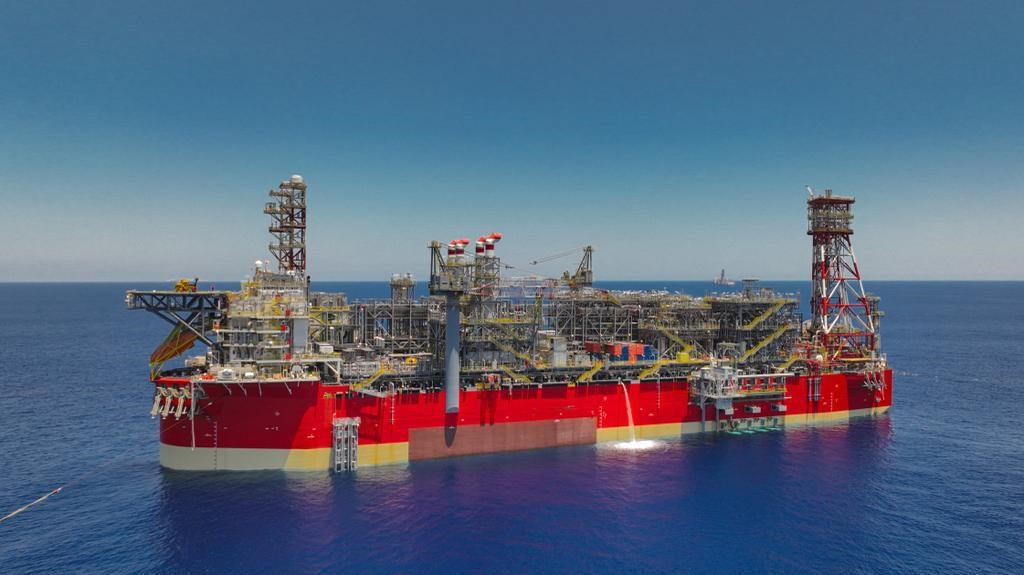
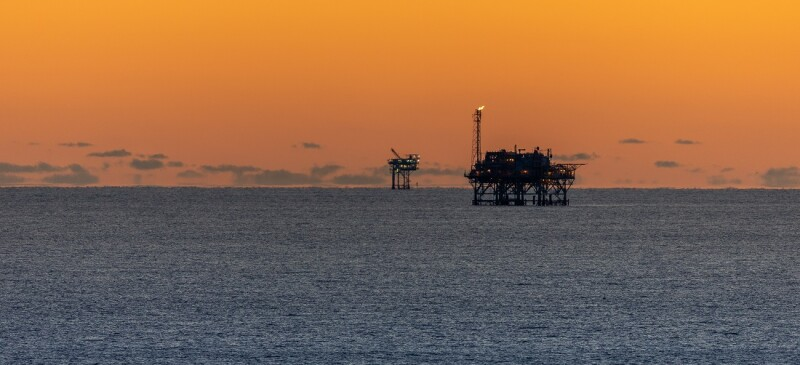
Initial assessments suggest that the drone was headed for offshore infrastructure at the Karish gas field, presumably the FPSO pictured above.
Posted in Offshore Energy - General, Uncategorized, tagged drone attack, Eastern Mediterranean, IDF report, Israel, Karish gas field on September 30, 2024| Leave a Comment »
Below is IDF video of a drone intercept by an Israeli naval vessel offshore northern Israel.
Initial assessments suggest that the drone was headed for offshore infrastructure at the Karish gas field, presumably the FPSO pictured above.
Posted in accidents, energy policy, tagged Christianso, harbor master, John Anker Nielsen, Nord Stream, pipeline sabotage, Seymour Hersh on September 30, 2024| 5 Comments »
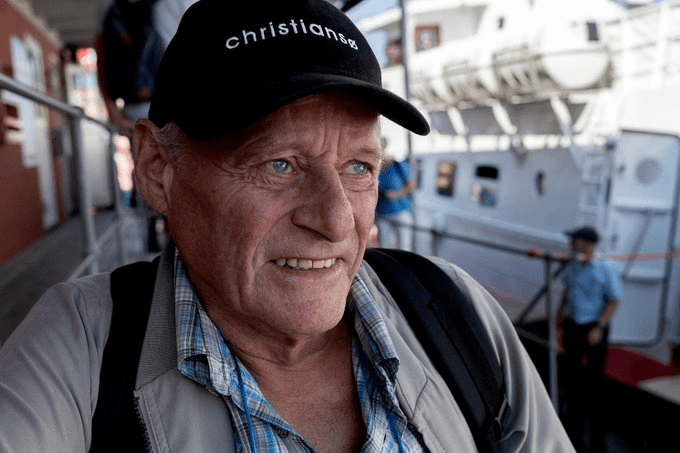
Just when the media seemed to be settling on rogue Ukrainians in a rented yacht being responsible for the sabotage of the Nord Stream pipelines, comments by a Danish harbor master have muddied the waters.
On the second anniversary of the Nord Stream pipeline sabotage, the Danish publication Politiken posted comments from John Anker Nielsen, harbor master on Christiansø, the small Danish Island near the explosion sites.
Swedish engineer, Erik Andersson tweeted an excerpt from the Politiken article:
“For the first few days, the harbor master said he was “not allowed to say a thing”. But today, John Anker Nielsen can reveal that four or five days before the Nord Stream blasts, he was out with the rescue service on Christiansø because there were some ships with switched-off radios. They turned out to be American naval vessels, and when the rescue service approached, they were told by Naval Command to turn back. Therefore, the harbor master has some faith in the theory that American star journalist Seymour Hersh, among others, has put forward without any documentation: that the US was behind the sabotage. The Americans have these small unmanned submarines that can solve any task, John Anker Nielsen has been told.”
Erik commented further:
The harbor master isn’t making this up. He wasn’t alone on the rescue vessel ordered to stay clear of the American warships.
Posted in Gulf of Mexico, hurricanes, Offshore Energy - General, tagged evacuations, Gulf of Mexico, Hurricane Helene, production shut-in on September 29, 2024| Leave a Comment »
Update: BSEE reports that as of 9/29/2024, essentially all production had been restored.
As of 9/28, 210,000 BOPD remained shut-in with only 4 platforms still evacuated. Presumably, production had not resumed (or had only partially resumed) on some high rate deepwater platforms.
BSEE shut-in, evacuation, and relocation data in the table below are as of 12:30 p.m. ET on the specified date.
| date | 9/24 | 9/25 | 9/26 | 9/27 | 9/28 |
| oil s.i.(BOPD) % of total | 284,000 16.21 | 511,000 29.18 | 441,923 25.25 | 427,000 24.39 | 210,000 12 |
| gas s.i.(MMCFD) % of total | 208 11.2 | 313 16.85 | 363.39 19.81 | 343 18.46 | 112 6.04 |
| platform evacs % of total | 4 1.08 | 17 4.58 | 27 7.28 | 9 2.43 | 4 1.08 |
| rig evacs % of total | 0 0 | 1 20 | 1 20 | 0 | 0 |
| DP rigs moved % of total | 2 9.5 | 3 14.3 | 3 14.3 | 1 4.76 | 1 4.76 |
Posted in energy policy, Offshore Energy - General, Offshore Wind, tagged Coos County, Curry County, floating turbines, lack of bidders, litigation, NewSun Energy, Offshore Wind, opposition, Oregon on September 28, 2024| Leave a Comment »
Update 2: Oregon’s Governor requested cancellation. (letter attached)
“I am disappointed that BOEM’s accelerated process over the last year has further divided stakeholder communities, and put the Confederated Tribes of the Coos, Lower Umpqua and Siuslaw Indians in the position of challenging BOEM in federal district court. Oregon’s legislative Coastal Caucus is likewise now in full opposition to BOEM’s proposed lease.“
Update: The sale has been cancelled.
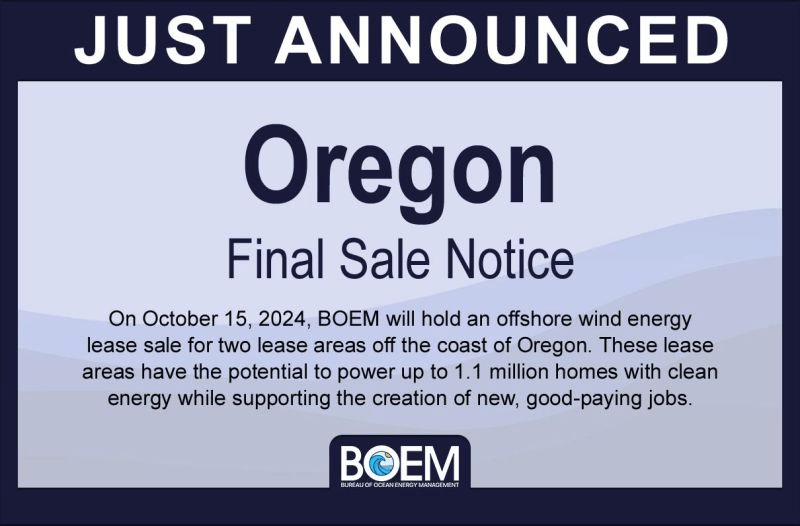
Despite the usual hype about the number of homes that could be powered and “good-paying jobs,” the upcoming Oregon wind lease appears to be very much in doubt. If legal action by Oregon tribes doesn’t halt or delay the sale, the absence of bidders may.
OregonLive reports that only one company, NewSun Energy, continues to be interested in participating in the sale. NewSun is primarily a solar energy developer with no apparent offshore wind experience.
Wind development offshore Oregon would be complex and very expensive given the need for floating turbines and new high-voltage transmission lines over the Coast Range. At least two counties, Coos and Curry, are set to vote on whether to publicly oppose offshore wind development off their coast.
If the sale is delayed such that BOEM is not able to issue leases before 12/20/2024, the leases cannot be issued until a qualifying oil and gas lease sale is held.
Posted in climate, flaring and venting, Offshore Energy - General, tagged % gas flared, % gas vented, data, flaring and venting, gas well gas, methane, oil well gas, ONRR on September 25, 2024| Leave a Comment »
Note: I have attached a PDF for those who want to download the charts and table. I have also added a “flaring and venting” category for easy access to these posts.
Minimizing flaring and venting is important from both environmental and resource conservation standpoints. Flaring and venting volumes are also good indicators of how well production systems are designed, managed, and maintained.
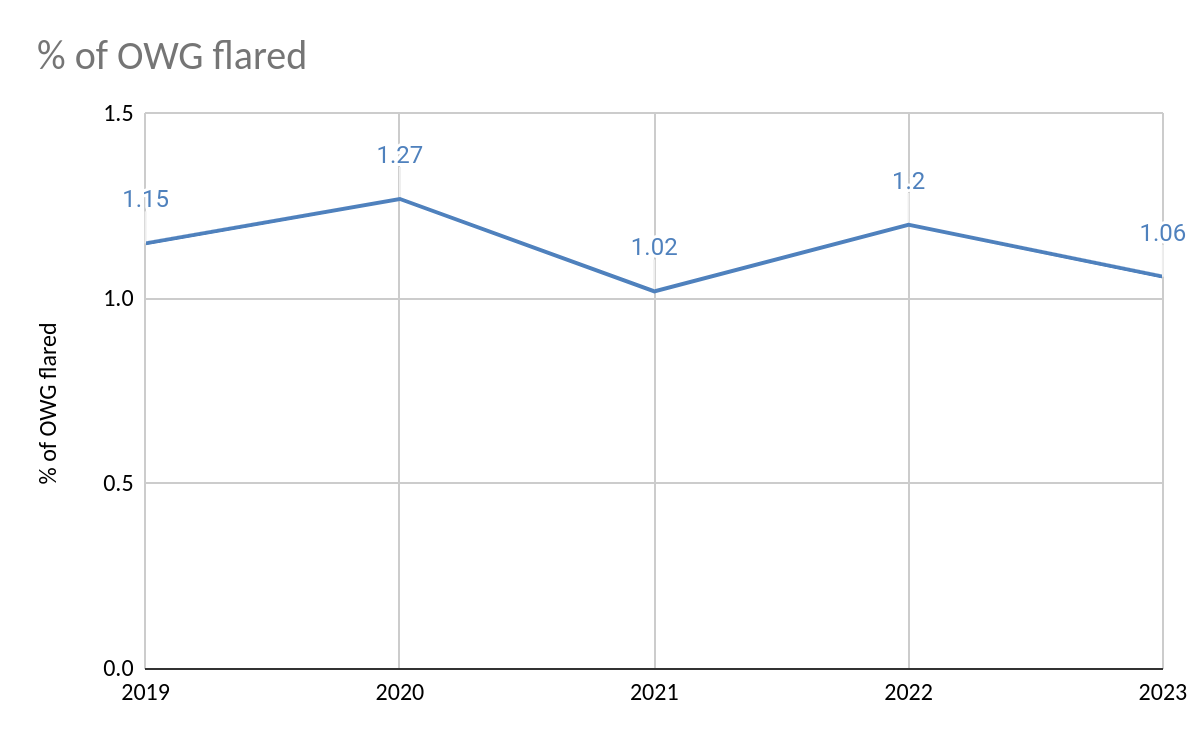
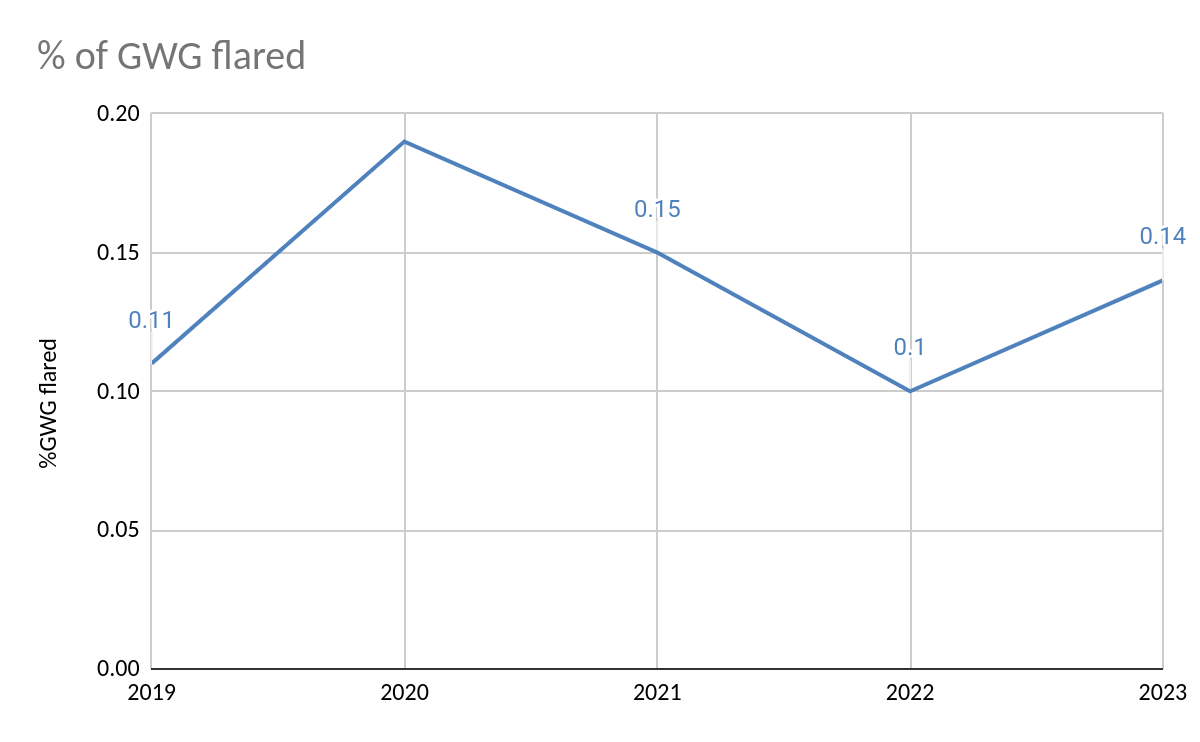
The best performance indicators are the percentages of produced gas that are flared and vented both for oil-well gas (OWG, also known as associated gas or casinghead gas) and gas-well gas (GWG or non-associated gas).
I compile monthly flaring and venting volumes for the Gulf of Mexico using data submitted to the Office of Natural Resources Revenue (ONRR). Reporting these data is mandatory and strictly enforced. Violators are subject to civil and criminal penalties.
In assessing performance trends, it’s important to segment venting and flaring volumes for both OWG and GWG production. Venting produced gas (mostly methane) is a more significant environmental concern from both air quality and greenhouse gas (GHG) perspectives. Reductions in methane emissions are a priority for regulators and leading operators.
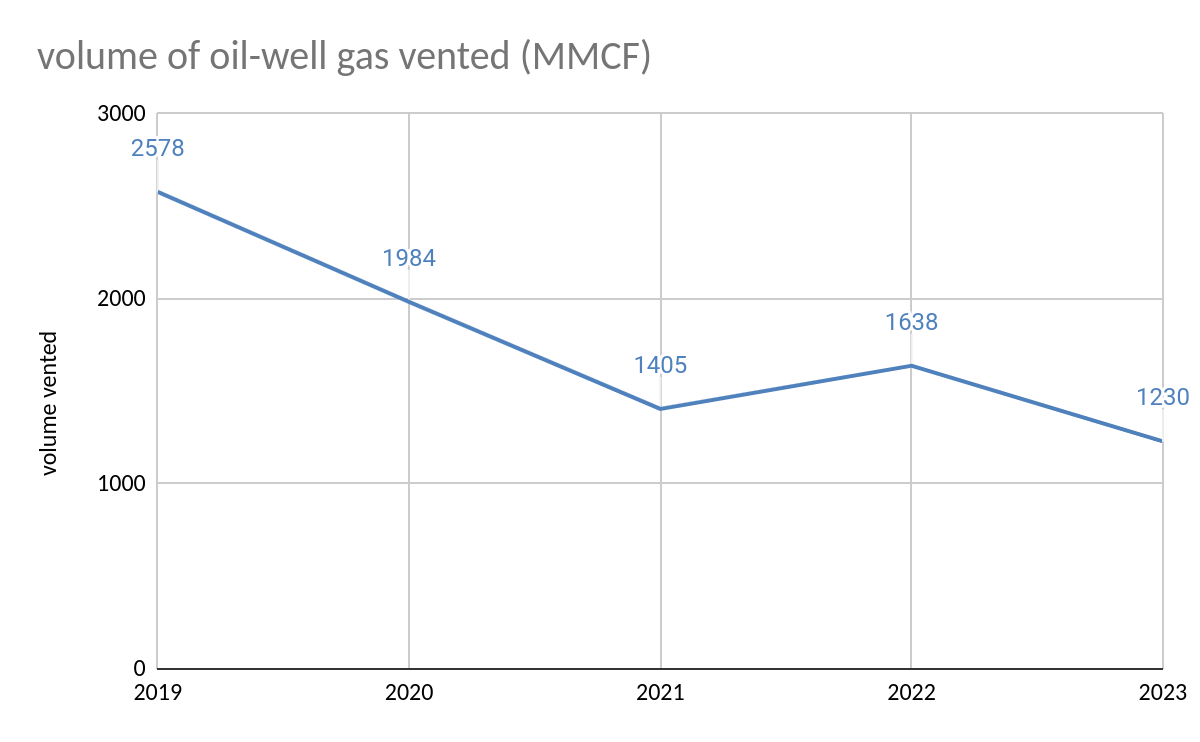
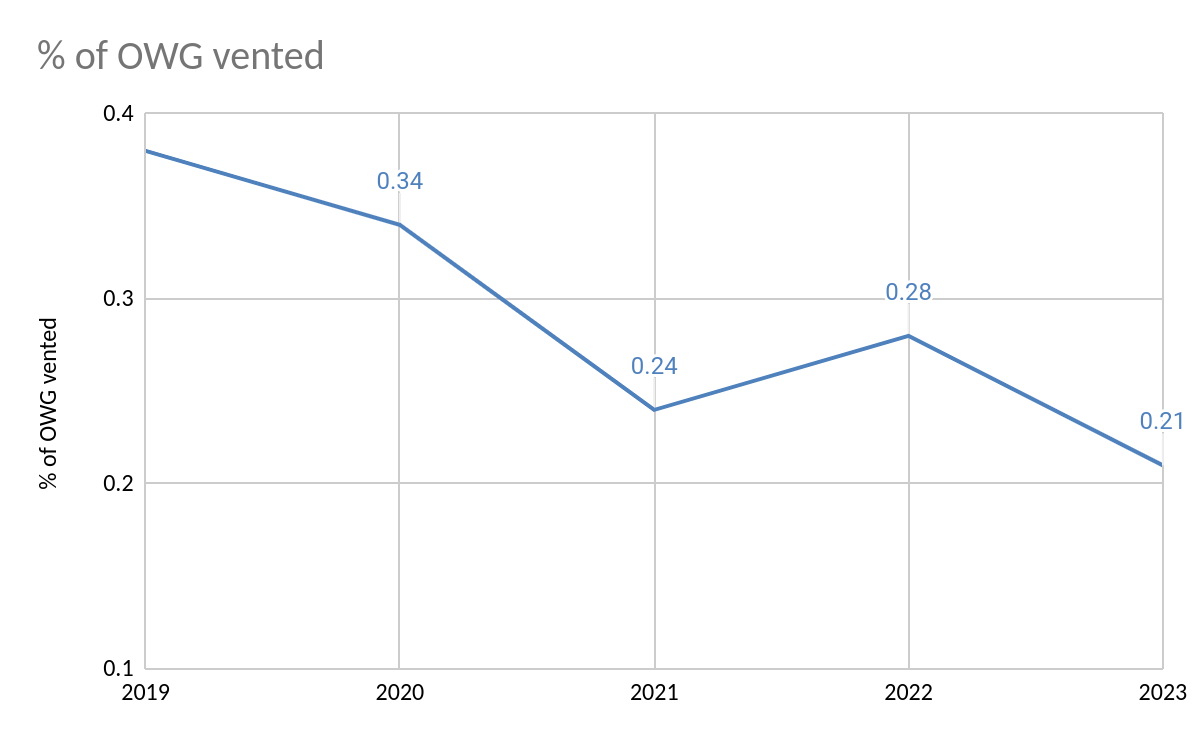
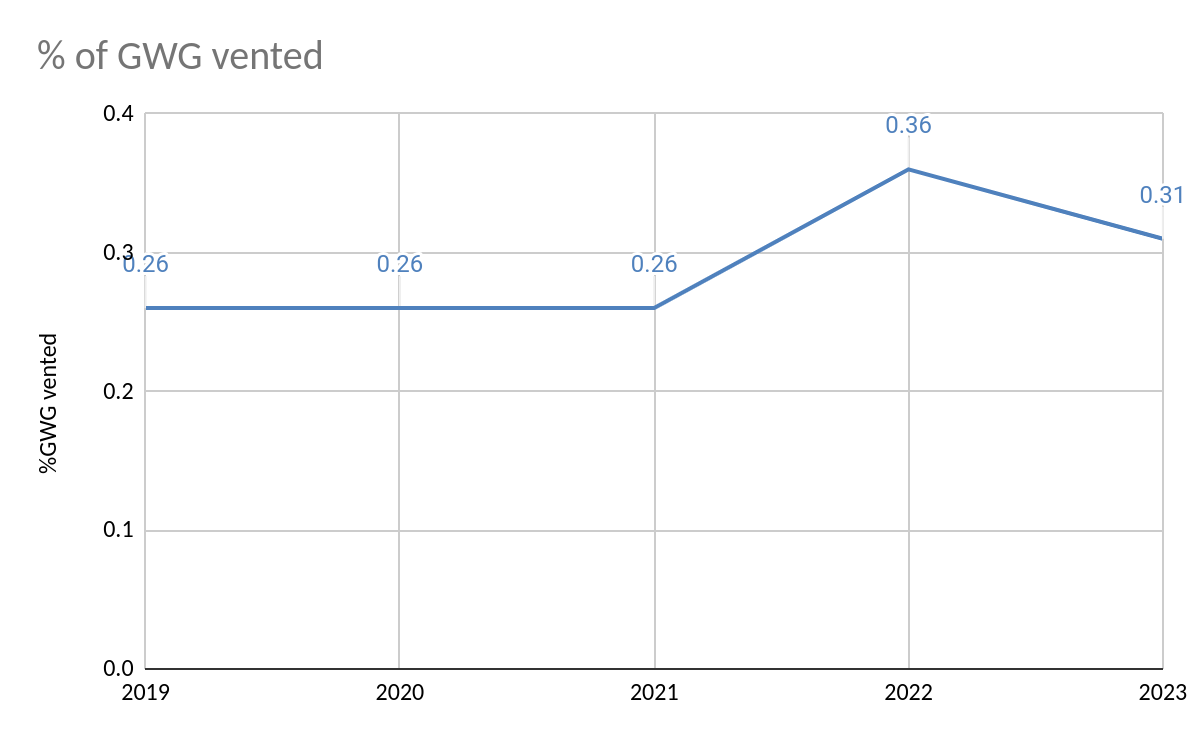
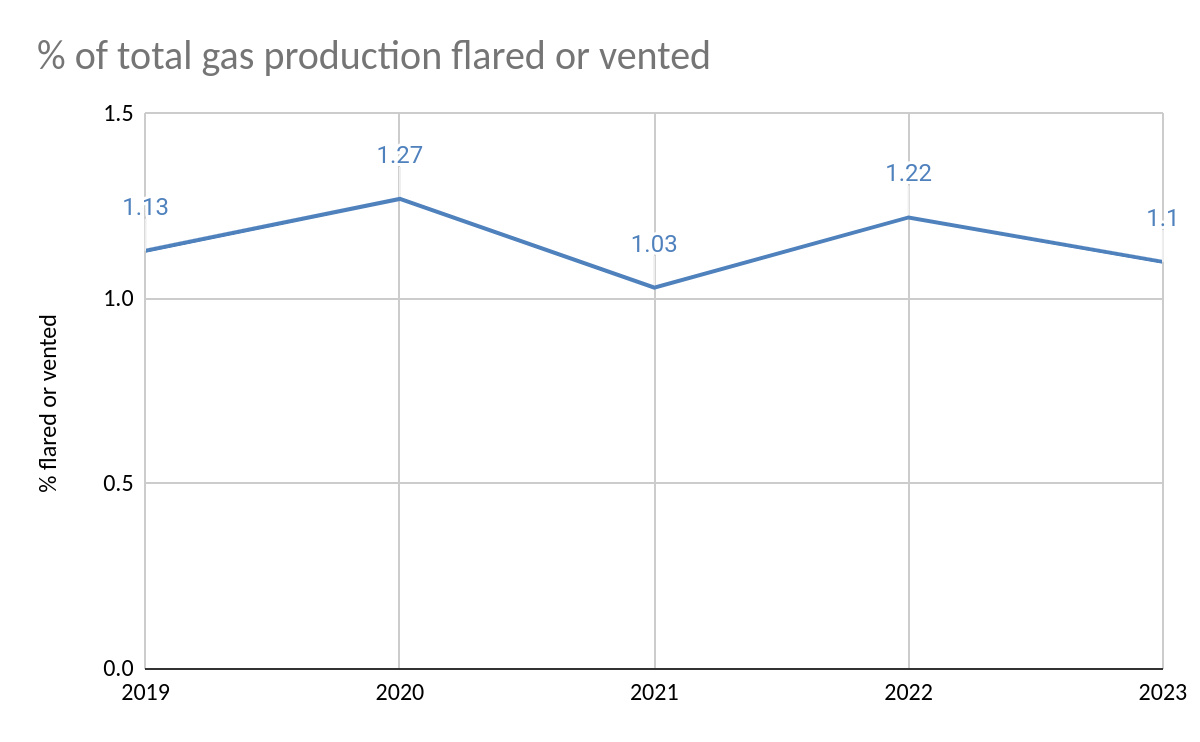
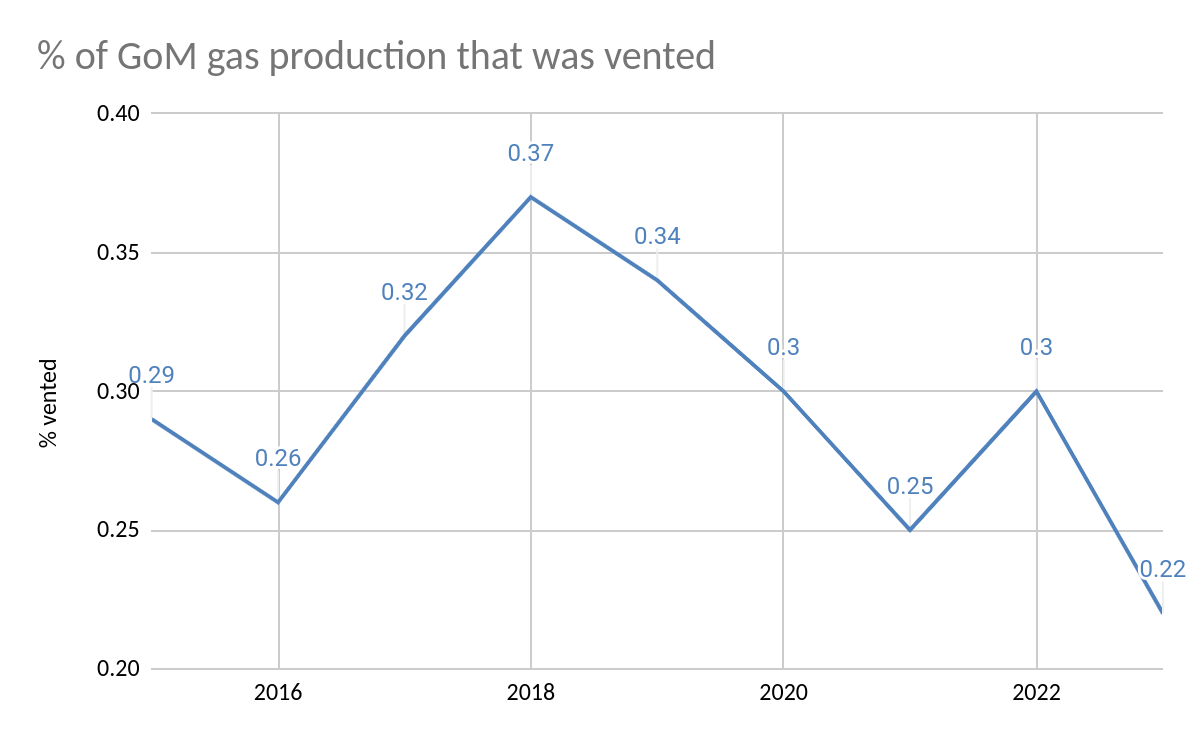
Flaring and venting data for 2019-2023 are summarized in the charts and table below. All volumes are in millions of cubic feet (MMCF). For the last chart (% of total gas production vented), I added ONRR data for 2015-2018 to provide a longer term perspective on overall venting performance.
Observations:
| 2019 | 2020 | 2021 | 2022 | 2023 | |
| OWG flared | 7727 | 7385 | 5919 | 6987 | 6342 |
| OWG vented | 2578 | 1984 | 1405 | 1638 | 1230 |
| OWG produced | 670,699 | 582,254 | 582,824 | 581,235 | 598,005 |
| % OWG flared | 1.15 | 1.27 | 1.02 | 1.20 | 1.06 |
| % OWG vented | 0.38 | 0.34 | 0.24 | 0.28 | 0.21 |
| GWG flared | 405 | 432 | 311 | 213 | 212 |
| GWG vented | 958 | 578 | 548 | 722 | 468 |
| GWG produced | 364,082 | 224,808 | 209,558 | 203,342 | 152,400 |
| %GWG flared | 0.11 | 0.19 | 0.15 | 0.10 | 0.14 |
| %GWG vented | 0.26 | 0.26 | 0.26 | 0.36 | 0.31 |
| total flared and vented | 11668 | 10233 | 8183 | 9559 | 8252 |
| total gas production | 1,034,782 | 807,062 | 792,382 | 784,577 | 750,405 |
| % flared or vented | 1.13 | 1.27 | 1.03 | 1.22 | 1.10 |
| total vented | 3536 | 2416 | 1953 | 2360 | 1698 |
| % vented | 0.34 | 0.30 | 0.25 | 0.30 | 0.22 |
| total flared | 8132 | 7817 | 6230 | 7200 | 6554 |
| % flared | 0.79 | 0.97 | 0.79 | 0.92 | 0.87 |
OWG=oil well gas; GWG=gas well gas; all volumes are in MMCF
Posted in climate, energy policy, Offshore Energy - General, tagged 5 year leasing plan, elections, Maduro, production santions, US offshore oil and gas leasing, venezuela on September 24, 2024| Leave a Comment »
2024 will be the first year since 1958 without a single OCS oil and gas lease sale. There would not have been a sale in 2023 either were it not for a legislative mandate. The only 2022 lease sale was a micro-sale in the Cook Inlet that resulted in only a single bid. So, at the end of 2024 three years will have elapsed with only one meaningful sale, and that sale was mandated by Congress.
The current plan is for these de facto sanctions on US offshore production to continue. The Dept. of the Interior’s 5 year leasing plan includes a maximum of 3 sales, by far the fewest sales in any 5 year plan in OCS program history.

Meanwhile, the sanctions on Venezuelan production were further eased with the understanding that the Maduro regime would hold fair elections. To the surprise of no one, the evidence strongly suggests that those elections were not fair. Nonetheless, the sanctions on production have not been reimposed.
Apparently, the climate activists who have imposed their will on the OCS oil and gas program have less influence over our policy toward Venezuela. Or perhaps the production (and consumption) of Venezuelan oil is cleaner and greener (🙃 sarcasm intended!)
Posted in energy policy, Offshore Energy - General, Offshore Wind, tagged Aquinnah Wampanoag, BOEM, Brad Kneaper, Confederated Tribes, Deb Haaland, lawsuit, offshore wind sale, Oregon, wind leasing deadline on September 23, 2024| Leave a Comment »

The Confederated Tribes of the Coos, Lower Umpqua and Siuslaw Indians (“Tribe”) filed a lawsuit against BOEM in Oregon Federal District Court. The lawsuit (attached) challenges BOEM’s cursory environmental review for the development of private offshore wind energy facilities in two areas off the Oregon Coast near Coos Bay and Brookings.
“The Tribe has consistently urged that BOEM delay moving forward with wind energy development until a better understanding is made of the impacts to fish, wildlife, the marine environment, and cultural resources important to the Tribe,” said Tribal Council Chair Brad Kneaper. “No one, including BOEM has an understanding on how wind development will impact the fragile marine environment. BOEM developed an environmental assessment document that narrowly focused on the impacts of the lease sale and completely turned a blind eye to the inevitable impacts that construction and operation of these private energy facilities will have on Coastal resources, the Tribe, and other residents.”
“The timeframe for wind development appears to be driven by politics, rather than what is best for Coastal residents and the environmental,” said Chair Kneaper.
This suit and the Aquinnah Wampanoag tribe’s call for a moratorium on offshore wind development have to be uncomfortable for Secretary of the Interior Deb Haaland given her Native American heritage.
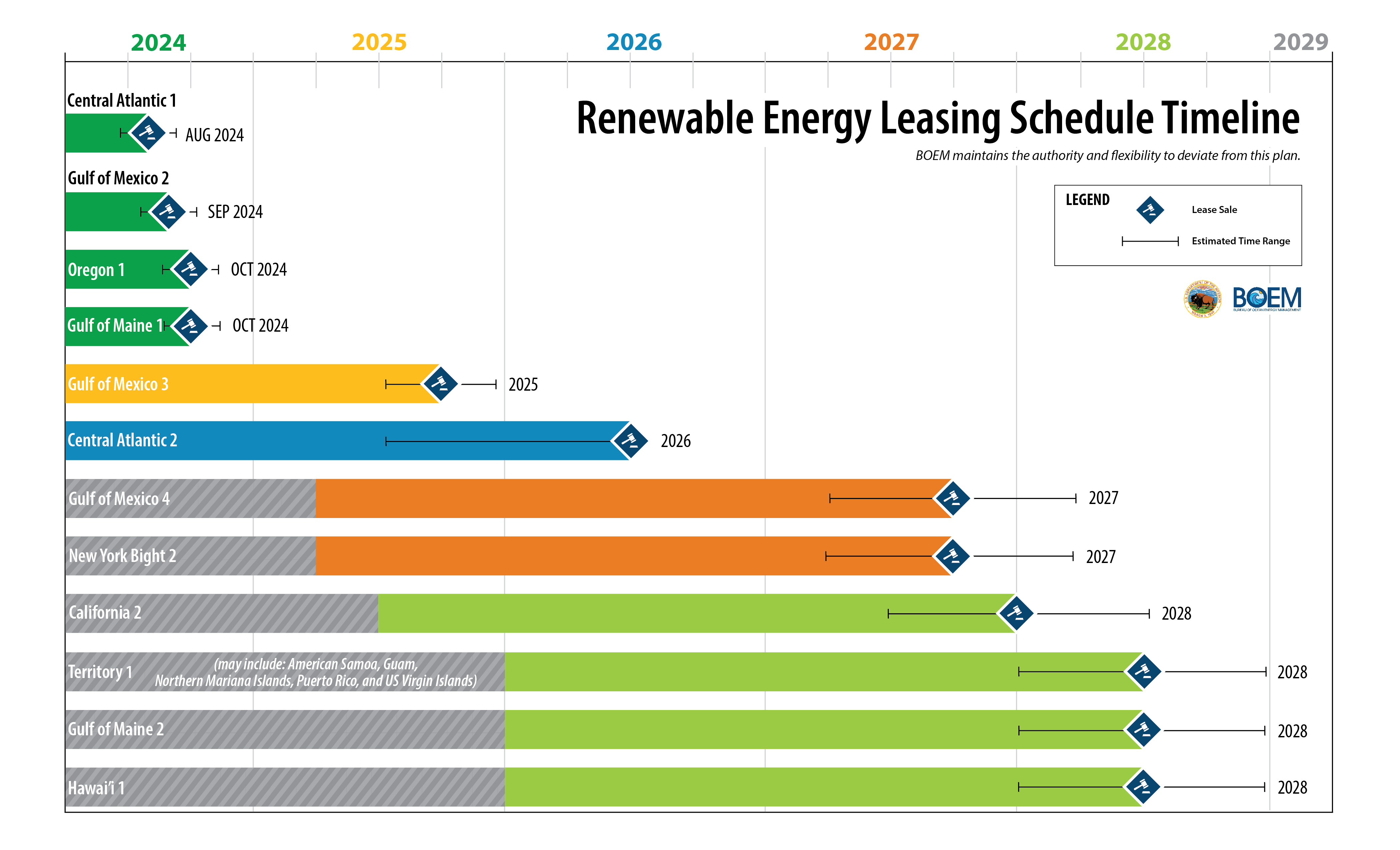
BOEM’s front-loaded 5 year wind leasing plan (graphic below) may have been influenced by (1) the possibility that the upcoming elections could affect offshore wind policy, and (2) the legislative prohibition on issuing wind leases after 12/20/2024 unless an oil and gas lease sale is held prior to that date.
Given that the next oil and gas lease sale will be in 2025 or later, BOEM was perhaps motivated to hold wind sales prior to the 12/20/2024 deadline (with a bit of a buffer to issue the lease documents). Indeed, the wind leasing plan proposed 4 sales between August and October of 2024 and only a single 2025 sale. That 2025 wind sale is in the Gulf of Mexico, where industry interest in wind leases is, at best, tepid.
Posted in climate, energy, Wind Energy, tagged Anemoi, JL Daeschler, no wind, Wind Energy on September 21, 2024| Leave a Comment »
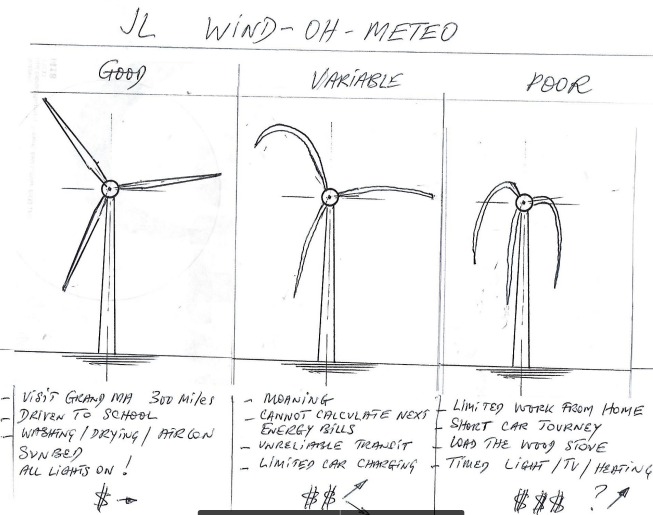
JL Daeschler reports that there has been no wind for the past 4 days at his home in Scotland, and his wind gauge is droopy. (See his sketch below and read the fine print 😉)
Posted in energy policy, natural gas, Offshore Wind, Wind Energy, tagged Denmark, dispatchable power, electricity imports, gas turbines, intermittent energy, Offshore Wind on September 20, 2024| Leave a Comment »
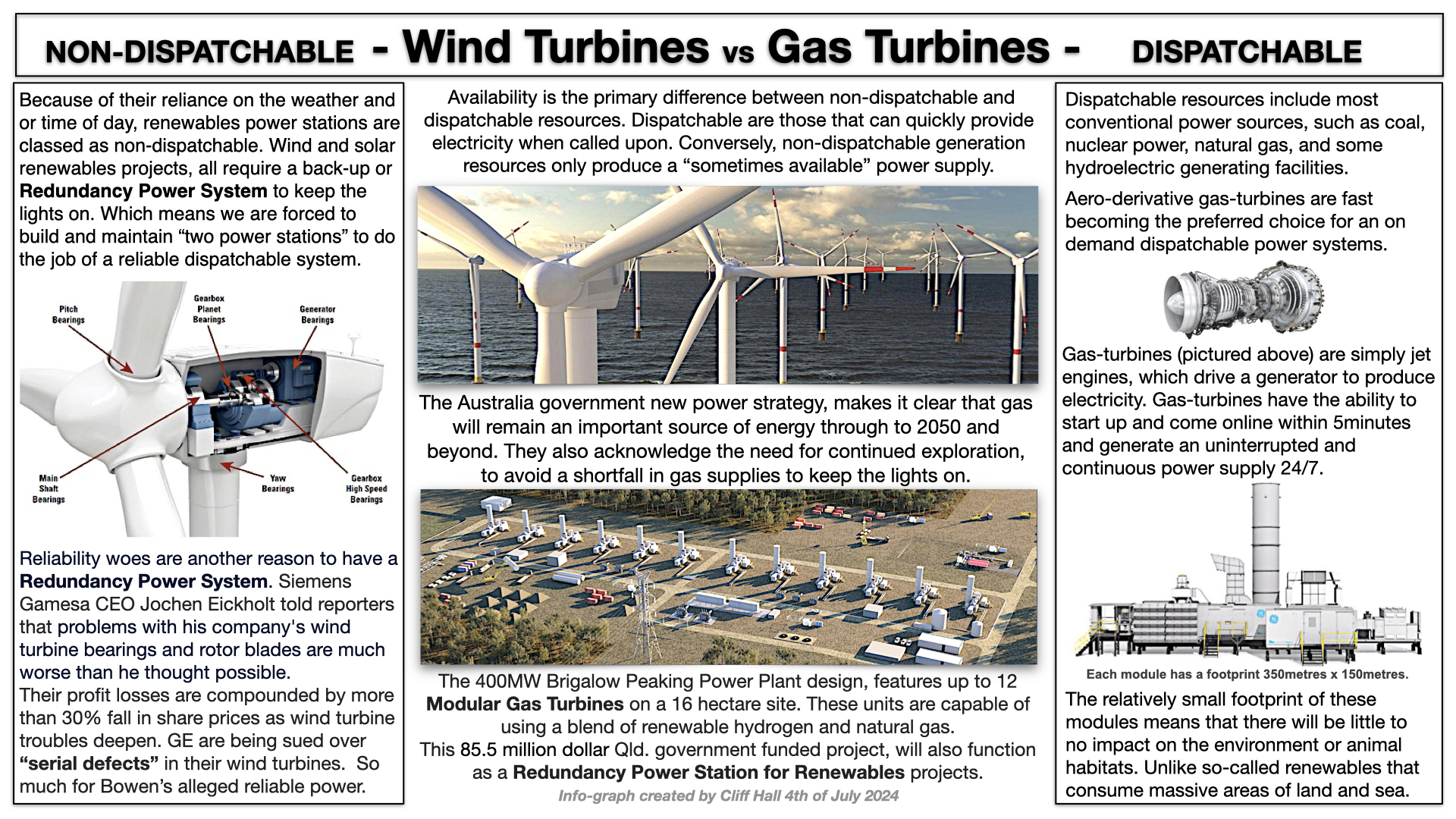
As previously noted, these power generation realities cannot be ignored:
This graphic by Australian Cliff Hall explains the importance of “dispatchable” power. Of course, imported electricity, on which wind-leader Denmark relies heavily, is an alternative to dispatchable power. However, that option is less than optimal from economic growth and energy security standpoints.
Posted in California, decommissioning, Offshore Energy - General, tagged bp, decommissioning, Exxon, natural seeps, Plains, Platform Holly, Refugio pipeline spill, Santa Barbara, State Lands Commission, UCSB, Venoco on September 19, 2024| Leave a Comment »
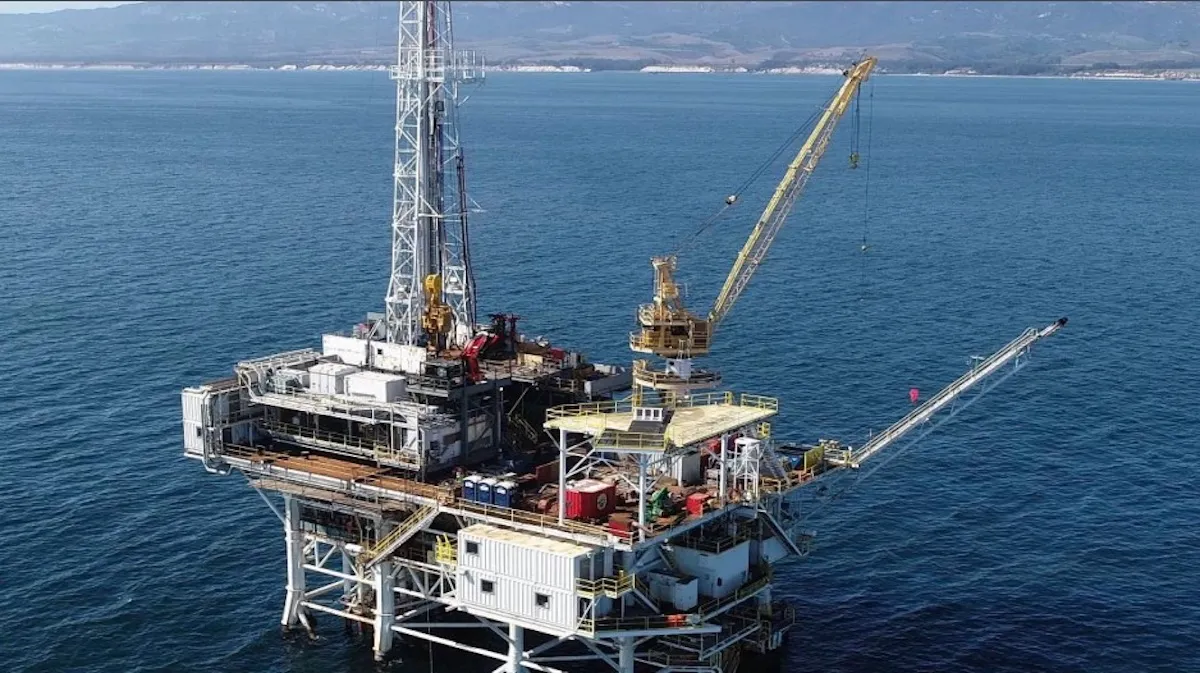
Platform Holly sits immediately offshore from the Univ. of California at Santa Barbara, and UCSB scientists have studied the platform and surrounding ecology extensively. Multiple studies have shown that production from Holly reduced natural seepage and methane pollution from shallow formations beneath the Channel. Platform Holly was thus a “net negative” hydrocarbon polluter.
The natural seepage in the Santa Barbara Channel was important to the earliest inhabitants of the area. The Chumash used the tar for binding and sealing purposes, including caulking their canoes. Since Holly shut down in 2015 following the Refugio pipeline spill, offshore workers and supply boat crews have reported a considerable increase in gas seepage.
Earlier this month, it was reported that well plugging operations at Holly had now been completed, but decisions regarding the final decommissioning of the platform remain.
Venoco declared bankruptcy in 2015 and the State of California became the platform owner. According to the State Lands Commission, Exxon will pay the costs for decommissioning the platform. This is because Exxon acquisition Mobil operated the platform from 1993-1997 before Venoco became owner.
The most recent Holly development is that Venoco has settled its law suit with Plains, the company responsible for the 2015 Refugio pipeline spill that halted production from Holly. Terms of the settlement have not been disclosed.
Note: As an aside, I’m curious as to whether Mobil provided a decommissioning guarantee as part of the sale to Venoco or whether the State is simply holding ExxonMobil accountable as a legacy owner. If it’s the latter, why isn’t bp (bp acquisition Arco was Holly’s operator from 1966-1993) also liable? Is it a matter of Mobil being the more recent predecessor owner?
 Bud's Offshore Energy (BOE)