Feeds:
Posts
Comments

Posts Tagged ‘safety’

This information is unconfirmed but the source is highly reputable:

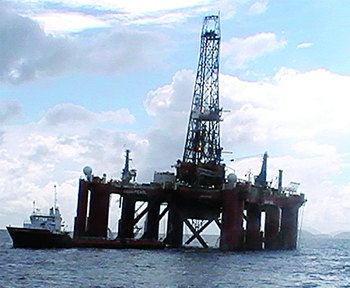
We just received word this morning that the Transocean Marianas rig  has developed a large crack in one of the pontoons on the #5/#6 anchor chain locker while they were picking up anchors, and is currently taking on water and listing.  The bilge pumps are keeping up (barely), but there’s certainly concern that it might sink on location. So far, 68 people have been evacuated from location.

According to RigZone, the Marianas was working offshore Nigeria. [Per one of our readers, (see comment below) Petrodata shows the rig operating offshore Ghana.]

More:  The Marianas, spudded the Macondo in October, 2009, but was damaged by Hurricane Ida and towed to shore.  The Deepwater Horizon was the rig that replaced the Marianas.

Read Full Post »

I don’t buy the argument that industry and regulators have paid too much attention to personal safety at the expense of process safety. Casualties from falls, falling objects, helicopter crashes, and other workplace activities have been persistent, and safety management programs must emphasize practices and procedures that will reduce occurrence rates.

Also, process safety has hardly been ignored. API RP 14 C has proven to be an effective safety analysis procedure for addressing undesirable events associated with each process component of a production facility.  For more complex facilities, Deepwater Operating Plans and API RP 14J, “Recommended Practice for Design and Hazard Analysis for Offshore Production Facilities, ” are good risk management supplements to RP 14C.

That said, we need better programs for sustaining the focus needed to further reduce the probability of low frequency, high consequence events.  When memories about the most recent disaster start to fade, what do we do to keep workers on edge and prevent complacency? What more can be done to prevent events with enormous consequence potential?  Some thoughts:

  1. Establish programs to remind employees about past disasters – how they happened and how they could have been prevented. How many offshore workers know the chain of events that led to the Santa Barbara blowout, Ocean Ranger sinking, Alexander Kielland capsizing, Piper Alpha fire and explosion, Ixtoc blowout, and other historic incidents? When discussing international incidents, we need to explain how our facilities or region might have been vulnerable under similar circumstances.
  2. Present information on minor incidents that could have escalated into disasters, emphasizing what could have gone wrong and why.
  3. Don’t just focus on the last disaster.  While addressing the operational and organizational issues that surfaced at Montara and Macondo, we also must assess incident data and identify activities and practices that could lead to the next disaster.
  4. Operators should not rely on the regulator to manage their operations. Reading about Montara and Macondo, one senses that the regulators were called on to referee internal company disputes and protect the operators and contractors from themselves.
  5. Regulators should not be making day-to-day operating decisions. Regulators should make sure that the regulations are clear and that operators have effective management procedures for adjusting programs as new information is obtained. Regimes that provide for regulator approval of each activity or adjustment promote operator complacency and are not in the best interest of safety over the long term.
  6. Service companies and contractors must challenge operators and regulators.  Operators should expect contractors to think and question, not to simply execute orders. There are impressive examples of contractors insisting on safety improvements, and being willing to forego business rather than compromise on safety.
  7. All sectors of the offshore industry should participate in standards development. Effective standards are dependent on diverse input.
  8. Industry and government leaders should promote innovation. Obvious weaknesses should be identified and industry should be challenged to propose solutions. For example, why do concerns about “false alarms” preclude automatic alarm activation (see Transocean’s Macondo report)? Data from redundant sensors can be analyzed by predictive software that is capable of quickly identifying real events. Similarly, why have advances in BOPE, including monitoring systems, been so slow? Why are BOP capabilities still poorly understood? Why are well integrity and casing pressure issues (producing wells) so common?

Read Full Post »

Links

Animation of Transocean’s BOP analysis

Transocean’s BOP Defense:

Forensic evidence from independent post-incident testing by Det Norske Veritas (DNV) and evaluation by the Transocean investigation team confirm that the Deepwater Horizon BOP was properly maintained and did operate as designed. However, it was overcome by conditions created by the extreme dynamic flow, the force of which pushed the drill pipe upward, washed or eroded the drill pipe and other rubber and metal elements, and forced the drill pipe to bow within the BOP. This prevented the BOP from completely shearing the drill pipe and sealing the well.

In other words, Transocean contends that properly maintained BOPE was not up to the task of shutting-in and securing a high-rate well. If true, this finding has significant implications for the offshore industry.  I’m looking forward to reading the government’s findings on the BOP failure when the Joint Investigation Team report is issued next month.


Read Full Post »

BP settled Macondo litigation with Weatherford, manufacturer of the float equipment equipment used in the Macondo well. The failure of this equipment was a key contributing factor in the Macondo blowout. Under the agreement, Weatherford will pay BP $75 million.  This money will be applied to the $20 billion Macondo trust fund.

Weatherford is the first of BP’s contractors to formally agree with BP that the entire industry can and should learn from the Deepwater Horizon incident. Accordingly, Weatherford has committed to working with BP to take actions to improve processes and procedures, managerial systems, and safety and best practices in offshore drilling operations. BP and Weatherford will encourage other companies in the drilling industry to join them in this improvement and reform effort.

Comments:

  1. $75 million seems like a rather modest payment by Weatherford given the magnitude of Macondo damage costs. BP will “indemnify Weatherford for compensatory claims resulting from the accident.”  Presumably, Weatherford’s sales agreements provide good legal protection.
  2. One of the root causes of the Montara blowout was also a float collar failure. That float collar was also supplied by Weatherford.  I’m surprised that this common cause and supplier have received almost no attention. Of course, no one has paid much attention to Montara, either before or after Macondo. Had more attention been paid to the Montara inquiry, Macondo might have been avoided.  (Note that most of the post-Macondo commentary still implies that deep water is the threat even though Montara was in 80 m of water and the root causes of Macondo were not water depth related).
  3. When do we learn more about the “improvement and reform effort” described in the quote above?

Read Full Post »

Because of recent involvement with products and systems that have Safety Integrity Level (SIL) ratings, I read the comment (below) in the PSA Deepwater Horizon review with interest. While administrative and effectiveness issues must be carefully assessed, the application of SIL should be part of the BOP performance dialogue.  SIL ratings may also be appropriate for entire well control or well integrity systems.

Today’s requirements stipulate a risk analysis for the control system of a drilling BOP, with specified minimum requirements for its safety integrity level (SIL). As a result of the DwH incident and of the fact that blowouts are not confined to drilling operations, the question is whether such an analysis, with a specified minimum SIL level, should also apply to all types of BOPs, including well-intervention models. In addition, consideration should be given in this context to whether other control and management systems related to well integrity/control exist which should be subject to such requirements.

Read Full Post »

In their comments on the Coast Guard’s Deepwater Horizon Joint Investigation Team Report, Transocean made these statements about BOP maintenance standards incorporated in MMS drilling regulations:

By glossing over the contours of the regulatory language, the Draft Report unilaterally converts API Recommended Practice 53 from an advisory guideline into a mandatory requirement. Notwithstanding the Draft Report’s insistence otherwise, the API’s recommendation that the BOP “should” be disassembled and inspected according to the manufacturer’s guidelines is not mandatory. The API clarifies that the word “should” indicates a recommended practice for which a comparably safe alternative is available or which may be impractical or unnecessary in some conditions. In contrast, to denote a recommended practice that is “advisable in all circumstances,” the API uses the word “shall.” The API also emphasizes that “the formulation and publication of API standards is not intended in any way to inhibit anyone from using any other practices.” Though it recommends specific practices, API acknowledges that “equivalent alternative installations and practices may be utilized to accomplish the same objectives.” On its face, the language of API RP 53 makes clear that the recommendation that the BOP “should” be disassembled and inspected in accordance with the manufacturer’s guidelines is a recommendation, and nothing more.

Although the MMS regulations governing BOP maintenance incorporate API RP 53 sections 17.10 and 18.10 by reference, this does not convert the API’s recommendations into a mandatory requirement. As the MMS has clarified, “[t]he legal effect of incorporation by reference” is merely that “the material is treated as if it were published in the Federal Register.”

Treating API RP 53 as if it had been published in the Federal Register does not imbue its language with more regulatory significance than it had before. The API’s recommendations regarding BOP maintenance—as well as the API’s acknowledgement that alternative practices “may be utilized to accomplish the same objectives”—remain recommendations, not requirements.  Transocean’s complete comments are posted on their website.

I’ll withhold my comments on the above statements, except to say that my opinion differs substantially from Transocean’s.

More significantly, these and other recent industry and government comments demonstrate the complexity of standards policy issues. How are standards most effectively applied by operators in formulating safety management programs, operating plans, and safety cases? Contractors? How should deviations from standards be assessed and documented? How should regulators use standards? To what extent should standards be incorporated into regulations? What is the appropriate role for regulators in standards development? These issues may prove to be more challenging than updating technical requirements. Stay tuned!

Read Full Post »

A month ago, BOE posted a list of major accidents for which no official company or government reports had been released.  Below is the latest update on these accidents. If you have updated information, or if there are other events that should be added to the list, please let us know.

The following recent accidents are on our “watch list.”  Accidents are added to the “missing report list” when six months have elapsed since the accident.

Read Full Post »

From the standpoint of post-Macondo safety and regulatory issues, this concise summary is the most comprehensive and useful report that I have read since the blowout.

I have pasted (below) comments about information management – one of the many important topics considered in the report – and hope you take time to read the entire summary. It is only 12 pages.

Conducting a critical review of the information used to manage major accident risk is one of the measures relevant for the companies. This work could include an assessment of
 the relevance, reliability and modernity of the indicators used to follow up risk trends
 inappropriate use of indicators, incentives and reward systems
 the need for better indicators and other information about the business which can be used to secure an early warning about a weakening in safety-critical barrier elements.
The PSA is of the opinion that the quality of information applied in managing major accident risk is also a question of what overview the players have of their own business, and thereby a question of the players’ own control. The PSA assumes that managing major accident risk cannot be outsourced. In light of the DwH accident, it could be relevant for the companies to review the processes intended to provide the necessary information about the business, assess in part how these processes support a culture of accountability and how various management and audit functions, third-party verifications and so forth contribute in this connection.


Read Full Post »

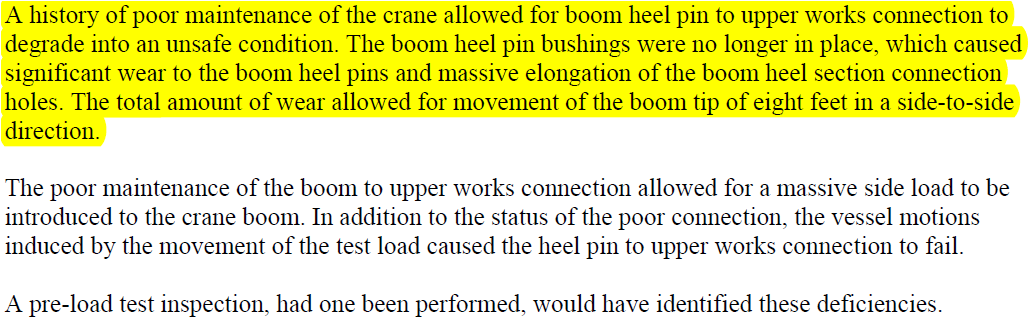
Thanks to a reader, we have obtained a copy of a report on the Jack Ryan crane failure (August 2010) that killed one worker and injured three offshore Nigeria. As BOE readers know, we have been pursuing information on this accident for months.

At BOE our highest priority is drawing attention to and disseminating information on offshore accidents.  In that regard, we greatly appreciate the support we have received from readers.

Excerpt:

Link to Jack Ryan report.

We understand that Total is conducting an inquiry, and assume that Transocean has also investigated this accident. We hope those reports are made publicly available.

Read Full Post »

Aban Pearl listing off Trinidad in August 2009

While our interest in the sinking of the Aban Pearl pertains to what went wrong and why, former PDVSA board member Gustavo Colonel continues to question Aban Pearl contracting irregularities. Is PDVSA refusing to release the report on the Aban Pearl sinking so as not to draw further attention to these contracting issues?

The whole Board is responsible for the loss of about 800,000 barrels per day of oil production; for the fraudulent certification of “proven oil reserves” in the Orinoco heavy oil region; for the irregular contracting, with a ghost company, of the offshore drilling barge Aban Pearl for twice the amount really paid to the owners of the barge; for the importing of 180,000 tons of food that later went to rot in Venezuelan ports but provided some of the members of the board with millions of dollars in criminal profits; and in numerous other corrupt practices that are well documented.

Read Full Post »

« Newer Posts - Older Posts »