U.S. District Judge Martin Feldman in New Orleans today ordered offshore energy regulators to act within 30 days on six pending permit applications filed by companies that have contracts with Ensco Offshore Co., the Louisiana drilling company leading the legal challenge to the government’s offshore drilling bans. Bloomberg
Posts Tagged ‘Regulation’
Judge orders action on six drilling applications
Posted in drilling, offshore, Regulation, tagged Ensco, Judge Feldman, offshore drilling, permits, Regulation on May 10, 2011| Leave a Comment »
PSA adds substantial value at a relatively low cost
Posted in Norway, Regulation, tagged North Sea, Norway, offshore, Regulation, safety on May 6, 2011| Leave a Comment »

Surprisingly, the post-Macondo discussion about regulatory approaches has been largely devoid of value and cost-benefit assessments. While PSA has been praised for Norway’s outstanding offshore safety record, little attention has been paid to their relatively low regulatory costs.
According to data in the 2010 Annual Report, PSA has 161 employees, and had total operating expenses of NOK 202,762,689 ($US 38.1 million) for 2010. These modest cost and staffing numbers are particularly impressive when the magnitude and complexity of Norwegian offshore operations are considered. In March 2011, Norwegian oil production averaged 2.017 million barrels per day (no. 2 offshore oil producer slightly behind Brazil) and gas production averaged 11.6 billion cubic feet per day (world offshore leader). PSA is also responsible for onshore processing facilities.
PSA’s costs are relatively modest for the same reason that their regulatory program is successful. They hold companies responsible for managing their operations and conducting inspections. They don’t approve every detail of every operation, but focus on ensuring that the company management systems are effectively implemented. They identify risks and insist that industry address them. As Magne Ognedal said in his interview with BOE:
Our regulatory philosophy is indeed firmly based on the legislated expectation that those who conduct petroleum activities are responsible for complying with the requirements of our acts and regulations. Furthermore, our regulations require that they employ a management system that systematically probes and ensures such compliance at any time. The approach to achieving this should be risk-based. So, ensuring compliance with rules and regulations is the operator’s job – not ours.
Three offshore oil and gas bills clear House Natural Resources Committee
Posted in Uncategorized, tagged drilling, House Natural Resources Committee, leasing, macondo, offshore drilling, offshore oil, permitting, Regulation, safety on April 18, 2011| Leave a Comment »

- Require that a Central Gulf of Mexico (GoM) oil and gas lease sale be held within 4 months of enactment, and that a second sale for that area be held within 12 months.
- Require that a Western GoM sale be held within 8 months of enactment.
- Stipulate that prior environmental reviews would satisfy NEPA requirements for the GoM sales.
- Require that a Virginia offshore sale be conducted within 1 year of enactment. [Comment: While I support a sale offshore Virginia, I do not believe this can be accomplished in one year.]
- Require that specified volumes of oil and gas (per estimates made by MMS in 2006) be made available for leasing.
- Set offshore production goals.
- Give credits (for use in paying lease bonuses) to companies for costs associated with pre-sale seismic surveys. [Comment: If the legislation provides reasonable assurance that lease sales will be held, why are the seismic survey credits needed? The seismic data will have a high commercial value. Collection of these data should not have to be subsidized by the Federal government.]
- Require that DOI act on drilling applications within 60 days.
- Extend the term leases where the approval of drilling applications was delayed following the Macondo blowout.
- Make the 5th Circuit Court the venue for any civil actions involving GoM energy projects.
- [Comment: The important question is not the number of days that the regulator should be given to review applications, but whether a complex permit review and approval process is the optimal regulatory approach. A lesson learned from virtually every major accident, from Santa Barbara through the Ocean Ranger, Alexander Kielland, Piper Alpha, and Macondo, is that command and control regulation is not in the best interest of offshore safety. Industry should not rely on government to manage its operations and government should focus on safety achievement, not directing the day-to-day activities of offshore companies. Over the long-term, the US would be better served if regulatory resources were dedicated to risk assessment, data analysis, assessment of operator and contractor management systems, targeted inspections and audits, participation in standards development and research, and safety leadership.]
GAO Report on Government Waste
Posted in Regulation, tagged GAO, government waste, Regulation, safety on March 1, 2011| Leave a Comment »
GAO’s report entitled “Opportunities to Reduce Potential Duplication in Government Programs, Save Tax Dollars, and Enhance Revenue” has just been released. The report identifies $billions in potential savings that could be realized by reducing program duplication.
Comments:
- Not only could taxpayer dollars be saved by reducing overlap and duplication, but greater efficiencies and safety benefits would be achieved. As BOE has frequently noted, a single agency should be responsible and accountable for safety and pollution prevention at offshore facilities. For regulators, “overlap means underlap.” Important issues are sure to be overlooked, misunderstood, or confused. Jurisdictional redundancy inevitably results in unnecessary complexity, and regulatory and industry personnel are required to spend too much time resolving and coordinating administrative and procedural matters. This time would be better spent focusing on mission critical safety issues.
- Much of the duplication among agencies is the result of the overlapping responsibilities of congressional committees, complex and poorly crafted legislation, and insufficient emphasis on function-based management.
- Program savings achieved by one government unit are immediately absorbed by another, discouraging cost-effective management practices. Senior and mid-level Federal managers should be able to transfer savings directly to a debt reduction fund that cannot be used for any other purpose. Federal managers should receive positive recognition for savings and efficiency, not criticism or immediate budget reductions.
New York Times on NEPA
Posted in accidents, Regulation, tagged accidents, blowouts, Deepwater Horizon, drilling, Gulf of Mexico, macondo, NEPA, offshore oil, oil spill, Regulation, well control on February 4, 2011| Leave a Comment »
The future pace of drilling approvals in the Gulf of Mexico might be slowed less by new laws or regulations stemming from last year’s massive spill but by a decades-old law that opens the door to longer environmental reviews and litigation. New York Times
We know the NEPA process is slow and repetitive, but how much value is added? NEPA reviews don’t improve well integrity, BOP performance, or safety management programs; nor do they even address these fundamental safety and pollution prevention considerations, at least not in a substantive way. Why not publish a single, comprehensive online environmental review for drilling and production operations in the region? The review would cover all possible impacts for every type of operation. This detailed “living document” would be continuously updated as new environmental information is acquired, technology advances, and regulations and standards are updated. The public could comment on specific operations as they are proposed, and could otherwise comment on the document at any time. Periodic public meetings could be held as necessary and desirable.
Was MMS Visionary?
Posted in Regulation, tagged Cullen Report, MMS, offshore oil, Piper Alpha, Regulation, safety on January 31, 2011| Leave a Comment »
Some post-Macondo commentary has characterized MMS employees as regulatory Neanderthals who couldn’t see beyond their checklists, had no understanding of operating systems and the associated process-safety risks, and were dreadfully behind their industry and regulatory peers. The reality is quite different, as those who worked with or for the MMS know. Someone who did both, Doug Morris, an engineer and attorney with extensive industry and regulatory experience, shared this excerpt from an April 1988 Federal Register notice. The Notice publishes the outcome of a 5-year regulatory review that updated and consolidated all MMS operating requirements for offshore oil and gas operations. One of objectives was to establish performance standards for all types of operations to encourage innovation and discourage a “compliance mentality.” Keep in mind that this Notice was published before Piper Alpha, the Cullen report, and the worldwide wave of regulatory reform that followed.
The following summarizes the major changes from current rules:
(1) Performance Standards. Performance standards were added which describe the safety, environmental, property, and resource protection goals intended to be achieved by specified design and engineering requirements. These additions are intended to identify the purpose of the detailed requirements and thus provide a basis for approving an alternative method for achievement of the stated purpose. New, different, better, and more efficient techniques and practices are intended to be available to lessees on the basis of these performance standards.
(a) Performance Requirements. A “Performance requirements” section was added. This section clarifies that the specific detailed requirements of the rule do not preclude the approval for use of alternate or new techniques, procedures, equipment, or activities when the lessee satisfies MMS that the proposed alternate approach provides equal or greater protection than that provided by the requirements specified in the rule. The establishment of performance standards in addition to specific detailed requirements is intended to remove obstacles to innovation and ensure that MMS’s regulations are not unnecessarily prescriptive.
Increased Post-Macondo Regulatory Role for IMO?
Posted in accidents, Regulation, tagged Deepwater Horizon, Gulf of Mexico, IMO, macondo, offshore oil, Regulation on November 17, 2010| Leave a Comment »
In conveying our deep condolences and solidarity to the United States Government and while sharing in the anguish of those whose livelihoods had been seriously affected, I asked that the report ofthe investigation into the accident be submitted to IMO as soon as possible after it has been concluded, so that we may move swiftly to introduce, into the regulatory regime of the Organization, whatever lessons may be learned from the incident in order to enhance safetyand environmental protection in the offshore industry and strengthen, should that prove necessary, the provisions of any relevant IMO instrument. Remarks by Secretary-General Efthimios Mitropoulos

The Secretary-General seems to be committed to an expanded role for IMO in regulating offshore oil and gas facilities. Questions:
- Is an organization with a shipping history and culture the right body to be regulating drilling and production operations? While IMO has experience with mobile drilling units, primarily the vessel aspects, the organization has had little or no involvement with well construction and integrity, production operations or pipelines.
- What would an expanded IMO role mean for existing offshore regulators and their cooperative efforts (primarily through the International Regulators’ Forum) to coordinate activities and improve safety performance? Generally speaking, the principal safety regulators for offshore facilities have had a very limited role in IMO activities.
Back to the Future!
Posted in Regulation, tagged BLM, MMS, offshore oil, Regulation, safety, USGS on November 1, 2010| Leave a Comment »
Hyannis Halloween - 1981
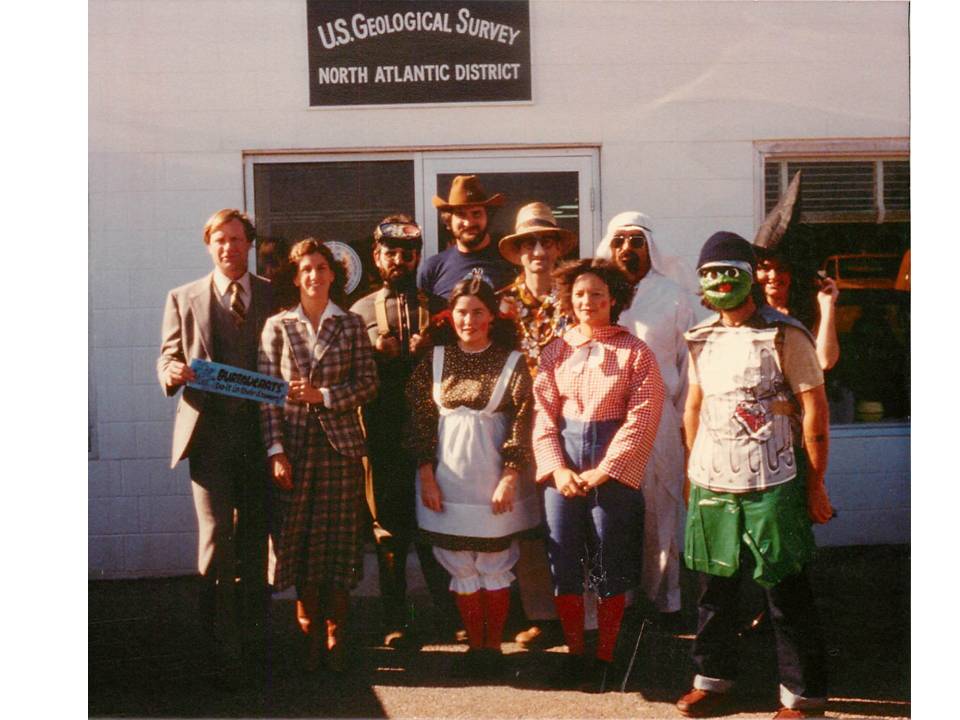
Note the sign (above) on our office at Barnstable Municipal Airport in Hyannis. Prior to 1982 when the Minerals Management Service was formed, the OCS regulatory program was part of the US Geological Survey (Conservation Division) and the leasing program was in the Bureau of Land Management. After a 28-year marriage, these functions are again being separated.
As one who worked in the OCS program for 10 years prior to the formation of MMS, I think the the pre-1982 framework is conceptually preferable. However, unless the separation is carefully executed, disruptive conflicts between the two organizations are guaranteed. Such conflicts were common in the pre-MMS days, and the Department of the Interior had to set up a special office to coordinate activities and manage disputes.
In addition to being independent, the new regulatory authority must be fully responsible (without interference) for all regulatory actions from plan approval through abandonment. Without such independence and authority, the separation will only add to the regulatory confusion that has handicapped the OCS program throughout its history.
Technical and scientific personnel in the OCS regulatory program must be freed from non-productive and time-consuming internal disputes and coordination responsibilities so they can concentrate on performance measurement, risk assessment, safety leadership, standards, and technical studies.
Offshore Wind Turbine Safety
Posted in Offshore Wind, Wind Energy, tagged NAS, Offshore Wind, Regulation, safety, Wind Energy on June 25, 2010| Leave a Comment »
 Kudos to the National Academies and the very distinguished panel of experts who will be advising the government on the best approach for regulating offshore wind turbines.
I look forward to speaking to them next week.
Will Other Nations Learn the Lessons from Montara?
Posted in accidents, Offshore Energy - General, Regulation, well control incidents, tagged Australia, blowouts, Magne Ognedal, Montara, offshore oil, Regulation, safety on April 20, 2010| Leave a Comment »
My experience is that you unfortunately often need a major accident or even a disaster to engender political support for streamlining regulatory regimes. Moreover, history shows that major accidents apparently must happen in your own jurisdiction to have such an effect on political support. Magne Ognedal
Magne’s astute comment repeatedly came to mind while I was reading the Montara testimony. Our political systems are good at reacting, but are not so good at making tough decisions when the spotlight is elsewhere. Crises provide the political capital needed to make major changes, but seldom yield the best solutions.
Will the Montara blowout provide the impetus needed for other countries to review and improve their offshore regulatory regimes? These Montara issues should be of concern to all of us:
- Multiple regulators with unclear divisions of responsibility
- Regulatory gaps and overlap
- Ineffective use of standards and best practices
- Lack of clarity regarding operator and contractor responsibility and accountability
- Balancing goal-setting with prescription
- Monitoring operations effectively without taking “ownership”
- Applying regulatory resources efficiently and where the risk is greatest
- Absence of meaningful performance measures for operators and regulators
- Authority to remove rogue operators
- Ability to update standards and regulations in a timely manner
- Weaknesses in training programs for operators, contractors, and regulators
I’ll stop at ten (now eleven :)).
Many of these issues will be discussed at the International Regulators’ Offshore Safety Conference in Vancouver (18-20 October). I hope you plan to attend!
 Bud's Offshore Energy (BOE)