The Gulf of Mexico and Norwegian branches of the offshore family have a long record of technological innovation and production leadership.
As a followup to our last GoM-Norway update, the respective oil production rates are presented below. The Gulf of Mexico now has a small edge as a result of new production from deepwater facilities.
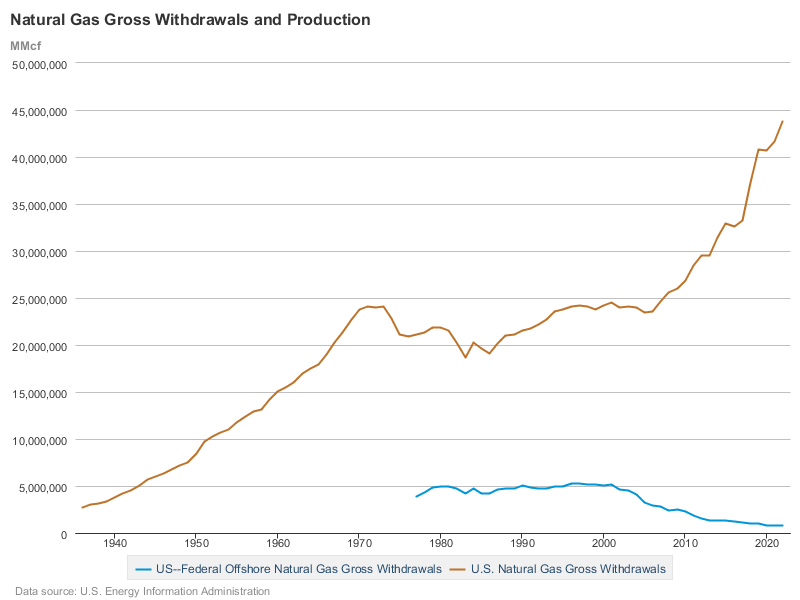
Natural gas is a different story, and Norway’s offshore gas production is much higher. US gas production (second chart below) has been dominated by the onshore sector since advances in horizontal drilling and well stimulation procedures triggered the shale gas revolution twenty years ago.
If you get a chance to visit Stavanger, the Norwegian Oil Museum is highly recommended. See the short video below.
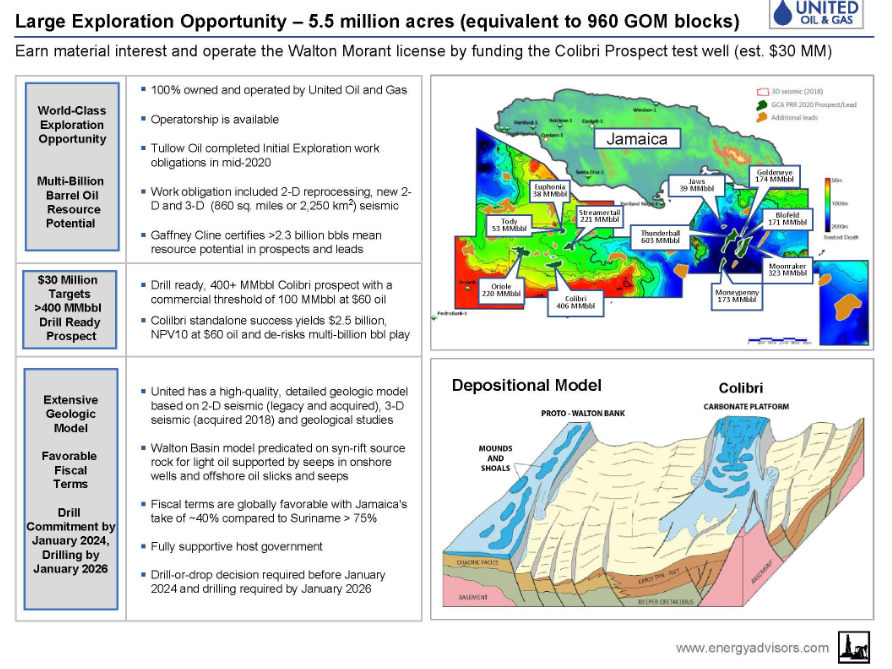
Gaffney, Cline & Associates have audited the drill-ready target prospect with mean resources of 400 MMbbls
Standalone success on hitting the mean target is expected to achieve NPV10 of $2.5 billion at $60 oil
The test well cost is estimated to be $30 million and provides exposure to own a material interest in the entire license
The initial target is a carbonate platform and shows strong evidence of reservoir trap and intact seal, Cretaceous kitchen source and live oil seeps
Recent advanced seismic relative dispersion technical work provides further evidence of reservoir porosity and permeability, the presence of a seal, and additional reservoir potential
The License, formerly owned by Tullow, is well-supported by the Jamaican government with attractive fiscal terms
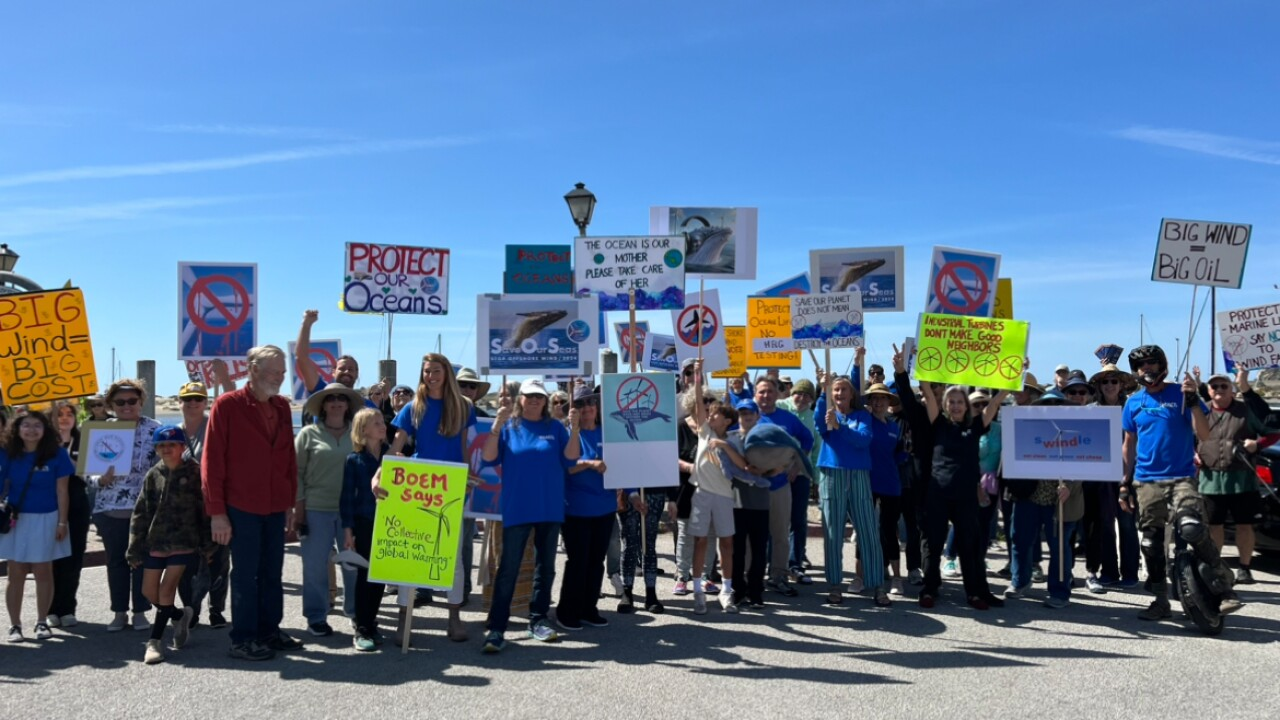
While it’s highly unlikely that wind turbine siting activities are responsible for the alarming number of whale deaths, some of the vociferous wind industry defenders would have been among the first to point the finger at oil and gas operations if there were any in the US Atlantic.
Some quotes from a recent USA Today article followed by BOE comments:
“It’s just a cynical disinformation campaign,” said Greenpeace’s oceans director John Hocevar. “It doesn’t seem to worry them that it’s not based in any kind of evidence.” (Comment: World class chutzpah on the part of Greenpeace, the master of disinformation.)
Gib Brogan, a campaign director with Oceana, an international ocean advocacy group, said those opposed to wind power are using a spate of whale deaths in the area as an opportunity. (Comment: Does Oceana suddenly find this type of opportunism to be shocking?)
“Groups opposed to clean energy projects spread baseless misinformation that has been debunked by scientists and experts,” said JC Sandberg, chief advocacy officer with the American Clean Power Association, a renewable energy trade group. (Comments: Use of the term “clean energy” is clever advocacy that serves to discredit other forms of energy. All energy sources have pros and cons, environmentally and otherwise. Wind and solar have significant visual, space preemption, navigation, wildlife risk, and intermittency issues, and are heavily dependent on subsidies and mandates. When all issues are considered, one could argue, as we have, that offshore gas, particularlynonassociated gas, is perhaps the environmentally preferred energy alternative.)
Liz is an experienced attorney and leader in clean energy, climate change, and environmental law and policy. A member of the Biden-Harris administration since January 20, 2021, Liz has served as Senior Counselor to Secretary Haaland with an emphasis on water policy and climate change resilience. In this role, Liz also served as Chair of the Indian Water Rights Working Group, which manages, negotiates and implements settlements of water rights claims.
Prior to joining the Administration, Liz was Deputy Director of the non-partisan State Energy & Environmental Impact Center at NYU School of Law, which supports state Attorneys General addressing clean energy, climate, and environmental initiatives of regional and national importance. President Biden is the third President under which Liz has served at Interior, having worked for both the Clinton and Obama administrations. Under Secretaries Ken Salazar and Sally Jewell, Liz served as Interior’s Associate Deputy Secretary as well as Principal Deputy Assistant Secretary in the Office of Policy, Management and Budget. She was a key architect of the Obama Administration’s work to create a new offshore wind industry and leasing program.
Congratulations to Ms. Klein on being appointed to lead the Bureau of Ocean Energy Management. In addition to her commendable support for offshore wind energy, I trust that she appreciates the national importance of the OCS oil and gas program and the need for regular lease sales.
“Mom” (US govt) strongly and openly favors one child (offshore wind) over the other (offshore oil and gas). As a result, beneficial family synergy is not realized, and neither “child” reaches her full potential.
The wind program was intended to complement the oil and gas program, not replace it.
These articles highlight some of the challenges facing offshore wind:
WSJ: Soaring Costs Threaten U.S. Offshore-Wind Buildout
Bloomberg: US Ignored Own Scientists’ Warning in Backing Atlantic Wind Farm
NJ.com: Offshore wind is on N.J.’s horizon but activists worry of impact to whales, economy, the view
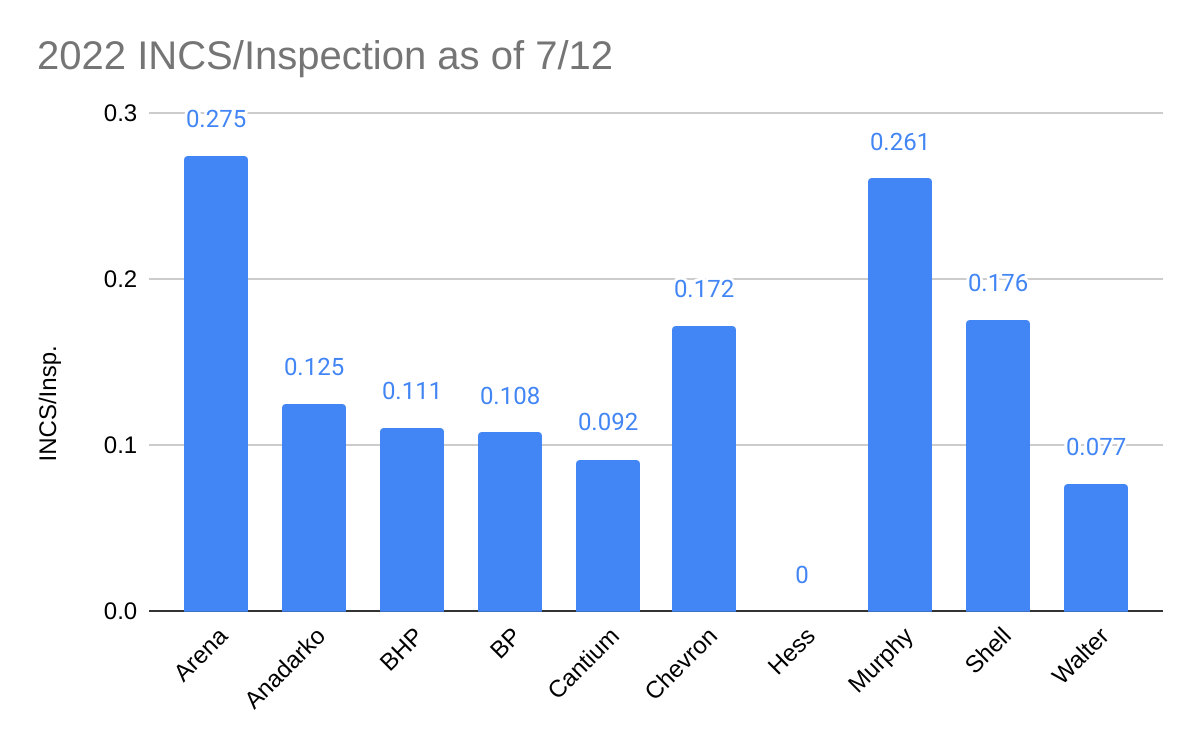
Operating companies (listed alphabetically): Arena, Anadarko (Oxy), BHP, bp, Cantium, Chevron, Hess, Murphy, Shell, and Walter
Criteria:
Must average <0.3 incidents of compliance (INCs) per inspection. (This is less than half the GoM 2022 YTD average of 0.64 INCs/inspection.)
Must operate at least 3 production platforms.
Must have drilled at least one well.
Pacific and Alaska operations will be considered in a separate post.
Comments:
Impressive performance by Hess: 21 inspections and no INCs
Cantium and Walter averaged less than 0.1 INCs/inspection. The INC rates for Anadarko (Oxy), BHP, and BP were only slightly higher.
Among the Honor Roll companies, Shell (highest production, 9 deepwater platforms, and 13 well starts) and Arena (115 shelf platforms and 12 well starts) were the deepwater and shelf activity leaders.They thus had the highest INC exposure.
Although CSI and FSI INCs are typically more significant than W INCs, that is not always the case, so the INCs have not been weighted by type.
As has been previously noted, more inspection data should be readily available online. At a minimum, the specific INC (type) numbers (e.g. P-103, G-110, etc) should be posted so the public can better assess performance. Absent this information, interested parties are left to speculate about the significance of the violations.
While compliance is not synonymous with safety, most experienced observers believe there is a strong correlation. In the 1990’s, John Shultz, a PhD candidate at Carnegie Mellon Univ., studied US offshore facilities and safety data and developed expert and regression models to predict the likelihood of accidents and spills. That was a data rich era in that there were ~4000 US offshore platforms (more than twice the current number) and ~100 well starts/month (>10 times the current rate). In John’s thesis, he found that INCs are a very good predictor of accidents and spills. The offshore world has changed and further study of the correlation between compliance and safety performance is highly recommended.
WASHINGTON (May 19, 2022) — During testimony before the U.S Senate Committee on Energy and Natural Resources today, Secretary of the Interior Deb Haaland confirmed that, despite delays in implementation from the previous Administration, the Interior Department will release the Proposed Program – the next step in the five-year offshore energy planning process – by June 30, 2022, which is the expiration of the current program. A Proposed Program is not a decision to issue specific leases or to authorize any drilling or development.
9/30/2021 – BOEM announces Lease Sale 257 as necessary to comply with the order of the Louisiana Federal Court. DOI will “continue its comprehensive review of the deficiencies associated with its offshore and onshore oil and gas leasing programs.”
11/15/2021 – Press Secretary Psaki: “We believe the (Louisiana court) decision is wrong, and the Justice Department is appealing it. So it’s in the courts; it’s in a legal process. We’re required to comply with the injunction. It’s a legal case and legal process, but it’s important for advocates and other people out there who are following this to understand that it’s not aligned with our view, the President’s policies, or the executive order that he signed.”WTI = $80.85/bbl
11/17/2021: Sale 257 bids opened and announced despite pending litigation. In a surprising twist, Exxon was the sole bidder on 94 carbon sequestration tracts offshore Texas. Neither the Notice of Sale nor the environmental review announced or assessed carbon sequestration operations in Federal offshore waters. BOEM/DOI have not commented publicly on the CCS bidding.
1/27/2022: Judge Contreras, DC Federal Court, vacates Sale 257. The Judge agreed with the plaintiffs’ assertion that BOEM failed to consider the effect that reduced production (and thus higher prices) would have on foreign consumption and the associated GHG emissions. The judge not only decided in favor of the plaintiffs, but ruled that BOEM’s omission was so serious that the lease sale had to be vacated. The judge reached this decision even though (1) the five year leasing plan expires in June leaving the timing of any future sale very much in doubt and (2) all of the sale 257 bids, which are based on proprietary assessments, are now public information, thus compromising the integrity of the leasing process at the next sale (if and when that occurs). WTI= $87.61/bbl
2/8/2022: API and the State of Louisiana appeal the Sale 257 decision.
2/24/2022: Russia invades Ukraine
2/28/2022: The Administration announces that it will not appeal the Sale 257 decision. WTI = $96.13
3/8/2022: WTI peaks at $123.70/bbl
3/30/2022: EIAP Report for API and NOIA estimates economic impacts from leasing program delays noting: In most cases, additional leases are required to produce an existing field fully or to underpin the economics of processing and transportation infrastructure. It is thus important for the industry to have continued opportunities to secure leases through a predictable leasing program. (US lease blocks are too small for optimal development in deepwater and frontier areas, increasing the importance of regular lease sales.)