Feeds:
Posts
Comments

Posts Tagged ‘incident data’

The Center for Offshore Safety (COS) was established in response to a recommendation by the National Commission on the BP Deepwater Horizon Oil Spill and Offshore Drilling for improved self-regulation by the offshore industry. The Commission supported the creation of a non-profit, industry-funded organization similar to the Institute of Nuclear Power Operations, to promote the highest levels of safety and operational excellence. 

The COS has been effective in strengthening corporate Safety and Environmental Management Systems, influencing the industry’s safety culture, and sharing best practices and lessons learned. These are important accomplishments.

The COS has fallen short in gathering the data needed to assess the offshore industry’s safety performance. As is the case with most voluntary reporting programs, data completeness and accuracy issues limit the significance of COS performance reviews.

Observations regarding the most recent COS Offshore Safety Performance Report follow:

  • The COS uses accepted performance indicators and a logical classification scheme.
  • COS reports that their members accounted for 78% of OCS oil and gas activity in 2024. This is accurate when cross-checked with BSEE hours worked data. However, the % of hours worked is not a good measure of the % of incidents reported in any category.
  • Companies not participating included important operators like LLOG, Cantium, Walter, and W&T, a host of smaller Gulf independents, the 2024 violations leader (by a wide margin) Cox, and troubled Fieldwood. (See Fieldwood’s 2021 and 2022 performance.)
  • Only two drilling contractors – Helmerich & Payne and Valaris – are members. Major contractors like Noble, Transocean, and Seadrill are not members. Their incidents will thus not be reported if they are not working for a COS member.
  • No production contractors are COS members. These companies conduct most of the platform operations on the shelf, where many of the lease operators are not COS members.
  • Pacific and Alaska Region operators do not participate.
  • Looking only at fatalities (table below), the most important and easily verified incident category, there are troubling omissions:
    • COS reports no 2024 fatalities when in fact there was a fatality during an operation for a COS member.
    • COS reports no 2022 fatalities when there were actually five. A workover incident took the life of one worker, and four died in a helideck crash on an OCS platform. In both cases, the facility operator was a non-member company.
    • COS records one 2021 fatality, but fails to include a 2021 Fieldwood fatality. There were also 6 “non-occupational” fatalities on OCS facilities in 2021, as classified by BSEE. Given the importance of worker health (the H in HSE), such a high number of non-occupational fatalities should be of interest industry-wide.
    • The COS report includes only two of the six 2020 fatalities, 2 of which were classified by BSEE as non-occupational.
    • The bottom line is that COS accounted for only 3 of 12 (25%) occupational fatalities during the 2020-24 period. There were at least 20 fatalities if you include the non-occupational incidents.
fatalities per COSoccupational
fatalities (from BSEE data)
non-occupational
fatalities (from BSEE data)
202401?
202300?
202205?
2021126
2020242

The offshore industry is only as good as its worst performer, so complete participation is essential. Voluntary reporting is seldom complete reporting, because some companies are more concerned about confidentiality than completeness and information sharing.

For industry reporting programs to be comprehensive and credible:

  • The entity receiving the reports and managing the data must be independent and not affiliated with an industry advocacy organization.
  • All operating companies must participate and complete reporting must be required. This can be accomplished contractually. If necessary, the regulator can require participation (either as a separate regulation or as a SEMS element).
  • Company incident submittals should be audited by the independent entity.
  • Fees should be solely for the purpose of supporting the independent reporting system.
  • For SP1 and SP2 incidents (per the COS classification scheme), the names of the responsible companies should be included in the performance reports. The current COS system prioritizes confidentiality over accountabiity and information sharing.

Read Full Post »

As we enter the third month of 2024, BSEE has finally updated the incident tables to include 2022 data.

The OCS program managers I was privileged to work for would never have accepted such delays in posting fundamental safety data. Carolita Kallaur (RIP) wouldn’t tolerate a delay of 14 days in publishing quarterly incident statistics, let alone a delay of 14 months for annual data with no quarterly updates. Transparency and timeliness in informing the public about offshore safety performance was her highest priority. Cynthia Quarterman, Tom Readinger, and other OCS program leaders were similarly insistent on timeliness and transparency in the reporting of incident data.

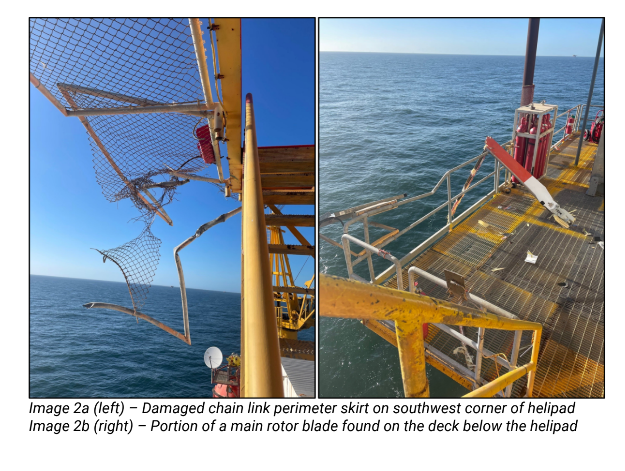
The belated 2022 BSEE tables also include a glaring error. The most important figure, the number of fatalities, is incorrect. Five workers died from US OCS incidents in 2022, not one. The fatal helicopter crash at the West Delta 106 A helideck on 12/29/2022 that killed four workers (photos below) is inexplicably not included. 

Is the failure to include this fatal incident a regulatory fragmentation issue? OCS safety data should be reported holistically and should not be parsed based on perceived regulatory jurisdiction? In any event, the tragic accident at the West Delta 106 A platform occurred at the helideck, which per the MOA with the Coast Guard is under BSEE jurisdiction.

It’s unfortunate that 2023 data are not available, even in summary form. At a minimum, BSEE should be proudly reporting that 2023 was the first zero fatality year on the US OCS since at least 1963! While acknowledging that this outstanding achievement will be difficult to repeat, it most certainly deserves public attention.

Lastly, what about incident data for the offshore wind program? When will these data be posted?

Read Full Post »

Still waiting for:

Read Full Post »

Among the more important workstreams of the International Regulators’ Forum, a group of offshore safety regulators, are country performance data which provide a means of measuring and comparing offshore safety performance internationally. As we near the midpoint of 2023, the last data posted are for 2020. This lag makes it difficult to assess current trends and risks.

In addition to more timely updates, there are significant holes in the IRF data sets. For example, per IRF guidelines fatalities associated with illnesses or “natural causes” are not counted; nor are helicopter incidents that are not in the immediate vicinity of an offshore facility. Also, incidents associated with geophysical surveys, many pipeline segments, and (inexplicably) subsea wells and structures are excluded (see excerpts below).

Excerpts from IRF Performance Measurement Guidelines:

  • Exclude Geophysical and Geotechnical surveying and support vessel operations not directly associated with activities at an Offshore Installation
  • Exclude horizontal components associated with incoming and outgoing pipelines and flowlines beyond either the first flange at the seabed near an Offshore Installation or a 500 meter radius, whichever is less.
  • Exclude helicopter operations at or near an Offshore Installation
  • Exclude mobile or floating Offshore Installations being transported to or from the offshore location.
  • Exclude subsea wells and structures.
  • Do not include Fatalities and Injuries that are self-inflicted.
  • Do not include Occupational Illnesses in Fatality or Injury counts.
  • Do not include fatalities that are due to natural causes.

Perhaps the IRF can consider these and other data collection and publication issues at their next conference. Because voluntary incident reporting schemes have always suffered from incomplete or selective reporting, the regulators have to drive incident data collection and transparency.

Parallel US concerns about offshore incident data: After a review of BSEE fatality data provided in response to a Freedom of Information Act request, WWNO reported that “nearly half of known offshore worker fatalities in the Gulf of Mexico from 2005 to 2019 didn’t fit BSEE’s reporting criteria.” They noted that 24 of the 83 known offshore worker fatalities during that period were classified as “non-occupational.” (As previously posted, the rash of “natural cause” deaths (12) at Gulf of Mexico facilities in 2021 and 2022 is particularly troubling and warrants further investigation.)

Read Full Post »

Read Full Post »

The New York Times calls out the CDC for not releasing Covid data:

Kristen Nordlund, a spokeswoman for the C.D.C., said the agency has been slow to release the different streams of data “because basically, at the end of the day, it’s not yet ready for prime time.” She said the agency’s “priority when gathering any data is to ensure that it’s accurate and actionable.”

Another reason is fear that the information might be misinterpreted, Ms. Nordlund said.

“The C.D.C. is a political organization as much as it is a public health organization,” said Samuel Scarpino, managing director of pathogen surveillance at the Rockefeller Foundation’s Pandemic Prevention Institute. “The steps that it takes to get something like this released are often well outside of the control of many of the scientists that work at the C.D.C.”

BOE and others interested in offshore safety have expressed similar frustration over delays in the release of incident data and reports by BSEE and the Coast Guard, and the limited inspection data that are publicly available. As is the case with the CDC, we suspect these issues have more to do with bureaucratic obstacles than technical limitations or staff reluctance.

Read Full Post »