- 2021 (entire year) and 2022 (first half) BSEE incident tables. If safety is the highest priority, these data should be updated quarterly.
- IRF 2021 safety performance data
- An international treaty (accompanied by a standard) on disclosing major offshore accidents and the collection and release of incident data. (Also, see this related post.)
- Hogan and Houchin decommissioning update, most notably the financial responsibility aspects
- Huntington Beach pipeline spill report
- Workable California decommissioning legislation
- ONRR flaring and venting data (update: ONRR advises that they anticipate publication of these data in September.)
- DOI statement on the Sale 257 carbon sequestration bids
- Definitive casualty information and report on the 2-2-2022 Trinity Spirit FPSO fire
- Updated DOI-DOT offshore pipeline regulations
- Coast Guard report on the May 2008 Russell Peterson liftboat tragedy
- Updated US Coast Guard Subchapter N regulations
- Information on the mysterious sinking of the Aban Pearl semi-submersible in May 2010.
Posts Tagged ‘Huntington Beach’
Still waiting for…
Posted in accidents, CCS, decommissioning, Offshore Energy - General, pipelines, Regulation, tagged aban pearl, BSEE, CCS, flaring, Hogan and Houchin, Huntington Beach, incident data, offshore pipelines, Russell Peterson, Trinity Spirit, USCG on August 11, 2022| Leave a Comment »
Some perspective on offshore California oil spills
Posted in California, Offshore Energy - General, pipelines, seeps, tagged Huntington Beach, NASEM, natural seeps, Oil in the Sea III, pipeline spill, platforms and pipelines on July 18, 2022| Leave a Comment »
Although we are still waiting for the report on the 2021 Huntington Beach pipeline spill, all evidence indicates that the spill was caused by a container ship anchor. Available information to date also suggests that the pipeline was well maintained and properly operated. The volume spilled and resulting damage was less than predicted. Nonetheless, some vocal opportunists took full advantage of the spill to further demonize offshore production.
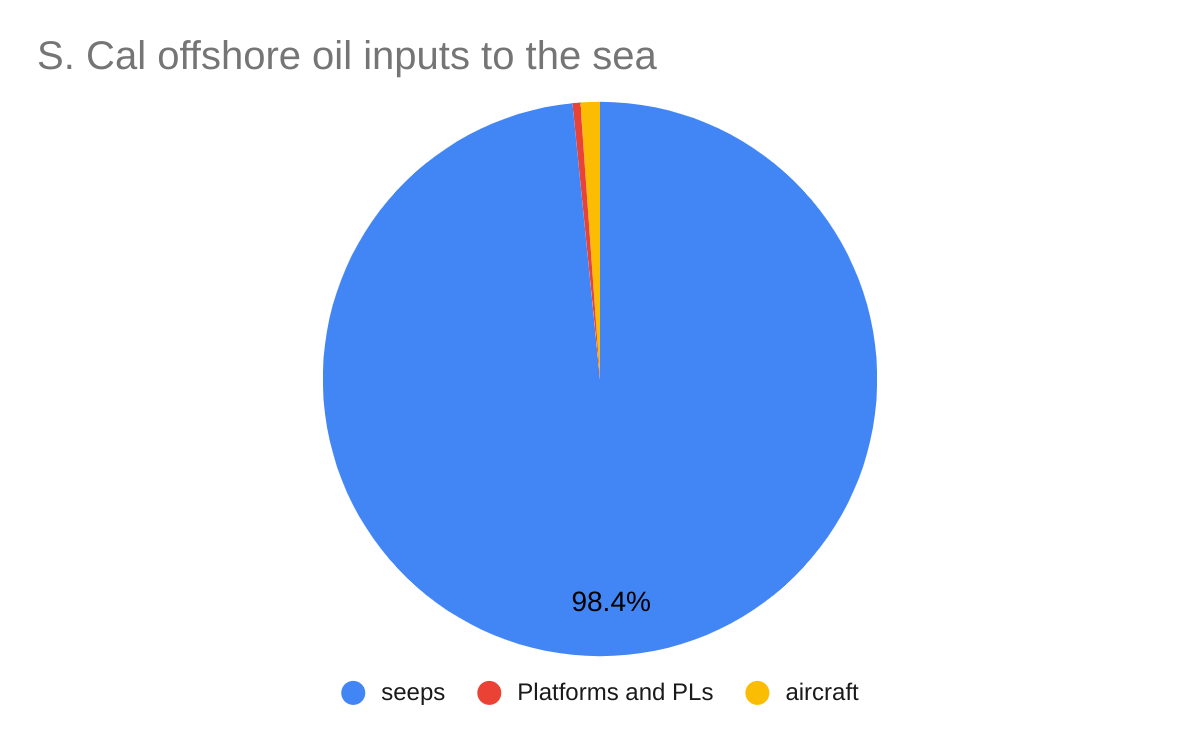
One of our very savvy BOE readers shared data (attached) from Oil in the Sea III, a National Academies report that is the best source of information on oil inputs into US waters. The data for Southern California are presented below in 3 charts. The first chart shows that natural seeps are overwhelmingly the leading offshore source of oil entering SoCal waters, with offshore platforms and pipelines accounting for <0.5% of the oil.
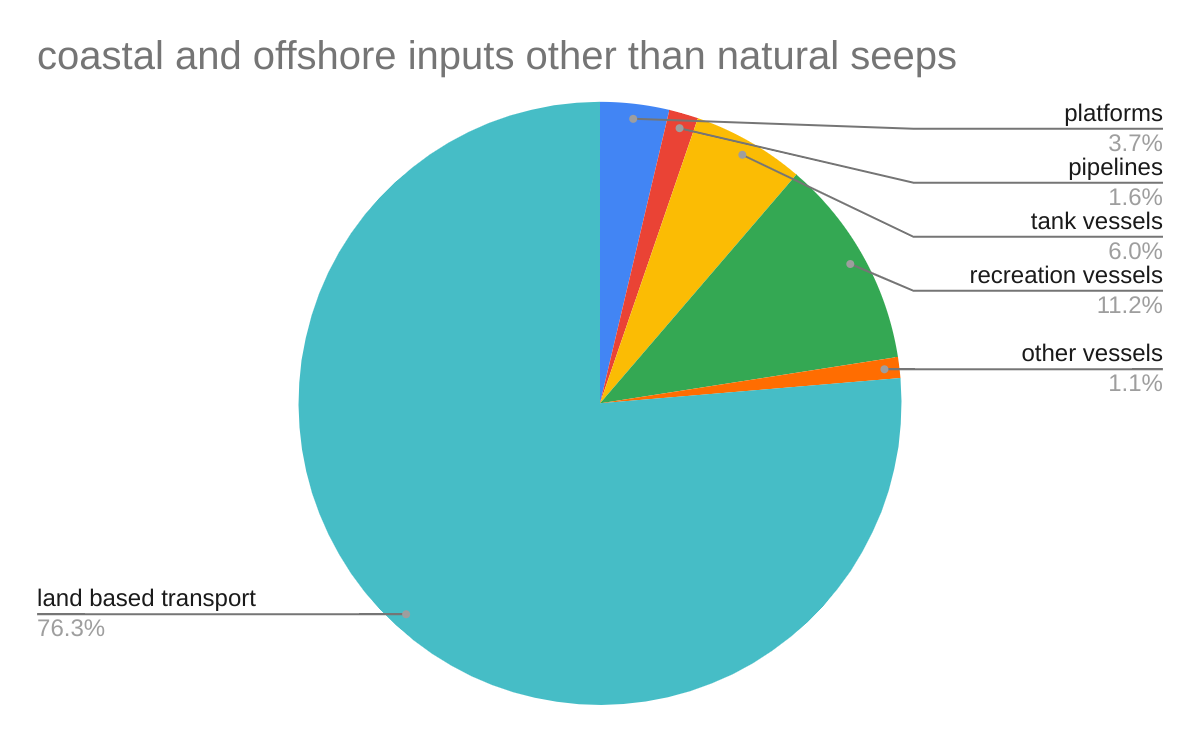
The second and third charts exclude natural seepage and compare the coastal and offshore oil inputs from the other sources. When land based transportation inputs are included (chart 2), platforms and pipelines (combined) account for 5.3% of the oil.
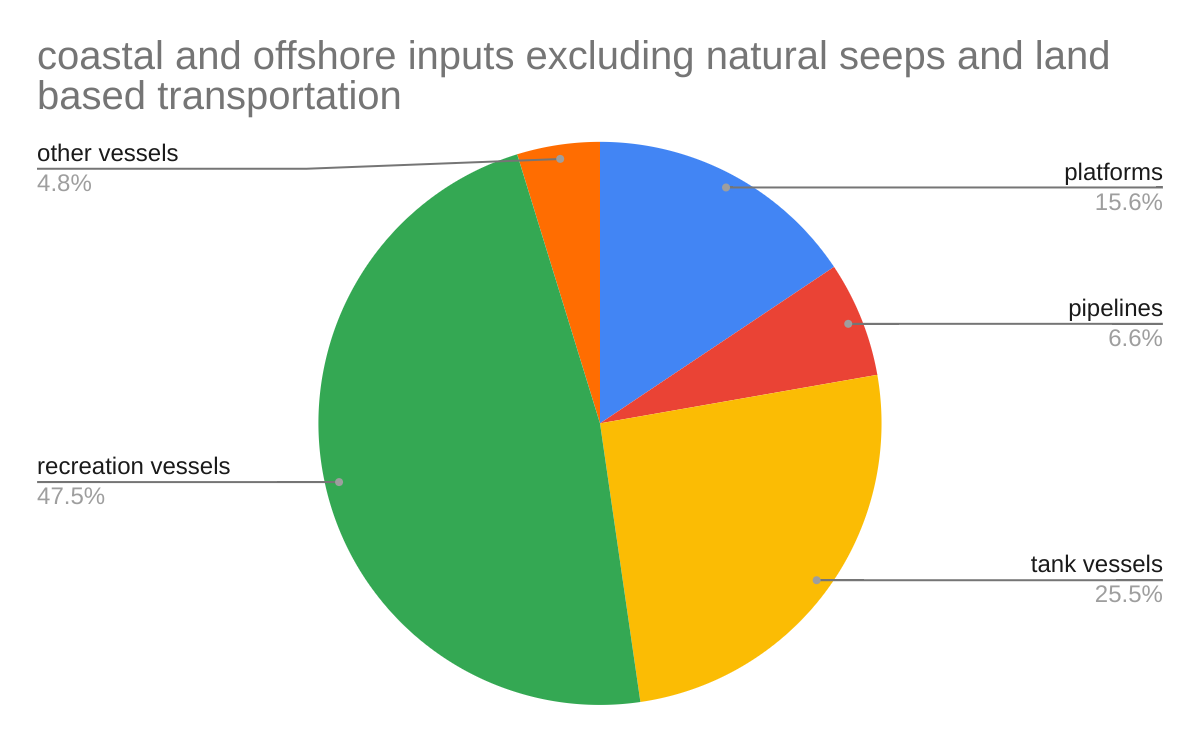
Excluding natural seepage and land based transportation inputs (chart 3), recreation vessels are by far the leading source of oil (47.5%), with platforms and pipelines (combined) accounting for less than half that volume (22.2%).
These data add important perspective, but are not intended to discount platform and pipeline spills. These spills can have significant localized impacts, and every effort must be made to prevent their occurrence.
What is the status of the Huntington Beach pipeline spill investigation?
Posted in accidents, California, Offshore Energy - General, pipelines, tagged ACOE, Amplify, Coast Guard, Huntington Beach, pipeline spill on June 28, 2022| Leave a Comment »
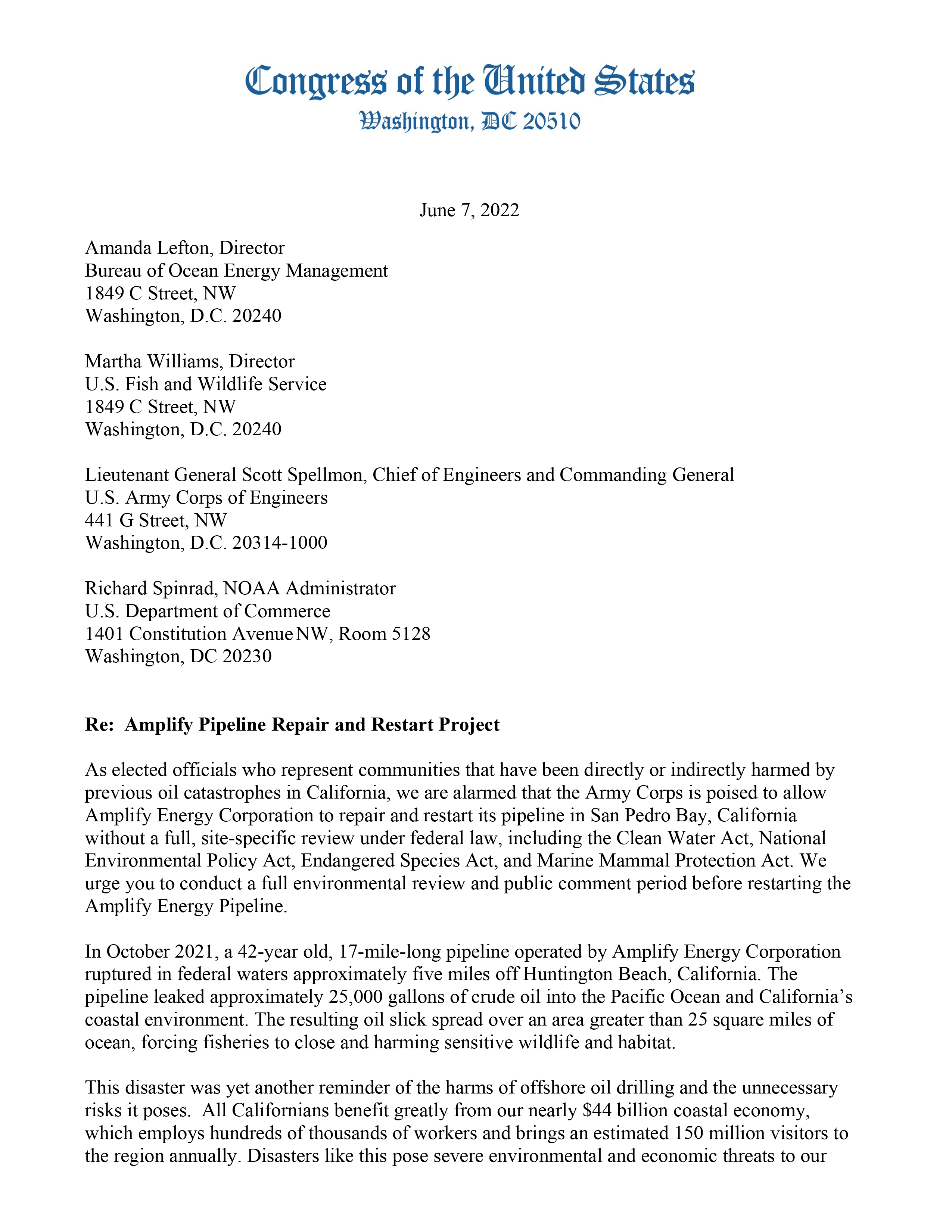
The pipeline rupture, which was apparently caused by a ship’s anchor, occurred almost 9 months ago, but no investigation report has been issued. In February, the LA Times reported that the investigation was being delayed by bureaucratic processes. Meanwhile local politicians (see letter below) seem intent on preventing future production through the pipeline, regardless of the investigation’s findings.
Reports indicate that the pipeline was in excellent condition at the time of the incident. The best reporting and expert commentary on the incident also explains why immediate leak detection can be difficult on low pressure pipelines.
LA Times: “Permit problem stalls investigation into Huntington Beach oil spill”
Posted in accidents, California, Offshore Energy - General, pipelines, tagged Amplify, Coast Guard, Huntington Beach, NTSB, pipeline spill on February 25, 2022| Leave a Comment »
This is inexcusable if true:
A federal investigation into the October oil spill that paved the Orange County coast has been stalled for several months as authorities await approval to cut, remove and analyze part of the ruptured pipeline.
LA Times
Coast Guard and National Transportation Safety Board investigators currently have to rely on video captured during underwater pipeline inspections. Without a more detailed forensic examination of the damage in a lab, investigators won’t know whether to continue with their original investigation or move the investigation in a new direction.
LA Times
It’s not good when bureaucratic processes stall an important investigation. Hopefully the responsible agencies will be sufficiently embarrassed to get the investigation moving.
Decisions, investigations, reports, and trends that BOE will be tracking in 2022
Posted in accidents, decommissioning, energy policy, hurricanes, Offshore Energy - General, tagged 2020 offshore fatalities, Beta Unit pipeline, Globetrotter II, Hogan and Houchin, Huntington Beach, Khamsin, Lease Sale 257, offshore production, Russell Peterson on January 10, 2022| Leave a Comment »
- DC Federal Court decision on Gulf of Mexico Oil and Gas Lease Sale 257: Will the Court uphold the 11/17/2022 sale? If the Court upholds the sale, will BOEM accept the carbon sequestration bids without having announced that tracts would be offered for those purposes, and without advising about lease terms and bid analysis procedures?
- Investigation reports for the 6 fatal US offshore incidents in 2020: When will these overdue reports be issued? Also, we know that there were at least two 2021 fatalities? When will those reports be issued?
- Platforms Hogan and Houchin, Santa Barbara Channel: When will we learn more about the Inspector General’s findings regarding the improper use of decommissioning funds? Why was the lessee, Signal Hill, allowed to withdraw funds from those accounts for purposes unrelated to decommissioning? How does this affect the liability of predecessor lessees?
- Investigation of the Huntington Beach pipeline spill: When will the the joint investigation team report be issued? To what extent can the pipeline operator be held liable for a leak caused by anchor dragging, particularly given the leak detection limitations for low pressure pipelines?
- Globetrotter 2 incident during Hurricane Ida: When will the Coast Guard issue their report on the delayed relocation of the Noble Globetrotter 2 drillship during Hurricane Ida? In light of this incident, the fatality on the Pacific Khamsin prior to Tropical Storm Laura (2020), and similar incidents, further attention to the timely relocation of dynamically positioned drillships would seem to be in order.
- US offshore drilling and production trends: With several deepwater fields scheduled to begin producing in 2022, will GoM oil production meet or exceed the August 2019 peak of 2.044 million BOPD, at least temporarily? Will exploratory drilling activity increase to levels needed for reserve replacement? Will the prolonged decline in US offshore gas production be reversed?
- Russell Peterson liftboat tragedy (2008): Will the Coast Guard ever explain why their investigation report in unavailable?
Huntington Beach pipeline spill: Amplify charged with illegally discharging oil
Posted in accidents, California, pipelines, tagged anchor dragging, Beta Unit, Huntington Beach, leak detection, pipeline spill on December 16, 2021| Leave a Comment »
This will be an interesting case given that the root cause of the leak appears to be anchor dragging and the responsible shipping company has yet to be identified. Also, these informed quotes about leak detection from a previous post are highly pertinent:
“My experience suggests this would be a darned hard leak to remotely determine quickly,” said Richard Kuprewicz, a private pipeline accident investigator and consultant. “An opening of this type, on a 17-mile-long (27-kilometer) underwater pipe is very hard to spot by remote indications. These crack-type releases are lower rate and can go for quite a while.”
The type of crack seen in the Coast Guard video is big enough to allow some oil to escape to potentially trigger the low pressure alarm, Kuprewicz said. But because the pipeline was operating under relatively low pressure, the control room operator may have simply dismissed the alarm because the pressure was not very high to begin, he said.
ABC News
The Coast Guard and National Transportation Safety Board identified the container ship “Beijing” as the vessel that damaged the Beta Unit pipeline (Huntington Beach spill)
Posted in accidents, California, Offshore Energy - General, pipelines, tagged Amplify, Beta Unit, Huntington Beach, NTSB, pipeline spill, US Coast Guard on December 9, 2021| Leave a Comment »
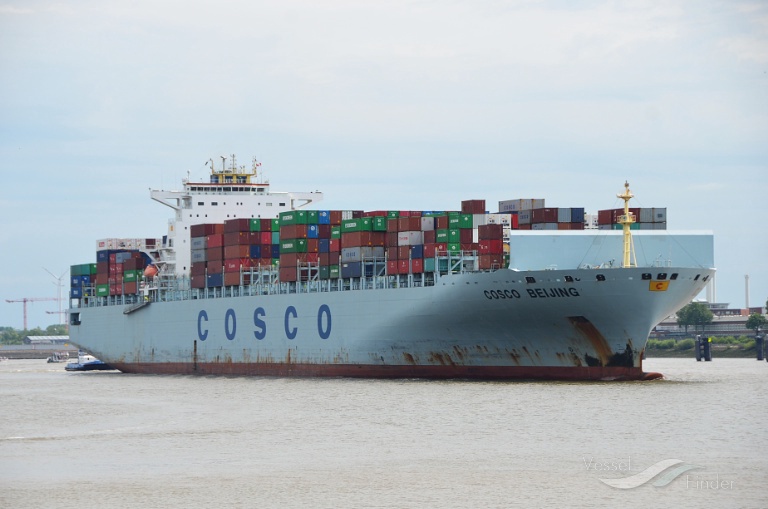
According to the Coast Guard, investigators determined the ship “was involved in an anchor dragging incident on Jan. 25, 2021 during a heavy weather event that impacted the Ports of L.A. and Long Beach.” The anchor- dragging occurred “in close proximity” to an underwater pipeline later determined to be the source of the October leak that spilled thousands of gallons of oil into the ocean, forcing the closure of beaches and harbors across Orange County.
CBS-LA
The hearings and the liability battles that follow will be most interesting. Those lined up to sue the pipeline operator (Amplify), such as this Huntington Beach disc jockey, may have difficulties.
More good news on the Huntington Beach pipeline spill
Posted in accidents, California, Offshore Energy - General, oil, pipelines, tagged Coast Guard, Huntington Beach, pipeline spill, spill response on October 27, 2021| Leave a Comment »
Due to water currents and a robust emergency clean-up effort, local beaches and ocean were re-opened on Oct. 11. By mid October, walking along the wide, sandy beaches there’s no sign of the spill as dolphins and surfers share the waves against a backdrop of cargo ships, oil rigs and the soft silhouette of Catalina Island.
Santa Cruz Sentinel
Further confirmation of the lower spill volume:
“Right now, there’s high confidence that the spill was approximately 24,696 gallons. The exact number won’t be able to be verified until the investigation has been completed. But there’s high confidence in that number,” Shaye said.
LCDR Shaye to the Sentinel
“Our world environment is very resilient, which is a positive thing,” Shaye said. “As far as the birds and wildlife; there have been some deaths, as happens in this kind of situation. But quite a few have been rehabilitated and released back into their environment.
LCDR Shaye to the Sentinel
Kudos to the responders. The training and response exercises worked!
“It’s one of the cleanest lines I’ve ever seen” – Chris Fox, CA State Lands Commission
Posted in accidents, California, Offshore Energy - General, oil, Regulation, tagged Amplify, Beta Unit, Huntington Beach, inspections, pipeline spill, SLC on October 17, 2021| Leave a Comment »
This quote from an AP article is consistent with the view expressed here after our review of the inspection reports for the Beta Unit (Platform Elly to shore) pipeline. Further per the AP article:
Safety inspections in 2015, 2017 and 2019 found anomalies in Amplify’s pipeline, including instances of metal loss and three dents that were previously repaired. But several experts who reviewed the reports said the metal loss — which can be a sign of a pipe wall thinning as it corrodes with age — was relatively minor. The dents were not in the same area as the spill.
AP
Inspection reports indicate that Beta Unit pipeline was well maintained.
Posted in accidents, California, Offshore Energy - General, oil, Regulation, tagged Beta Unit, BSEE, Huntington Beach, inspections, pipeline spill, SLC on October 14, 2021| Leave a Comment »
Aqueos 2020 external (ROV) inspection:
The 16” oil pipeline was found to be in good condition with no visible damage or anomalies.
Aqueos inspection report, May 2020
One (1) CP test point that was installed in 2014 was found to be displaced from its location on the pipeline (this was also noted in the 2018 survey), and no damage was noted at the location (Fix #101).
Pipe‐to‐electrolyte potential values recorded were:
‐ 921 millivolts (mV) on the 6” gas pipeline
‐ 910 millivolts (mV) on the 10” water pipeline
‐ 963 millivolts (mV) on the 10” gross fluids pipeline
‐ 906 millivolts (mV) on the 16” oil pipelineAs the NACE Standard SP0169‐2013 “Control of External Corrosion on Underground or Submerged Metallic Pipelines” criterion is ‐800 mV, all readings indicate that Cathodic Potential is within specifications.
Aqueos inspection report, May 2020
Metal loss data from Baker Hughes internal inspection (12/2019):
| Depth of Metal Loss | External Anomalies | Internal Anomalies |
| 30+% | 0 | 0 |
| 20-29% | 1 | 0 |
| 10-19% | 0 | 0 |
| total | 1 | 0 |
The metal loss findings are consistent with those reported in a previous internal inspection (Baker Hughes, 11/2017).
BSEE has general authority to require pipeline inspections under 30 CFR 250.1005. BSEE, the State Lands Commission, and the operator appear to have implemented an effective inspection program for the Beta Unit.
 Bud's Offshore Energy (BOE)