Feeds:
Posts
Comments

Posts Tagged ‘Gulf of Mexico’

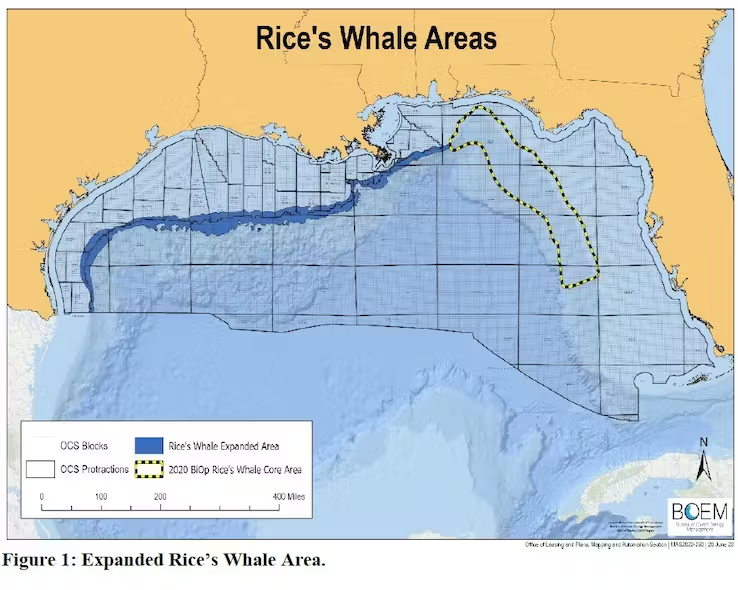
API’s comments on the Rice’s whale restrictions include a balanced assessment by Darren Ireland (begins on p. 22), a respected marine mammal scientist, and a good analysis of the economic impacts by EIAP.

Darren Ireland concludes (emphasis added):

The proposed critical habitat has been deemed, by NMFS, to have the essential physical and biological features needed for the Rice’s whale to feed, breed, and reproduce. However, direct evidence for what oceanographic features within the 100-400 m isobath band identified by NMFS are required to sustain the Rice’s whale is lacking, and the extent of those truly important features elsewhere in the GOMx is uncertain and may not reach into the central or northwestern GOMx as predicted by the habitat based density model (Garrison et al. 2023). Even though there is evidence to support the possible occurrence of Rice’s whale near the FGBNMS in the northwestern GOMx, there are no data that show this area is being used to support important life history functions such as breeding, feeding, or migrating. Additionally, the sightings and acoustic detections that have been recorded there are much less frequent than those recorded for Rice’s whale in the core habitat in the northeastern GOMx. Based on the limited data available on the use and occurrence of Rice’s whale in the central and northwestern GOMx (one acoustic study (Soldevilla et al. 2022b), one confirmed sighting (NMFS 2018a) and a few unconfirmed sightings (Rosel et al. 2021)), there is insufficient scientific evidence to determine that essential features for Rice’s whale conservation are indeed present in the central and northwestern GOMx. In fact, data on the life-history requirements of Rice’s whale even in the core habitat are still lacking and need further investigation.

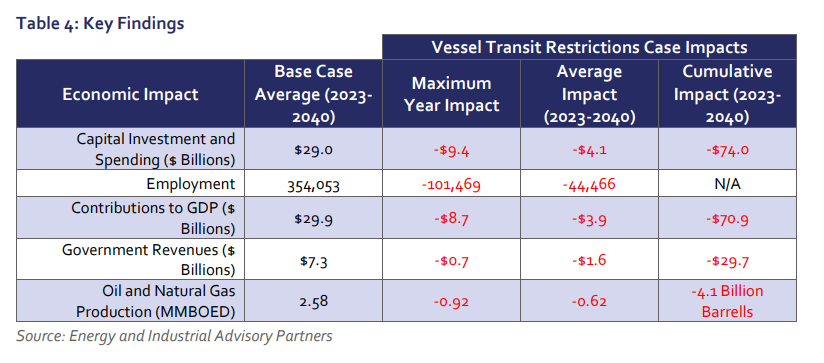
EIAP’s key findings on the estimated economic impacts from these restrictions are summarized in the table below. Those are very significant costs given the uncertainty of the whale habitat in the central and western GoM.

Separate comments submitted by the Offshore Operators Committee are also quite strong. Their letter is attached.

Read Full Post »

That’s the Polar Pioneer, an arctic class rig built in 1985 that last operated in the Chukchi Sea in 2015. The rig was recycled in Aliaga, Turkey in 2020. The US arctic, like 96.3% of US offshore waters, is no longer open to oil and gas leasing, and was not included in the new leasing program.

The Polar Pioneer was once a good rig for sub-arctic operations, but is not at all similar to the modern drilling units that are used on the deepwater Gulf of Mexico leases that now account for 93% of OCS oil production and 76% of the natural gas. With the exception of the GoM shelf, which is laudably being gleaned by independent producers, the deepwater GoM blocks are all that is left of the once robust US offshore leasing program.

Unless the picture of the scrapped drilling rig is intended to be symbolic of the current state of the leasing program, the photo choice implies inattention to significant technical details. The document does not include a single picture of a deepwater drilling unit or production facility.

Read Full Post »

The Proposed Final Program includes a maximum of three potential oil and gas lease sales – the fewest oil and gas lease sales in history – in the Gulf of Mexico Program Area scheduled in 2025, 2027 and 2029. 

DOI News Release

Tearing down what a lot of dedicated folks worked hard to build. 😢

Read Full Post »

Pictured: Transocean’s Deepwater Proteus. T/O should name one of their drillships Deepwater Diligence 😉

Seven of the deepwater exploratory wells drilled in the Gulf of Mexico in 2023 (YTD) were spudded within 4.5 years of the effective date of their leases. Three of these wells were spudded within 3 years of their lease effective dates (see table below).

These are impressive achievements when you consider the time required for consultation with partners (if any) and contractors, site surveys, exploration plan development and approval, well planning, and drilling permit preparation and approval.

The subject wells accounted for 28% of the deepwater exploratory well starts in 2023 (25 net YTD wells after subtracting restarts at the same location).

date lease
effective
spud dateelapsed time
(months)
water
depth (ft)
operator
3/1/20218/27/2023306498Shell
8/1/20205/21/2023342211Talos
8/1/20203/15/2023313338Talos
12/1/20196/5/2023424228Chevron
11/1/20196/1/2023434603Hess
7/1/20197/11/2023487486Kosmos
12/1/20186/6/2023544127bp

Below are the exploration plan (EP) and permit (APD) approval timeframes for these 7 wells. With the exception of the Kosmos EP which required a number of modifications, the regulator actions appear to have been timely. For the bp, Shell, and Chevron wells, only 4-6 months elapsed between EP submittal and APD approval.

operatorblockdate EP
received
date EP
approved
APD
received
APD
approved
ShellWR 3653/1/20235/17/20235/11/20238/8/2023
TalosGC 781/19/20214/16/20213/8/20235/26/2023
TalosMC 1624/1/20227/13/20228/2/20223/2/2023
ChevronMC 93712/7/20225/19/20234/21/20235/21/2023
HessMC 7278/30/202211/3/202212/21/20224/24/2023
KosmosKC 9641/3/202010/12/20224/18/20237/3/2023
bpGC 4361/18/20234/14/20233/29/20236/5/2023
Notes: EP=Exploration Plan, APD=Application for Permit to Drill, WR=Walker Ridge, GC=Green Canyon, MC=Mississippi Canyon, KC=Keathley Canyon

Read Full Post »

Of note (emphasis added):

IT IS ORDERED that appellants’ opposed motion for partial stay pending appeal is GRANTED in part. The preliminary injunction that was entered by the Memorandum Order of September 21, 2023, is hereby AMENDED only in that the sale that was set for September 27, 2023, is ORDERED to take place by November 8, 2023. No extension will be granted. That is to say: Insofar as the preliminary injunction is concerned, the final paragraph of the Memorandum Order remains in effect, pending appeal of the preliminary injunction, with the exception that “September 30, 2023,” is changed to “November 8, 2023.”

Read Full Post »

Assuming the Gulf of Mexico oil and gas lease sale proceeds tomorrow in accordance with Judge Cain’s order, some interesting questions and issues remain:

  • Will the lingering Rice’s whale issues affect bidding for deepwater leases? Friday’s court order is not a final resolution of those issues, either legally or administratively. While the Rice’s whale stipulation, at the direction of the Federal court, will not be included in the Sale 261 leases, BOEM’s Notice to Lessees and Operators (NTL) includes the same provisions and still stands pending further consultations with NOAA. Although the NTL is a “guidance document” (wink-wink), there are ways of making it stick through the exploration plan approval process. Even without binding requirements, companies might choose to fully comply to minimize legal risks.
  • When will the next GoM lease sale be held? Will the uncertainty spur or constrain bidding?
  • Will the 14 blocks with rejected high bids at Sale 259 receive bids at Sale 261? If so, will the bids be higher or lower?
  • Will bp, Chevron, Shell, Equinor, Oxy, and Woodside continue to be bullish on the GoM?
  • Will Red Willow Offshore, owned by the Southern Ute tribe, again be an active bidder?
  • Will Exxon again seek to acquire carbon sequestration leases at an oil and gas lease sale? After a long absence, it would be good to see the US super-major acquire leases for oil and gas purposes. Ditto for ConocoPhillips.
  • How many companies will participate in the sale? 30-35 would be a nice outcome.
  • What will be the sum of the high bids? >$300 million would be a good result.

Read Full Post »

Rice’s whale restrictions

Read Full Post »

Impressively, 4 GoM operators with significant production and well activity did not incur a single civil penalty payment during the most recent 4 year period. Each of these operators also had low incident of noncompliance (INC) to inspection ratios. The companies are as follows:

Operator2022 oil production (million bbls) 2022 oil production rank2022 gas production (bcf)No. of platformsNo. of well starts (2019-2022)
Hess21.6746.535
Kosmos8.5147.8subsea tiebacks 6
Beacon7.21512.2subsea tiebacks4
Cantium4.7196.18637
  • All of these companies deserve kudos.
  • Cantium’s record is especially impressive given that most of their platforms were installed more than 40 years ago and some date back to the 1950s. They have also been a very active development well driller.
  • Hess is the 7th biggest oil producer and 5th biggest gas producer in the GoM. Hess CEO John Hess made some encouraging comments (pasted below) about the deepwater GoM at a recent energy conference.
  • While Kosmos and Beacon have somewhat lower violation and penalty exposure because their production is via subsea wells tied back to surface facilities operated by other companies, they are demonstrating that entrepreneurial deepwater independents can also be safety leaders.

“The Pickerel-1 prospect was our first (exploration well on the Mississippi Canyon 727) and we are delighted that it was an oil discovery. Black Pearl will be the next and that will hopefully be a tieback (to Tubular Bells with first oil expected mid-2024).

“Then we have a wildcat opportunity (the Vancouver exploration prospect) later in the year in the Green Canyon. With the other 80 exploratory blocks that we have in the Gulf, we will be actively drilling for the next several years,” Hess said.

OilNow

Read Full Post »

For those interested in safety and compliance data, a good BSEE update for the Gulf of Mexico is attached.

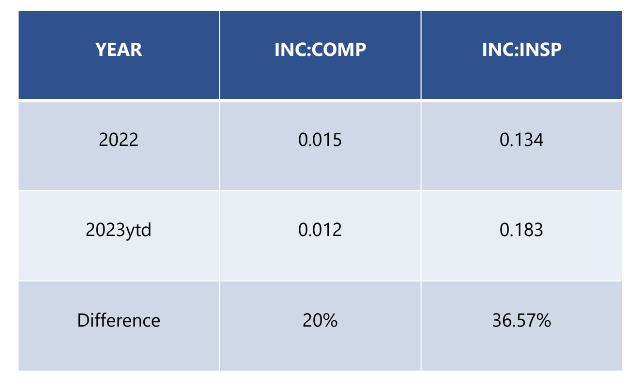
Interestingly, (slide pasted below), there were 20% fewer Incidents of Noncompliance (INCs) per component inspected but 37% more INCs/inspection. This would seem to imply high INC rates at less complex (typically older) facilities with relatively fewer components.

Posted 2023 inspection data indicate high INC/inspection rates for Cox and affiliates Energy XXI GOM and EPL that have filed for bankruptcy. Through August, these companies have accounted for 44% (635/1457) of all INCs issued in 2023. This may explain, at least in part, the divergence in the 2 compliance measures.

Read Full Post »

The plaintiffs assert “insufficient and arbitrary environmental analyses, in violation of the National Environmental Policy Act (NEPA) and the Administrative Procedure Act (APA).” The court filing is attached.

For those who missed it, supporters of the lease sale have challenged some of the provisions.

All of this will have to be resolved in the next 3 weeks, as the congressionally mandated sale, scheduled for 27 September, (presumably) cannot be postponed.

Read Full Post »

« Newer Posts - Older Posts »