| company | no. of Sale 259 high bids (Sale 257 in parentheses) | total Sale 259 high bids ($ millions) |
| Chevron | 75 (34) | 108 |
| BP | 37 (46) | 46.7 |
| Shell | 21 (20) | 20.1 |
| Equinor | 16 (1) | 18.3 |
| Beacon | 13 (4) | 9.0 |
| Anadarko (Oxy) | 13 (30) | 8.6 |
| Red Willow | 13 (5) | 3.8 |
| Hess | 12 (2) | 8.3 |
| Woodside | 12 (8) | 6.3 |
| Houston Energy | 8 (5) | 11.6 |
Posts Tagged ‘Gulf of Mexico’
Lease Sale 259 Top Ten: Chevron’s surges, BP is bullish on the GoM, Shell steady, Equinor awakens, Beacon sees the light, OK for Oxy, Red Willow surprises, Hess rebounds, Woodside has BHP, Houston means Energy!
Posted in Gulf of Mexico, Offshore Energy - General, tagged Beacon, bp, Chevron, Equinor, Gulf of Mexico, Hess, Houston Energy, Lease Sale 259, Oxy, Red Willow, Shell, Top Ten, Woodside on March 31, 2023| Leave a Comment »
GoM Lease Sale 259: Did the 50% increase in royalty rate suppress shelf bidding?
Posted in CCS, energy policy, Gulf of Mexico, Offshore Energy - General, tagged GOM Shelf, Gulf of Mexico, Lease Sale 259, royalty rate on March 30, 2023| Leave a Comment »
As anticipated, the increase in royalty and rental rates appears to have further weakened interest in leases in the shallow waters of the Gulf of Mexico continental shelf. Note the sharp declines in both the number of blocks receiving bids and the bid amounts.
| lease sale | blocks with bids (excluding CCS bids) | sum of high bids ($million, excluding CCS bids) |
| 257 | 46 | $8.1 |
| 259 | 29 | $4.1 |
Interesting Sale 259 items
Posted in CCS, Gulf of Mexico, Offshore Energy - General, tagged bp, Exxon, Focus Exploration, Gulf of Mexico, Lease Sale 257, Lease Sale 259 on March 30, 2023| Leave a Comment »
- In the previous Gulf of Mexico sale (257), the $1.8 million bid submitted by BP and Talos for Green Canyon Block 777 was rejected. BP bid again for this block in Sale 259, but their bid was only $583,000. One would assume that this bid will also be rejected, but perhaps there is more to the story (new geologic data?).
- Green Canyon 79 received a bid of $3.6 million at Sale 257, but no lease was ever issued. No explanation was provided and there were no bids for this block at Sale 259.
- There was actually a second bidder, Focus Exploration, for one of the 69 “CCS blocks,” that Exxon seeks to acquire (see below). Exxon’s bid was higher. Does this mean that Focus, a company that is presumably interested in exploring for oil and gas, will lose the block to a company that bid on the block for purposes not authorized in the Notice of Sale?

The “Lower Energy Costs Act” (H.R.1) would do little to increase offshore production
Posted in Alaska, energy policy, Gulf of Mexico, Offshore Energy - General, tagged Gulf of Mexico, HR 1, Lower Energy Cost Act, OCS oil and gas on March 28, 2023| Leave a Comment »
Comments on the major offshore provisions:
- The bill neither repeals nor amends the massive land withdrawals by Presidents Obama, Trump, and Biden that have fenced the OCS program into portions of the central and western Gulf of Mexico. Worse yet, the bill tacitly endorses those withdrawals by specifically stating that they are not affected in any way (Sec. 20114).
- Sec. 20107 mandates that at least 2 lease sales be held annually in the GoM. The certainty would provide some incremental benefit, but is unlikely to stem the decline in GoM reserves. We are becoming increasingly dependent on the 4% of our OCS that may be leased, about 3/4 of which is not prospective or has limited production potential.
- The bill also mandates at least 2 sales per year offshore Alaska. What will be offered given that most Alaska areas are off limits? We have seen how little interest there is in the Cook Inlet.
- Sec. 20601 lowers the revenue to the US Treasury and increases the revenue to Gulf producing states. This would garner further support from those states, but will have little effect on production.
- Sec. 20106 requires DOI to publish information and report to Congress on the processing of drilling permits. However, delayed drilling permit approvals do not seem to be a significant issue on the OCS.
China’s US OCS leases – exit coming?
Posted in Uncategorized, tagged Appomattox, China, CNOOC, Gulf of Mexico, Hess, JPMorgan, Nexen, Shell, Stampede on March 2, 2023| Leave a Comment »
Some may not be aware that the Chinese government, through a fully owned subsidiary of the China National Offshore Oil Corp. (CNOOC), is a leaseholder in the US Gulf of Mexico. Per BOEM records, CNOOC Petroleum USA Inc currently has ownership in 12 OCS leases. Most significantly, CNOOC holds 21% interest in the Appomattox Field, operated by Shell, and a 25% working interest in Stampede, operated by Hess. Peak oil production for these projects is expected to be 175,000 bopd for Appomattox and up to 80,000 bopd for Stampede.
CNOOC acquired the Gulf of Mexico properties through its purchase of Nexen, a Canadian company, in 2013.
The state-owned Chinese oil explorer surrendered operating control of those assets to quell U.S. national security concerns, said two people familiar with the agreement who asked not to be named because the terms aren’t public.
FInancial Post
Reuters has reported that CNOOC is considering an exit from its operations in the US, Canada, and the UK because of sanctions concerns. JPMorgan is reportedly assisting with the sale of the US assets.

December 2022 GoM production data are now posted
Posted in energy policy, Gulf of Mexico, hurricanes, Offshore Energy - General, tagged 2022 oil production, BOEM, energy transition, Gulf of Mexico, Gulf of Mexico production, production forecast on March 1, 2023| Leave a Comment »
Comments on 2022 oil production:
- Solid year given governmental ambivilence and corporate uncertainties
- Below BOEM production forecast.
- The 2019 annual production record remains intact at 1.897 million bopd, but could be exceeded in 2023 if (1) projected deepwater startups are on schedule, (2) prices remain above $70/bbl, (3) depletion is effectively managed, and (4) the hurricane season is again favorable
- The 2 million bopd average seems elusive, but could be surpassed in one of the next few years. After that, a greater commitment on the part of government and industry will be needed.
- The “energy transition” will not affect oil and gas demand for the foreseeable future, more nuclear power plants are not being built, and shale has its limitations. We better not neglect what is left of the OCS oil and gas program.

2021 losses of well control – US OCS
Posted in accidents, Gulf of Mexico, well control incidents, tagged 2022 incidents, blowouts, BSEE Director, Gulf of Mexico, losses of well control, shallow water flows, well completion incident on February 8, 2023| Leave a Comment »
Now that the 2021 US OCS incident spreadsheet has been posted and I have commented on the fatalities, I’ll be looking at some incidents by category starting with losses of well control (LWCs). Incident summaries and links to investigation reports follow the bullet points.
- 4 LWCs incidents in 2021
- None posed a significant threat to worker safety or the environment
- All were deepwater wells
- 3 were during exploratory drilling and 1 was during completion operations
- All 3 drilling incidents involved water flows after setting 22″ surface casing.
- Gas/water flows during/after cementing operations continue to be the leading cause of LWCs.
- At least one resulted in the loss of the well; unclear regarding the other 2.
- All 3 were exploration wells
- Per the Lars Herbst review, there were 29 new deepwater exploration well spuds in 2021, so >10% of these experienced losses of well control due to water flows. Much work has been done on preventing top-hole water flows while drilling deepwater wells, but it appears there is more work to do.
- The completion LWC was the result of the inadvertent opening of fluid control devices. The report on this incident provides important information for well completion risk assessments.
Incident summaries
Spreadsheet incident 19: Well completion operation. Inadvertent shearing and opening of the fluid loss control devices were not adequately assessed during the planning and review phases of the completion. While displacing the wellbore from 14.8 ZnBr to 14.8 packer fluid, the downhole equivalent circulating density sheared the upper and lower fluid loss control devices. The rig immediately began to experience fluid losses of 600 bph. A 50 bbl fluid loss pill was spotted and losses slowed to 345 bph. A second fluid loss pill was pumped which significantly decreased the losses eventually resulting in zero losses. After losses stopped, the rig experienced approximately a 14 bbl gain on the trip tank. The well was shut in on the annular and circulated out using the driller’s method. Oil was observed in the returns. While waiting on additional fluids and materials, wellhead pressure was managed by bullheading 14.8 brine when required. The well was killed via bullheading down the annulus followed by bullheading down the workstring with 3 CaCo3 pills. investigation report
BOE comment: While the cause of this incident is classified as “human error,” the failure to properly assess and plan for risks associated with the inadvertent shearing and opening of the fluid loss control devices is an organizational/management issue.
Incident 186: Shallow water flow during exploration drilling. Lost well. A shallow water flow was observed from one of the ports in the 38″ wellhead housing following cementation of the 22″ riserless casing string at Caramel Keg (GB 962 #1). Additional wireline logging (casing bond log and temperature log) runs were performed to gain additional insights into the potential source/location of the flow, as well as the quality and presence of cement behind the 22″ casing string. Approval from BSEE Lafayette district was received on April 1st to proceed with running the riser/BOP and continue with subsequent planned operations. Flow from the wellhead was monitored and a general reduction trend in flow from wellhead port was observed. Approval was received from BSEE on April 19th to install and close ball valves on two wellhead ports to isolate flow from wellbore. On April 20th, the ball valves were closed and flow from the wellbore ceased approximately 23 days after initial observation. Approval to temporarily abandon the well was received from BSEE on April 25, along with a monitoring plan of the wellbore and the surrounding area. TA operations concluded on April 27th. The ongoing monitoring program has since identified no indications of flow/broaching at or near the GB 962 #1 wellbore as of May 7th. No personnel were injured or evacuated as a result of this subsurface shallow water flow. report
Comment: The BSEE incident investigation team determined that salt contamination probably caused the cement to go under-balanced triggering flow and channeling behind the 22-in casing.
Incident 478: Exploration well – 7188′ WD; exploration. The 22″ casing cement job went as planned with positive cement returns to the mudline from dye and pH meter. The rig observed post cementing flow. Flow was predominantly gas. The flow started with a single source from the seabed, about 20 ft away from the wellhead. Within the next 2-3 hours, two other flow sources developed, one immediately adjacent to the jetpipe while another flow source surfaced about 10ft away from the wellhead. The rig continued to monitor the post cementing flow and completed multiple ROV wagon wheel surveys. No new seafloor anomalies or active flow points were identified away from the wellhead. Minor flow of water and gas continued at the wellhead. No investigation report.
Incident 507: Post Cement Flow Summary: The 22″ casing was cemented in place at 2:30 AM on August 18, 2021. At approximately 5:45 AM, a minor post cementing flow was observed by the ROV. The flow was only observed from 1 cement port/ball valve connected to the 28″x22″ annulus. The flow composition was predominately cement and absent hydrocarbons. The ROV continued to monitor the flow. No investigation report.
2022 Safety Honor Roll: Gulf of Mexico operators
Posted in Gulf of Mexico, Offshore Energy - General, Regulation, tagged AnadarkoOxy, bp, Cantium, Chevron, compliance leaders, Contango, Gulf of Mexico, Hess, LLOG, Murphy Oil, offshore oil and gas operations, Safety Honor Roll, Shell on January 24, 2023| 1 Comment »

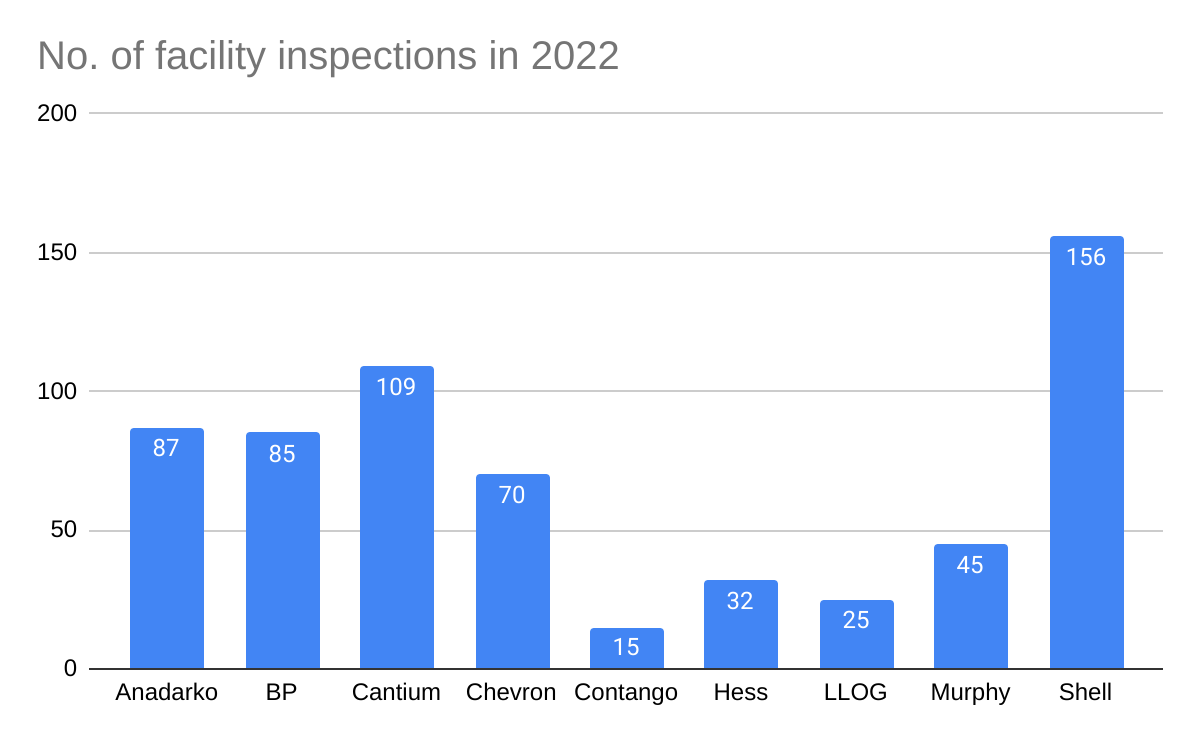
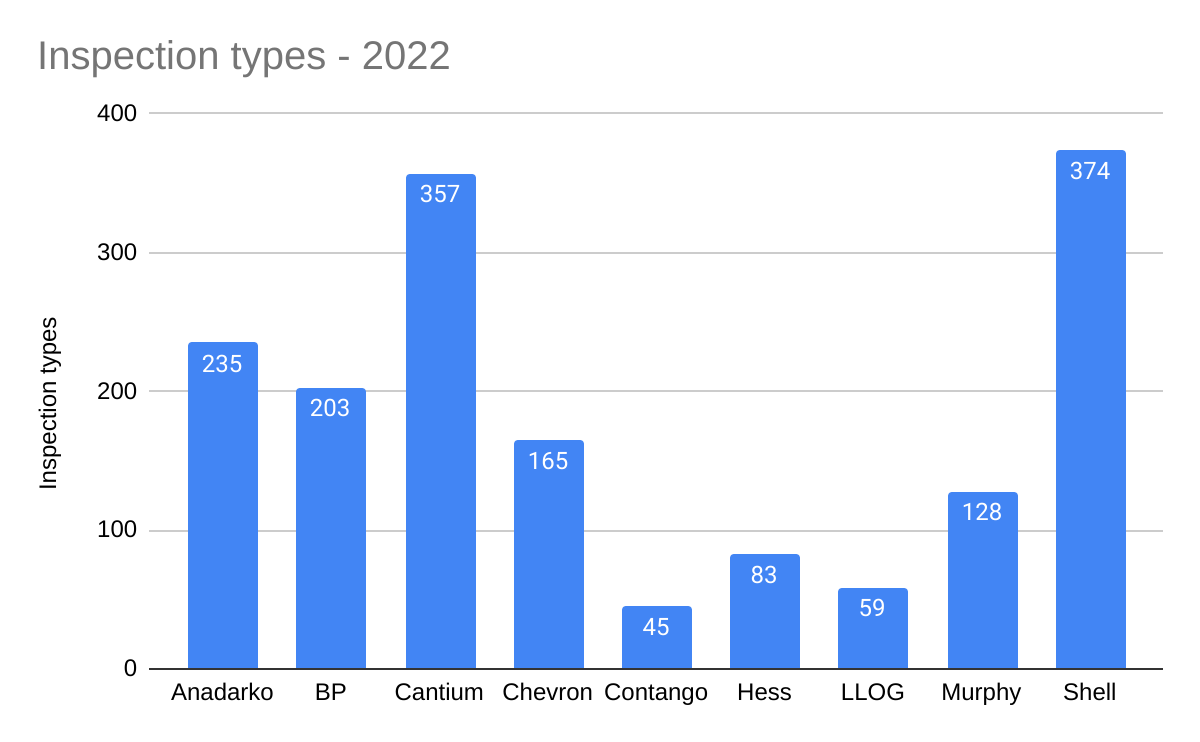
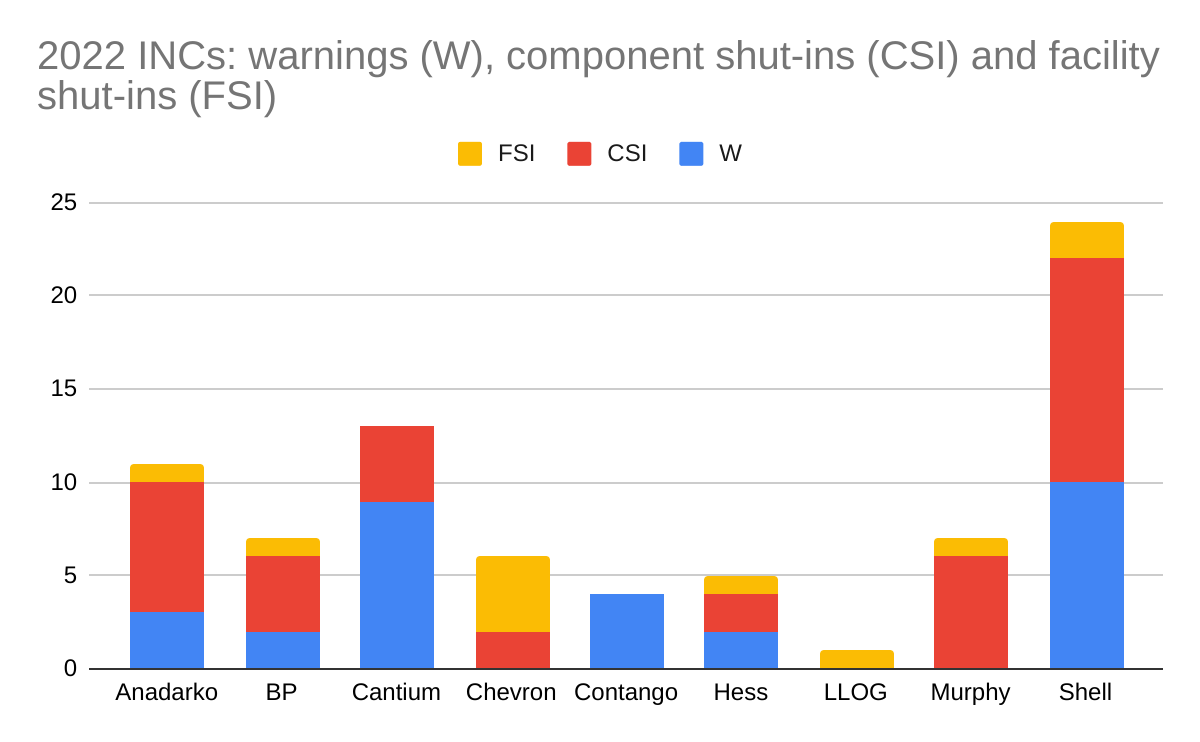
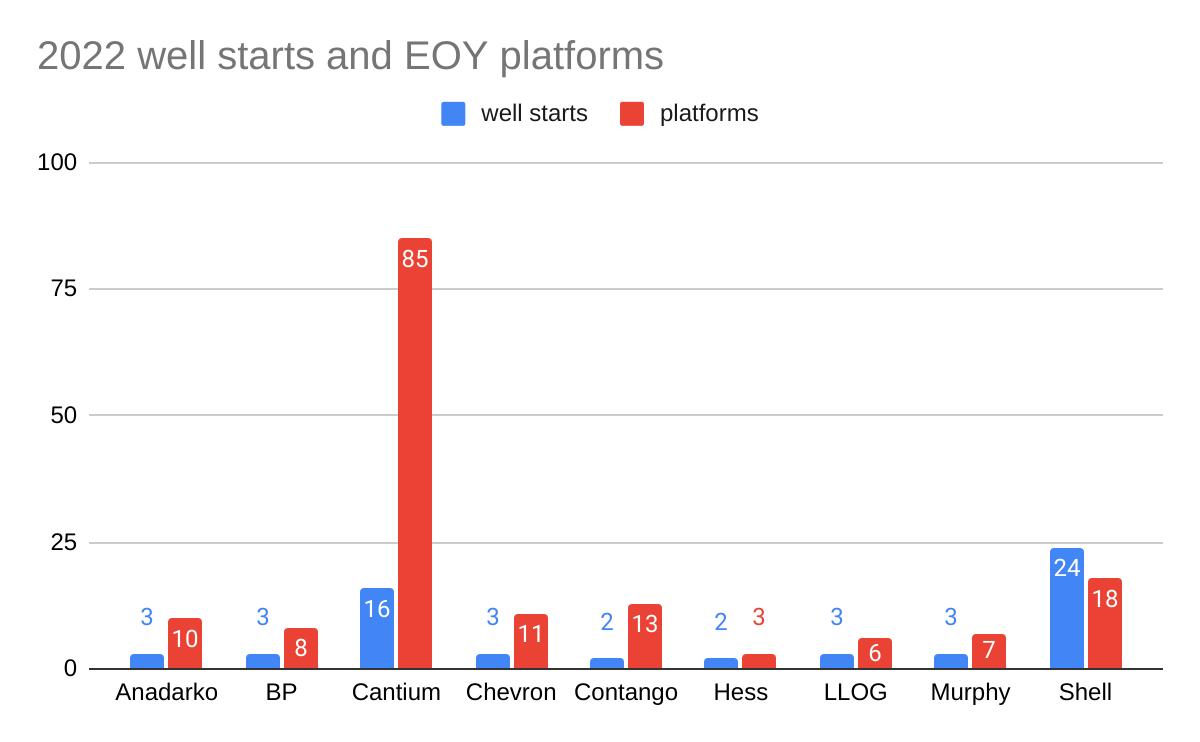
The Honor Roll companies for 2022 (listed alphabetically) are Anadarko (Oxy), bp, Cantium, Chevron, Contango, Hess, LLOG, Murphy, and Shell.
Our criteria:
- Must average <0.3 incidents of noncompliance (INCs) per facility-inspection.
- Must average <0.1 INCs per inspection-type. (Note that each facility-inspection may include multiple types of inspections (e.g. production, pipeline, pollution, Coast Guard, site security, etc). On average, each facility-inspection included 3.25 types of inspections in 2022. Here is a list of the types of inspections that may be performed.)
- Must operate at least 3 production platforms and have drilled at least one well (i.e. you need operational activity to demonstrate compliance and safety achievement).
- May not have a disqualifying event (e.g. fatal or life-threatening incident, significant fire, major oil spill). Due to the extreme lag in updates to BSEE’s incident tables, investigation and news reports are used to make this determination.
- Pacific and Alaska operations will be considered separately.


| oil (million bbls) | gas (BCF) | |
| Shell | 145.8 | 163.5 |
| bp | 82.4 | 57.1 |
| Chevron | 79.4 | 45.2 |
| Anadarko | 59.6 | 50.8 |
| Murphy | 28.1 | 45.5 |
| LLOG | 19.6 | 34.3 |
| Hess | 17.9 | 39 |
| Cantium | 3.9 | 5.3 |
| Contango | 0.02 | 3.5 |
2022 Gulf of Mexico Safety Honor Roll companies to be announced tomorrow
Posted in Gulf of Mexico, Offshore Energy - General, Regulation, tagged compliance leaders, Gulf of Mexico, nine operators, Safety Honor Roll on January 23, 2023| Leave a Comment »
Nine operating companies have qualified.
Marvels of the deep
Posted in Gulf of Mexico, Offshore Energy - General, Uncategorized, tagged Big Fin Squid, chemosynthetic communities, Gulf of Mexico, Perdido, Shell on January 20, 2023| Leave a Comment »

A rare photo of a Big-Fin Squid, caught on camera on November 11th 2007 by a Shell Oil company ROV, at a depth of 2,386 meters (1.5 miles). This species of Squid dwell at extreme depths, and are characterised by their long, thin tentacles. They can reach almost 20ft long when fully grown.
Hasan Jasim
ROV video:
Of course, much of our knowledge about deepwater biology is attributable to oil and gas exploration and the associated environmental studies. This includes the discovery and study of chemosynthetic communities in the Gulf of Mexico:
Some of the same conditions responsible for petroleum deposits also provide the basis for biological communities that receive energy from chemicals through a process called chemosynthesis (in contrast to photosynthesis that provides energy to terrestrial and shallow-water communities through processes in which sunlight is the basic energy source).
NOAA