Feeds:
Posts
Comments

Posts Tagged ‘compliance’

The final decommissioning financial assurance rule has been published and is largely unchanged from the proposed rule that we reviewed last summer.

Major concerns:

  • Despite ample evidence regarding the importance of compliance and safety performance in determining the need for supplemental financial assurance, BOEM has dropped all consideration of these factors. Did BSEE field personnel concur with this decision?
  • Proved reserves should not be a basis for reducing supplemental assurance. The uncertainty associated with reserve estimates and decommissioning costs can easily negate the assumed buffer in BOEM’s 3 to 1 reserves to decommissioning costs ratio. That approach failed completely at the Carpinteria Field in the Santa Barbara Channel (Platforms Hogan and Houchin). See other points on this issue.
  • Given that the reverse chronological order process for determining predecessor liability was dropped from consideration last April, there is no defined procedure for issuing decommissioning orders to prior owners. The absence of such a procedure increases the likelihood of confusion, inequity, and challenges, particularly when orders are first issued to companies that owned the leases decades ago, in some cases prior to the establishment of transferor liability in the 1997 MMS “bonding rule.”

BOEM’s concern (below) about investment in US offshore exploration and production is interesting given that their 5 year leasing plan strongly implies otherwise.

BOEM’s goal for its financial assurance program continues to be the protection of the American taxpayers from exposure to financial loss associated with OCS development, while ensuring that the financial assurance program does not detrimentally affect offshore investment or position American offshore exploration and production at a competitive disadvantage

final decommissioning rule, p. 40

I’m just guessing here, but my sense is that BOEM was pressured to finalize this rule in a timely manner (<10 months is timely for such a complex rule) and was thus reluctant to make any significant changes to the proposal published last summer. A public workshop during the comment period would have been a good idea to facilitate informed discussion on the important issues addressed in this rule. Such workshops were once commonplace for major rules.
Read Full Post »

Safety first: As a descendant of troubled Fieldwood Energy, which had a very poor safety and compliance record, QuarterNorth Energy (QNE) had much to prove. That said, QNE has had a good compliance record in its brief 2 year history. During 76 facility inspections in 2022 and 2023, QNE was cited for only 15 Incidents of noncompliance, all but 2 of which were warnings. This is on par with the companies that had the best compliance records during that period.

BSEE’s incident statistics are hopelessly out-of-date, with the latest data being for 2021, so we have limited information on QNE safety incidents. However, BSEE’s District Investigation Reports, which document the more significant incidents, are relatively current and no QNE incidents were investigated in 2022 and 2023.

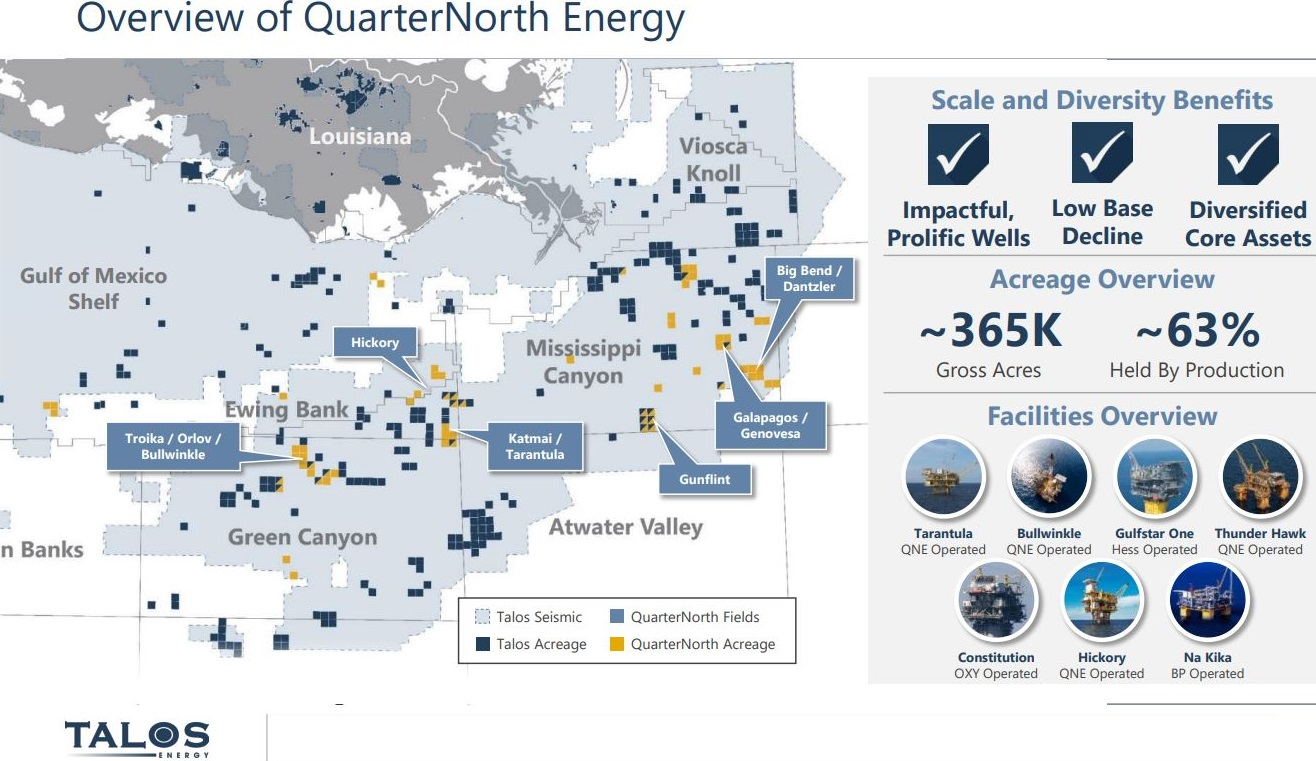
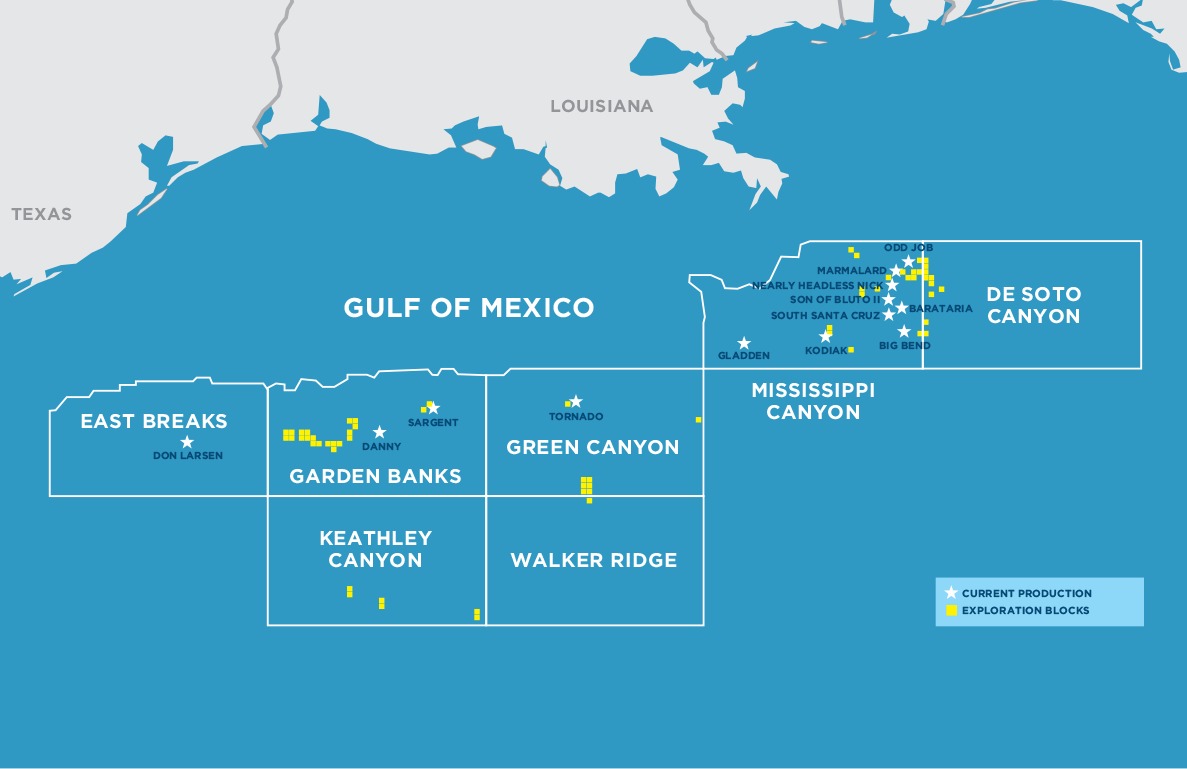
Platforms: Consistent with the general sense that QNE inherited the best of Fieldwood’s facilities, the company’s 15 platforms include Bullwinkle, the Thunder Hawk floating production unit in 6050′ of water, and prominent shelf platforms Tarantula and Hickory.

The acquisition reunites 2 iconic Shell platforms under the same ownership. QNE’s Bullwinkle, installed in 1988 in 1353′ of water, is the world’s tallest (non-compliant) steel tower platform. Talos’s Cognac, installed in 1978 in 1023′ of water, is the first platform in >1000′ of water.

Production and reserves: Per Talos, QNE adds 30,000 boe/d of production and 69 million boe of reserves.

Drilling: Per BSEE records, QNE was the operator for 2 deepwater exploration wells, both of which are classified as completed.

Active leases: The QNE acquisition will add 51 leases to the Talos’s 143 lease inventory.

Recent lease sale activity:

SaleQNETalos
2572/110/10
2596/45/4
2616/414/13
total/high bids for QuarterNorth (QNE) and Talos

Sales price and decommissioning: QNE was already on the market for “more than $2 billion,” shortly after the company was formed. Talos is paying $1.29 billion consisting of 24.8 million shares of Talos’s common stock and approximately $965 million in cash. A case study of the complex Fieldwood bankruptcy and the outcomes for the various parties would be most interesting. Also of interest would be a study of the decommissioning obligations of the former companies and the extent to which the sale proceeds are being applied.

Read Full Post »

An excellent compliance and incident update by Jason Mathews is attached. BSEE’s focus on risk assessment, compliance and incident trends, high potential near-misses, medivac capabilities, hot work safety, lifting operations, and gas releases is encouraging. Good work by the folks in BSEE’s Gulf of Mexico Region.

Observations:

  • Zero 2023 occupational fatalities through Q3. Hoping this holds through the end of the year and beyond.
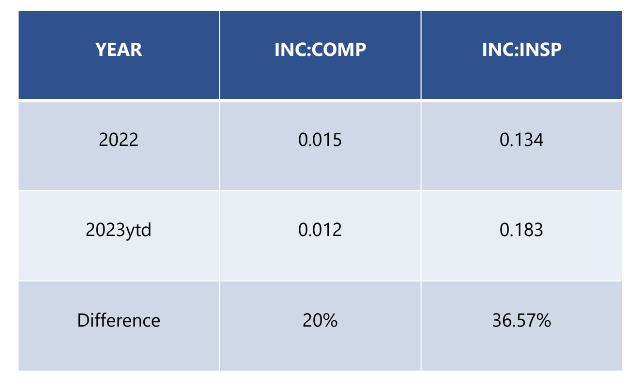
  • INCs/component are down but INCs/inspection are slightly higher. This may imply a relative increase in the inspection of high component deepwater facilities.
  • No. of hours worked is increasing; good sign for the offshore program.
  • Hand and finger injuries are driving up the injury count.
  • Well control incidents are stable at a low level.
  • Improved fire data help facilitate risk assessments
  • No YTD explosions
  • No. of collisions is down
  • 10 YTD spills> 1 barrel (total volume not specified)
  • Some evidence of decline in lifting incidents in Q2 and Q3
  • Gas releases are up (aging facilities, decommissioning related?)

Read Full Post »

Kosmos Energy announces deepwater GoM discovery. Oxy and Equinor are partners in this venture.

The Tiberius exploration well tested a four-way structural trap in the outboard Wilcox trend, located in Keathley Canyon Block 964. The well encountered approximately 250 feet (~75 meters) of net oil pay in the primary Wilcox target. Wireline logging has been completed and casing is currently being run to the target depth to enable the well to be used as a future oil producer. The Tiberius well is located in approximately 7,500 feet (2,300 meters) of water and was drilled to a total vertical depth of approximately 25,800 feet (7,800 meters).

BSEE data indicate that Kosmos has an excellent compliance record, having been cited for only 3 violations during 44 facility inspections (83 inspection types) since 1/1/2018.

Per the latest available BSEE summaries, Kosmos did not pay any civil penalties from 2019 through 2022.

One quibble: the Kosmos news release does not name the drilling unit or drilling contractor. The rig crew is the group most responsible for safely drilling the well.

Read Full Post »

For those interested in safety and compliance data, a good BSEE update for the Gulf of Mexico is attached.

Interestingly, (slide pasted below), there were 20% fewer Incidents of Noncompliance (INCs) per component inspected but 37% more INCs/inspection. This would seem to imply high INC rates at less complex (typically older) facilities with relatively fewer components.

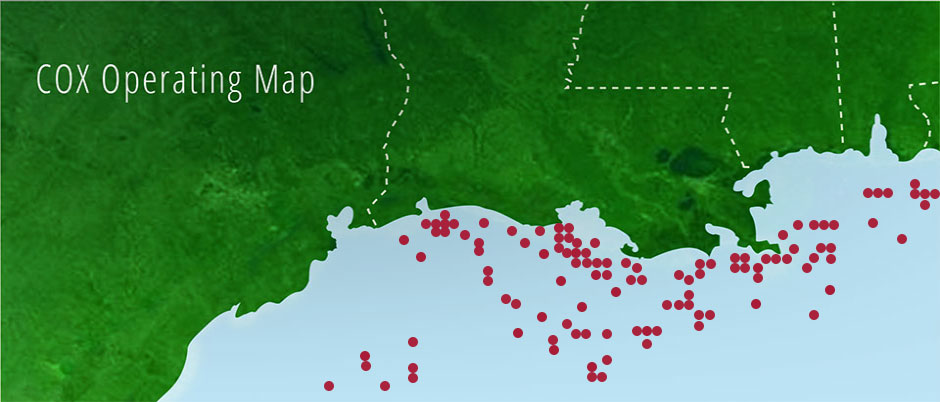
Posted 2023 inspection data indicate high INC/inspection rates for Cox and affiliates Energy XXI GOM and EPL that have filed for bankruptcy. Through August, these companies have accounted for 44% (635/1457) of all INCs issued in 2023. This may explain, at least in part, the divergence in the 2 compliance measures.

Read Full Post »

For the first time in the history of the US OCS program, Federal ontracts have been awarded for the decommissioning of facilities in the Matagorda Island area of the Gulf of Mexico. The use of taxpayer funds for this purpose should be an embarrassment for the offshore industry and its regulators, past and present.

Rather than touting these contracts, the regulators should be explaining how this happened and how it will be prevented in the future. Fortunately, BOEM’s proposed decommissioning financial assurance rule is open for comment until the end of this month, so we have an opportunity to provide input.

Matagorda Island Gas, the company whose wells the public will be plugging, had a poor compliance record, and is another example of why compliance should be a primary factor in determining supplemental financial assurance requirements.

Read Full Post »

For the first time in the history of the US offshore oil and gas program, taxpayers will be funding the plugging of OCS wells. This should be viewed as a collective failure by government and industry. Nearly 34 years have passed since the Alliance bankruptcy, the first of many wake-up calls, and we still haven’t figured this out.

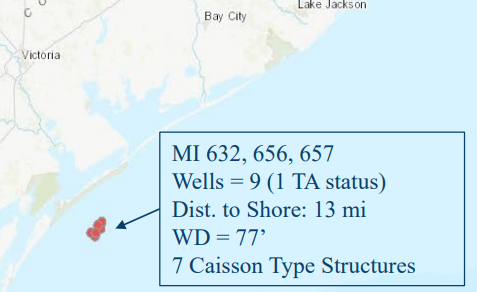
Per BSEE’s recent announcement, Federal funds will be used to plug wells in the Matagorda Island (MI) area of the Gulf of Mexico (see map below). Based on a BSEE presentation and BSEE borehole data, these wells were drilled by Matagorda Island Gas Operations LLC, a company that filed for bankruptcy in 2014.

Prior to the bankruptcy filing, Matagorda Island Gas was cited for 112 violations on 108 inspections. This INC/inspection rate is approximately double the Gulf of Mexico (all operators) rate in a typical year (0.52 in 2022), and is 4 to 25 times higher than the rate for the 2022 Honor Roll companies.

Read Full Post »

A Metairie-based oil company that’s one of the largest independent operators still working in the state’s shallow coastal waters has filed for bankruptcy protection, leaving dozens of south Louisiana service and supply companies facing potential bankruptcies of their own.

Bankruptcy court documents show Cox’s estimated liabilities are close to $500 million – more than $200 million of which is owed to small businesses in the Houma-Thibodeaux and Acadiana areas.

Court documents indicate that Cox followed a path that led to financial trouble for other companies in recent years: using debt to acquire large fields of aging wells in shallow Gulf waters.

Nola.com

This blog is primarily concerned with the potential impacts of the bankruptcy on safety performance, the plugging of wells, and the decommissioning of old facilities. Per BOEM’s data base, Cox currently operates 276 Gulf of Mexico platforms, all in shallow shelf waters. The company is reported (Nola.com) to owe $8 million in bond premiums needed to support well plugging operations.

Cox has not been an active driller of late with only 2 well starts since 1/1/2022 (BSEE borehole file).

Cox has been a major generator of INCs (incidents of noncompliance) with 437 INCs YTD. Cox has been responsible for 47% of all GoM INCs in 2023. Cox’s INC to inspection ratio was 2.46 vs. a combined ratio of 0.50 (490/972) for all other GoM operators.

Cox is currently ranked 11th and 18th respectively in GoM gas and oil production with 7.2 billion cu ft and 1.8 million barrels produced YTD.

BOE previously commented on Cox’s pursuit of Dept. of Energy funds to develop a carbon sequestration hub in the Gulf.

Read Full Post »

Linked below is an excellent compliance and incident data update by Jason Mathews. COVID-19 statistics are included. Kudos to BSEE’s Gulf of Mexico Region for their timely and comprehensive reviews and safety alerts.The collection, analysis, and timely publication of incident data are critical to safety achievement and continuous improvement.

Read Full Post »