Feeds:
Posts
Comments

Posts Tagged ‘Coast Guard’

In their comments on the Coast Guard’s Deepwater Horizon Joint Investigation Team Report, Transocean made these statements about BOP maintenance standards incorporated in MMS drilling regulations:

By glossing over the contours of the regulatory language, the Draft Report unilaterally converts API Recommended Practice 53 from an advisory guideline into a mandatory requirement. Notwithstanding the Draft Report’s insistence otherwise, the API’s recommendation that the BOP “should” be disassembled and inspected according to the manufacturer’s guidelines is not mandatory. The API clarifies that the word “should” indicates a recommended practice for which a comparably safe alternative is available or which may be impractical or unnecessary in some conditions. In contrast, to denote a recommended practice that is “advisable in all circumstances,” the API uses the word “shall.” The API also emphasizes that “the formulation and publication of API standards is not intended in any way to inhibit anyone from using any other practices.” Though it recommends specific practices, API acknowledges that “equivalent alternative installations and practices may be utilized to accomplish the same objectives.” On its face, the language of API RP 53 makes clear that the recommendation that the BOP “should” be disassembled and inspected in accordance with the manufacturer’s guidelines is a recommendation, and nothing more.

Although the MMS regulations governing BOP maintenance incorporate API RP 53 sections 17.10 and 18.10 by reference, this does not convert the API’s recommendations into a mandatory requirement. As the MMS has clarified, “[t]he legal effect of incorporation by reference” is merely that “the material is treated as if it were published in the Federal Register.”

Treating API RP 53 as if it had been published in the Federal Register does not imbue its language with more regulatory significance than it had before. The API’s recommendations regarding BOP maintenance—as well as the API’s acknowledgement that alternative practices “may be utilized to accomplish the same objectives”—remain recommendations, not requirements.  Transocean’s complete comments are posted on their website.

I’ll withhold my comments on the above statements, except to say that my opinion differs substantially from Transocean’s.

More significantly, these and other recent industry and government comments demonstrate the complexity of standards policy issues. How are standards most effectively applied by operators in formulating safety management programs, operating plans, and safety cases? Contractors? How should deviations from standards be assessed and documented? How should regulators use standards? To what extent should standards be incorporated into regulations? What is the appropriate role for regulators in standards development? These issues may prove to be more challenging than updating technical requirements. Stay tuned!
Read Full Post »

Like the National Commission on the BP Deepwater Horizon Oil Spill and Offshore Drilling, the Montara Commission of Inquiry, the Norwegian government, and leading safety and regulatory authorities around the world, the IADC recognizes the risks associated with complex, multi-agency regulatory regimes. A single authority should be responsible and accountable for safety and pollution prevention at offshore facilities, and should draw on the expertise of other agencies and organizations as necessary to achieve performance objectives. 

The safety and environmental  risks associated with fragmented or compartmentalized regulation include gaps, overlap, confusion, inconsistencies, and conflicting standards. Industry and governmental personnel spend too much time coordinating with multiple parties and not enough time managing safety and environmental risks.

Link to IADC comments.  Key quotes:

IADC continues to be concerned by seemingly duplicative regulatory requirements imposed by the Coast Guard and BOEMRE, particularly where the agencies appear to have divergent views regarding the placement of regulatory responsibility.

One cannot holistically address safety when faced with the unyielding and overlapping demands of multiple narrowly-focused regulatory agencies.

Read Full Post »

Ohmsett

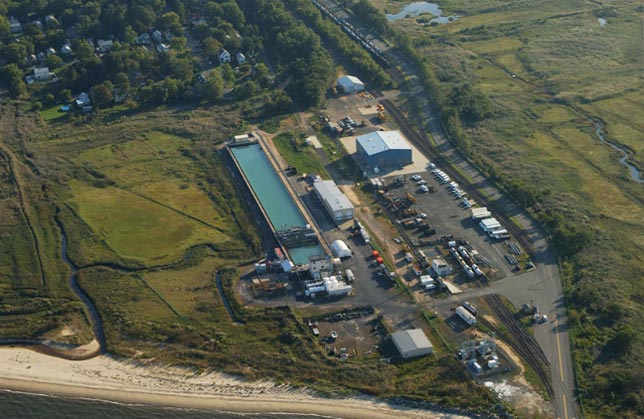
Yesterday’s Platt’s Oilgram News included an excellent Gary Gentile piece about Ohmsett and the recent visit by BOEMRE Director Bromwich and Admiral Zukunft of the Coast Guard. Both had high praise for this outstanding oil spill response test facility which has contributed greatly to improved understanding of boom and skimmer performance, in situ burning, and chemical treating agents. This quote from the Platt’s article gives you a sense of the facility’s importance:

AbTech Industries spent two days at OHMSETT testing a new polymer it hopes will be able to sop up hydrocarbons from produced water or water used in hydraulic fracturing. The company pumped saltwater contaminated with Louisiana crude at rates of up to 250 gallons per minute through its filtering system. “The facility is tremendously unique,” AbTech Chief Operating Officer Jonathan Thatcher said in an interview. “I don’t know where else we would go where we could pump up to 250 gallons per minute for days on end and contaminate it. It allows you to go and make any mistakes you need to make.”

As we have said before, those who claim that there has been no progress in spill preparedness either have no real interest in spill response or have not been paying attention. Much has been accomplished.

Kudos to spill response visionaries like Ed Tennyson and John Gregory, MMS employees who had been pushing for the re-opening of Ohmsett since EPA closed the facility in the mid-1980’s.  After the Valdez spill in 1989 they received the necessary support, and the facility has been going strong since its re-opening in 1992.

Read Full Post »

News: BOEMRE releases report on the September 2010 Mariner Fire in the Gulf of Mexico.
BOE Comments:

  • Good report and relatively timely. Nice job by the team.
  • Good discussion of the heater-treater and production safety issues.
  • This was a very serious incident and lives were jeopardized. Sadly, no oil spill means no public attention.
  • Why didn’t the Coast Guard participate in the investigation? Will they be reporting on the haphazard evacuation?
  • Age old question: Is the rather extensive discussion of violations appropriate for an accident report? Should violations and enforcement actions be managed independently from accident investigations?
BOE: Floating liquefaction facilities open interesting possibilities for producing natural gas in remote offshore locations, possibly including the arctic.  The first FLNG facility will be 488 m from bow to stern! Offshore to the future!
BOE: Lots of posturing and not much in the way of meaningful proposals from either party. Unlike Australia, the US has not responded to its blowout with necessary legislative action, most notably the establishment of a single offshore safety and pollution prevention regulator.
BOE: Engineers solve problems when given the opportunity and encouragement. JL Daeschler is busy at the drawing board!
News: Greenland rolls on. despite Greenpeace protests. Cairn Energy has begun a second summer of drilling.
Views: Last summer’s results must have been sufficiently encouraging to justify further exploration. 
News: Hurricane season officially begins tomorrow.
BOE: There has been surprisingly little public discussion about the offshore industry’s preparations. Hopefully, everyone is ready.
BOE: Where is the worldwide commitment from industry and government? This problem can and must be fixed!

Read Full Post »

Good report; worth reading.  Some of the positive points are unlikely to get much attention, so we’ll mention them here:

  1. The National Incident Management System/Incident Command System worked as intended
  2. Personnel provided by the Responsible Party (RP) and Coast Guard personnel worked effectively together, and there was “unity of effort” throughout the response organization.
  3. The team found no evidence of collusion between the Coast Guard and RP.
  4. The response generally benefited from the ability of the Government and the private sector to rapidly assess and adapt to new or unusual contingencies and develop innovative solutions for problems not previously experienced.
  5. The knowledge acquired and capabilities learned from this experience are unprecedented, and should become a basis for significant improvements in planning, preparedness, and response for industry, Government, and the response community.

The “Political Demands” section beginning on page 75 includes relatively candid observations on the challenges associated with the management of such a high profile response.

Read Full Post »

While C-SPAN has broadcast some of the proceedings, the Deepwater Horizon Joint Investigation hearings have inexplicably not been streamed live by the Coast Guard (USCG) and Department of the Interior (DOI).  The National Commission and Chemical Safety Board streamed their hearings live, but the USCG and DOI have not done so.  Why? This is perhaps the most significant accident in the history of the US offshore oil and gas program, and the most notable worldwide offshore disaster since Piper Alpha in 1988. Eleven men died on the Deepwater Horizon.  Economic costs will total in the tens of $billions. Major regulatory changes, some of which don’t appear to address identified risks, are being imposed.

The upcoming hearings are particularly important because the BOP issues that will be discussed have enormous international significance. In this era, the world shouldn’t have to travel to New Orleans to observe the hearings, rely on sketchy press reports, or wait months for transcripts to be released. (And how is it that the Montara Inquiry Commission in Australia was able to post transcripts within hours after the conclusion of each day’s hearing?)

Accident prevention is dependent on complete and timely information.  Had more people paid attention to Montara, Macondo may have been prevented. The upcoming Deepwater Horizon BOP hearings are of critical importance, and should be streamed so that all interested parties can follow the proceedings.

Read Full Post »

Our oil spill expert, Cheryl Anderson, has been monitoring the Gulf of Mexico slick reports, and has provided the following update:

Excerpt from a NOLA.com article below published 4-5 hours after yesterday’s Coast Guard media briefing regarding the source of the latest slick in Louisiana state waters :

A state official, speaking on condition of anonymity because of a continuing Coast Guard investigation, said the Department of Wildlife and Fisheries traced the emulsified oil on the west side of the river to its apparent source at West Delta Block 117. He said tests by a state-contracted lab confirmed that was the source of the oil.

Wildlife and Fisheries officials found the source of the oil Monday evening and encountered workers in a boat trying to restore a cap on the well using a remotely operated submarine.

There was a USCG Media Briefing at 2 pm local time Monday [4-5 hours before the NOLA.com article was published]. The briefing confirmed that the 100-mile sheen on Saturday was not petroleum, just sediments from water disturbances.

With regard to the most recent slick, the Coast Guard said:

–no source had been identified,

–no active spill incidents had been identified,

–spill had been Federalized,

–testing showed that it was Louisiana crude, and

–LSU was still working on the tests to see if the oil matched the Macondo well or any recorded previous spill incident.

Read Full Post »

Kudos to:

  1. The US Coast Guard for promptly analyzing the Gulf of Mexico sheen that was reported over the weekend and determining that it was not associated with offshore oil and gas production.
  2. The many news organizations and journalists who ignored the irresponsible speculation, and waited for the Coast Guard to complete its investigation.

Read Full Post »

Wall Street Journal:

What was reported as a miles-long oil slick in the Gulf of Mexico is likely a plume of silt emanating from a dredging operation on the Mississippi River, a U.S. Coast Guard spokesman said Sunday.

So much for the hysterical post-Macondo rush to judgement by a few reporters.

Read Full Post »

The Examiner is reporting the following:

The oil sheen is suspected of coming from the Matterhorn field which includes a deepwater drilling rig, Matterhorn Seastar that is owned by W&T Technology.   The oil is suspected from coming from a leak in the well which is a producing well.

Suspected by whom? Does the reporter have legitimate information or is this rank speculation? The Coast Guard is sorting this out, so we should know something soon. A statement from W&T would be helpful.

Read Full Post »

« Newer Posts - Older Posts »