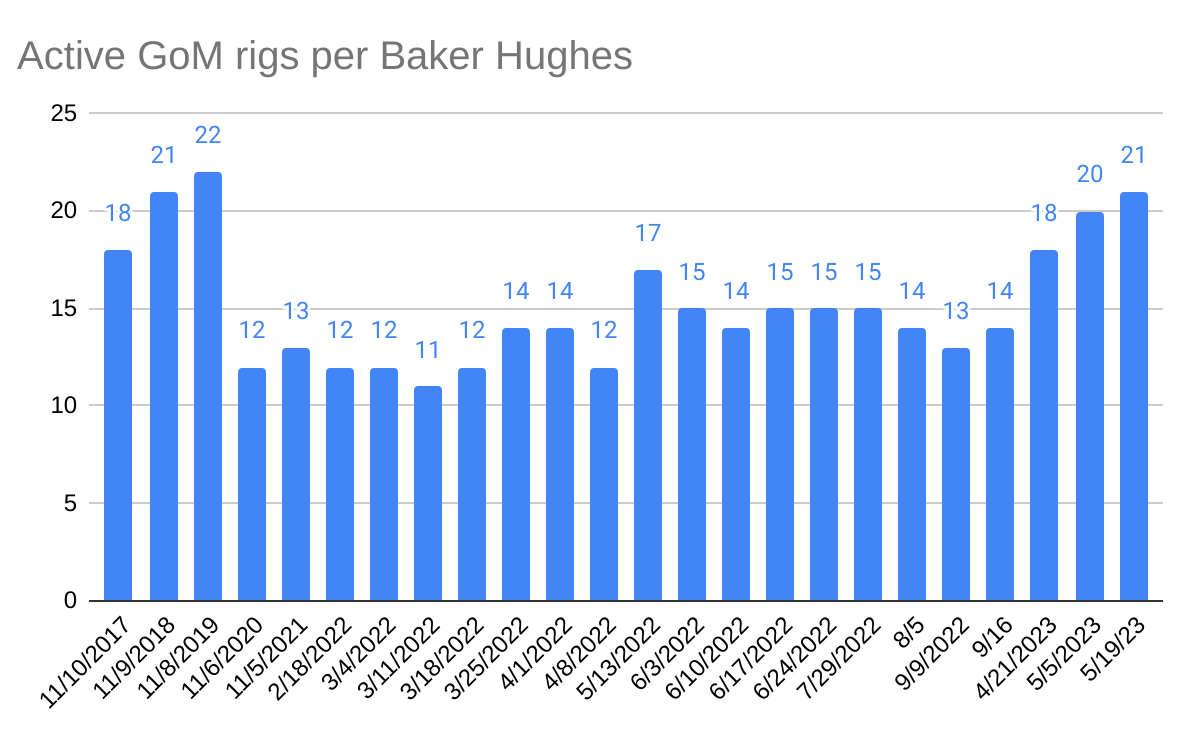
The latest Baker Hughes Rig Count Report shows only 10 rigs actively drilling in the Gulf. All are at deepwater locations – 7 in the Mississippi Canyon area, 2 in Green Canyon, and 1 in Alaminos Canyon. Per the BSEE borehole file, Shell accounts for most of the current MS Canyon wells and the Alaminous Canyon well. Beacon is also drilling in the MS Canyon, and the Green Canyon well appears to be a Chevron operation.
Only Anadarko/Oxy, Beacon/BOE, BP, Chevron/Hess, Shell, and Talos have spudded deepwater exploratory wells in 2025 YTD. Arena and Cantium are the only shelf drillers – all development wells.
Technological advances and extensions of past discoveries have sustained Gulf production, but declines are certain over the longer term if drilling activity doesn’t increase. Oil price uncertainty is an issue, but that’s always the case. Semiannual lease sales are now legislatively required and the terms will be attractive, so those issues are off the table. Let’s see what the bidding looks like at the upcoming sale.
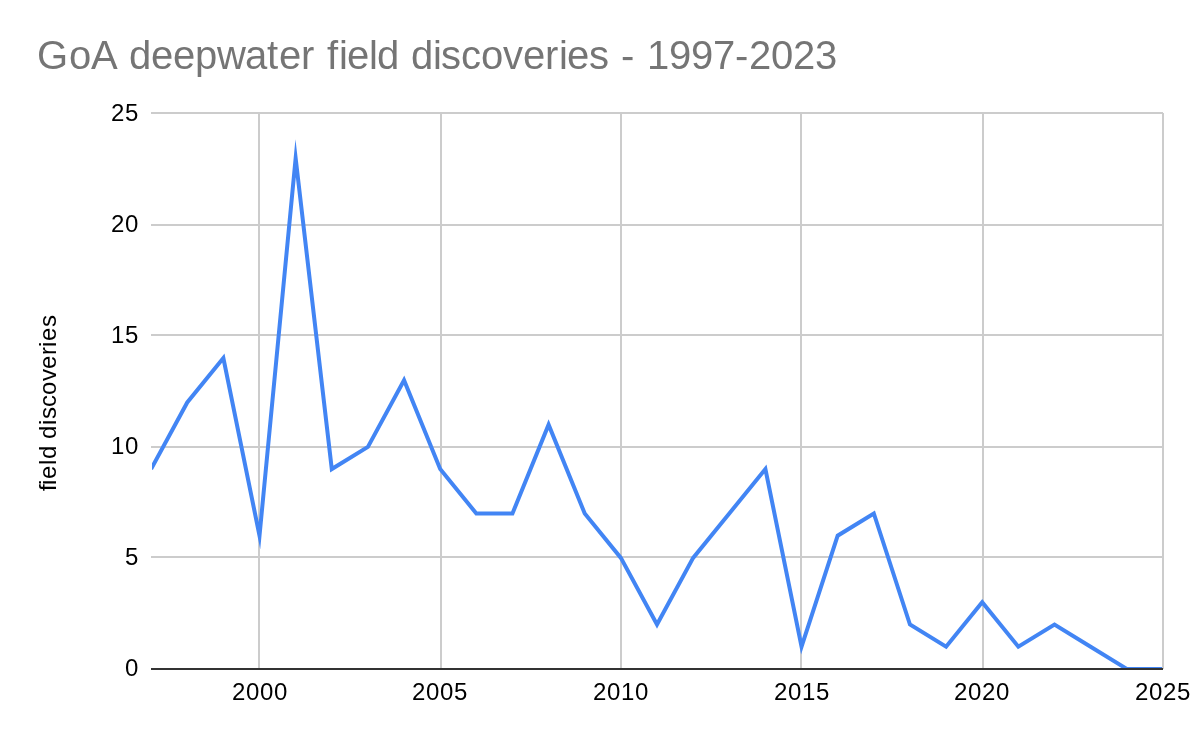
The decline in deepwater discoveries (BOEM data below) is particularly discouraging. Per BOEM, the last deepwater field discovery was in March 2023.
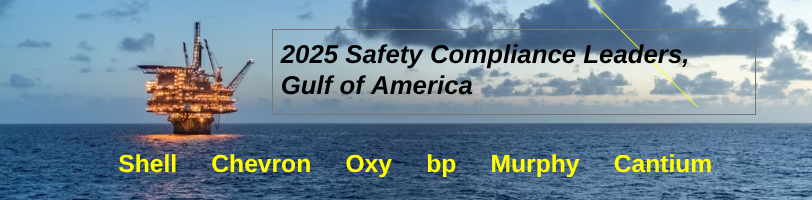
The 2024 Gulf of America Safety Compliance Leaders are ranked below according to the number of incidents of non-compliance (INCs) per facility inspection. To be ranked, a company must:
operate at least 2 production platforms
have drilled at least 2 wells during the year
average <1 INC for every 3 facility inspections (0.33 INCs/facility inspection)
average <1 INC for every 10 inspections (0.1 INCs/inspection). Note that each facility inspection may include multiple types of inspections (e.g. production, pipeline, pollution, Coast Guard, site security, etc). In 2024, there were on average 3.4 inspections for every facility inspection.
District investigation reports are more timely and provide additional insights into safety performance. Impressively, Hess had no incidents warranting a District investigation, and was the only ranked operator with this distinction. I will comment more on the District reports in a future post
Chevron’s 2024 compliance record was among the best in the history of the US OCS oil and gas program. Was it the absolute best? Were it not for the FSI INC at a Unocal (Chevron) facility, one could unequivocally assert that it was. Further evaluation of that INC would be helpful. However, details on specific INCs are not publicly available, so the significance of that violation cannot be evaluated.
operator
W
CSI
FSI
total INCs
facility insp
INCs/ fac insp
insp
INCs/ insp
Chevron
1
0
1
2
117
0.02
311
0.006
BP
2
3
0
5
93
0.05
251
0.02
Anadarko
8
9
1
18
143
0.13
344
0.05
Hess
2
3
0
5
26
0.19
67
0.07
Walter
6
4
1
11
50
0.22
161
0.07
Shell
23
17
5
45
199
0.23
495
0.09
Cantium
24
8
0
32
123
0.26
537
0.06
Murphy
8
9
1
18
70
0.26
191
0.09
Arena
29
28
3
60
189
0.32
803
0.07
Gulf-wide
957
398
109
1464
3133
0.47
10664
0.14
Notes: Numbers are from published BSEE data; INC=incident of non-compliance; W=warning INC; CSI=component shut-in INC; FSI=facility shut-in INC; INCs/fac insp= INCs issued per facility inspection; each facility-inspection may include multiple types of inspections (e.g. production, pipeline, pollution, Coast Guard, site security, etc), in 2024, there were on average 3.4 inspections for every facility inspection
Not meeting the production facilities requirement to be ranked among the top performers, but nonetheless noteworthy, was the compliance record of BOE Exploration & Production (no relation to the BOE blog 😀). See their impressive inspection results below:
W
CSI
FSI
total INCs
facility insp
INCs/ fac insp
insp
INCs/ insp
BOE
1
1
0
2
21
0.1
48
0.04
Transparency on inspections and incidents is important for a program that is dependent on public confidence. For independent observers to better evaluate industry-wide and company-specific safety performance, publication of the following information should be considered:
quarterly updates of the incident tables, as was once common practice
posting of violation summaries for inspections resulting in the issuance of one or more INCs
A post from last March discussed the high and seemingly unfair royalty and rental rates for new leases in the shallow waters of the Gulf of Mexico shelf. A 50% increase in the shelf royalty rate for lease sales 259 and 261 combined with rather punitive rental rates have likely contributed to the sharp decline in bidding for shelf lease blocks (see table below).
This decline in shelf bidding is unfortunate because the smaller companies that operate in the shallow waters of the Gulf are critical to sustaining the production infrastructure. These companies are also significant producers of environmentally favorable nonassociated (gas-well) natural gas.
lease sale
shelf blocks with bids (excluding CCS bids)
sum of high shelf bids ($million, excluding CCS bids)
BOEM has completed their evaluation of the Sale 261 shelf bids (see below). Each of these blocks received only a single bid, and every bid was accepted. Ironically, the invalid CCS bids for blocks that have no oil and gas value, were the first to be accepted. This was also the case for Sales 257 and 259.
Company
Block
high bid ($) per acre ($)
date accepted
Byron
SM 60
128,750 25.75
2/2
Byron
SM 70
182,235 33.32
2/20
Cantium
GI 35
125,000 25.00
2/20
Cantium
GI 36
125,000 25.00
2/20
Cantium
MP 314
125,000 25.00
3/12
Cantium
SP 63
125,000 25.00
3/12
Arena
EI 231
135,000 27.18
2/20
Arena
EI 277
135,000 27.18
2/20
Arena
EI 281
135,000 27.18
2/20
Arena
EI 340
135,000 27.18
2/20
Arena
EI 343
135,000 27.18
2/20
Arena
WD 119
135,000 26.75
3/12
Focus
V 152
121,152 25.16
2/20
Repsol
36 CCS bids
187,200 (1) 32.50
1/23
(1) All of the Repsol bids were $32.50/ac. Total bids varied by block size, but were $187,200 for the 5760 acre blocks.
Suggestions:
Seek a legislative fix to the Inflation Reduction Act😉 provision that established a 1/6 royalty rate floor for all OCS leases (formerly the royalty rate was 1/8 for leases on the shelf).
In the interim, administratively lower the royalty for shelf leases to 1/6 (from 18 3/4%).
For future oil and gas lease sales, accept all high bids that exceed the specified minimum bid (currently $25/ac for the shelf). The Gulf of Mexico shelf has been extensively explored and developed for 70 years. While prospects remain, they are generally marginal as evidenced by the recent lease sale results. Fair market value is what any company is willing to bid (above the specified minimum).
Focus on assuring that lease purchasers are technically qualified to minimize safety risks, and that financial assurance for decommissioning (for new and existing leases owned by the high bidder) has been fully addressed.
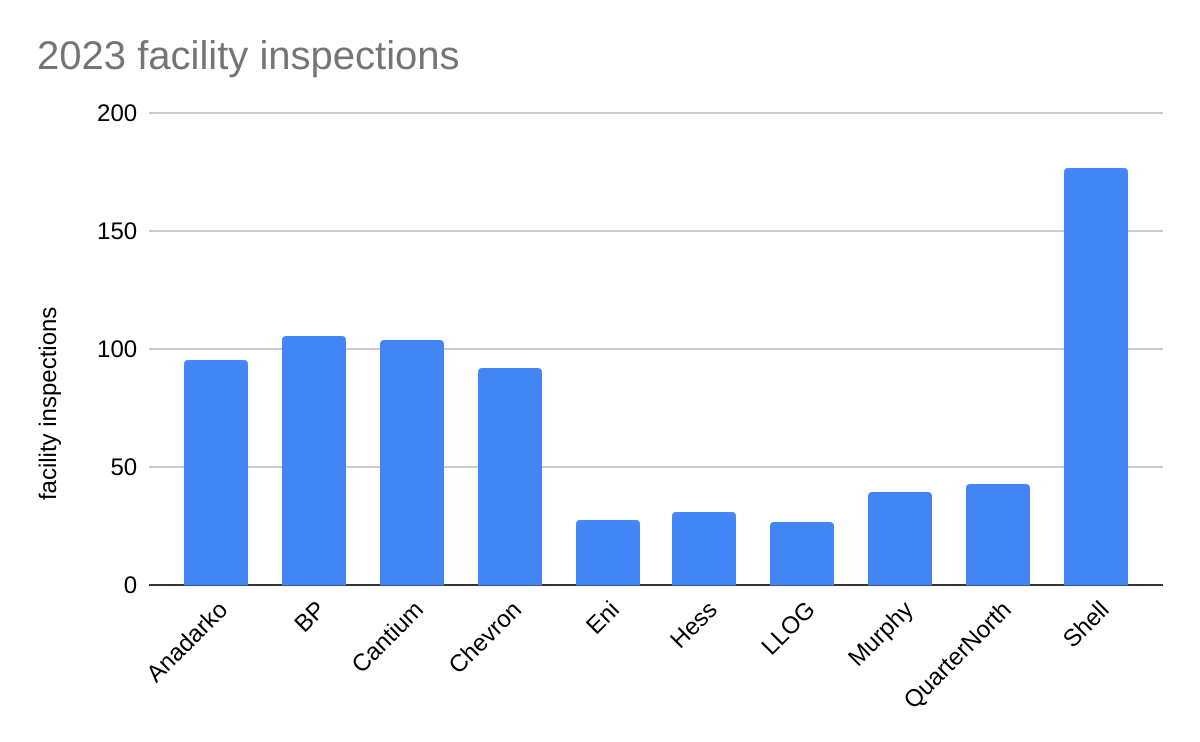
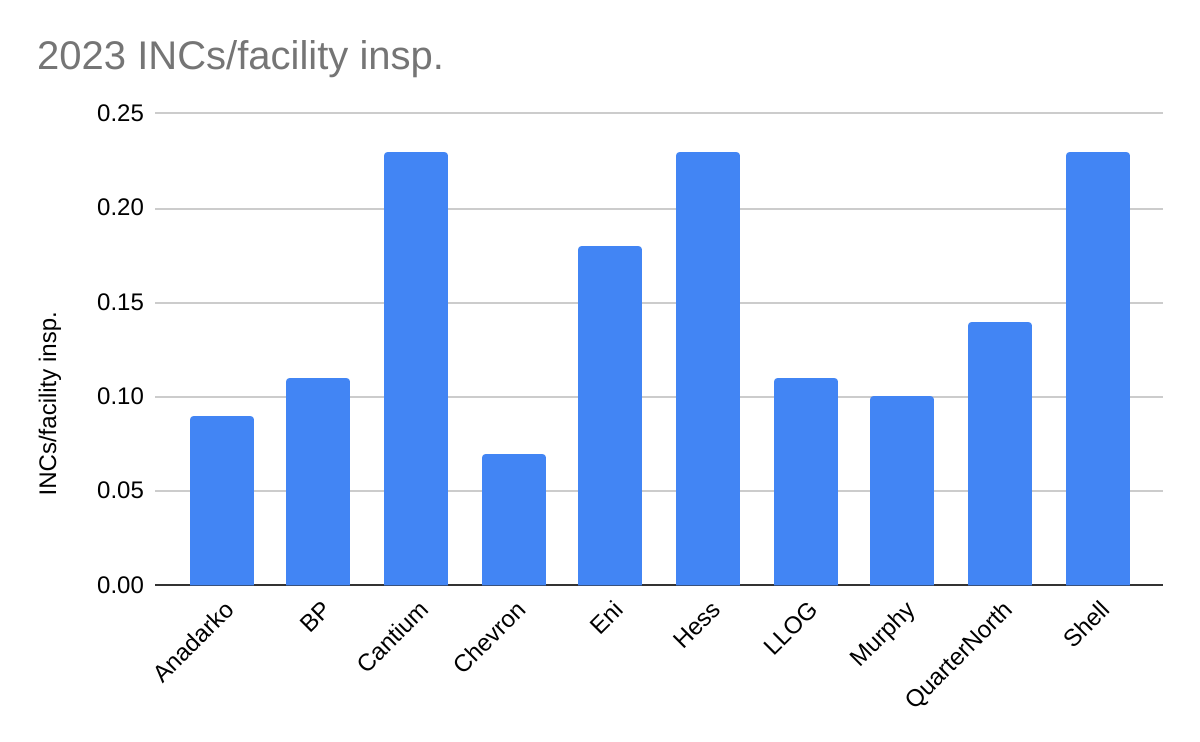
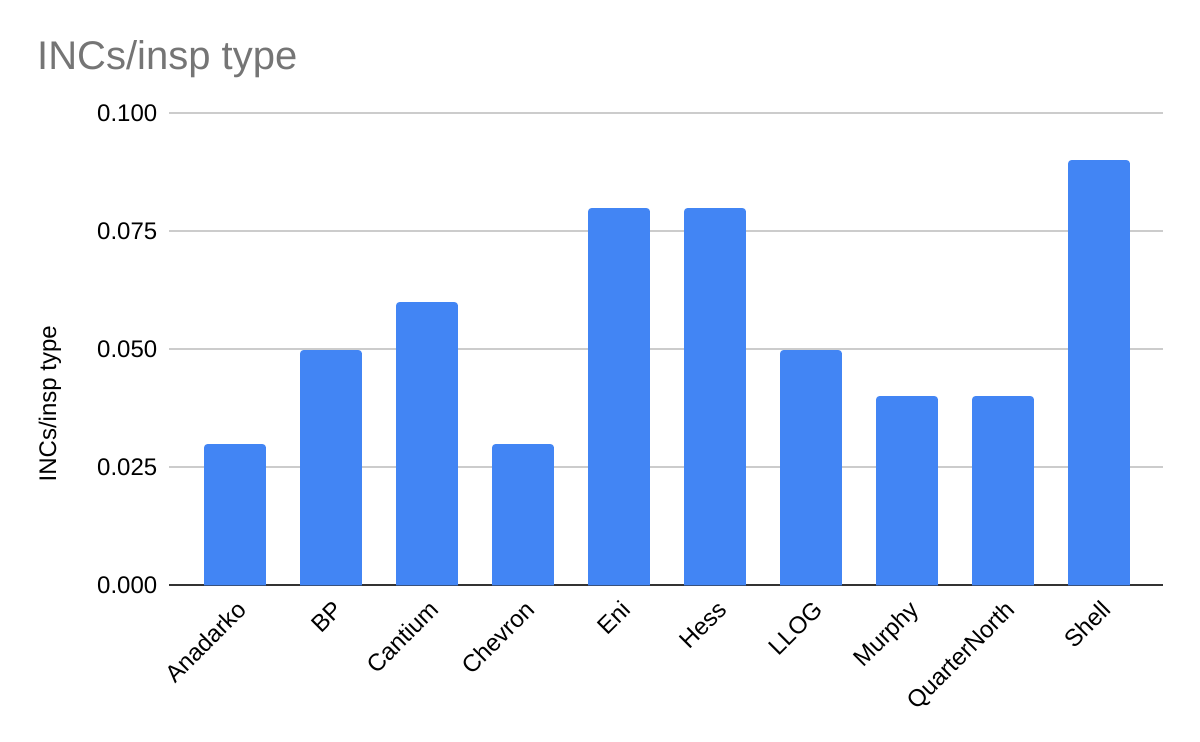
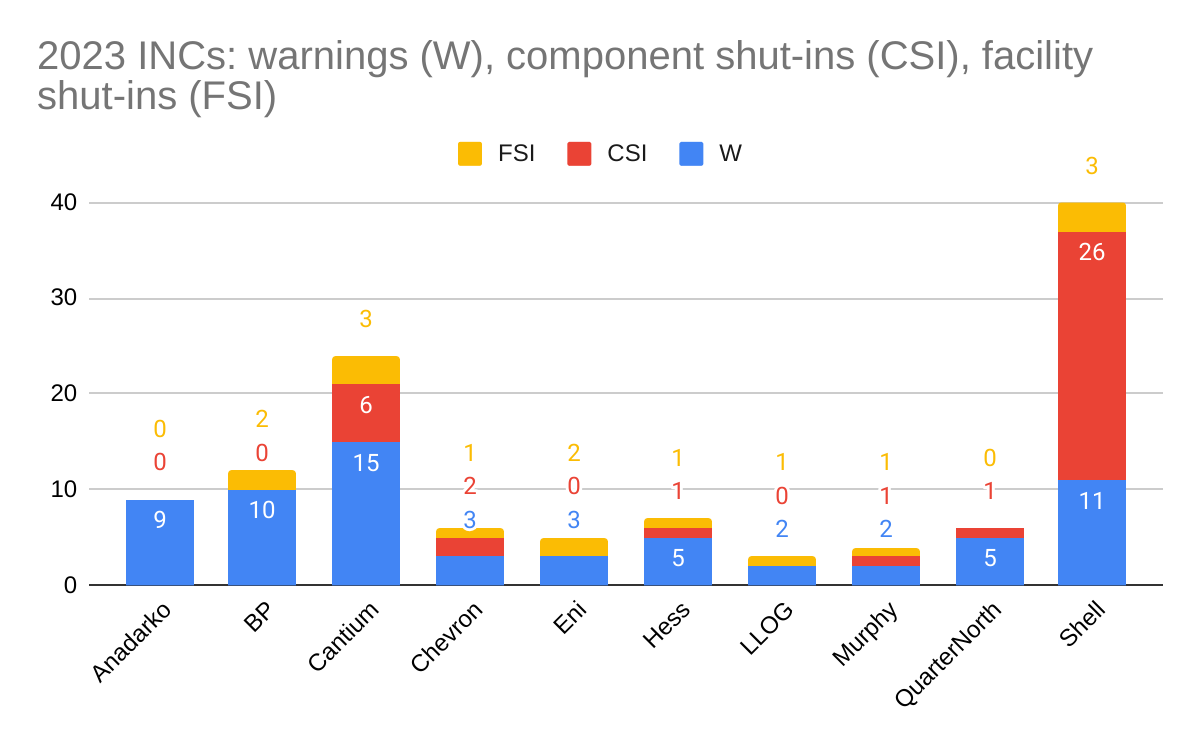
The Honor Roll companies for 2023 (listed alphabetically) are Anadarko, bp, Cantium, Chevron, Eni, Hess, LLOG, Murphy, QuarterNorth, and Shell.
BOE Honor Roll criteria:
Must average <0.3 incidents of noncompliance (INCs) per facility-inspection.
Must average <0.1 INCs per inspection-type. (Note that each facility-inspection may include multiple types of inspections (e.g. production, pipeline, pollution, Coast Guard, site security, etc). On average, each facility-inspection included 3.3 types of inspections in 2023. Here is a list of the types of inspections that may be performed.
Must operate at least 3 production platforms and have drilled at least one well (i.e. you need operational activity to demonstrate compliance and safety achievement).
May not have a disqualifying event (e.g. fatal or life-threatening incident, significant fire, major oil spill). Due to the extreme lag in updates to BSEE’s incident tables, district investigations and media reports are used to make this determination.
platforms
2023 well starts
2023 (10 mos.) oil prod. (million bbls)
2023 (10 mos.) gas prod. (bcf)
Anadarko
10
11
66
60
BP
7
11
105
65
Cantium
96
10
5
6
Chevron
8
10
67
39
Eni
3
1
6
13
Hess
3
3
18
36
LLOG
10
7
25
35
Murphy
7
4
42
57
QuarterNorth
9
1
13
23
Shell
20
20
141
140
Also noteworthy:
Zero shut-in violations for Anadarko in 2023
<1 INC for every 10 facility inspections for Anadarko, Chevron, and Murphy
<1 INC for every 20 inspections (all types) for Anadarko, bp, Chevron, LLOG, Murphy, and QuarterNorth
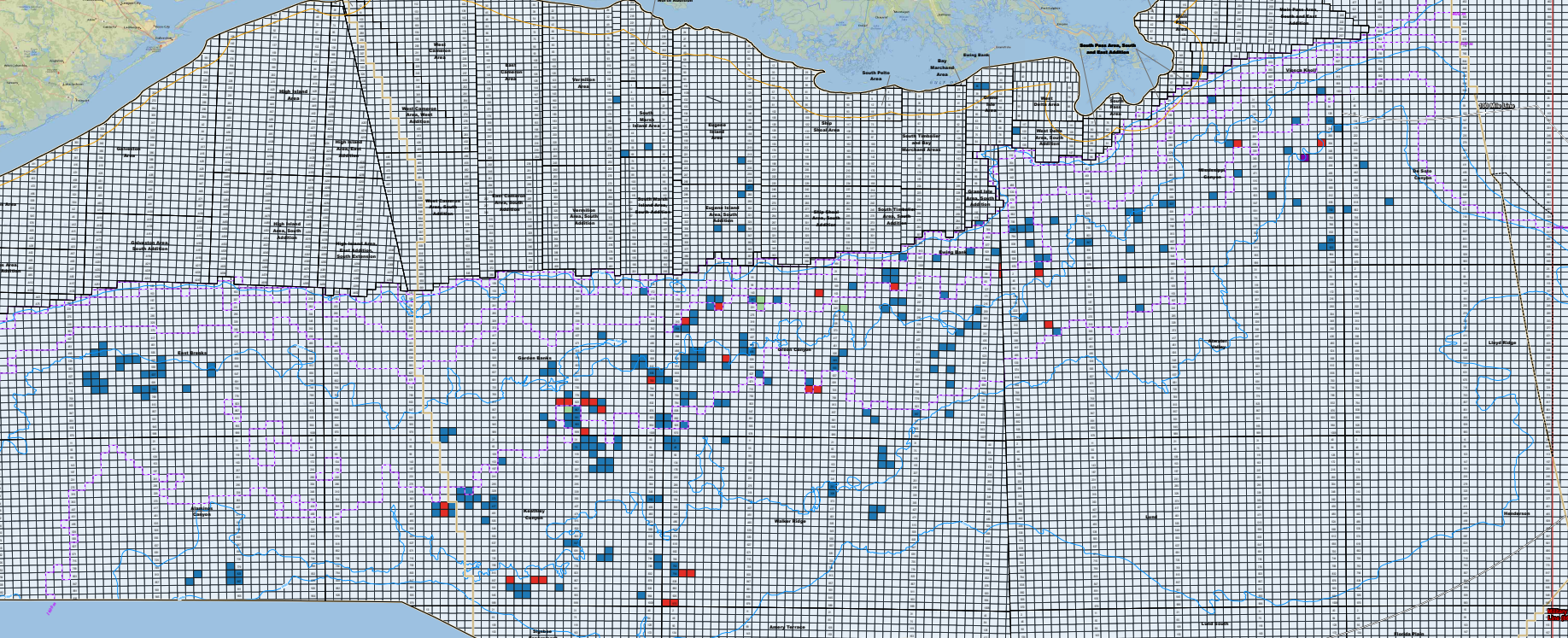
Sale 261: single bid tracts in blue, multi-bid tracts in red (2), green (3), and purple (5)
The interest of the majors and most independents has shifted entirely to deepwater prospects, as evidenced by the above graphic and sale data. Nonetheless, a few resourceful companies continue to find value in the shallow waters of the continental shelf.
“There’s an art to finding oil—particularly in the Gulf of Mexico. After decades of drilling, this world-class basin still holds vast potential for those skilled enough to unlock it. Arena energy is applying expert insight and advanced technology to identify new Gulf of Mexico oil and gas exploration opportunities. This is the art of oil finding in the 21st century.“
Arena Energy, a successful shelf operator for a quarter of a century, was the leading shelf bidder with 6 high bids. In 2023 Arena was once again the most active shelf driller with 20 well starts. They claim a 94% drilling success rate. Arena currently operates 123 platforms and is the GoM’s 7th ranked natural gas producer and the 11th ranked oil producer.
Cantium, another leading shelf operator, was the high bidder on 4 tracts. Cantium drilled 10 wells in 2023 and currently operates 86 platforms. Cantium claims to maintain “the highest level of operational safety and regulatory compliance by maximizing efficiencies and empowering employees,” and publicly available compliance data bear that out. Cantium was a BOE Honor Roll company for 2022, and a preliminary look at the data indicates that their 2023 performance was also excellent. Cantium is ranked 18th in both oil and natural gas production.
Byron Energy, which is headquartered in Australia, is the only international company investing in the GoM shelf. Byron was the high bidder on 2 tracts and currently operates 2 platforms. The company drilled 3 wells in 2023. Byron intends to continue focusing on the shallow waters of the Gulf.
Thoughts on the attributes of a successful shelf operator:
Bid alone and conduct operations independently to facilitate efficiency and timely decisions.
Lean and flat organizational structure for optimal communication and effective project management.
Skilled staff and state-of-the art exploration technology.
Outstanding contractor selection and oversight.
Safety, environmental, and compliance leadership, absent which your company won’t be around for long.
Think small. Gleaning old fields and producing modest new discoveries can be profitable!
Control growth and debt. Busts follow booms and highly leveraged companies are the most vulnerable.
Study the successful shelf operators and the failures. What did they do right and wrong?
Cantium’s record is especially impressive given that most of their platforms were installed more than 40 years ago and some date back to the 1950s. They have also been a very active development well driller.
While Kosmos and Beacon have somewhat lower violation and penalty exposure because their production is via subsea wells tied back to surface facilities operated by other companies, they are demonstrating that entrepreneurial deepwater independents can also be safety leaders.
“The Pickerel-1 prospect was our first (exploration well on the Mississippi Canyon 727) and we are delighted that it was an oil discovery. Black Pearl will be the next and that will hopefully be a tieback (to Tubular Bells with first oil expected mid-2024).
“Then we have a wildcat opportunity (the Vancouver exploration prospect) later in the year in the Green Canyon. With the other 80 exploratory blocks that we have in the Gulf, we will be actively drilling for the next several years,” Hess said.
Per the BSEE borehole file, there were 2 deepwater exploratory well starts since 4/1/2023. The Shell well is another GoM milestone in that it is the 150th well spudded in >8000′ of water. The first was in the year 2000.
Operator
spud date
location
water depth
Chevron
5/5/2023
Mississippi Canyon 608
6678′
Shell
4/13/2023
Alaminos Canyon 728
8660′
Arena and Cantium continue to drive shelf drilling. Below are the shelf development wells since 4/1/2023:
Deepwater (>1000′) activity continues to dominate, accounting for 61% of the well starts.
Not a single company drilled both shelf and deepwater wells.
While shelf facilities currently account for only about 7% of GoM oil production, 1122 of the 1179 remaining platforms are on the shelf and they account for 24% of GoM gas production, most of which is environmentally favorable nonassociated gas.
Two companies, Arena and Cantium, accounted for 75% of the shelf well starts. Excluding the CCS bids, Arena and Cantium were the most active shelf bidders in Sale 279. Arena bid alone on 7 blocks. Cantium was the high bidder on 5 blocks. (Focus Exploration was high bidder on 4 shelf blocks and was “outbid” by Exxon for High Island 177.)
One company, Shell, accounted for 39% of the deepwater well starts
One of BP’s exploratory wells (drilled subsequent to Sale 257) was in Green Canyon 821, immediately south of GC 777, the block that BP/Talos bid $1.8 million for in Sale 257. That bid was rejected by BOEM. In sale 259, BP was the sole bidder for GC 777, and their bid was only $583,000, less than 1/3 of their Sale 257 bid. Perhaps the GC 821 exploratory well reduced the value of GC 777? Will this lower bid now be accepted?
DW expl
DW dev
shelf expl
shelf dev
Anadarko
5
1
Arena
22
BOE
1
4
BP
2
3
Byron
2
Cantium
20
Chevron
3
Contango
2
Cox
2
Eni
2
5
EnVen
5
Greyhound
2
Hess
2
Kosmos
1
LLOG
3
1
Murphy
4
QuarterNorth
2
Shell
25
9
Talos
2
8
Walter
1
Woodside
3
1
Gulf of Mexico well starts during 2022 and the first quarter of 2023
The Honor Roll companies for 2022 (listed alphabetically) are Anadarko (Oxy), bp, Cantium, Chevron, Contango, Hess, LLOG, Murphy, and Shell.
Our criteria:
Must average <0.3 incidents of noncompliance (INCs) per facility-inspection.
Must average <0.1 INCs per inspection-type. (Note that each facility-inspection may include multiple types of inspections (e.g. production, pipeline, pollution, Coast Guard, site security, etc). On average, each facility-inspection included 3.25 types of inspections in 2022. Here is a list of the types of inspections that may be performed.)
Must operate at least 3 production platforms and have drilled at least one well (i.e. you need operational activity to demonstrate compliance and safety achievement).
May not have a disqualifying event (e.g. fatal or life-threatening incident, significant fire, major oil spill). Due to the extreme lag in updates to BSEE’s incident tables, investigation and news reports are used to make this determination.
Pacific and Alaska operations will be considered separately.
Without much hype, shelf operators continue to find and extract oil and gas from beneath the shallow waters of the GoM. The 1700 shelf platforms that remain provide energy for our economy and important hardbottom substrate for marine life. Keep it going! Only 25 more years until the 100th anniversary! 😀