Feeds:
Posts
Comments

Posts Tagged ‘AnadarkoOxy’

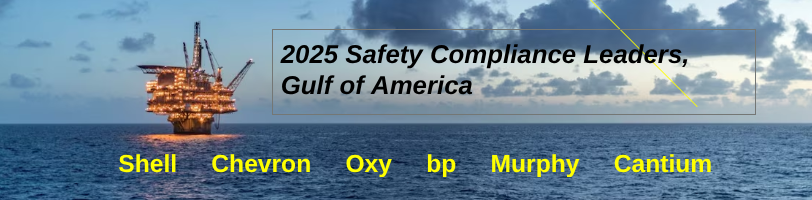
The 2025 Gulf of America Safety Compliance Leaders are ranked below according to the number of incidents of non-compliance (INCs) per facility inspection. To be ranked, a company must:

  • operate at least 2 production platforms
  • have drilled at least 2 wells during the year
  • average <1 INC for every 5 facility inspections (0.20 INCs/facility inspection). This is a higher standard (fewer INCs) than in previous years.
  • average <1 INC for every 10 inspections (0.1 INCs/inspection). Note that each facility inspection may include multiple types of inspections (e.g. production, pipeline, pollution, Coast Guard, site security, etc). In 2025, there were on average 3.2 inspections for every facility inspection.
operatorWCSIFSItotal INCsfacility inspINCs/
fac insp
inspINCs/
insp
Shell381122310.055570.02
Chevron1080182600.077720.02
Oxy26191330.073250.03
BP820101220.083040.03
Murphy6208700.111770.05
Cantium574161210.134880.03
Gulf-wide 202581544584134431790.42102180.13
Gulf-wide 2024957398109146431330.47106640.14
Notes: Numbers are from published BSEE data; INC=incident of non-compliance; W=warning INC; CSI=component shut-in INC; FSI=facility shut-in INC; INCs/fac insp= INCs issued per facility inspection; each facility-inspection may include multiple types of inspections (e.g. production, pipeline, pollution, Coast Guard, site security, etc), in 2025, there were on average 3.2 inspections for every facility inspection

Criteria: This ranking is based solely on BSEE’s published compliance data. The absence of timely public information on safety incidents (e.g. injuries, fires, pollution, gas releases, property damage) precludes inclusion of these data. Although Panel Investigations are conducted for fatalities, serious injuries, and significant pollution events, the last panel report was for an incident on 3/25/2022, and no information is available for any ongoing investigations. BSEE District offices investigate the more significant incidents that don’t qualify for panel investigations. These District Investigation reports are more timely, but some are not issued within 90 days of the incident. The District reports will be reviewed later in the year. Note that there were no occupational fatalities in 2025.

Observations:

  • The overall inspection and INC results for 2025 were similar to those for 2024.
  • The top companies performed better in 2025 than in 2024. In 2024, only 2 companies had INC/facility inspection ratios of <0.10 and only 3 had ratios <0.15. In 2025, all 6 of the performance leaders had ratios <0.15.
  • All 6 of these top companies were also on the 2024 top performers list.
  • Shell’s total INCs and INCs/facility inspection decreased by 73% and 78% respectively vs. 2024
  • Cantium, which operates 85 shallow water platforms, has demonstrated that a shelf operator can be an outstanding safety performer. Cantium’s total INCs and INCs/facility inspection decreased by 50% vs. 2024
  • Should fewer inspections be conducted at facilities that have such low INC rates? On the one hand, fewer inspections would reduce regulatory costs and transportation risks. On the other hand, there are benefits from BSEE inspection visits besides compliance enforcement. These include direct communication with offshore workers (including contractors) regarding regulatory policies and safety practices, witnessing safety tests, evaluating new technology, and assessing management system implementation and corporate culture at the facility level.
  • Absent specific details on the violations, no attempt was made to weight the INCs. Although shut-in INCs are generally considered to be more significant than warnings, that is not always the case. For example, a component shut-in INC for a safety device that is marginally out of tolerance and is corrected on the spot may be less serious than a warning that is indicative of structural deterioration, poor maintenance, or organizational shortcomings.

Not meeting one of the activity level requirements, but nonetheless noteworthy, were the compliance records of LLOG and BOE Exploration & Production (younger than and unrelated to the BOE blog 😀). See their impressive results below:

operatorWCSIFSItotal INCsfacility inspINCs/
fac insp
inspINCs/
insp
BOE0011330.03780.01
LLOG1113290.10780.04

Read Full Post »

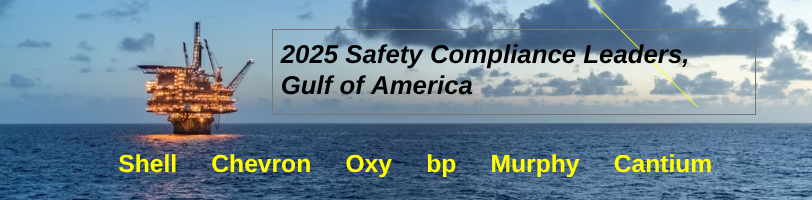
Shell topped the list followed by Chevron, Oxy/Anadarko, bp, Murphy, and Cantium.

Details and observations will be posted tomorrow.

Read Full Post »

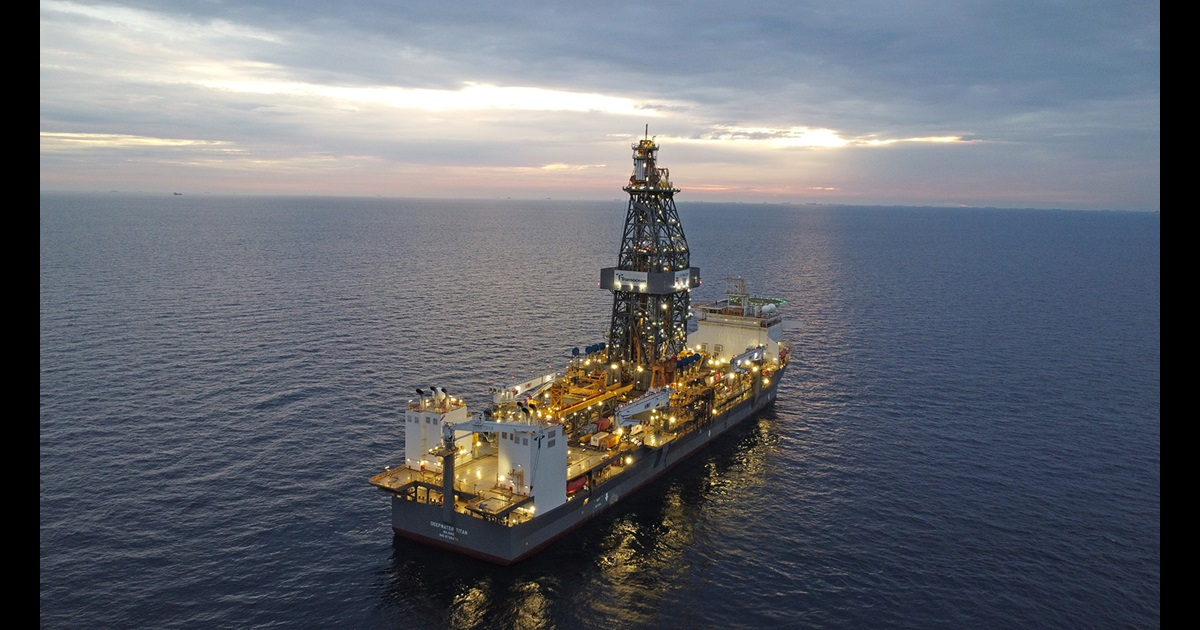
Deepwater Titan, Gulf of America

The latest Baker Hughes Rig Count Report shows only 10 rigs actively drilling in the Gulf. All are at deepwater locations – 7 in the Mississippi Canyon area, 2 in Green Canyon, and 1 in Alaminos Canyon. Per the BSEE borehole file, Shell accounts for most of the current MS Canyon wells and the Alaminous Canyon well. Beacon is also drilling in the MS Canyon, and the Green Canyon well appears to be a Chevron operation.

This current rig count, which has hovered between 9 and 12 all year, is troubling if you are concerned about long-term production. By comparison the Gulf rig count reached 22 last year and was 100+ during the 10 year period from 1994 to 2003.

Only Anadarko/Oxy, Beacon/BOE, BP, Chevron/Hess, Shell, and Talos have spudded deepwater exploratory wells in 2025 YTD. Arena and Cantium are the only shelf drillers – all development wells.

Technological advances and extensions of past discoveries have sustained Gulf production, but declines are certain over the longer term if drilling activity doesn’t increase. Oil price uncertainty is an issue, but that’s always the case. Semiannual lease sales are now legislatively required and the terms will be attractive, so those issues are off the table. Let’s see what the bidding looks like at the upcoming sale.

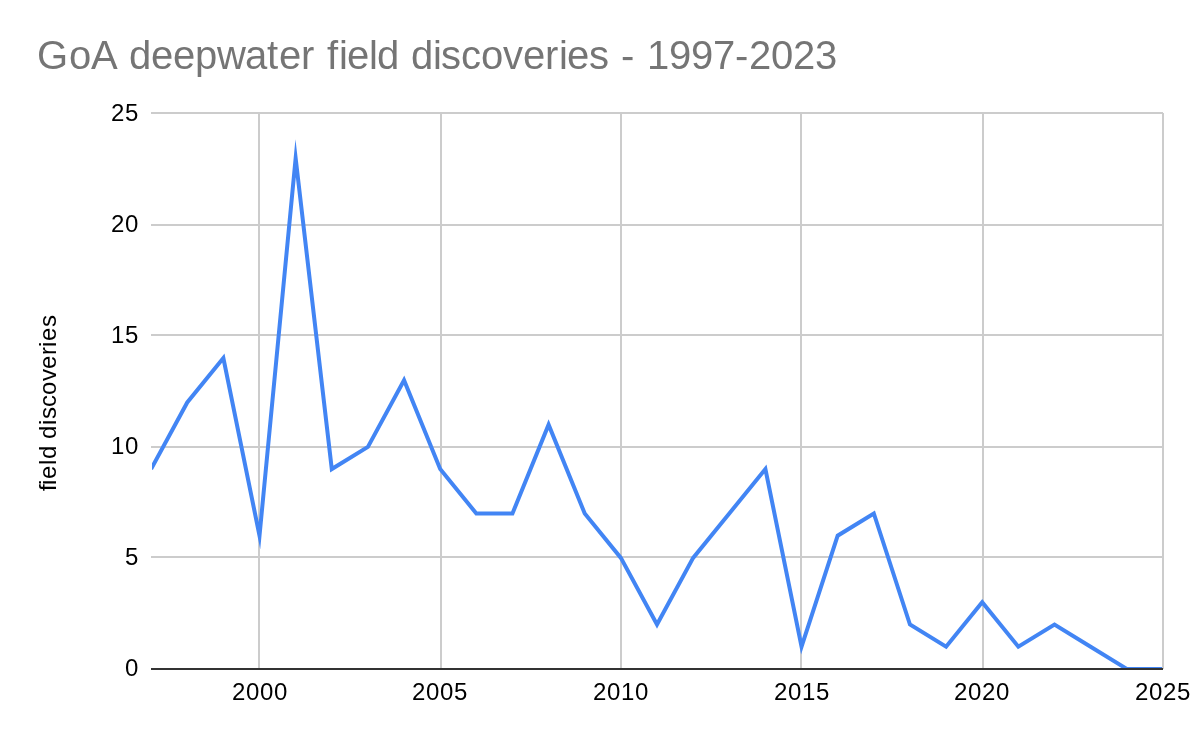
The decline in deepwater discoveries (BOEM data below) is particularly discouraging. Per BOEM, the last deepwater field discovery was in March 2023.

Read Full Post »

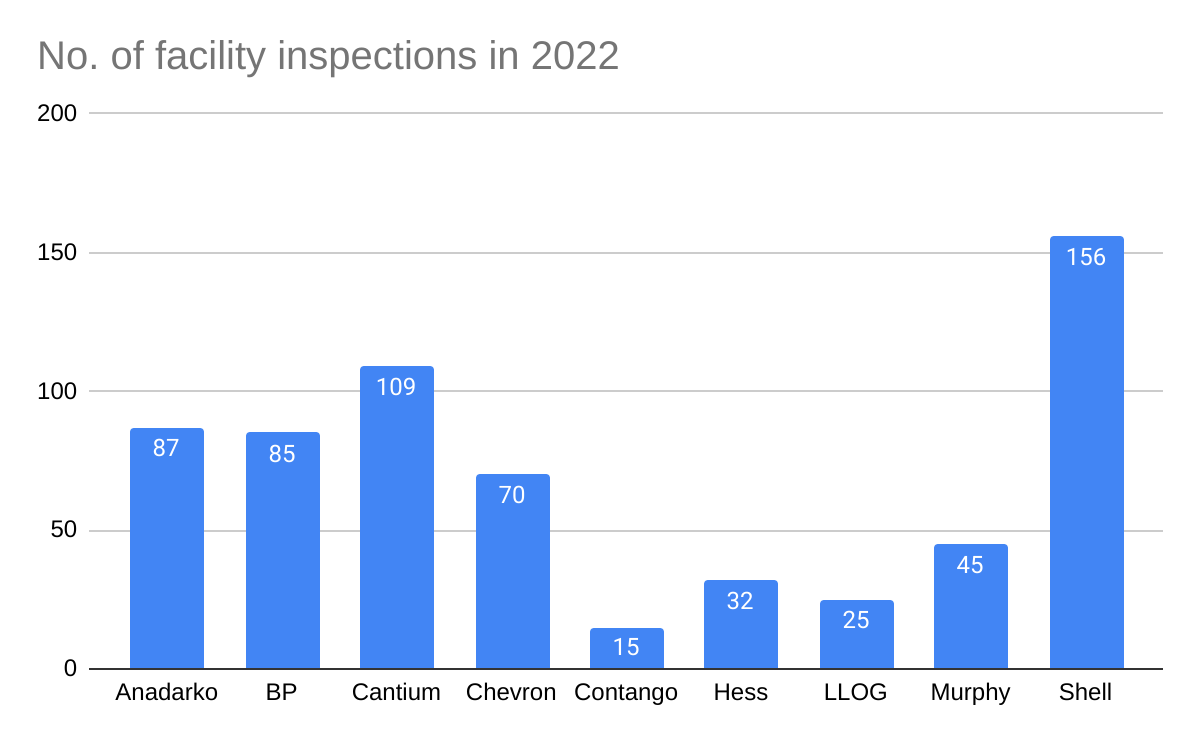
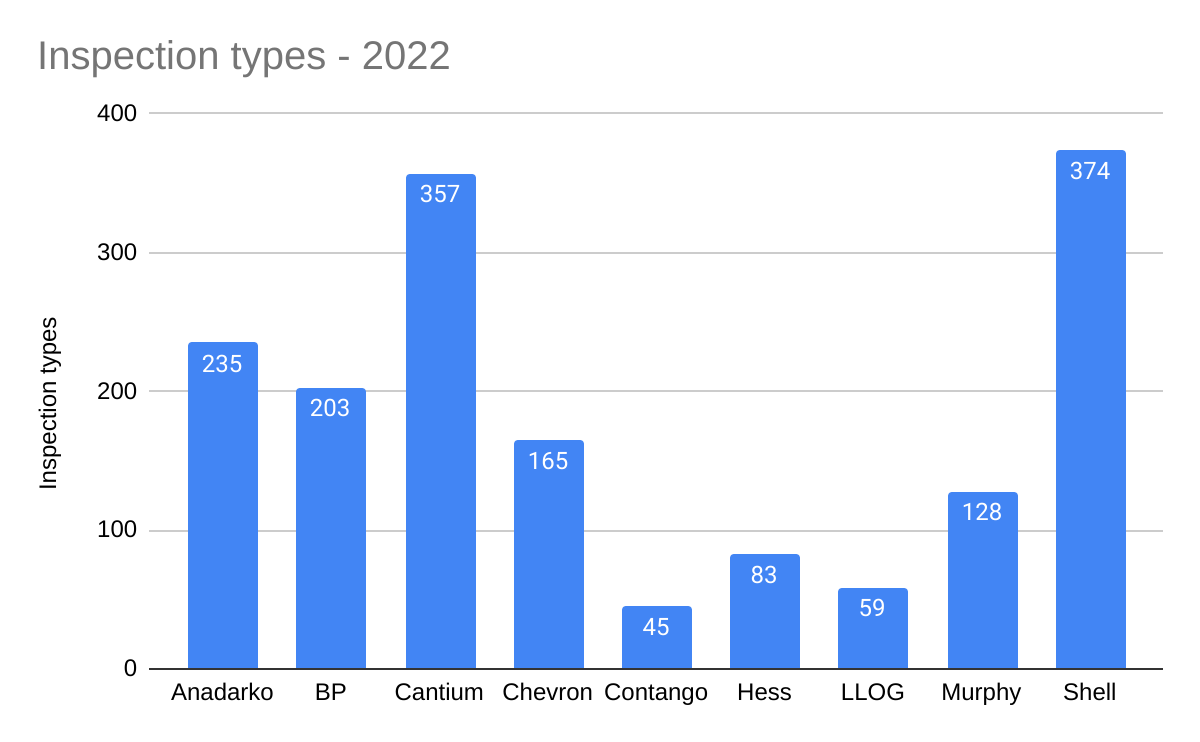
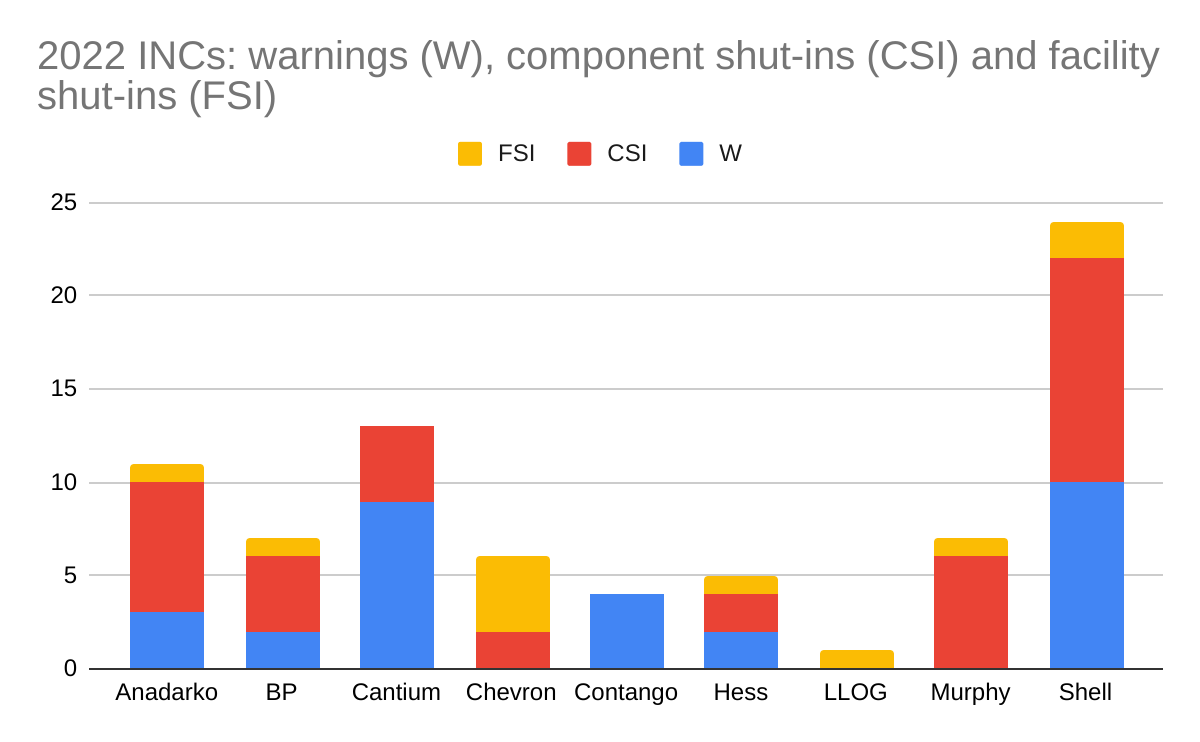
The Honor Roll companies for 2022 (listed alphabetically) are Anadarko (Oxy), bp, Cantium, Chevron, Contango, Hess, LLOG, Murphy, and Shell.

Our criteria:

  • Must average <0.3 incidents of noncompliance (INCs) per facility-inspection.
  • Must average <0.1 INCs per inspection-type. (Note that each facility-inspection may include multiple types of inspections (e.g. production, pipeline, pollution, Coast Guard, site security, etc). On average, each facility-inspection included 3.25 types of inspections in 2022. Here is a list of the types of inspections that may be performed.)
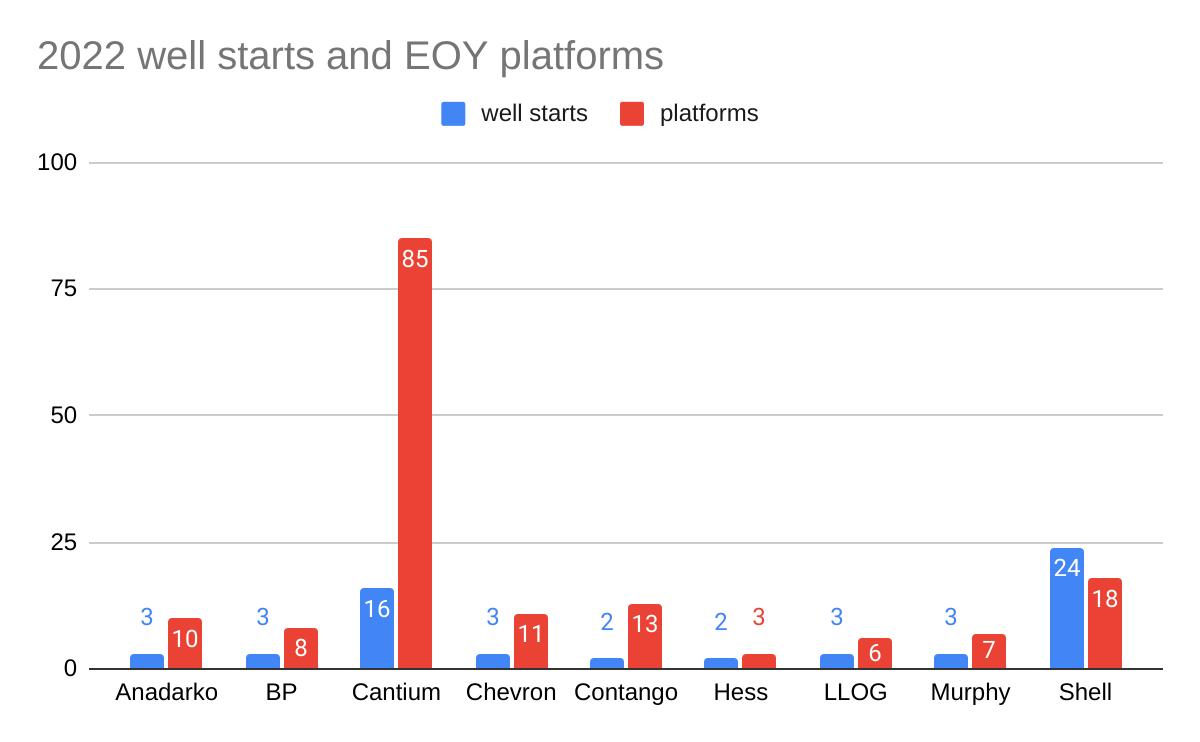
  • Must operate at least 3 production platforms and have drilled at least one well (i.e. you need operational activity to demonstrate compliance and safety achievement).
  • May not have a disqualifying event (e.g. fatal or life-threatening incident, significant fire, major oil spill). Due to the extreme lag in updates to BSEE’s incident tables, investigation and news reports are used to make this determination.
  • Pacific and Alaska operations will be considered separately.
oil (million bbls)gas (BCF)
Shell145.8163.5
bp82.457.1
Chevron79.445.2
Anadarko59.650.8
Murphy28.145.5
LLOG19.634.3
Hess17.939
Cantium3.95.3
Contango0.023.5
2022 production through Oct.

Mid-Year 2022 review

Read Full Post »

  • Operating companies that produced >1 million bbls of oil or >1 BCF of gas in 2021 are listed in descending order based on oil production.
  • Both the total number of well starts and the number of exploratory wells are indicated
  • An INC is an Incident of Noncompliance (i.e. a violation). W=warning, CSI=component shut-in, and FSI=facility shut-in are the enforcement actions.
  • All of the below data are publicly available on the BSEE-BOEM websites.
2021
oil (MMbbls)
2021
gas (BCF)
2021/22
well starts

total-expl
2021/22
INCs
W-CSI-FSI
Shell149.8190.828-1211-14-4
bp114.082.75-26-3-4
Chevron83.742.28-81-1-3
Anadarko (Oxy)67.757.88-68-5-1
Hess27.561.72-27-4-0
Murphy25.150.07-74-8-1
LLOG20.429.03-01-1-1
Talos17.723.05-025-26-14
BHP14.55.93-22-3-0
Exxon13.22.31-1-1
Beacon10.515.71-00-0-0
Fieldwood10.424.7685-235-91
EnVen9.612.66-02-6-3
Kosmos9.48.41-11-0-0
Arena8.627.932-068-45-19
Walter8.136.22-23-1-2
Cox6.230.3237-169-3
Eni4.713.62-08-0-2
W&T5.027.21-065-40-7
Cantium4.55.518-023-15-2
QuarterNorth4.28.3no data
GoM Shelf2.34.852-5-2
ANKOR1.42.50-0-1
Byron1.04.45-8-2
Renaissance0.71.620-9-3
Sanare0.34.538-20-3
Helis0.21.21-0-2
Contango0.035.04-0-0
Samchully0.021.2no data

Comments:

  • “Energy transition” companies Shell and bp still love the Gulf of Mexico, which is a good thing for them and us. Together they accounted for 42.4% of the 2021 oil production.
  • The top 4 producers, Shell, bp, Chevron (includes Unocal), and Anadarko accounted for 2/3 of GoM oil production, nearly all of which was from deepwater leases.
  • Those are impressive production numbers for Anadarko (Oxy). No wonder Warren Buffett likes Oxy stock.
  • The relative number of deepwater exploratory wells is mildly encouraging given our concerns about sustaining production.
  • Exploratory well determinations are rather subjective and may not be entirely consistent.
  • Understandably, no exploratory wells were drilled by Arena or Cantium, the companies responsible for most well operations on shelf (shallow water) leases.
  • Overall, the INC numbers are impressively low for the deepwater operators, with Chevron and LLOG standing out. BSEE does not post the specific violation information (more on this in an upcoming post), so it’s difficult to properly assess a company’s compliance record.
  • Unfortunately, incident data could not be included on the scoreboard. BSEE’s incident tables are badly out of date, and no 2021/2022 summaries have been posted.
  • Fieldwood’s disturbing INC numbers were discussed earlier this year. High INC rates for 3 other operators have also were noted last month.
  • Exxon production is limited to the Hoover Diana spar, which was installed 22 years ago. The largest US oil company has only drilled one GoM exploratory well (2018) in the past 5 years. Currently, their main GoM interest seems to be the sequestration (disposal) of onshore emissions. (More on this topic in an upcoming post.)

Read Full Post »