Of particular interest are mandated reviews of the:
RIsk Management and Financial Assurance Rule: Those who want to gut this rule should come to the table with proposals that better protect the taxpayer from decommissioning liabilities. Pretending that decommissioning financial risks don’t exist or that they are someone else’s (or the govt’s) problem is unacceptable.
5 Year leasing program – This review is urgently needed. See this and this!
BOP/Well Control Rule – This keystone safety rule has undergone multiple reviews in recent years. Because of the rule’s importance, further review for continuous improvement purposes may nonetheless be warranted. Here are the blog comments on the current version of the rule.
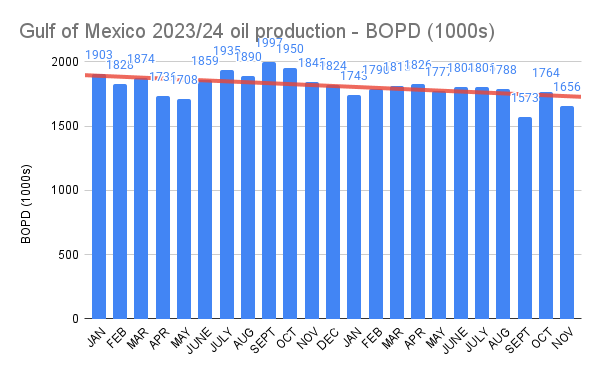
November 2024 Gulf of Mexico oil production was the lowest in the 2023/24 timeframe, with the exception of Sept. 2024 when production was reduced by Tropical Storms Francine and Helene.
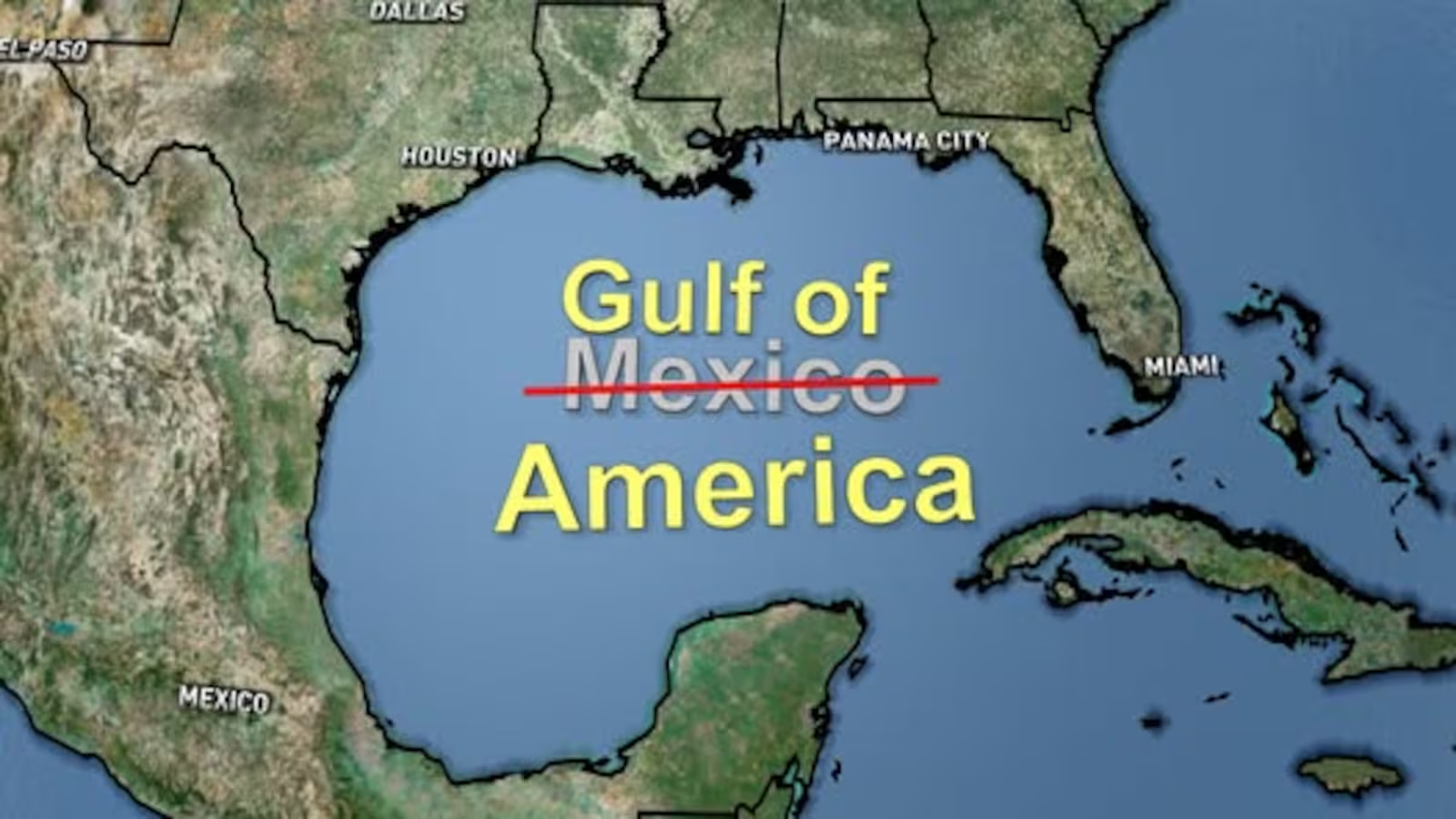
Look for production in the Gulf of America to soar! (eventually😉)
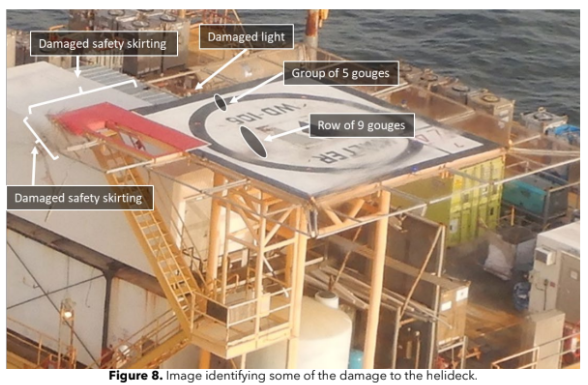
The NTSB has finally issued their report (attached) on the 12/29/2022 helicopter crash that resulted in 4 fatalities at Walter’s West Delta 106 A platform. The NTSB report on the Huntington Beach pipeline spill took a comparable amount of time (26 months) to complete. By comparison, the lengthy and complex National Commission, BOEMRE, Chief Counsel, and NAE reports on the Macondo blowout were published 6 to to 17 months after the well was shut-in.
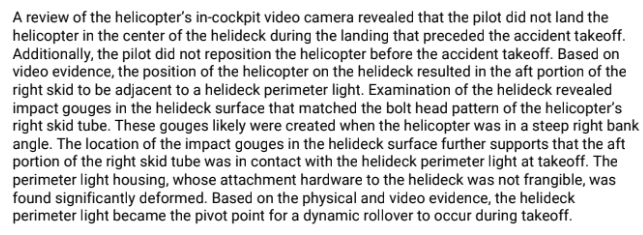
The gist of the NTSB’s findings is pasted below.
The report summarizes operations standards, but does not consider the associated operator/contractor safety management systems that are intended to prevent such incidents. The report notes that:
Was the contractor/operator aware of these deviations from company policy? Should they have been?
The report implies that human (pilot) error was the cause of the dynamic rollover, but fails to assess the organizational controls that are intended to prevent such errors. How was a pilot with 1667.8 flight hours (1343.8 as the PIC), who had made 23 trips to this platform, repeatedly making fundamental positioning and takeoff errors?
The report also notes that:
This is interesting wording given that the perimeter light was identified as the pivot point, one of the 3 requirements for a dynamic rollover. Why wasn’t that violation observed by the operator/contractor and corrected? What helideck inspection procedures were in place? Did NTSB consider the fragmented regulatory regime for helicopter safety, particularly with regard to helidecks?
Centre Party leader Trygve Slagsvold Vedum: “What we were clear about all along is that beginning the process of linking ourselves more closely to the EU’s dysfunctional electricity market and energy policy is completely out of the question.”
While looking at electric prices and power sharing, consideration should be given to the desirability of transmitting electricity from shore to distant offshore platforms that have ample natural gas for power generation purposes. This practice increases electric prices for consumers and introduces reliability/safety concerns with no net environmental benefits.
Picture of Old Stavanger where former colleague and BOE contributor Odd Bjerre Finnestad (RIP) once lived.Stavanger is both a lovely city and the “Oil Capital of Norway.”
The Secretary of the Interior is, by far, the most important offshore energy official in the Federal government. Yesterday, Doug Burgum was easily confirmed to be the next Secretary. Nonetheless, the following 18 senators chose to vote against his confirmation:
“For three decades you were labeled a crank, a “climate denier,” someone who pigheadedly rejects “settled science,” if you didn’t embrace the belief that life on earth faces imminent extinction from “global warming” and, later, “climate change.” The possibility that an entire academic discipline, climate science, could have gone badly amiss by groupthink and self-flattery wasn’t thought possible. In many quarters this orthodoxy still reigns unquestioned.“
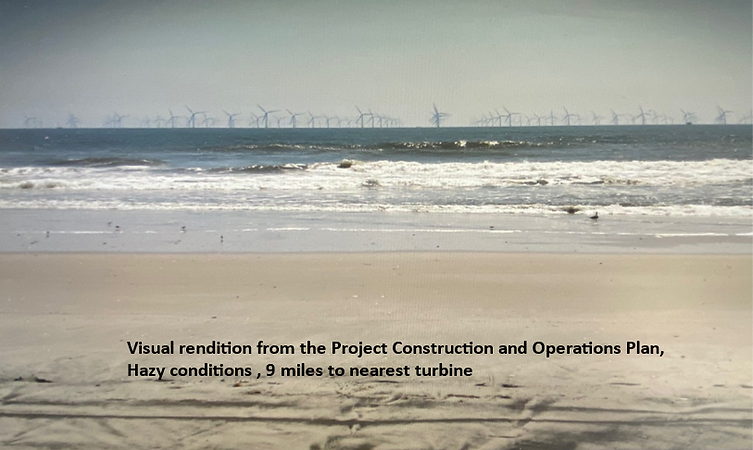
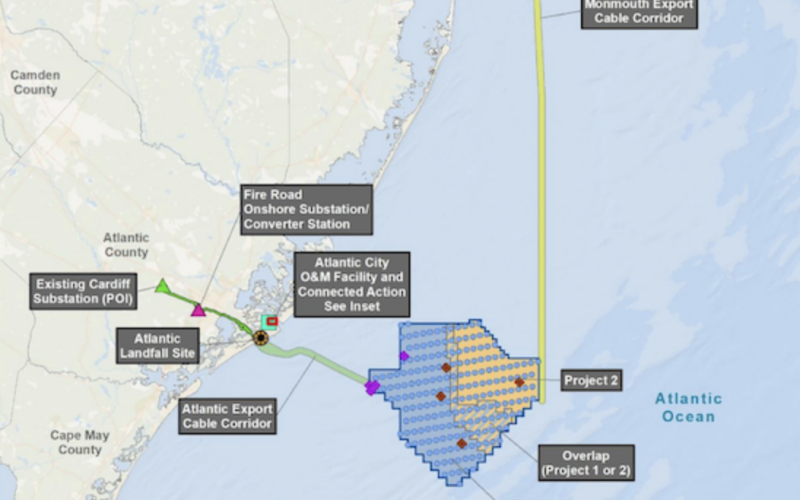
In their quarterly earnings report released on Jan. 30, Shell disclosed a $996 million impairment associated with their withdraw from the controversialAtlantic Shores wind project offshore New Jersey.
Shell is no longer a participant in any US offshore wind projects. This leaves Equinor (2/3 Norwegian govt ownership) as the only major oil company pursuing US offshore wind development.
Those Atlantic states that have linked their economic future to offshore wind better be reassessing their energy strategy.
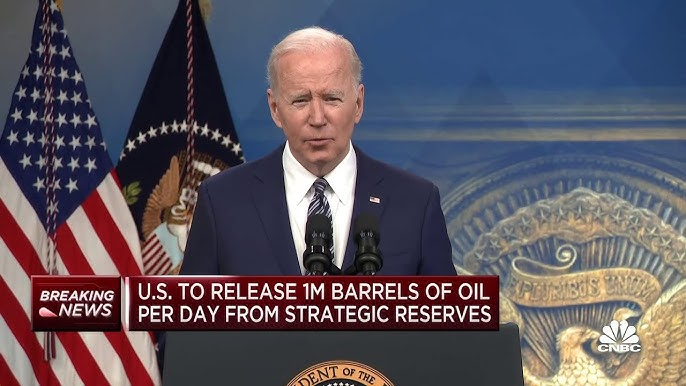
Closing the books on the Biden administration’s management of the Strategic Petroleum Reserve:
Incoming reserve as of 1/22/2021: 638.086 million bbls (This was also the max. volume during the Biden administration.)
Outgoing reserve as of 1/17/2025: 394.566 million bbls
Net loss: 234.520 million bbls
% loss: 38.2%
Cost to replace (assuming $70/bbl ave. oil price): $16.416 billion
Time required to refill at max. rate of 685,000 bopd: 342.5 days (Taking into consideration acquisition, operational, and maintenance delays, and concerns about oil price impacts, a more realistic estimate would be 5 years, and this would require a concerted effort.)
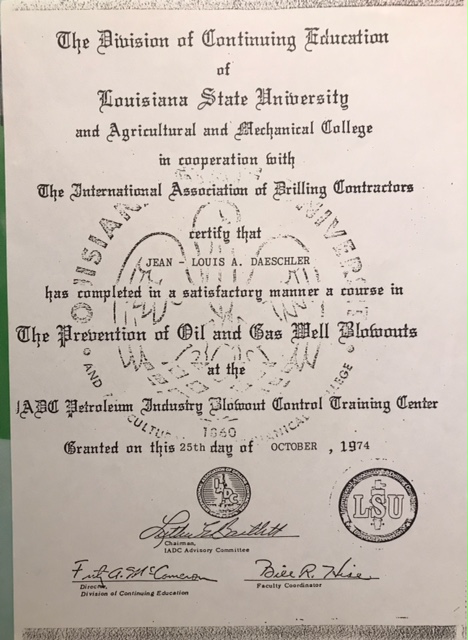
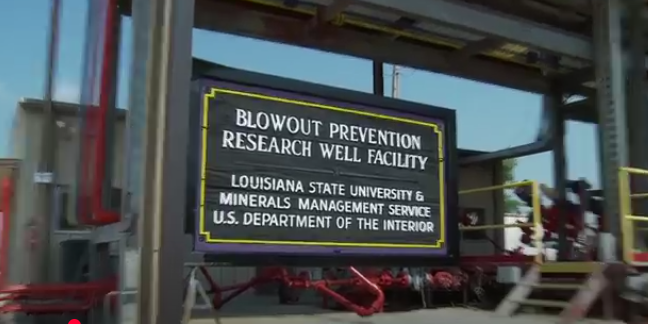
Pioneering offshore engineer J.L. Daeschler, a Frenchman who lives in Scotland and has worked on drilling rigs worldwide, shared his 1974 training certificate signed by Bill Hise, the first director of the Blowout Prevention and Well Control Training Center at LSU. JL recalls his training:
The LSU well control course was new and very well organized. Training options were limited at that time. LSU took a step forward and incorporated equipment donated by Cameron Iron Works, Armco Steel /National, VETCO, and others.
The course was split between indoor class room style and outdoor trainingon a live well to remind us of the real things, like hard hats, tally books, and safety shoes.
LSU had a 1200 ft vertical well and a small 2″ diameter gas injection line to create a bottom hole gas kick, using a nitrogen truck as the supply. (note: the live well was a first for any well control school.) You had a choice of several manual chokes. I selected the Cameron Willis choke to circulate the gas kick out with no increase in mud weight (drillers method).
The mud return level, kick detection, and general management of the operation were realistic as if on a rig. The gas would whistle and escape thru a vent line.
The training was simple and effective in that proper well control procedures were learned. In the process, there were many errors. Mud was seen flying out of the mud shaker/pits. School management would bring things under control and explain the errors that were made !!!
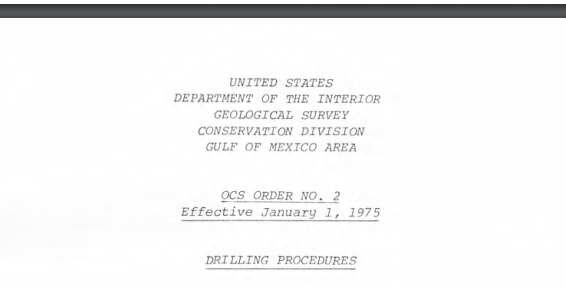
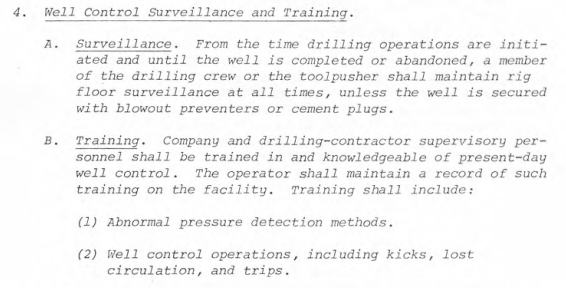
Given the importance of minimizing drilling risks, the Minerals Management Service (MMS) was the primary funder of the LSU facility. MMS predecessor, the Conservation Division of USGS, first established well control training requirements in 1975 (pasted below).
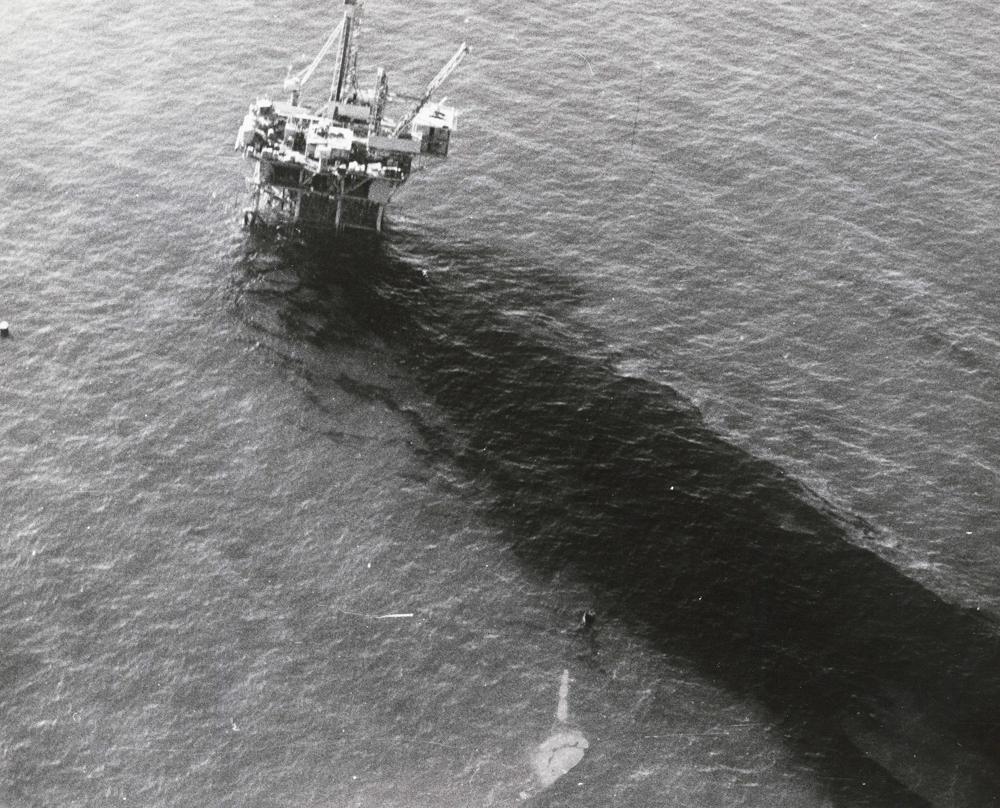
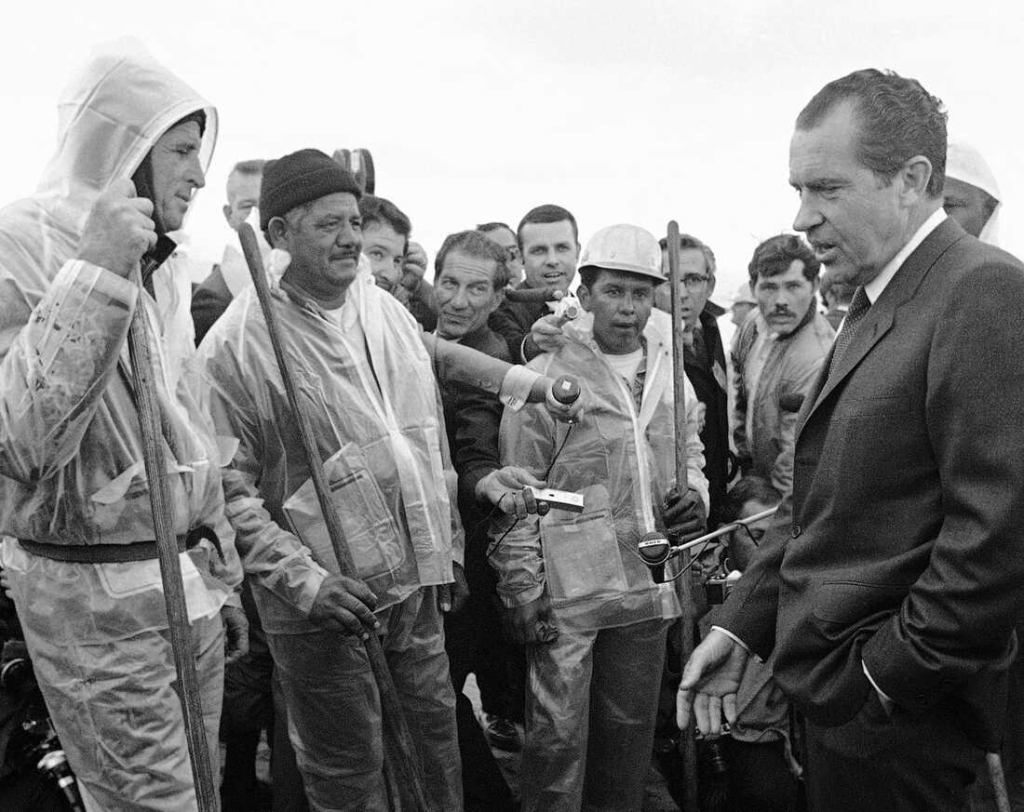
… Union Oil Company’s reckless well plan forever scarred the U.S. offshore program. Learn more about the details.
Santa Barbara blowout
Examinations of the Santa Barbara, Montara, and Macondo blowouts, the Piper Alpha fire, and other major incidents should be a part of every petroleum engineering curriculum, and should be mandatory for those who conduct and regulate offshore oil and gas operations.
There is no better learning experience than studying the failures that had such enormous human and economic consequences.







 Bud's Offshore Energy (BOE)