February 28, 2011 by offshoreenergy
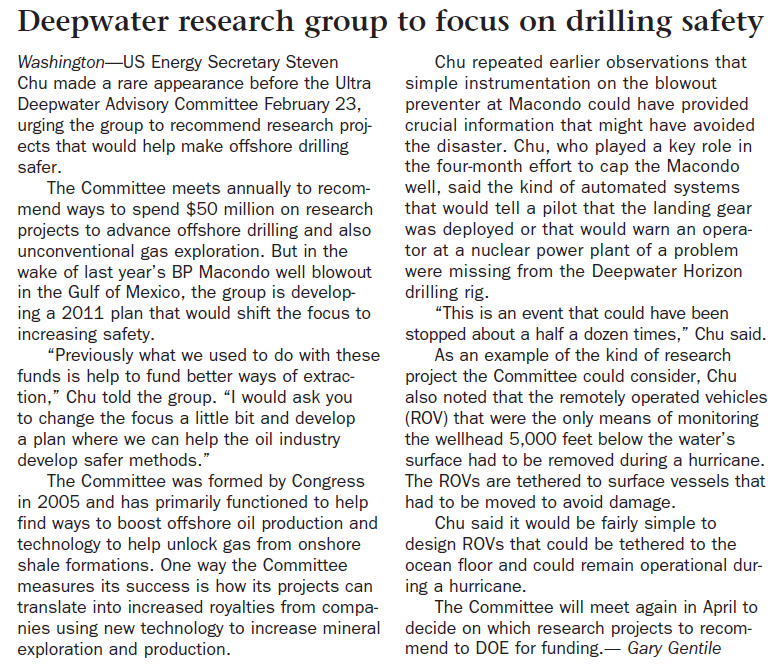
Good Nola.com article on the well containment systems
Comments on well capping and containment:
- Capping and containment systems, while important and necessary, are for blowout response, not blowout prevention. Their use, successful or otherwise, would only occur after a series of unacceptable failures.
- Having two capping and containment consortia in the Gulf of Mexico (and none anywhere else in the world) does not seem to be very cost effective or efficient.
- What are the plans for subsea capping and containment systems elsewhere?
- A capping/containment capability would not have saved a single life on the Deepwater Horizon. Verified barriers must be in place to prevent flow from the well bore.
- The well responsible for our other major drilling blowout spill (Santa Barbara – 1969), was capped at the surface by closing the blind ram on the BOP shortly after flow began. However, capping doesn’t work if you don’t have a competent well bore. The well flowed through numerous channels back to the seafloor.
- Capping subsea wells is safer than capping surface wells.
- Capping the Montara blowout (2009) in only 80m of water was neither safe nor technically feasible because of the way the well was suspended. Despite the complete absence of a capping option at Montara, the capping of surface wells has received little attention.
- The more critical, but less publicized, post-Macondo initiatives pertain to well design, construction, and verification. In that regard, important new standards, including the Well Construction Interface Document, are scheduled to be completed soon. That work must not be delayed.
- While capping stacks and containment systems will only be used in the event of a series of major failures, design and construction procedures are critical every time a well is drilled. The importance of the initial design decisions continues into the production phase and beyond, even after the well has been plugged and abandoned.
Posted in accidents, Uncategorized, well control incidents | Tagged accidents, blowouts, capping and containment, drilling, Gulf of Mexico, Helix, macondo, Marine Well Containment Company, Montara, offshore oil, oil spill, well control | 2 Comments »
February 27, 2011 by offshoreenergy
This is a must read letter from Gustavo Coronel, petroleum geologist and former member of Venezula’s Congress, to Alí Rodríguez Araque, Venezuelan Minister of Electric Energy.
You recently spoke in the National Assembly and challenged anyone who opposes the government’s petroleum policy to speak openly.
I take this opportunity to do so. I feel qualified to do this because, when you were a member of the Venezuelan guerrillas during the 1960’s, in charge of blowing up oil installations, I was active in building them. During much of my life I have produced oil while you have lived off the oil we have produced.
On the Aban Pearl:
The renting of offshore drilling barges, such as the Aban Pearl, which sank last year in Venezuelan waters, has been full of irregularities that I have denounced in much detail without any action being taken, so far.
Just a few days ago at an advisory committee meeting, some of us were talking about what an outstanding company PDVSA used to be. At Penn State, we had some very bright petroleum engineering students from Venezuela who went on to work for PDVSA. I am sure they have some very interesting stories to tell about their careers and the changes in Venezuela’s oil industry.
Posted in Uncategorized | Tagged aban pearl, Gustavo Coronel, PDVSA, Penn State, venezuela | Leave a Comment »
February 27, 2011 by offshoreenergy
Add Sonangol, Angola’s state-owned oil company, to the intriguing list of companies that will be involved in Cuban exploration:
“We have signed agreements with Cupet (the Cuban state-run oil company) to explore and develop two blocks,” said Mateus de Brito, a member of the corporate executive committee. El Universal
Posted in cuba | Tagged Angola, cuba, offshore drilling, Sonangol, venezuela | Leave a Comment »
February 26, 2011 by offshoreenergy
These hearings should be interesting:
The JIT expects to hold another set of public hearings the week of April 4 to focus specifically on the BOP and findings from the forensic examination. BOEMRE and the USCG expect to issue a joint release regarding the investigation by mid-April.
Posted in accidents, well control incidents | Tagged accidents, blowouts, Deepwater Horizon, Gulf of Mexico, macondo, offshore oil, oil spill, safety, well control | Leave a Comment »
February 25, 2011 by offshoreenergy
Giant metal shears successfully sliced and closed pipe full of runaway crude in the early moments of last April’s Deepwater Horizon disaster, but the oil blasted through rubber gaskets around the blades and unleashed the nation’s largest spill, according to sources familiar with an ongoing investigation. Houston Chronicle
That would be consistent with the video evidence recorded on the Q4000, but we still need a lot more information about the timing of the shear ram closure, the position of the ram and drill pipe before and after shearing, maintenance, and other important BOP issues.
Kudos to the Chronicle for their ongoing coverage of Macondo issues.
Posted in accidents, well control incidents | Tagged accidents, blowouts, BOEMRE, BOP, Coast Guard, Deepwater Horizon, drilling, Gulf of Mexico, macondo, safety, well control | Leave a Comment »
February 25, 2011 by offshoreenergy
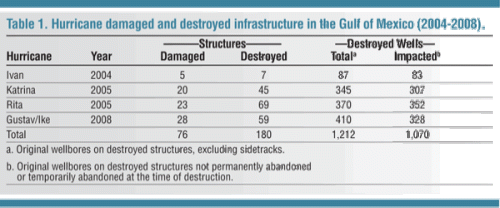
from Offshore
Mark Kaiser (LSU) has published a nice summary in Offshore Magazine of the damage to Gulf of Mexico facilities from recent hurricanes and the associated decommissioning challenges.
Comment: Hurricane issues were an enormous challenge for the offshore industry and regulators in the five years prior to Macondo. Did the focus on hurricane damage and repairs increase the risk of a drilling incident? Not directly, but hurricane issues were the primary concern of industry and governmental personnel during that period. Resources that might have addressed other identified needs (e.g. cementing standards) were necessarily involved with hurricane projects.
Posted in Uncategorized | Tagged deco, Gulf of Mexico, hurricanes, macondo | Leave a Comment »
February 24, 2011 by offshoreenergy
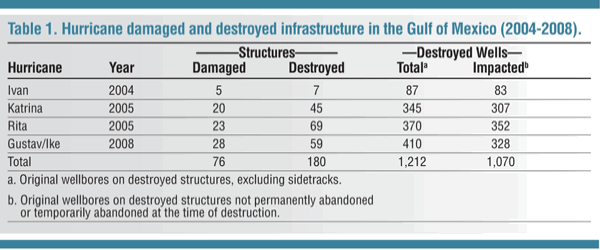
 Few Cabinet Secretaries are scientists or engineers, and none has been a Nobel Prize winner. We expect Secretary Chu to be different and yesterday’s meeting with DOE’s Ultra-Deepwater Advisory Committee was not your typical Washington “hit and run” performance. Rather than making a quick speech and running along to his next appointment, Secretary Chu engaged in technical dialogue with our committee for a full hour, offering insights and responding to questions. Among the topics discussed were BOP instrumentation and monitoring, well integrity, ROV/AUV issues, and Macondo findings.
Kudos to Secretary Chu for his commitment to offshore safety.
Gary Gentile published this report on the meeting in Platts Oilgram News. (click on the story to enlarge)

Posted in accidents, drilling, Offshore Energy - General, well control incidents | Tagged DOE, drilling, macondo, safety, Secretary Chu, Ultra-Deepwater, well control | Leave a Comment »
February 24, 2011 by offshoreenergy
“Our internal investigation into the events of that tragedy is nearing completion,” Newman told investors during a conference call to discuss Transocean’s fourth-quarter earnings. “In light of continuing delays and obtaining information on the third-party testing of the Horizon’s (blowout preventer), we expect to release findings in the next month or two.” Fox Business
Posted in accidents, well control incidents | Tagged accidents, blowouts, drilling, Gulf of Mexico, macondo, offshore oil, oil spill, safety, transocean, well control | Leave a Comment »
February 24, 2011 by offshoreenergy

Developed by SevMash, the first Barents Sea oil rig will be a steel table the size of a football pitch and capable of withstanding temperatures of down to minus 50 Celsius. The whole point of it is that standing on the seabed, it will allow drilling and pumping the way they are done of firm land. This is a very far cry from the Deepwater Horizon. That platform was semi-submersed, positioned dynamically and designed to pump oil from beneath a mile of sea. When the oil gushed, the spill proved almost unstoppable. The Barents Sea platform will employ a very different production technology, which involves the use of powerful pumps. Chief Technology Officer of the Gazpromneft Shelf company Dr Alexander Kisser
Comment:
- Don’t demonize deepwater production to promote the arctic (or vice versa). The world needs responsible production from both.
- “Can’t happen here (or to me)” talk impresses no one. Explain how a disasters can happen to you and what you are doing to prevent them.
- Identify the special risks at your site and how they will be mitigated. Don’t tell us why the arctic isn’t the Gulf of Mexico.
- Perhaps we should present Can’t Happen Here awards as part of the Not My Job awards program.
Posted in accidents | Tagged accidents, arctic, blowouts, Can't Happen Here Award, Deepwater Horizon, Gulf of Mexico, offshore oil, Russia, safety, well control | Leave a Comment »
February 23, 2011 by offshoreenergy
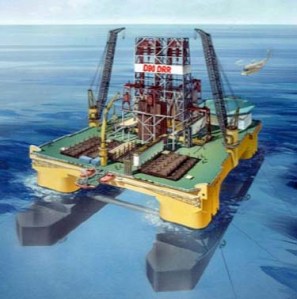
Scarabeo 9
Delivery of a Chinese-built drilling rig that will open the first full-scale exploration for oil in Cuban waters looks unlikely until at least August in the latest delay to beset the project, sources said this week. Upstream
Comment: Look for the first well to be delayed until after the hurricane season, possibly into next year.
Posted in cuba | Tagged cuba, drilling, Saipem, Scarabeo 9 | Leave a Comment »
« Newer Posts - Older Posts »