“Each rig successfully secured its respective well in progress and took evasive actions to avoid the storm’s path.” (No mention of the delay in relocating the Globetrotter II or the rig, riser, and LMRP damage already reported on social media.)
“several riser joints and the lower marine riser package separated from the rig during the storm and sank to the seabed.” (Confirms social media reports.)
“All personnel are safe and accounted for.” (No mention of the injuries alluded to in social media reports.)
In a proper safety culture, you don’t downplay serious incidents and you never declare victory. Spin control is for politicians, not safety leaders. The Globetrotter II, with 140 workers aboard, was slammed by a major hurricane, perhaps unnecessarily. After the frightening social media reports, Noble released an “all is well” statement that minimized the significance and potential consequences of the delayed rig relocation. Noble continued to downplay the incident when they update their statement 5 days later.
The Coast Guard and BSEE will be investigating the Globetrotter II relocation, and their findings will be of great interest. Noble has historically been a very good drilling contractor with a strong commitment to safe operations. Hopefully, they and others will learn and apply lessons from this and similar events that have occurred in the Gulf and elsewhere. Companies may also want to assess the compatibility of their messaging practices with their commitment to a robust safety culture and continuous improvement.
Approximately 2 miles south of Port Fourchon which took a direct hit from Ida. (Appears that the pipeline is in Louisiana State waters).
Water depth = 34′
Talos funding spill response, although the company said it was not their pipeline
Leak has slowed significantly; apparently production is not entering the line and the spill is limited to pipeline inventory
This type of incident is not surprising given the magnitude and track of Ida and the pipeline infrastructure that was exposed to major hurricane conditions
This Canadian video was a big hit at an awards program in Houston 15 years ago. I was pleased to find it on YouTube and thought it would be a nice Labor Day feature. Kudos to the workers who produce the energy that supports our economy and our way of life. Your efforts are greatly appreciated! Happy Labor Day!
In sports, the experts are soon exposed. In regulations and standards, consensus misjudgments are less obvious and may take years to be demonstrated. Also, regulations and standards are often outdated and may not reflect best practices. That is why compliance with regulations and adherence to industry standards is not sufficient. We need to continuously assess risks, observe, listen, review data, and actively manage our operations to achieve safety and environmental objectives.
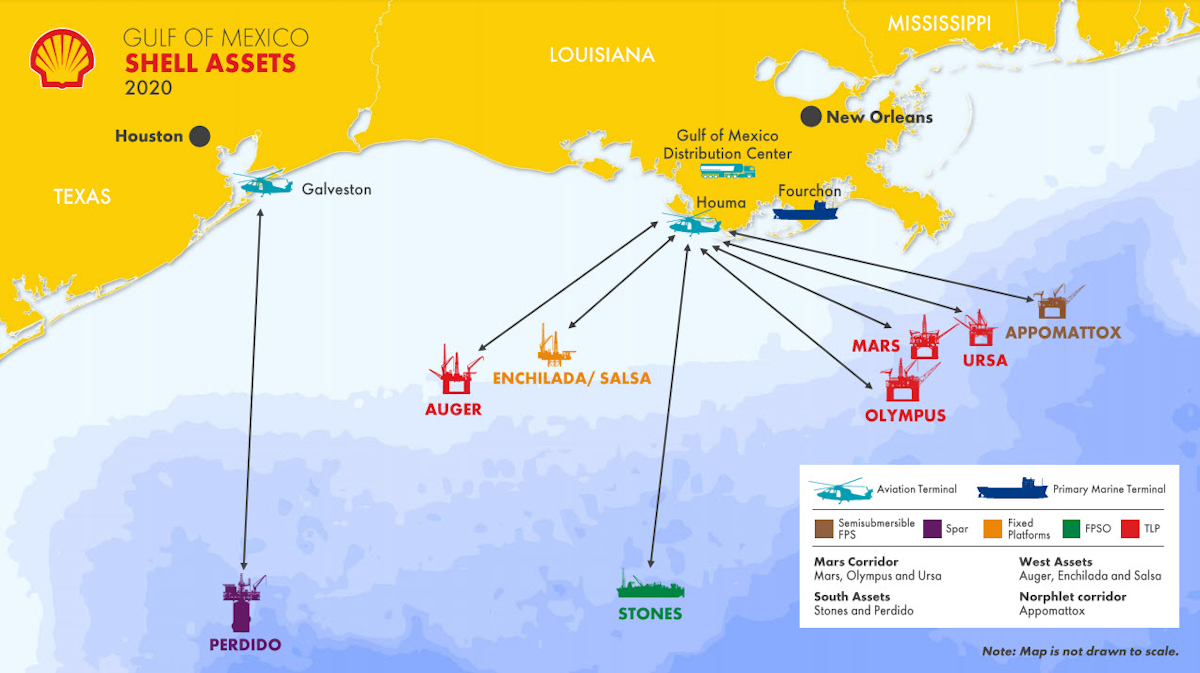
Shell Offshore Inc. (Shell), a subsidiary of Royal Dutch Shell plc, conducted an initial flyover of our assets in the path of Hurricane Ida. During this initial flight, we observed damage to our West Delta-143 (WD-143) offshore facilities. When it is safe to do so, we will send personnel offshore to provide a closer inspection of these facilities to understand the full extent of the damage and the degree to which our production in the Gulf of Mexico will likely be impacted.
This is a very significant report given the importance of the WD 143 platform in transferring all production from Shell facilities in the “Mars corridor.” These facilities include the Mars, Olympus, and Ursa platforms.
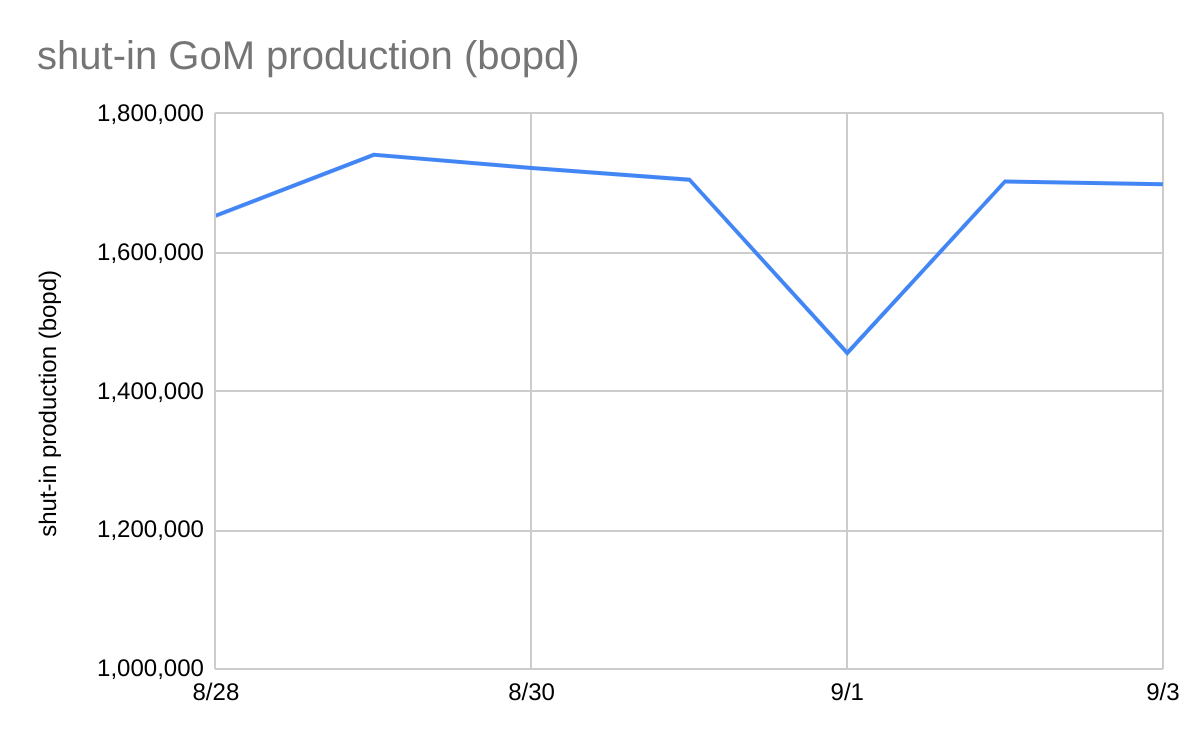
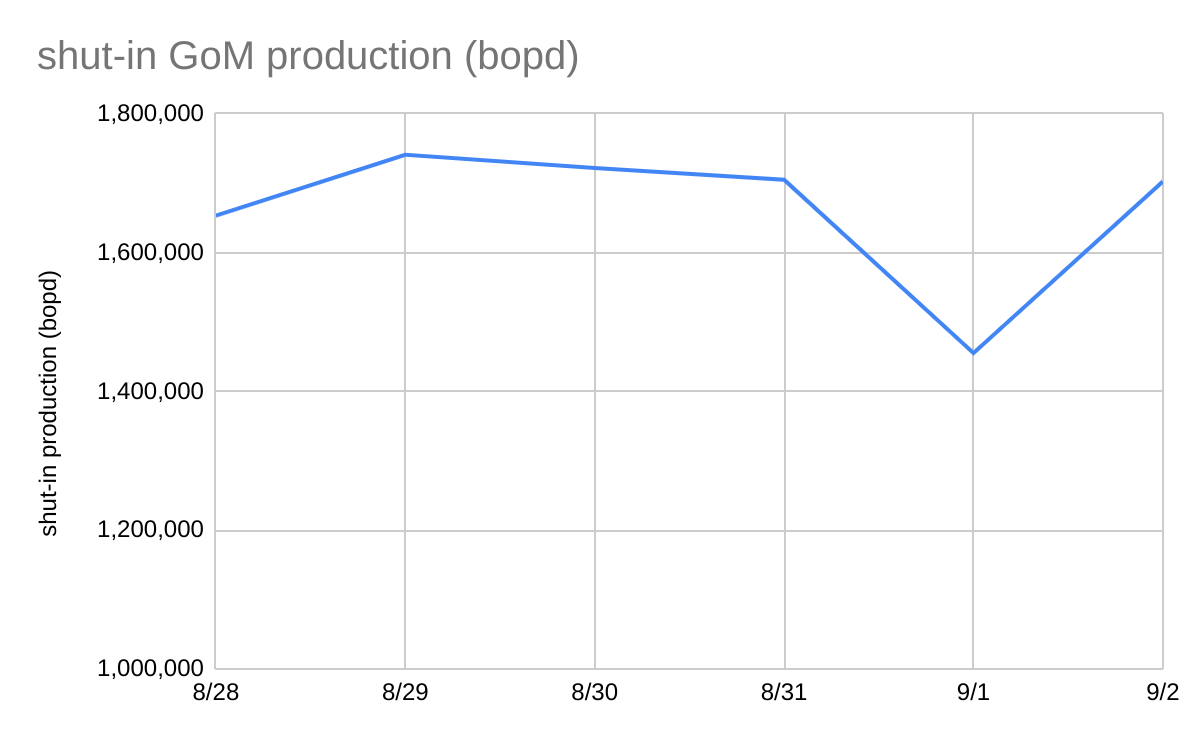
In a bit of a surprise, the volume of shut-in GoM oil production rebounded to more than 1.7 million BOPD (see BSEE’s 9/2 update). Because several deepwater platforms had reportedly resumed production, the sharp increase in shut-in volumes could have something to do with downstream facility damage or bottlenecks. The daily Ida shut-in volumes are plotted below.
Presumably, most of the restored GoM production is from platforms like Exxon Hoover that were not subjected to hurricane conditions. Per BSEE, the total oil production shut-in as of 9/1 is 1,455,279.
The latest EIA production report for June 2021 has just been released and GoM oil production averaged 1.825 million BOPD.
In light of the ongoing litigation regarding the Department of the Interior’s “leasing pause,” DOI’s Record of Decision for Sale 257 is most encouraging. The viewpoints expressed in the two quotes below are fundamental to the future of the OCS Oil and Gas Program. Hopefully, all parties can put aside their differences and build upon these consensus views.
While offshore exploration and development cannot be made risk free, OCS oil- and gas-related activities can be conducted safely and responsibly with strong regulatory oversight and appropriate measures to protect human safety and the environment.
ROD, p. 5
The decision to hold Lease Sale 257 recognizes the role that GOM oil and gas resources play in addressing the Nation’s demand for domestic energy sources and fosters economic benefits, including employment, labor income, and tax revenues, which are highest in Gulf Coast States and also distributed widely across the United States. Revenues from offshore oil and gas lease sales support national conservation programs and coastal resiliency for applicable coastal states and political subdivisions under the Gulf of Mexico Energy Security Act of 2006.