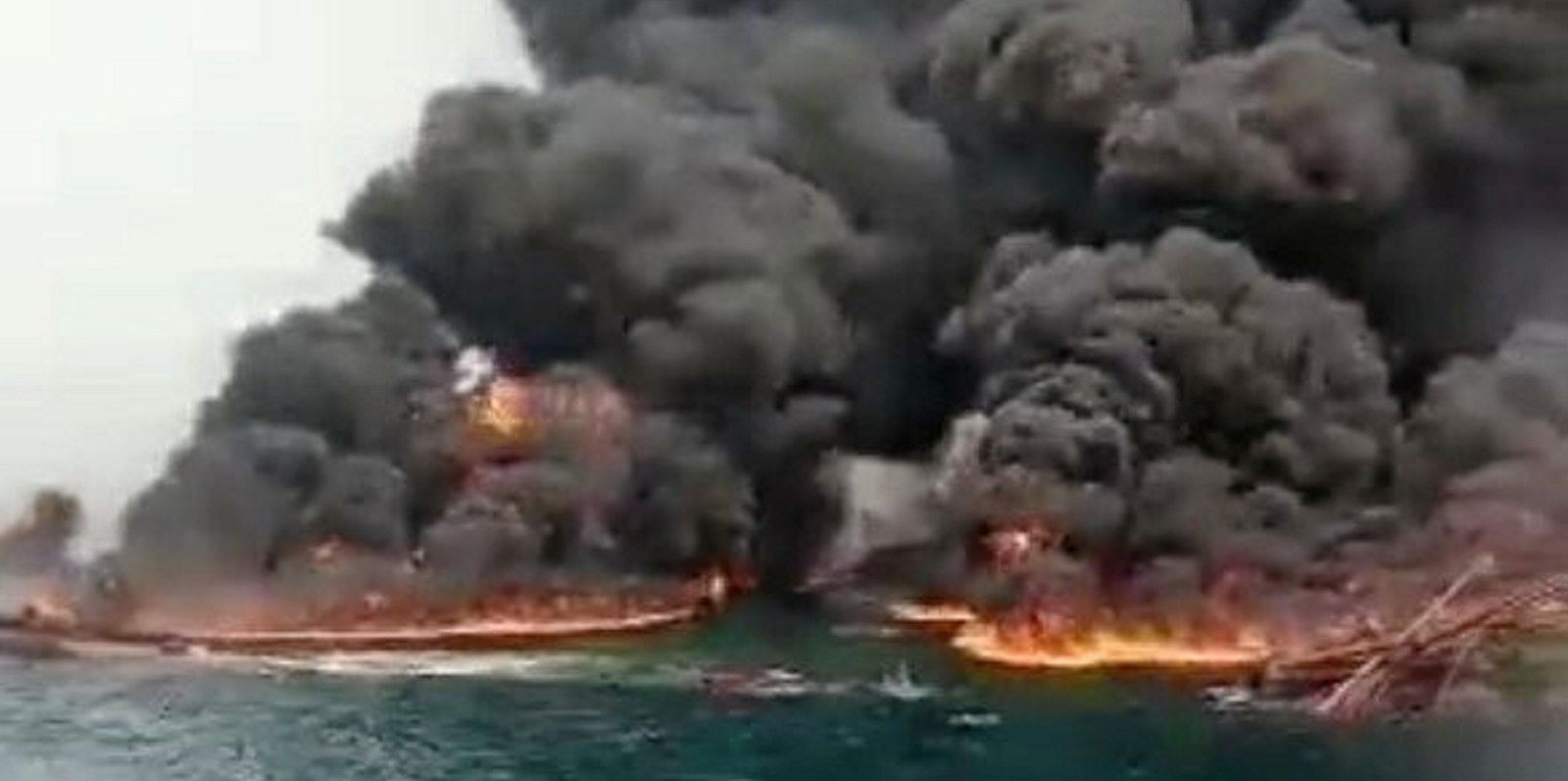
The Nigerian Upstream Petroleum Regulatory Commission (NUPRC) Thursday disclosed that it had commenced an investigation into the circumstances surrounding the explosion of a Floating Production, Storage and Offloading (FPSO) vessel in Warri, Delta State.
Industry source indicated that the FPSO was not producing at the time and had about 50,000 barrels in storage
No indication that any wells are on fire
Per Rystad the FPSO has not been producing since 2019 and was being used solely for storage.
Per Reuters, SEPCOL is the technical operator of the block though the production licence was held by consortium member Express Petroleum. SEPCOL’s production license had reportedly been revoked in 2019 for legacy debts.
Lots of important technical, operational, and management aspects to this major incident. Hopefully, NUPRC’s report will be publicly available at the conclusion of their investigation.
The number of GoM platforms is down 75% from its peak and continuing to decline.
Most new production is in the deepwater GoM and is accomplished with very few, remote and widely dispersed facilities. There are currently only 57 deepwater platforms across the entire Gulf.
The wind industry appreciates the synergy between offshore oil and gas and offshore wind operations. Indeed the oil industry has been very supportive of offshore wind, and some of the same operating companies and contractors are major players in both industries.
t has been 17 years since the enabling legislation was passed, yet we are still awaiting the first commercial wind project in the US Atlantic. You can’t blame the oil and gas industry for that delay. To the contrary, one can make the case that the presence of oil and gas operations would have accelerated Atlantic wind development.
The enabling legislation for offshore wind was drafted by the agency that managed the offshore oil and gas program and recognized the compatibility of oil and wind development. Wind development is clearly a high priority for BOEM, the current OCS land manager.
Will the Administration appeal the court decision to vacate the lease sale or does the decision assist them by reinstating their leasing pause? How will the conflict between the DC court decision and the injunction invalidating the leasing pause (Federal Court for the Western District of Louisiana) be resolved?
What does this mean for the 94 leases that were to have been acquired for carbon sequestration purposes? Will BOEM have a proper CCS sale after conducting an environmental assessment, determining bidding terms and evaluation criteria, and publishing a Notice of Sale? Or will there be a legislative end run that authorizes the issuance of the leases without these steps?
Our last GoM update predicted November oil production of 1.8 million BOPD. The EIA figure released yesterday came in slightly less than that at 1.795 million BOPD.
BOEM had correctly determined that, from a GHG standpoint, US offshore production was preferable to more carbon intensive foreign production.
The plaintiffs, who are seemingly intent on stopping all oil and gas production regardless of the economic consequences, argued that BOEM failed to consider the “positive” effect that higher prices (the logical result of lower production) would have on reducing demand.
In particular, the plaintiffs asserted that BOEM failed to consider the effect that reduced production (and higher prices) would have on foreign consumption and the associated GHG emissions.
The judge not only decided in favor of the plaintiffs, but ruled that BOEM’s omission was so serious that the lease sale had to be vacated.
The judge reached this decision even though (1) the five year leasing plan expires in June leaving the timing of any future sale very much in doubt and (2) all of the sale 257 bids are now public information compromising the integrity of the leasing process at the next sale (if and when that occurs).
So, if BOEM has to consider the environmental benefits of higher oil and gas prices, shouldn’t they also have to consider the negative economic and environmental effects from the resulting price inflation and energy poverty? Are higher prices, which are most detrimental to the poor and to developing nations, “energy justice?”
If your only objective is the destruction of the US offshore oil and gas program, this was a great decision. For everyone else, this is yet another reason to be concerned about our energy future.
On January 28, 1969, well A-21, the 5th well to be drilled from Union Oil Company’s “A” platform began flowing uncontrollably through fractures into the Santa Barbara Channel.
The absence of any well casing to protect the permeable, fractured cap rock meant that the operator couldn’t safely shut-in a sudden influx of hydrocarbons into the well bore (i.e. a “kick”). Shutting-in the well at the surface would create well bore fractures through which oil and gas could migrate to shallow strata and the sea floor. The probability of an oil blowout was thus essentially the same as the probability of a kick (>10-2). Compare this with the historical US offshore oil blowout probability (<10-4) and the probability of <10-5 for wells with optimal barrier management.
Here, in brief, is the well A-21 story:
Well drilled to total depth of 3203′ below the ocean floor (BOF).
13 3/8″ casing had been set at 238′ BOF. The well was unprotected from the base of this casing string to total depth.
Evidence of natural seeps near the site suggested the presence of fracture channels
The well was drilled through permeable cap rock and a small high pressured gas reservoir before penetrating the target oil sands.
When the well reached total depth, the crew started pulling drill pipe out of hole to in preparation for well logging.
The first 5 stands of drill pipe pulled tight; the next 3 pulled free suggesting the swabbing of fluids into the well bore..
The well started flowing through the drill pipe. The crew attempted to stab an inside preventer into the drill pipe, but the well was blowing too hard. The crew then attempted unsuccessfully to stab the kelly into the drill pipe and halt the flow.
The crew dropped the drill pipe into the well bore and closed the blind ram to shut-in the well.
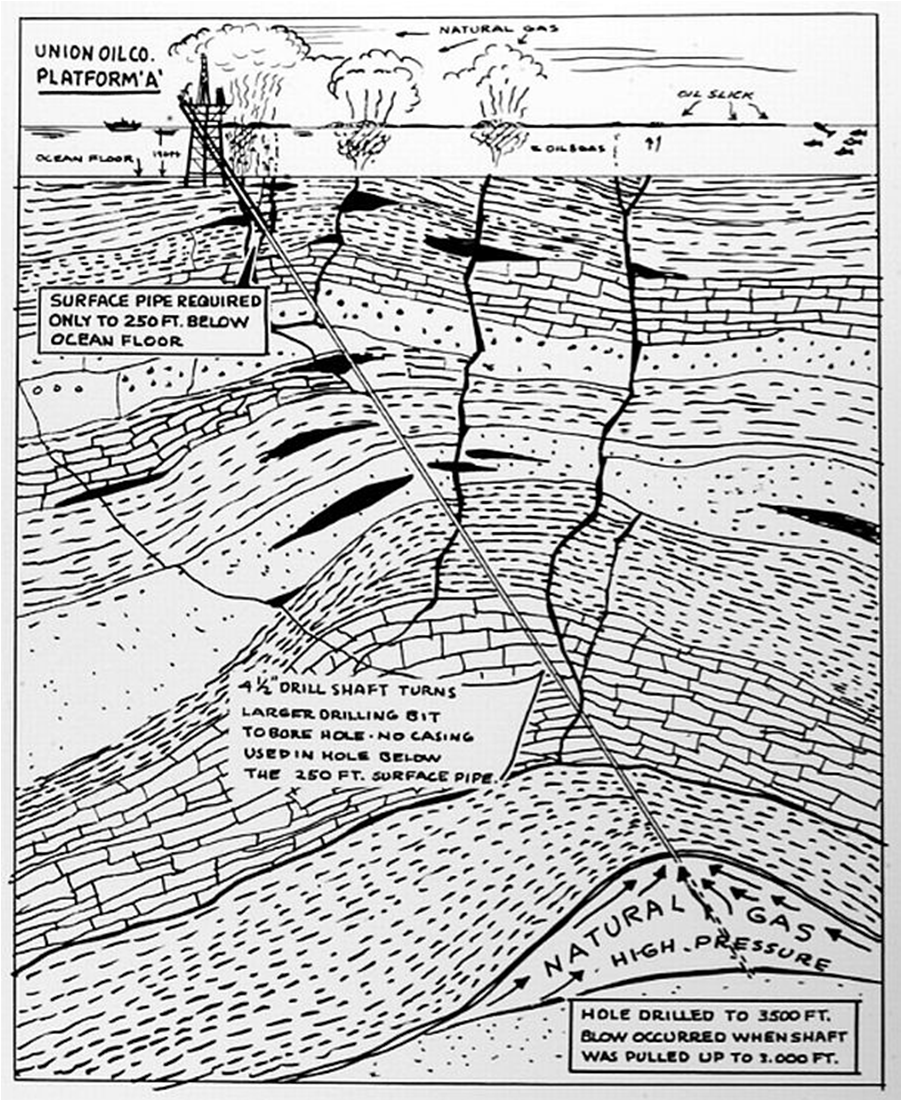
Boils of gas began to appear on the water surface. Oil flowed to the surface through numerous fracture channels. The sketch below by a former colleague depicts the fracturing, which greatly complicated mitigation of the flow.
We need to continue studying these historically important incidents, not just the technical details but also the human and organizational factors that allowed such safety and environmental disasters to occur. The idea is not to shame, but to remember and better understand.
Although OSHA is withdrawing the Vaccination and Testing ETS as an enforceable emergency temporary standard, OSHA is not withdrawing the ETS to the extent that it serves as a proposed rule
The law suit makes reference to the aging offshore facilities and the Huntington Beach pipeline spill:
Oil companies have been drilling off California for more than 50 years. The first platforms were installed in 1968 and production continues today. Much of this infrastructure has outlived its expected lifespan and is well beyond the age scientists say significantly increase the risk of oil spills.
Indeed, just months ago a pipeline connected to a platform in federal waters off Huntington Beach ruptured and spilled tens of thousands of gallons of oil into the marine environment. The spill fouled sensitive marine, beach, and wetland habitat; forced closure of fisheries; and harmed and killed birds, fish, plants, invertebrates, and marine mammals.
The combination of high production of oil and gas from a total of 94 fields, significant demand and high commodity prices led to a historically high level on the State’s revenues from petroleum.
Production in 2021 came to 102 million standard cubic metres of oil (642 million barrels) and 113 billion standard cubic metres of gas. This corresponds to about four million barrels of oil equivalent per day, a minor increase from the previous year.
Norway wisely eased the petroleum tax burden during the pandemic with favorable results.
The temporary change in the petroleum tax has most likely led to an increase in project activity. The projects would most likely have been carried out even without the tax package, but some of them would have been postponed.
An aspect of Norwegian offshore policy that is confusing to this outside observer is the emphasis on transmitting electric power from shore to offshore platforms (see quote below). In most cases, offshore platforms produce sufficient gas to support their power demands. Should platforms be powered from shore, gas that is not used for platform operations would presumably be marketed for consumption elsewhere or reinjected. If the gas is marketed and consumed elsewhere, there is essentially no net (global) CO2 emissions reduction benefit. Gas that is reinjected is wasted unless there is an enhanced oil recovery benefit. So it would seem that importing electric power from shore would only make sense if the net reduction in offshore gas consumption increased ultimate oil production (which could be viewed as undesirable if you take carbon management to the extreme).
While production remains high, CO2 emissions are dropping. The most important reason for this is the use of power from shore. The objective is to cut emissions in half by 2030 compared with the level in 2005.
In a separate article, NPD notes that power from shore increases the cost of platform operations and will also lead to an increase in electricity prices in Norway. Given these considerations, the very small net global reduction in CO2 emissions seems costly.
Platform electrification no doubt helps Norway achieve domestic emission reduction commitments. However, from a global perspective, how important is it for a minor CO2 emitter like Norway to achieve further reductions? Also, isn’t it somewhat contradictory for a major oil and gas exporter to take such extreme measures to reduce the emissions associated with the production of these resources?