A federal investigation into the October oil spill that paved the Orange County coast has been stalled for several months as authorities await approval to cut, remove and analyze part of the ruptured pipeline.
Coast Guard and National Transportation Safety Board investigators currently have to rely on video captured during underwater pipeline inspections. Without a more detailed forensic examination of the damage in a lab, investigators won’t know whether to continue with their original investigation or move the investigation in a new direction.
It’s not good when bureaucratic processes stall an important investigation. Hopefully the responsible agencies will be sufficiently embarrassed to get the investigation moving.
Bad decision by Blackstone; worse timing. Putin and OPEC must be pleased.
Blackstone Inc., once a major player in shale patches, is telling clients its private equity arm will no longer invest in the exploration and production of oil and gas, according to people with knowledge of the talks. The firm’s next energy fund won’t back those upstream investments — a first for the strategy.
As the United States continues to tie its hands with regard to the transportation of natural gas, a fuel that has actually led to a large decrease in CO2 emissions over coal, Russia and China reached an agreement under which Russia will supply 100 million tons of coal to China so that China can continue to open up new coal-fired power plants
Britain sees a “good, solid” future for the North Sea’s oil and gas industry and will issue new licences to expand output in the future, Energy Minister Greg Hands said on Tuesday.
“We need continued investment into the North Sea,” Hands told the International Energy Week online conference.
Meanwhile, the US government seems intent on supporting legal and administrative actions that stymie offshore exploration and development. The US is sanctioning its own offshore industry during an international crisis centered around energy.
2021 was the first year in the history of the US offshore program dating back to the passage of the OCS Lands Act in 1953 without a single oil and gas sale, and there is no lease sale on the horizon.Most years have had multiple sales, regardless of the party in power. The only attempted 2021 sale (no. 257) was required by a Federal Court decision in Louisiana. That sale was annulled by a questionable DC court decision that the Federal government chose not to appeal.
Kristen Nordlund, a spokeswoman for the C.D.C., said the agency has been slow to release the different streams of data “because basically, at the end of the day, it’s not yet ready for prime time.” She said the agency’s “priority when gathering any data is to ensure that it’s accurate and actionable.”
Another reason is fear that the information might be misinterpreted, Ms. Nordlund said.
“The C.D.C. is a political organization as much as it is a public health organization,” said Samuel Scarpino, managing director of pathogen surveillance at the Rockefeller Foundation’s Pandemic Prevention Institute. “The steps that it takes to get something like this released are often well outside of the control of many of the scientists that work at the C.D.C.”
BP owns almost a fifth of Russia’s largest oil producer Rosneft. UK-listed rival Shell controls 27.5 per cent of Gazprom’s huge Sakhalin-2 offshore gas project in Russia’s far east. Exxon has been operating in Russia for 25 years and producing oil and gas in eastern Russia since 2005 in a partnership involving two Rosneft affiliates.
More than 20 European countries import gas from Russia. The Czech Republic and Latvia import 100% of their gas from Russia. Hungary, Slovakia, Bulgaria, Finland, Germany, and Poland import more than half of their gas from Russia.
Clumsy sanctions could send oil and gas prices soaring to Russia’s benefit and the West’s detriment. We should first remove the sanctions that have intentionally and inadvertently been imposed on our own producers, including leasing blockades and permitting obstacles. The Ukraine crisis and its side effects will be with us for years, as will the demand for oil and gas. We need both immediate and longer term supply solutions.
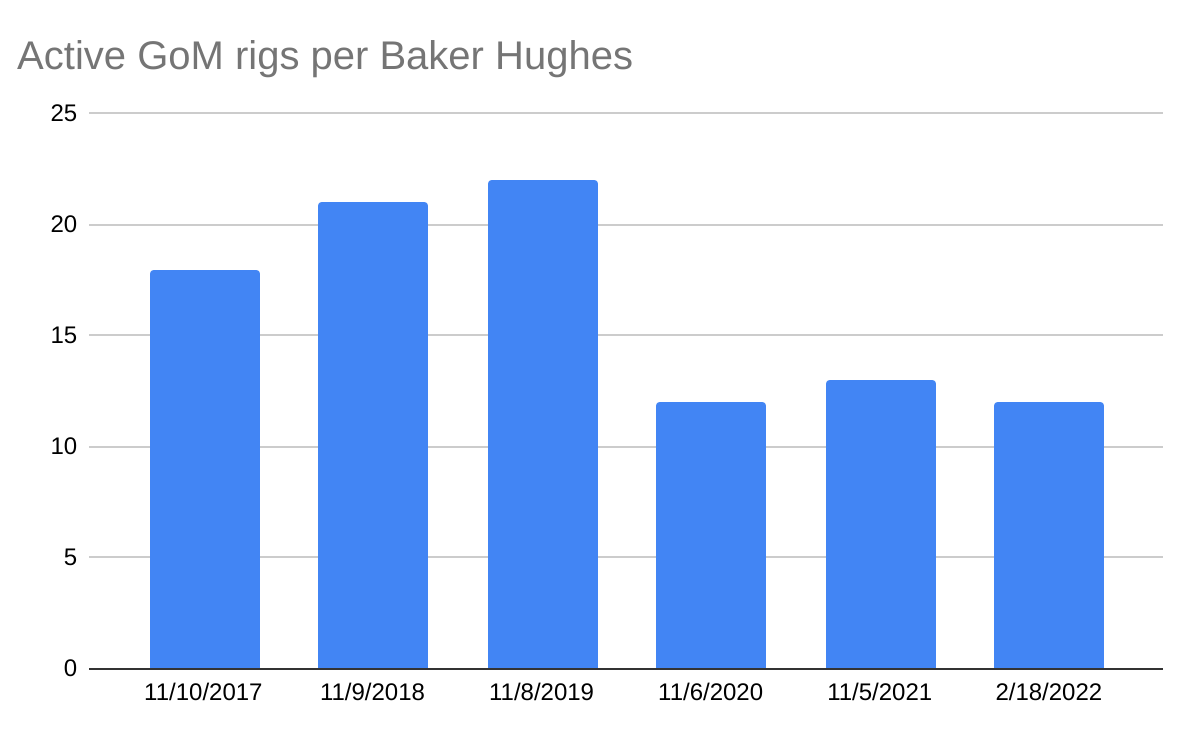
The rig count remains low at 12 (see the updated chart below). Per BSEE’s borehole file, only 3 deepwater exploratory wells have been spudded in 2022 YTD (2/21) – one each for Shell, Hess, and Anadarko.
What’s going on? Better opportunities elsewhere? Uncertainty about lease sales? Concerns about legal challenges and the future of the US offshore program?
Meanwhile, however, drillers may be running out of sweet spots in the shale basins of the country. In an article citing well data, the Wall Street Journal reported earlier this month that because of the quick depletion rates of shale wells, low-cost resources are giving way to higher-cost deposits. And this is motivating a warier approach to production growth.
The shale revolution made the US a net oil exporter, but skepticism about shale production forecasts suggests the need for other supply sources. Given the shale uncertainty and the unrealistic expectations regarding the energy transition, greater US dependence on imported oil is on the horizon. This bodes well for OPEC, but not so well for US and international consumers.
On 2/11/2022 Judge Cain (Western District of Louisiana) issued ruled that a Biden executive order contradicts Congress’ intent regarding the consideration of global effects:
The Court finds that EO 13990 contradicts Congress’ intent regarding legislative rulemaking by mandating consideration of the global effects. The Court further finds that the President lacks power to promulgate fundamentally transformative legislative rules in areas of vast political, social, and economic importance, thus, the issuance of EO 13990 violates the major questions doctrine.
Judge Cain’s order seems, at least to this non-lawyer, to contradict the 1/27/2022 ruling by Judge Contreras, DC Federal Court, that BOEM “acted arbitrarily and capriciously in excluding foreign consumption from their greenhouse gas emissions calculation.” The plaintiffs had asserted that BOEM failed to consider the effect that reduced US offshore production (and higher prices) would have on foreign consumption and the associated GHG emissions. (Poverty is good?)
For a second time this week, Fatih Birol, the executive director of the International Energy Agency (IEA), called on the OPEC+ group on Wednesday to narrow the widening gap between its production quotas and the much lower actual supply to the market.
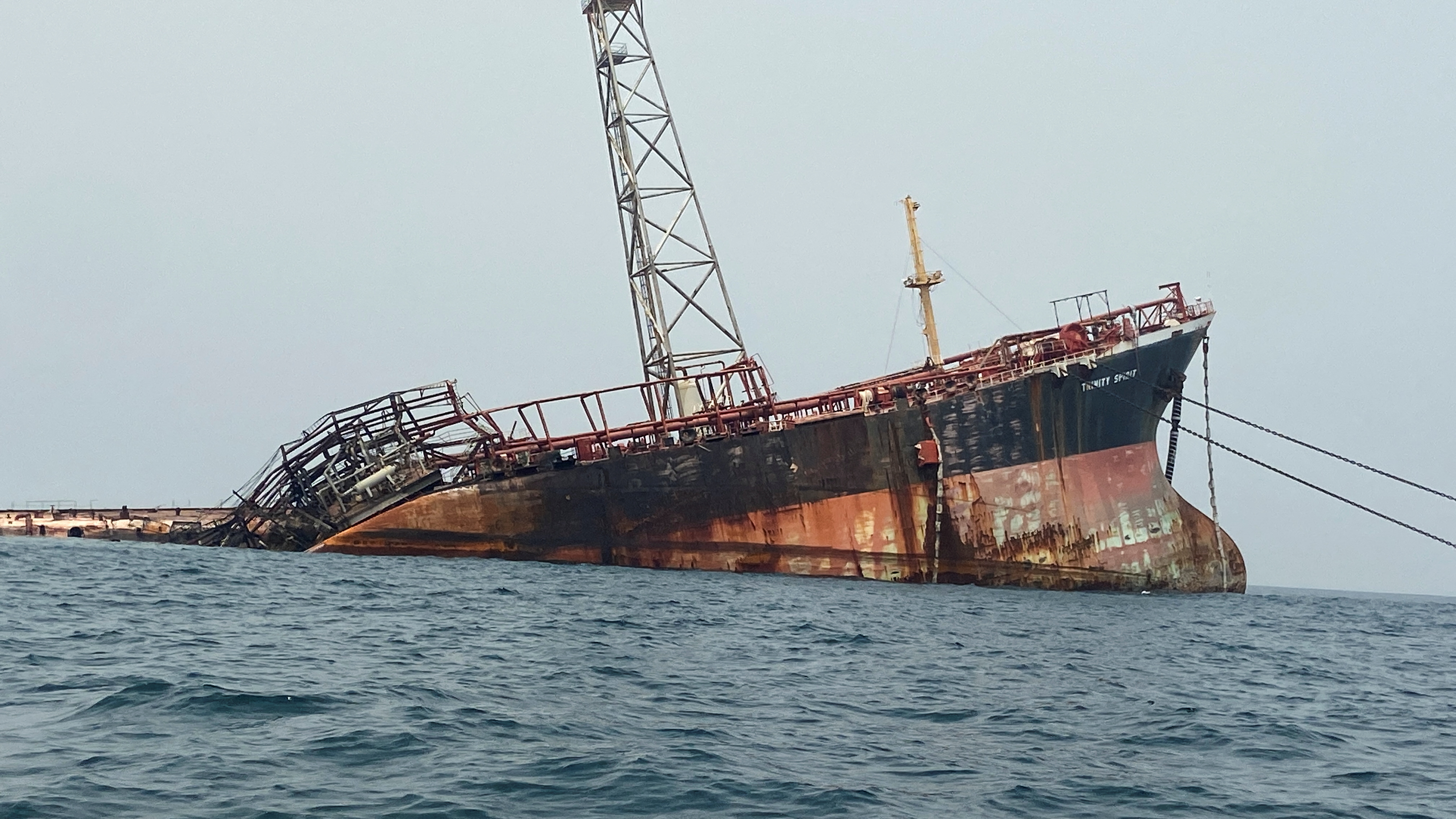
Two weeks after the Trinity Spirit FPSO fire offshore Nigeria we still don’t know the fate of the crew. Neither the operator nor the regulator websites include any mention of the fire. The last operator statement (more than a week ago) advised that 3 workers were confirmed dead and others were still missing. There has been no subsequent update and the media have moved on, as is usually the case when there is no ongoing oil spill.
We need an international standard that identifies incident information to be publicly disclosed and specifies the timeframes and methods for releasing this information. An API or ISO committee would seem to be the best means of developing such a standard. If these organizations are unwilling to take the lead, perhaps the International Regulators’ Forum can do so. The credibility of the offshore industry is at stake.