Published today.
Archive for the ‘Regulation’ Category
Final BSEE well control rule is attached
Posted in drilling, Offshore Energy - General, Regulation, well control incidents, tagged BSEE, Well Control Rule on August 23, 2023| Leave a Comment »
Comments on BOEM financial assurance rule for decommissioning
Posted in California, decommissioning, Gulf of Mexico, Offshore Energy - General, Regulation, tagged BOEM, compliance and safety, decommissioning, financial assurance, oil and gas reserves, proposed rule on August 22, 2023| Leave a Comment »
The attached comments were submitted to BOEM via Regulations.gov. The comments address specific provisions of the proposed rule and include a recommendation to hold companies fully accountable for their lease transfers, but not for subsequent transfers in which they are not a party.
Do I get a t-shirt for being one of the first 2000 entries? 😀
Ominous signs for the future of Gulf of Mexico production
Posted in climate, energy policy, Gulf of Mexico, Offshore Energy - General, Regulation, Wind Energy, tagged 5 year leasing plan, carbon sequestration, Gulf of Mexico exploration slump, Gulf of Mexico oil production, offshore leasing, Offshore Wind on August 16, 2023| Leave a Comment »
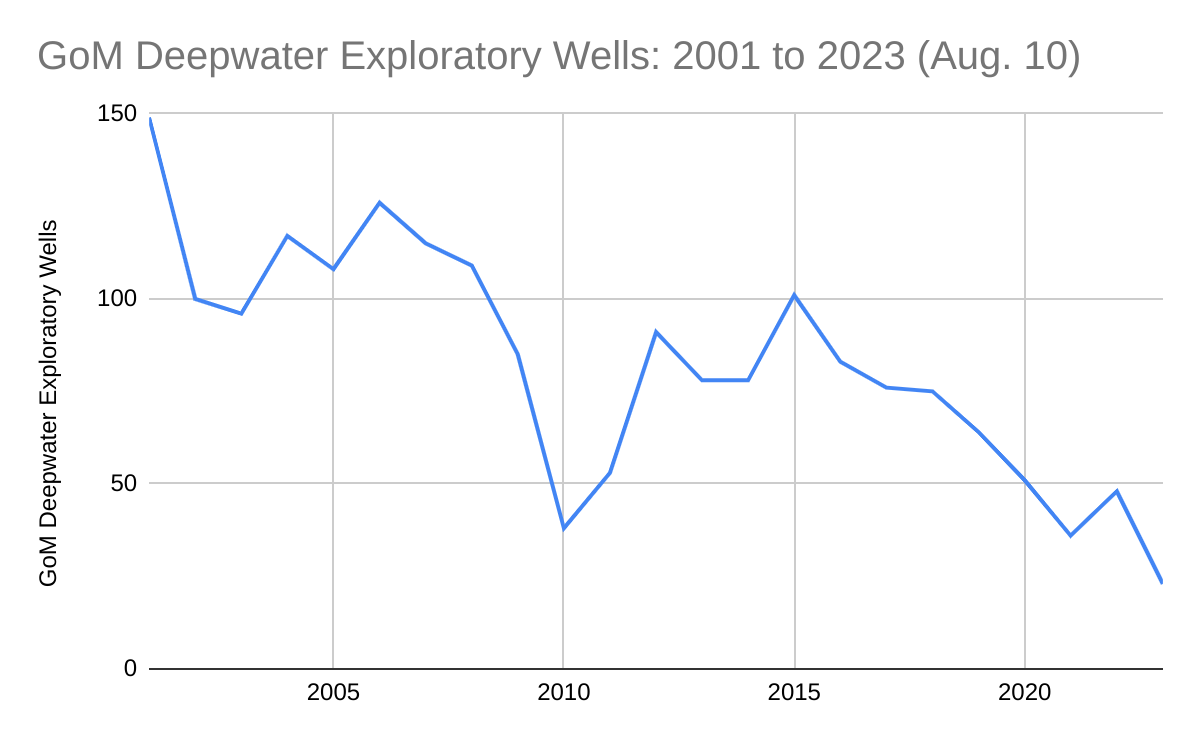
Record low exploratory drilling: 2023 will be the third consecutive year with fewer than 50 deepwater exploratory well starts. The only other year this century with <50 deepwater exploratory well starts was 2010 when there was a post-Macondo drilling moratorium.
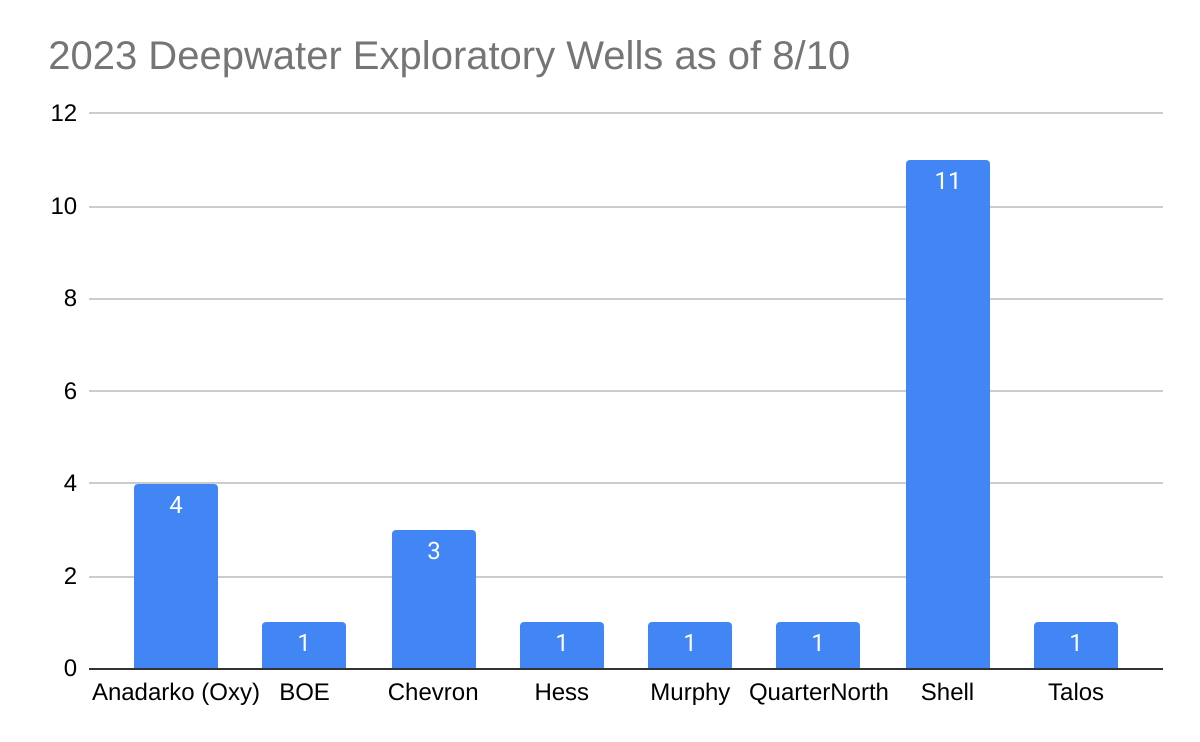
Low participation: Only 8 companies have started deepwater exploratory wells in 2023 YTD. Anadarko, Chevron, and Shell drilled 78% of the wells, with Shell alone accounting for 48%. Compare these numbers with 2001, when 24 companies drilled 149 deepwater exploratory wells.
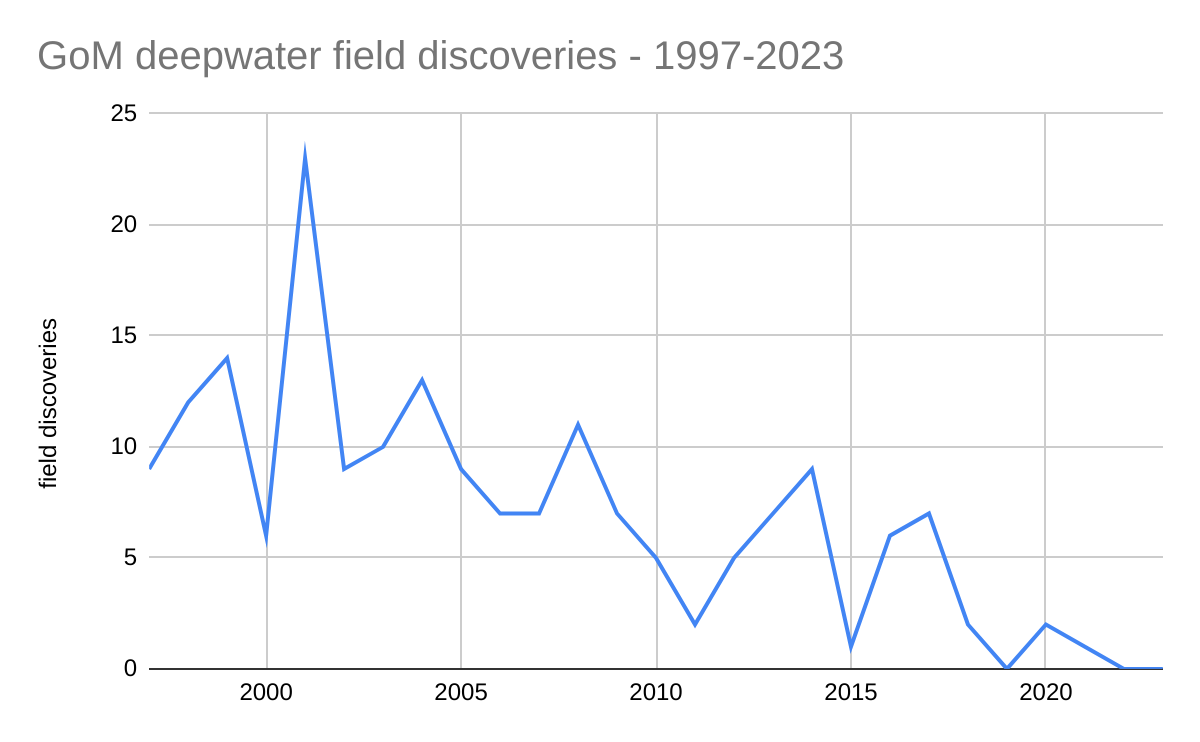
Absence of new field discoveries: Per BOEM’s database, no deepwater fields have been discovered since March 2021 and there were only 3 discoveries in the past 5 years (see chart below)
Leasing and regulatory uncertainty: When will the 5 year leasing plan be finalized and how much will leasing be restricted? What will be the effect of the expanded Rice’s whale area on deepwater operations? To what extent is this expansion justified? What other legal and regulatory threats are on the horizon?
Unrealistic expectations regarding the “energy transition:” In a stunning introductory statement, the Proposed 5 Year Leasing Plan expressed concerns that new leases would produce too much oil and gas for too long. OPEC+ must love the way the US sanctions its own energy production, most notably the oil and gas resources of the OCS. More than 96% of the OCS is off-limits to oil and gas leasing, and the 5 year plan proposed to constrain leasing in the only areas that remain. The favored offshore wind program was intended to be a complement to, not a replacement for, the oil and gas program. Wind energy is limited by intermittency, space preemption, navigation, and wildlife protection concerns.
Some companies have visions of the GoM as a carbon dumping hub: The largest US oil company, which hasn’t drilled a well in the GoM in nearly 4 years and operates just one production platform, seeks praise and profit by sequestering CO2 beneath the Gulf while maximizing oil production elsewhere. How will this sustain economically and strategically important GoM oil and gas production?
Lots of public comments on BOEM’s proposed financial assurance rule (decommissioning)
Posted in decommissioning, Offshore Energy - General, Regulation, tagged BOEM, decommissioning, financial assurance, Regulation on August 15, 2023| Leave a Comment »

1137 comments to date per Regulations.gov. This would imply one or more organized commenting campaigns.
I will share my comments on this blog after they have been submitted.
Final BSEE well control rule update should be published soon
Posted in Gulf of Mexico, Offshore Energy - General, Regulation, well control incidents, tagged BOP, BSEE, regulatory agenda, Well Control Rule on August 2, 2023| Leave a Comment »
Per the DOI regulatory agenda published on 7/27/2023 (excerpt below), the final BSEE well control rule was published in June. Of course, that did not happen, but the update tells us that the final rule should be published soon. The delay is probably in the internal review process which moves at the pace of continental drift 😉.
BOE comments on the proposed rule are attached here.
12. Oil and Gas and Sulfur Operations in the Outer Continental Shelf-Blowout Preventer Systems and Well Control Revisions [1014–AA52]
Legal Authority: Not Yet Determined [BOE note: This is rather comical since the OCSLA authority was specified in the preamble to the proposed rule and you would never publicly imply that you didn’t know the authority for a final rule. 😉]
Abstract: This rulemaking revises the Bureau of Safety and Environmental Enforcement (BSEE) regulations published in the 2019 final rule entitled “Oil and Gas and Sulfur Operations in the Outer Continental Shelf-Blowout Preventer Systems and Well Control Revisions,” 84 FR 21908 (May 15, 2019), for drilling, workover, completion and decommissioning operations. In accordance with Executive Order (E.O.) 13990 (Protecting Public Health and the Environment and Restoring Science to Tackle the Climate Crisis) and the E.O.’s accompanying “President’s Fact Sheet: List of Agency Actions for Review,” BSEE reviewed the 2019 final rule and is updating to subpart G of 30 CFR part 250 to ensure operations are conducted safely and in an environmentally responsible manner.
Timetable:
| Action | Date | FR Cite |
|---|---|---|
| NPRM | 09/14/22 | 87 FR 56354 |
| NPRM Comment Period End | 11/14/22 | |
| Final Action | 06/00/23 | |
| Final Action Effective | 07/00/23 |
Settlement agreement threatens deepwater Gulf of Mexico operations
Posted in energy policy, Gulf of Mexico, Offshore Energy - General, Regulation, tagged BOEM, Gulf of Mexico, NOAA, Rice's whale, settlement agreement, vessel transit restrictions on July 31, 2023| Leave a Comment »

Attached is a settlement agreement between NOAA and 4 NGOs that could have major implications for deepwater oil and gas operations in the Gulf of Mexico.
As background, the Rice’s Whale (formerly Bryde’s whale) area has been expanded (see map above) such that it fences off deepwater leases by creating a barrier to vessel transportation. The expansion is based on a single study that concluded that Rice’s whales were “the most plausible explanation” for moan calls observed in the northwest GOM shelf break area. No Brice’s whales were sighted in the expanded area during this study. The authors do point to a 2017 sighting offshore Corpus Christi, which is apparently the only actual sighting of a Brice’s whale along the NW GoM shelf break.
The settlement agreement commits BOEM, presumably with their concurrence, to exclude the expanded area from future leasing, to issue a Notice to Lessees and Operators (exhibit 1 below) and to attach stipulations to new leases (exhibit 2). Because BOEM’s authority to impose major new requirements without proposing a regulation for public review and comment is questionable, the Notice (NTL) describes the restrictions as “recommended measures.” However, the liability risks associated with the failure to comply with this “guidance” would be unacceptable to most companies. Adding to the muddle, the language in the lease stipulation differs by making it perfectly clear that compliance is required.
The most troubling restriction from an operational standpoint:
“To the maximum extent practicable, lessees and operators should avoid transit through the Expanded Rice’s Whale Area after dusk and before dawn, and during other times of low visibility to further reduce the risk of vessel strike of Rice’s whales.“
Comments:
- Deepwater facilities are typically far from shore, and a requirement to transit only between dusk and dawn, particularly in the winter, is unrealistic and onerous. This is further complicated by the speed limit provision.
- Those who have worked offshore know that periods of low visibility are unpredictable and can extend for days. The low visibility transit restriction is thus highly punitive and increases operational risks on the vessels and at the facilities they serve.
- The vague “to the maximum extent practicable” caveat provides little comfort for planners, managers, and crews, and is a de facto acknowledgement that the requirement is unreasonable.
- These restrictions, coupled with the required Automatic Identification System data, open the door to endless challenges, especially given the keen interest of the litigious organizations that are parties in the settlement agreement.
- Deepwater GoM operations are few in number and highly dispersed, which is a more important mitigating factor than those included in the agreement. More on this tomorrow.
- In addition to the deepwater operations that will be much more difficult to supply, there are currently 81 production platforms within the expanded Rice’s whale area (100 to 400 m water depth).These include important facilities like Amberjack, Cognac, Cerveza, and Lobster. What are the implications for these platforms? Will they be required to have full-time whale observers? Can they only be supplied during daylight hours with good visibility? Why not consider using these platforms as bases for more definitive studies?
- Further to the previous point, there are 103 existing leases in the 100-400 m depth zone that is now excluded from leasing? 90 of these leases are still in their primary term, and 21 were issued in the past 2 years. How will the contractual rights of these leaseholders be protected? (In fact, the value of all 1550 active leases in >100 m water depth is affected by this agreement.)
- Have BSEE and Coast Guard been consulted on the practicality and safety implications of these requirements?
- Deepwater operations have been ongoing in the GoM for 50 years, and there is no apparent evidence of impacts to this species. Why can’t the consultation process and any necessary followup studies be completed before decisions are made regarding operating restrictions?
- These types of restrictions, coupled with the diminished state of the Strategic Petroleum Reserve and tightening oil markets, raise serious energy security and economic concerns.
Finally, BOEM’s third footnote in the NTL (pasted below), doesn’t demonstrate great confidence in the need for the onerous requirements that are being imposed.
“This is not meant to be construed as a blanket determination as to whether BOEM, at present, has determined that there is a “reason to believe” that incidental take may occur, within the meaning of the ESA, the consultation regulations, or BOEM’s regulations. Those decisions will be made on a case-by-case basis in accordance with BOEM regulations referenced below.” Comment: Huh??? How are these blanket restrictions case-by-case, and how are they being imposed without public review?
Opportunity to formally comment on offshore carbon sequestration is on the horizon
Posted in CCS, energy policy, Gulf of Mexico, Offshore Energy - General, Regulation, tagged carbon sequestration, CCS, DOI, Exxon, infrastructure bill, Lease Sale 257, Lease Sale 259, Ocean Dumping, OCSLA on July 18, 2023| Leave a Comment »
ENERGYWIRE has reported that the Department of the Interior will publish the legislatively mandated carbon sequestration rule later this year. Given that even close followers of the OCS program were completely unaware of the enabling legislative provisions prior to their enactment, the proposed DOI rule will provide the first opportunity to formally comment.
Within the oil and gas industry and the environmental community, there are considerable differences of opinion about carbon sequestration in general, and more specifically, offshore sequestration. All interested parties are encouraged to submit comments on these important regulations.
Some background information on the sequestration legislation and subsequent actions:
- 11/15/2021: The “Infrastructure Investment and Jobs Act” was enacted with surprising late additions to facilitate offshore carbon sequestration. These provisions:
- amend the OCS Lands act to authorize “the injection of a carbon dioxide stream to sub-seabed geologic formations for the purpose of long-term carbon sequestration.”
- exempt CO2 injection from the restrictions on ocean dumping by stipulating that such injection “shall not be considered to be material (as defined in section 3 of the Marine Protection, Research, and Sanctuaries Act of 1972.” Without this exemption, CO2 streams would clearly be “material,” as defined in 33 U.S.C. 1402, and would be subject to the stringent requirements of that act.
- direct that “not later than 1 year after the date of enactment of this Act, the Secretary of the Interior shall promulgate regulations to carry out the amendments made by this section.” (This deadline has been missed, which is rather common for such directives.)
- authorize $2.5 billion in Federal funding for commercial CCS projects and much more for other carbon capture and sequestration (CCS) activities.
- 11/17/2021: Two days after the enactment of this legislation, Exxon was the sole bidder on 94 nearshore tracts with very limited oil and gas production potential. This was an oil and gas lease sale and there were no provisions for carbon sequestration leasing. Nonetheless, Exxon was awarded leases for all 94 tracts.
- 3/29/23: Exxon bid at Sale 259 on 69 nearshore tracts with little oil and gas potential. Once again, this was strictly an oil and gas lease sale and Exxon’s CCS intentions were clear. Nonetheless, the leases were awarded.
Exxon and other companies intend to commercialize carbon sequestration, and Exxon projects an astounding $4 trillion CCS market by 2050. Such a market will of course be dependent on mandates and subsidies, and the costs will ultimately be borne by taxpayers and consumers.
Is it not a bit unsavory and hypocritical for hydrocarbon producers to capitalize on the capture and disposal of emissions associated with the consumption of their products? Perhaps companies that believe oil and gas production is harmful to society should exit the industry, rather than engage in enterprises that sustain it.
More:
Jones Act workaround is good for Newfoundland
Posted in Canada, energy policy, Offshore Energy - General, Offshore Wind, Regulation, tagged Argentia, Jones Act, monopiles, Newoundland, Wind Energy on July 17, 2023| Leave a Comment »
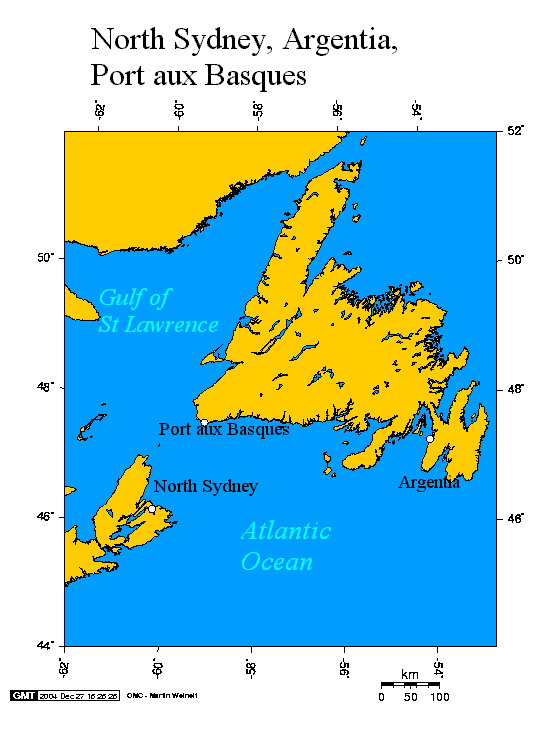
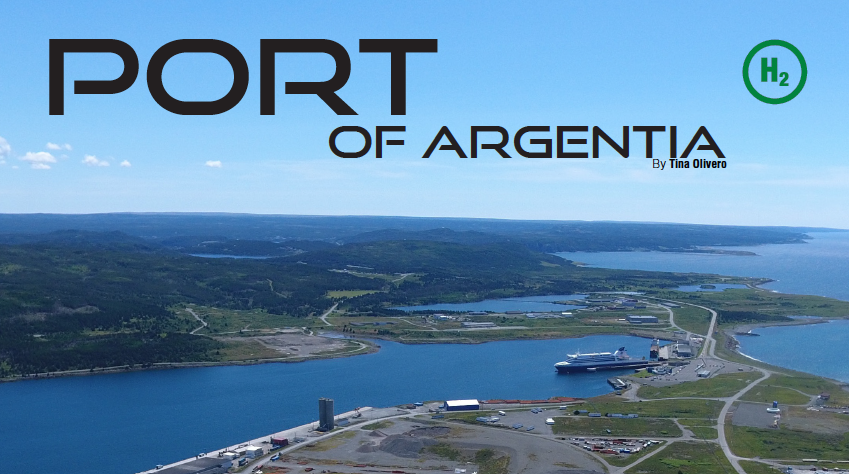
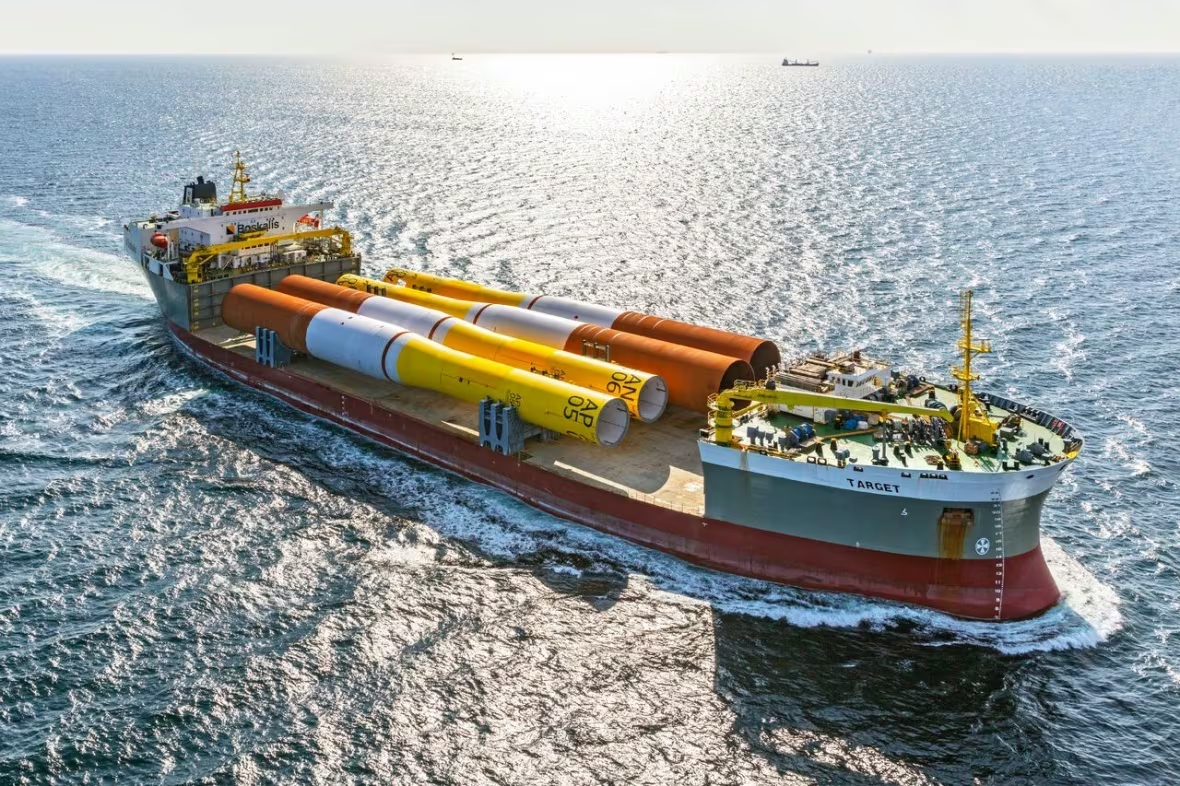
The Jones Act, protectionism at its finest, was enacted 113 years ago, and stipulates that vessels which transport merchandise or people between two US points must be US built, flagged, owned, and crewed. Congress tightened the screws further by ordaining that offshore energy facilities, including wind farms, are US points. That precludes the transportation of wind turbine components from US ports to offshore wind farms.
The Jones Act has thus provided an opportunity for the Port of Argentia, a former US Navy base in southeast Newfoundland, and the port is set to become a key node in the offshore wind supply chain. Monopiles constructed in Europe will be stored in Argentia, until they are delivered to US wind farms in the North Atlantic. Kudos to the folks at the Port of Argentia for taking advantage of this opportunity.
BOEM’s proposed financial assurance rule (decommissioning): preliminary observations
Posted in California, decommissioning, energy policy, Gulf of Mexico, Regulation, tagged BOEM, decommissioning, financial assurance, proposed rule, reverse chronological order on July 10, 2023| Leave a Comment »
Some preliminary thoughts about BOEM’s proposed revision to the decommissioning financial assurance regulations for US offshore oil and gas operations:
- BOEM has rather surprisingly proposed to eliminate consideration of a company’s compliance record in determining the need for supplemental financial assurance. An opposing view will be posted tomorrow.
- If a lease has proved reserves with a value of at least three times that of the estimated decommissioning cost, no supplemental financial assurance would be required. Comparing two imprecise and variable estimates is neither a simple nor reliable method for determining the need for supplemental financial assurance. BOEM should look at the history of the Carpenteria field (Santa Barbara Channel) and the reserve estimates that were provided to discount decommissioning risks. More on this at a later date.
- Transferor liability applies only to those obligations existing at the time of transfer; new facilities, or additions to existing facilities, that were not in existence at the time of any lease transfer are not obligations of a predecessor company and are considered obligations of the party that built such new facilities and its co- and successor lessees. This is a good policy, but is difficult to implement. Some of the complexities may need to be addressed. More later.
- The “reverse chronological order” provision was withdrawn in April, so there is no defined process for issuing decommissioning orders to predecessor lessees. Is it good policy to first issue such orders to companies who may have owned leases decades ago, in some cases prior to the establishment of transferor liability in the 1997 MMS “bonding rule?”
- The proposed rule would clarify that BOEM will not approve the transfer of a lease interest until the transferee complies with all applicable regulations and orders, including the financial assurance requirements. BOEM needs to be firmly enforce this policy. See tomorrow’s post.
- The proposed rule would not allow BOEM to rely upon the financial strength of predecessor lessees when determining whether, or how much, supplemental financial assurance should be provided. This is a good provision.
- BOEM proposes to use the P70 probabilistic value to set the amount of any required supplemental financial assurance. These estimates do not seem sufficiently conservative to protect other parties and the public in the event of default. This is particularly true after storm damage which can increase plugging costs more than tenfold.
- The probabilistic cost estimates were updated in 2020 and are based on data submitted subsequent to 2016 and 2017 NTLs. How often will these estimates be updated?
- The final rule should specify that funds may not be withdrawn from decommissioning accounts for operational purposes, and that BOEM approval is required for such withdrawals.
35 years ago today, fires and explosions destroyed the Piper Alpha platform in the North Sea and killed 167 workers. We must never forget this tragedy.
Posted in accidents, Gulf of Mexico, Offshore Energy - General, Regulation, UK, tagged fire, Lord Cullen, North Sea, Piper Alpha, safety case, South Pass 60 B on July 6, 2023| Leave a Comment »


The Piper Alpha fire was the worst disaster in the history of offshore oil and gas operations and sent shock waves around the world. Eight months later another interactive pipeline-platform fire killed 7 workers at the South Pass 60 “B” facility in the Gulf of Mexico. A US Minerals Management Service task group reviewed the investigation reports for both fires and recommended regulatory changes with regard to:
- the identification and notification procedures for out-of-service safety devices and systems,
- location and protection of pipeline risers,
- diesel and helicopter fuel storage areas and tanks,
- approval of pipeline repairs, and
- location of ESD valves on pipelines.
Paul Schneider and I wrote a paper on the task group’s findings and that paper was published in Offshore Operations Post Piper Alpha (Institute of Marine Engineers,1991). The proposed regulations that followed summarized these findings and can be be found at this Federal Register link.
Lord Cullen’s comprehensive inquiry into the Piper Alpha tragedy challenged traditional thinking about regulation and how safety objectives could best be achieved, and was perhaps the most important report in the history of offshore oil and gas operations. Per Cullen:
“Many current safety regulations are unduly restrictive because they impose solutions rather than objectives. They also are out of date in relation to technological advances. Guidance notes lend themselves to interpretations that discourage alternatives. There is a danger that compliance takes precedence over wider safety considerations and that sound innovations are discouraged.“
Cullen advocated management systems that describe the safety objectives, the system by which those objectives were to be achieved, the performance standards to be met, and the means by which adherence to those standards was to be monitored. He called for safety cases that describe major hazards on an installation and provide appropriate safety measures. Per Cullen, each operator should be required in the safety case to demonstrate that the safety management systems of the company and the installation are adequate to assure that design and operation of the platform and its equipment are safe.
Links for the full Piper Alpha Inquiry: volume 1 and volume 2
 Bud's Offshore Energy (BOE)