German investigators are sceptical of claims that Russian naval ships sabotaged the Nord Stream gas pipelines and are instead pursuing leads that point to the Ukrainian authorities, according to a report.
The vacuum of official information has been filled by speculation variously pinning the blame on the United States, Russia, the Ukrainian secret services and an unnamed businessman in Ukraine. All three states have denied responsibility.
Times of London
Archive for the ‘pipelines’ Category
More Nord Stream speculation
Posted in accidents, pipelines, Russia, tagged Nord Stream, Ukraine on May 22, 2023| Leave a Comment »
Regulatory fragmentation and offshore safety
Posted in accidents, Gulf of Mexico, Offshore Energy - General, pipelines, Regulation, tagged BOEM, BSEE, Coast Guard, fires and explosions, Huntington Beach pipeline spill, macondo, OCS fatalities, regulatory fragmentation, safety, South Pass 60 B on May 18, 2023| Leave a Comment »
Linking an interesting academic paper on regulatory fragmentation:
Regulatory fragmentation occurs when multiple federal agencies oversee a single issue. Using the full text of the Federal Register, the government’s official daily publication, we provide the first systematic evidence on the extent and costs of regulatory fragmentation. We find that fragmentation increases the firm’s costs while lowering its productivity, profitability, and growth. Moreover, it deters entry into an industry. These effects arise from regulatory redundancy and, more prominently, regulatory inconsistency between agencies. Our results uncover a new source of regulatory burden: companies pay a substantial economic price when regulatory oversight is fragmented across multiple government agencies.
Regulatory Fragmentation
The US has a highly fragmented offshore regulatory regime that has become even more fragmented with the complex division of responsibilities between BOEM and BSEE. The slide below is from a presentation on this topic.
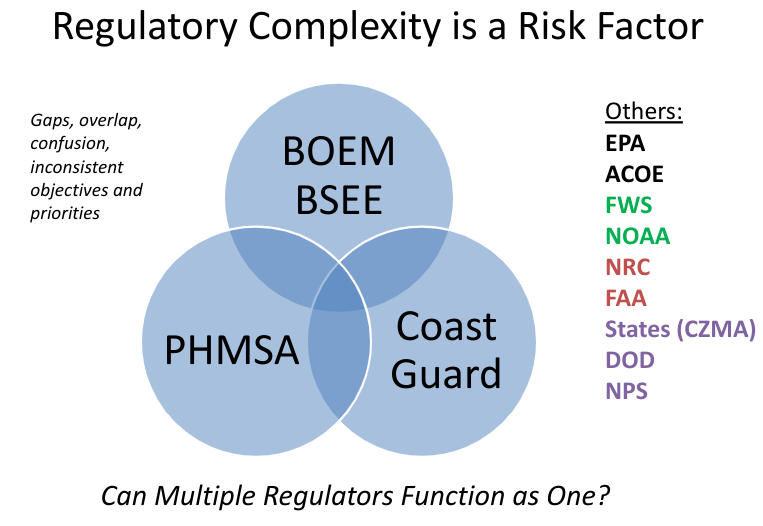
While the linked paper focuses on costs and productivity, fragmentation may also be a significant safety risk factor. A UK colleague once asseted that “overlap is underlap,” and I believe there is something to that. If multiple agencies have jurisdiction over a facility, system, or procedure, the resulting redundancy, inconsistency, and ambiguity may create significant gaps in industry and governmental oversight.
For example, regulatory fragmentation was arguably a significant factor in the most fatal US offshore fire/explosion incidents in the past 35 years – the South Pass B fire in 1989 and the Macondo blowout in 2010. More specifically:
South Pass 60 B: The investigation of the 1989 South Pass 60 B platform explosion that killed 7 workers noted the inconsistency in regulatory practices for the platform, regulated by DOI, and the pipeline regulated by DOT. Cutting into the 18-inch pipeline riser did not require an approved procedure, and the risks associated with hydrocarbon pockets in the undulating pipeline were not carefully assessed. Oversight by the pipeline operator was minimal, and the contractor began cutting into the riser without first determining its contents. A massive explosion occurred and 7 lives were lost.
Decades later, DOT and DOI pipeline regulations and oversight practices are still inconsistent. Note the confusion regarding the applicable regulations following the Huntington Beach pipeline spill in 2021. As posted following that spill:
One would hope that this major spill will lead to an independent review of the regulatory regime for offshore pipelines. Consideration should be given to designating a single regulator that is responsible and accountable for offshore pipeline safety (a joint authority approach might also merit consideration) and developing a single set of clear and consistent regulations.
Macondo: While the root causes of the Macondo blowout involved well planning and construction decisions regarding the casing point, cementing of the production casing, and well suspension procedure, the blowout would likely have been at least partially mitigated (and lives saved) if the gas detection system was fully operable, the emergency disconnect sequence was activated in a timely manner, flow was automatically diverted overboard, or engine overspeed devices functioned properly. Indeed, regulatory overlap led to underlap as summarized below:
| Macondo contributing factor | jurisdiction |
| flow not automatically diverted overboard | DOI/USCG (also concerns about EPA discharge violations) |
| some gas detectors were inoperable | DOI/USCG |
| generators did not automatically shutdown when gas was detected | USCG/DOI |
| failure to activate emergency disconnect sequence in a timely manner (training deficiencies and chain-of-command complications) | USCG/DOI |
| engine overspeed devices did not function | USCG/DOI |
| hazardous area classification shortcomings | USCG/DOI |
MOUs and MOAs are seldom effective regulatory solutions as they are often unclear or inconclusive, and tend to be more about the interests of the regulator and protecting turf. They also do nothing to ensure a consistent commitment among the regulators. In the case of the US OCS program, BOEM-BSEE have a greater stake in the safety and environmental outcomes given that offshore energy is the reason for their existence. That is not the case for any of the other regulators identified in the graphic above.
The contributing factors listed in the Macondo table are not clearly or effectively addressed in the current MOAs for MODUs and floating production facilities.
Helicopter safety is another example of MOA inadequacy. Three offshore workers and a pilot died in December when a helicopter crashed onto the helideck of a GoM platform during takeoff. The most recent Coast Guard – BSEE MOA for fixed platforms added to helideck regulatory uncertainty by assigning decks and fuel handling to BSEE and railings and perimeter netting to the Coast Guard. This is the antithesis of holistic, systems-based regulation.
Beta Unit resumes production, but still no Federal investigation report
Posted in accidents, California, oil spill response, pipelines, tagged Amplify Energy, Beta Unit, BSEE, PHMSA, pipeline spill on April 12, 2023| Leave a Comment »
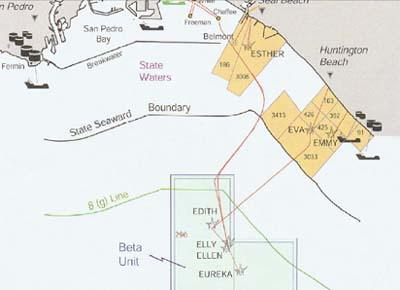
HOUSTON, April 10, 2023 (GLOBE NEWSWIRE) — Amplify Energy Corp. (“Amplify” or the “Company”) (NYSE: AMPY) today announced that it has received the required approvals from federal regulatory agencies to restart operations at the Beta Field. Initial steps to resume full operations will involve filling the San Pedro Bay Pipeline with production, a process which commenced over the past weekend and is expected to take approximately two weeks to complete. Following the line fill process, the pipeline will be operated in accordance with the restart procedures that were reviewed and approved by the Pipeline and Hazardous Materials Safety Administration (PHMSA).
Amplify Energy
Odd that the news release didn’t mention BSEE, the agency which would have had to approve the resumption of production.
18 months after the pipeline spill near Huntington Beach, settlements have been reached, fines have been paid, and production from the Beta Unit has resumed, but the Federal investigation report is still unavailable. Why?
Also, per our 10/6/2021 post:
One would hope that this spill will lead to an independent review of the regulatory regime for offshore pipelines. Consideration should be given to designating a single regulator that is responsible and accountable for offshore pipeline safety (a joint authority approach might also merit consideration) and developing a single set of clear and consistent regulations.
Nord Stream: interesting interview with ex-CIA officer Ray McGovern
Posted in energy, pipelines, Russia, tagged Nord Stream, Ray McGovern, Russia, Sweden, Ukraine on April 10, 2023| Leave a Comment »
The Nord Stream discussion begins at the 21 minute mark, but the entire interview is interesting.
Also, Swedish prosecutor Mats Ljungqvist, is apparently unconvinced by the improbable Nord Stream explanation that was fed to the NY Times.
“We don’t rule out anything, but that it is a state actor who is directly or at least indirectly behind this is of course our absolute main scenario, given all the circumstances.”
Mats Ljungqvist
Seymour Hersh: “The Cover-Up” (Nord Stream followup)
Posted in energy policy, pipelines, Uncategorized, tagged Cover-up, Nord Stream, Seymour Hersh on March 22, 2023| Leave a Comment »
The agency did its job and, with the help of German intelligence, concocted and planted stories about an ad hoc “off the books” operation that had led to the destruction of the pipelines. The scam had two elements: a March 7 report in the New York Times citing an anonymous American official claiming that “[n]ew intelligence…suggests” that “a pro-Ukrainian group” may have been involved in the pipeline’s destruction; and a report the same day in Der Zeit, Germany’s most widely read weekly newspaper, stating that German investigative officials had tracked down a chartered luxury sailing yacht that was known to have set off on September 6 from the German port at Rostock past Bornholm island off the coast of Denmark.
“It was a total fabrication by American intelligence that was passed along to the Germans, and aimed at discrediting your story,” I (Hersh) was told by a source within the American intelligence community.
The comments following the “SHEERPOST” re-posting of the Hersh update piece are also interesting.
NYT: Intelligence suggests Pro-Ukrainian group sabotaged Nord Stream pipelines
Posted in pipelines, Russia, tagged intelligence, Nord Stream, sabotage, Seymour Hersh on March 7, 2023| Leave a Comment »
This intelligence leak seems rather convenient in that it absolves both the US and Ukrainian governments, but who knows?
U.S. officials said that they had no evidence President Volodymyr Zelensky of Ukraine or his top lieutenants were involved in the operation, or that the perpetrators were acting at the direction of any Ukrainian government officials.
New York Times
Meanwhile, Seymour Hersh is promising a followup Nord Stream report next week.
Huntington Beach pipeline spill – $100 million settlement in favor of the pipeline operator
Posted in accidents, California, Offshore Energy - General, pipelines, tagged Amplify, Beta Unit, Huntington Beach, pipeline spill on March 2, 2023| Leave a Comment »
A group of international shipping companies and their subsidiaries tentatively agreed Wednesday to pay $96.5 million to Houston-based Amplify Energy Corp. to dismiss one of the last remaining lawsuits over the oil spill, which sent at least 25,000 gallons of crude into the waters off Huntington Beach in October 2021.
LA Times
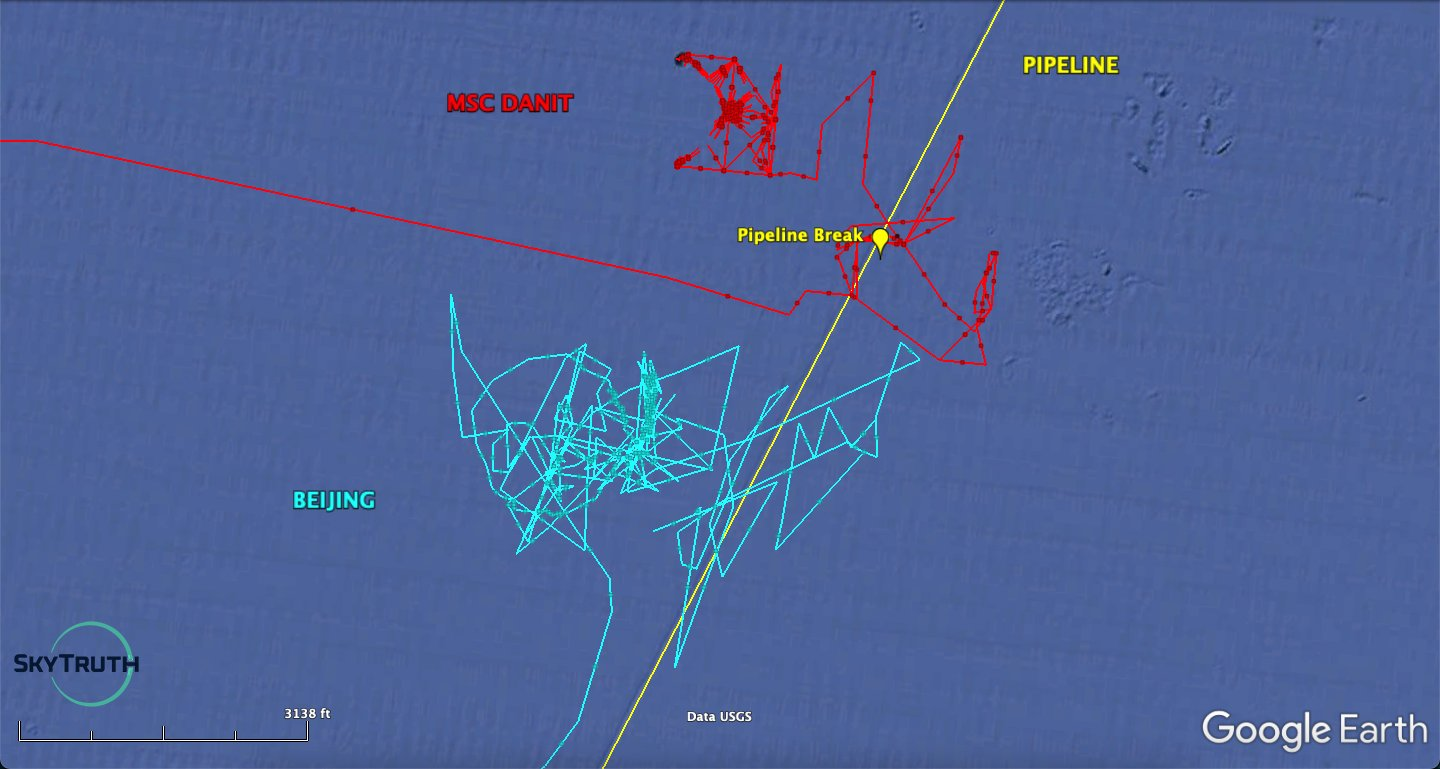
Although the Coast Guard’s investigation report has yet to be published, available information suggests that the pipeline was well maintained and that Amplify’s Beta Unit facilities had a good safety and compliance record. Absent the anchor dragging captured in the above image, a spill would have been highly unlikely. The large settlement in favor of Amplify is therefore quite understandable.
Nord Stream: Nothing new, but a good overview by Briahna Joy Gray (The Hill)
Posted in energy policy, pipelines, tagged Briahna Joy Gray, Nord Stream, Seymour Hersh, the Hill on February 19, 2023| Leave a Comment »
The corporate media is disinterested (which is a story by itself), but independent journalists like Briahna Joy Gray are coming to the fore.
Huntington Beach pipeline spill: another settlement but still no investigation report
Posted in accidents, California, Offshore Energy - General, pipelines, tagged Amplify, Beta Unit, cargo ships, Huntington Beach, law suits, pipeline spill on February 17, 2023| Leave a Comment »

Per the LA Times, companies linked to the cargo ships accused of dragging anchors over Amplify Energy’s pipeline have agreed to pay $45 million to settle lawsuits. The ships were identified by Sky Truth (see above image) shortly after the spill (October 1, 2021).
Meanwhile, Amplify is suing the vessel owners for damaging the pipeline and failing to notify the authorities after the damage occurred. Amplify would seem to have a good case given that inspection reports indicate that the pipeline was in good shape prior to the anchor damage and that the Beta Unit platforms had a good safety and compliance record.
Finally, when will we see the investigation report for this spill? It has now been nearly 17 months since the incident.
 Bud's Offshore Energy (BOE)