Feeds:
Posts
Comments

Archive for the ‘pipelines’ Category

Die Zeit graphic

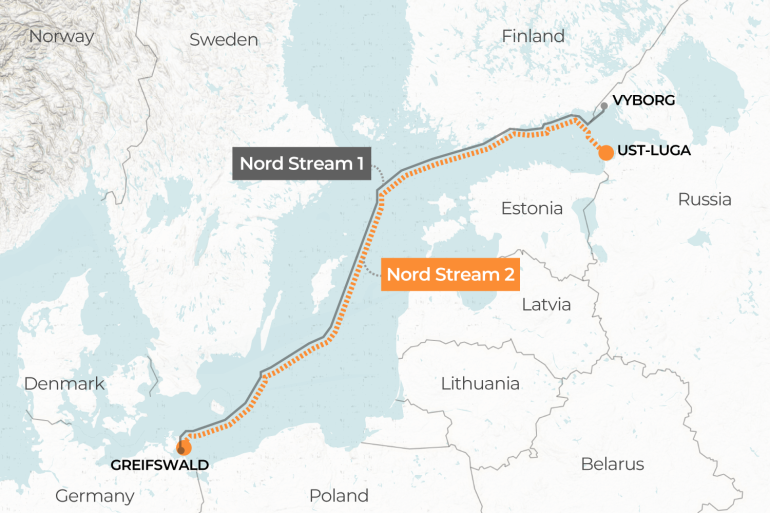
Just when we were settling on Der Spiegel’s account of the Nord Stream sabotage, Michael Kobs provides reasons for skepticism. Are the detailed revelations in Der Spiegel part of a coordinated effort to relieve governments of any responsibility and glorify the destruction of economically important pipelines?

Since the German arrest warrant for a participant in the Nord Stream terrorist attack, efforts have also increased in Germany to portray the terrorist attack as a “legitimate” or even “admirable” war effort. However, the greatest effort is to relieve the burden on state actors. And so, since recently, the alleged perpetrators seem to be chatting without reservation, spreading out every little detail in front of journalists, and putting every (already revealed) fact in the “right” non-governmental light.” ~Michael Kobs

Kolb also raises questions about the circuitous route followed by the Andromeda in arriving at the blast sites (illustration below) and the presence of 3 US Navy warships in the area. His piece is interesting reading for those who are still trying to make sense of all of this.

Meanwhile, independent journalist Jeffrey Brodsky continues to delve deeply into Nord Stream issues. A recent interesting and detailed piece refutes assertions that Gazprom and Russia somehow benefited from the Nord Stream attack. Mr. Brodsky provides evidence to the contrary concluding that the destruction of the pipelines has contributed significantly to Gazprom’s financial problems. He noted that:

  • Gazprom announced a loss of $6.9 billion for 2023, marking its first annual loss in more than two decades. 
  • Nord Stream 1 supplied EU nations with a whopping 35% of all Russian gas imports.
  • Gazprom contributed $80 million of Russia’s $407 million in Federal govt revenues in 2022, and was a source of revenue that Russia would not want to jeopardize.

Unsurprisingly, the “experts” and politicians who argued that the Nord Stream sabotage would benefit Gazprom and Russia have failed to modify or correct their assertions. Mr. Brodsky concludes his detailed analysis as follows:

However, despite the numerous facts that have emerged since the attack, the damage caused to  Russia and Gazprom by the sabotage remains willfully ignored. Politicians and experts who claimed that the sabotage would be beneficial to Russia or Gazprom financially, legally or geopolitically seem to have merely skimmed the first chapters of the Nord Stream story. So far, almost none of them have publicly corrected themselves after hastily familiarizing themselves with its complex plot. But since the perpetrator of the sabotage has not yet been unmasked, they still have the opportunity to pre-order the unfinished sequel to the book. Perhaps it will end up being an international bestseller. ~ Jeffrey Brodsky

Read Full Post »

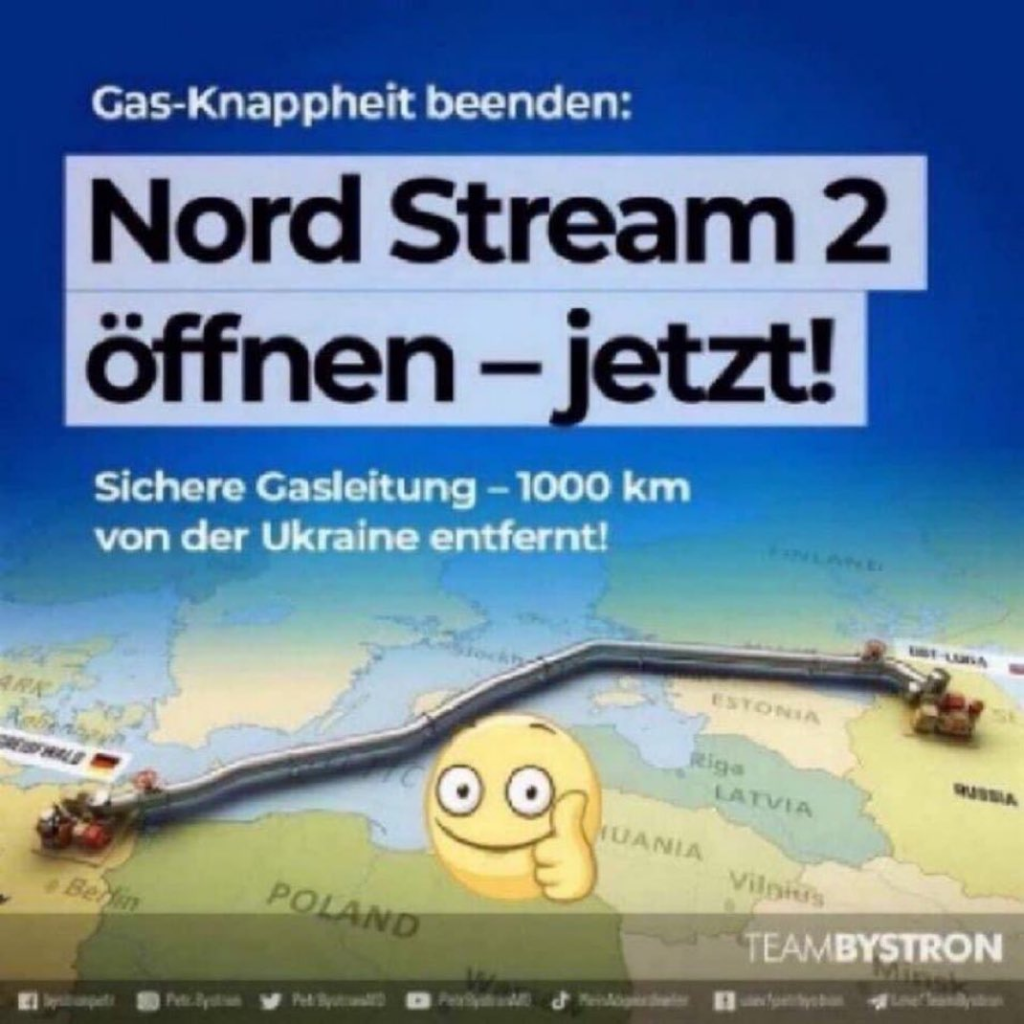
American businessman Stephen Lynch wants to acquire the Swiss company that controls the Nord Stream 2 pipeline.

From his investment firm’s website: Over the last twenty years, Mr. Lynch has acquired and managed distressed assets in Eastern Europe, Central Asia, Russia, and Ukraine. He specializes in securing cross-border collaboration on transactions and settlements around special situations and corporate conflicts. Lynch is a life member of the Council on Foreign Relations.

Lynch has worked closely with the US Department of The Treasury’s Office of Foreign Assets Control (OFAC) to acquire and de-Russify important industrial assets in U.S. partner nations.

With regard to Nord Stream: “The bottom line is this: This is a once-in-a-generation opportunity for American and European control over European energy supply for the rest of the fossil-fuel era,” Lynch told the Wall Street Journal.

Nord Stream 2 bankruptcy proceedings are scheduled to begin in January.

A “US official” told the Washington Post that a Nord Stream revival is not in the US interest right now. However, a resumption of the flow of Nord Stream gas could be a significant consideration in talks to end the Ukraine – Russian war. Also, in light of economic and energy supply challenges, there is growing German interest in restoring ties with Russia.

This appears to be a serious initiative on the part of Mr. Lynch that should not be discounted.

Also looming is a court decision in the litigation between Nord Stream AG and their insurers.

Read Full Post »

sailboat Andromeda
testing candidate bomb designs

Der Spiegel: “Wie ein ukrainisches Geheimkommando Nord Stream sprengte

Observations:

  • Der Spiegel’s detailed account is based on interviews with the perpetrators whose identities are being withheld.
  • ~a dozen men and one woman, all Ukrainians, were involved in the sabotage. Some were soldiers, some were civilians; some had past connections with the CIA.
  • <$300,000 budget funded by a Ukrainian businessman
  • Saboteurs received no payments
  • Low tech operation using the sailboat Andromeda
  • The article includes details on how the mission was accomplished.
  • To the commandos, Nord Stream sabotage was viewed as a military objective, a legitimate act of self defense.
  • The team understood that only a small hole in the outer wall would suffice to burst the pipe given the gas pressure in the lines.
  • Tested bomb designs in a lake, and trained in a flooded mine to depths of 100 m.
  • Zelensky was not fully trusted and was intentionally not informed of the plan. (However, the authors are not completely ruling out some Zelensky involvement in the planning.)
  • Western intelligence heard about the plan 3 months before the operation. Zelensky was then informed by a CIA officer in Kiev.
  • A CIA agent contacted one of the commandos who he knew. To protect the mission, the commando said he didn’t know anything about such a plan, but would inquire further.
  • The commandos decided they needed to get on with the operation before sea conditions worsened in the fall.
  • 6 bombs were planted under sometimes difficult conditions. One did not explode, so the Nord Stream 2 B pipeline remained intact.

Der Spiegel’s account seems credible. If that is the case, Seymour Hersh and his informant have some explaining to do.

Read Full Post »

Jeffrey Brodsky, a journalist who traveled to all four Nord Stream blast sites, shared Nord Stream AG’s response (attached) to the 30 Sept. court filing by the insurers.

Particularly noteworthy is Nord Stream’s response to the insurers’ claim (par. 22.2 (a) of their filing) that the pipeline damage was the result of “the conflict between Russia and Ukraine.” In par. 13.1 of their response (attached), Nord Stream called the insurers’ assertion “embarrassing for want of particularity.” (clever wording that may prove useful in the future 😉)

Brodsky’s observations on the Nord Stream filing:

  • Nord Stream AG calls the insurers (Lloyd’s and Arch) failure to provide evidence for the country that blew up the pipelines “embarrassing.” (See above comment.)
  • Nord Stream argues that the insurers still must pay even if the sabotage was an act of war. This aligns with what legal scholar Said Mahmoudi told Brodsky.
  • Mahmoudi: “The defendants’ argument is prima facie irrelevant if one cannot prove that the damage is caused by a named government that has been directly involved in a war in the area. The burden of proof in this case is…on the defendant.”
  • Mahmoudi: “Even if the sabotage is an act of terrorism, the author of the act can be a state or a private entity.”
  • Mahmoudi: “If a private entity, the insurance company, is the only source for the compensation; if a state is responsible for the terrorist act, it is the insurance company & that state that have a legal obligation to compensate for the damage.”

Related comment by Erik Andersson: Nord Stream AG has consistently claimed they should receive compensation regardless of whether or not a government was responsible for the sabotage. Nord Stream AG does not seem interested in providing an alternative to Lloyds’ claim that Ukraine did this as an act of war. (That horse might be too big to ride 😉)

Read Full Post »

Swedish engineer Erik Andersson has personally investigated the September 2022 sabotage of the Nord Stream pipelines. He is perhaps the most informed independent investigator of the incident and the associated legal and political drama.

Andersson provided an updated defense document filed by the pipelines’ insurers (attached) and posted his observations on X. His X comments are consolidated below.

  • Nord Stream insurers Lloyds & Arch just filed an amended defense document (attached) which reveals technical details confirming a fifth Nord Stream bomb, which failed to break the NS1B line, placed just 90 meters from the successful bomb on NS1 line A.
  • Lloyds & Arch intend to prove in court that the government of Ukraine ordered the destruction.
  • The insurers have access to classified information in the criminal investigation which not even the victims have had up to now.
  • The insurers doubled down on their previous claim that the destruction was an act of war (and thus they are not liable). They all but say it was ordered by the Ukrainian government, and will rely on “expert evidence” of this.
  • The locations of the northern Nord Stream bombs are marked on the nautical chart (pasted below). The previously known bombs have orange markers and the new bomb we learned about in the NS vs Lloyds filing is marked red.
  • I (Andersson) have repeatedly said that I dismissed Seymour Hersh claim of 8 bombs after my expedition, and have assumed there were exactly four bombs. This has now been proven false, and I think that we again have to account for the possibility that there were perhaps 8 bombs, and that Sy Hersh is perhaps right in his claim that “the Americans sped back to the crime scene to remove the unexploded bombs.”
  • Andersson’s personal view is that it doesn’t matter much if Team USA trusted and protected the Ukrainian sailboat crew so they could place the bombs, or if they just waited for the sailboat cover operation to finish before detonating the bombs they had placed there by other means (making sure they didn’t do anything that couldn’t have been done from a sailboat).
  • The presence of American, Danish and Swedish warships in the area, with all their surveillance capabilities, including the underwater surveillance, makes it a very hard sell that the Ukrainians did this alone without American participation.
  • American warships were also present at the crime scene when it was closed off (justified by an erroneous interpretation of international law) and cleaned up by the Swedish investigation. If any materials were found which contradicted the sailboat narrative, these materials could have been removed.
  • It’s impossible to trust the investigations when (1) the crime scene was illegally blocked & cleaned with US military protection, (2) international investigation was blocked, and (3) the Swedish and Danish investigations were closed with a bogus justification contradicting the premise of “jurisdiction” which was used to seize control of all information in the first place. (Very interesting point about Sweden and Denmark. After 16+ months of investigation, they both punted. Sweden suddenly didn’t have jurisdiction and Denmark decided they didn’t have sufficient grounds to pursue a criminal case.)

Read Full Post »

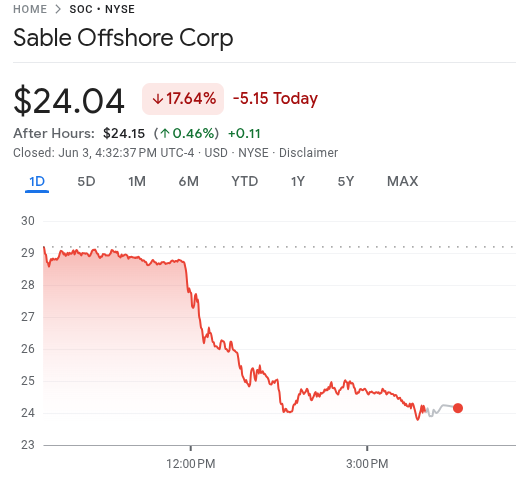
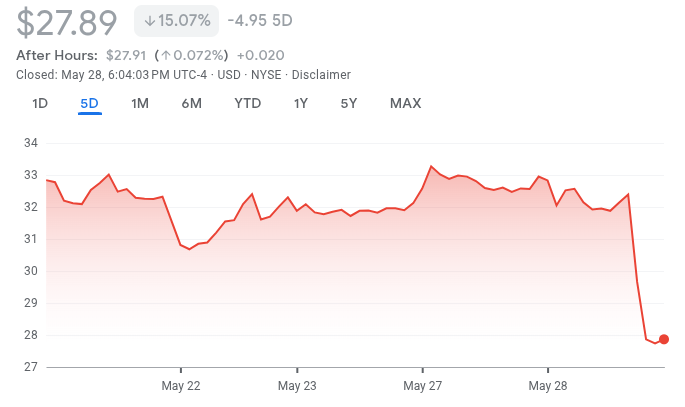
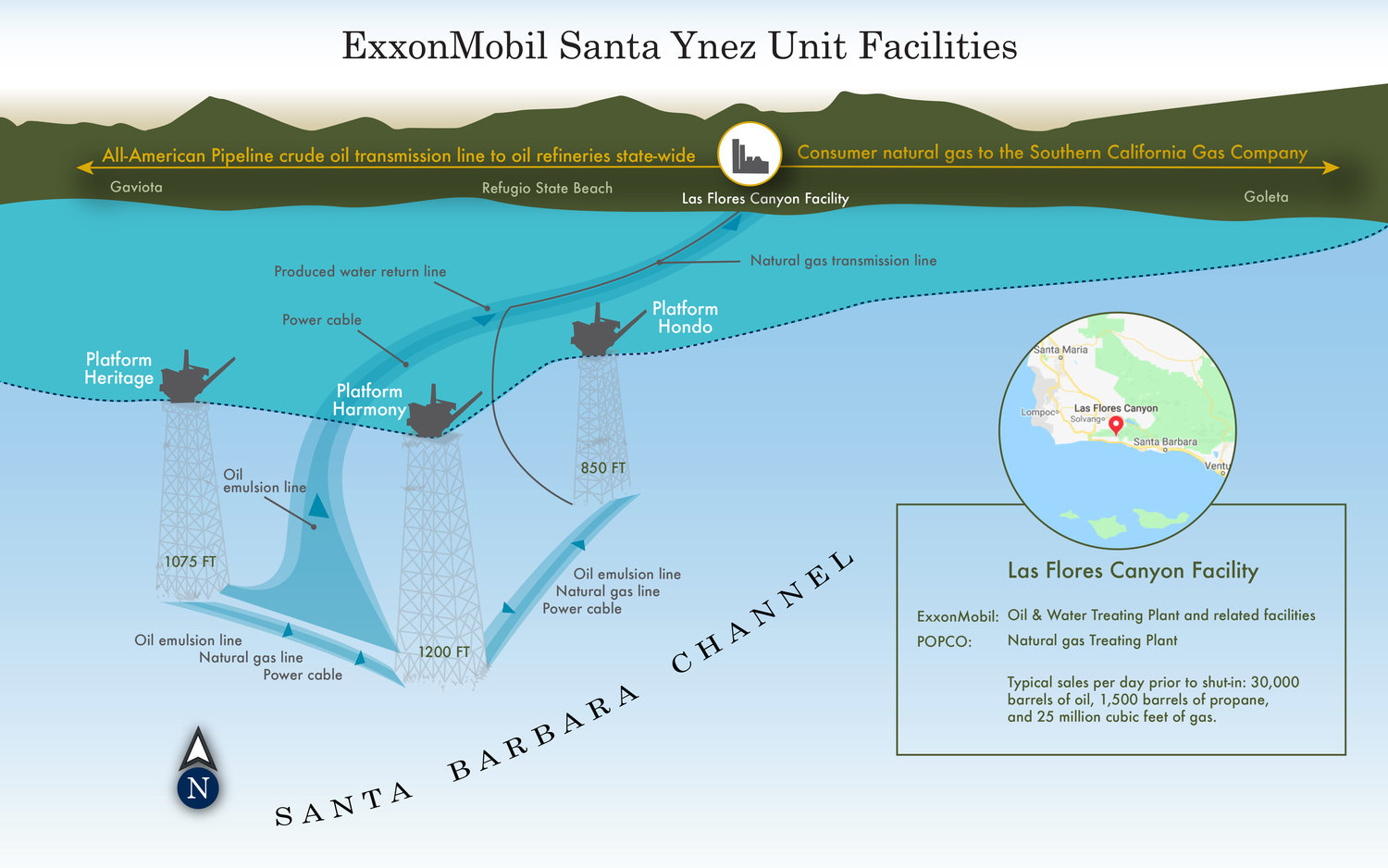
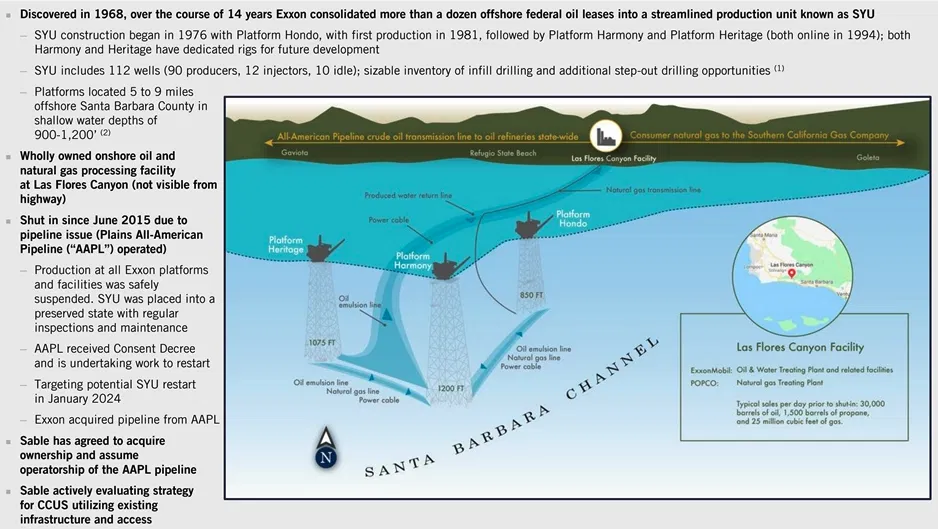
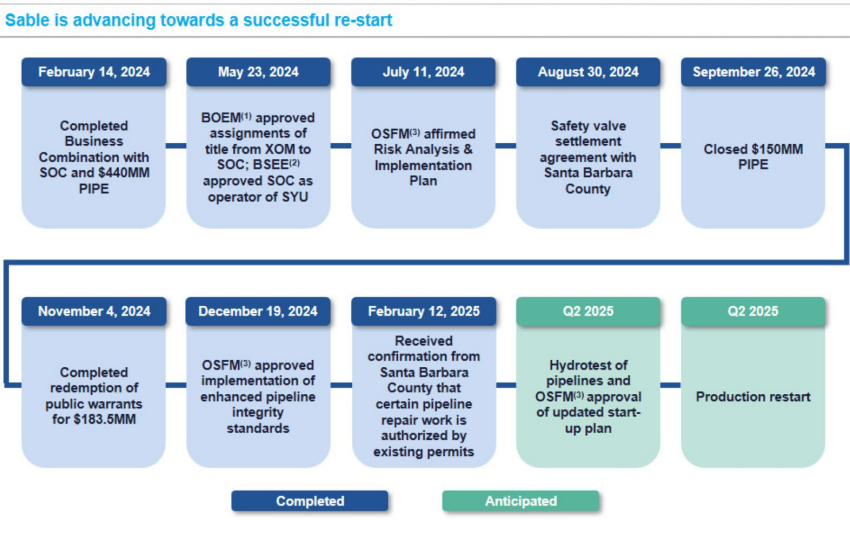
Sable’s stock price soared after the company reached an agreement with Santa Barbara County that will allow them to comply with the California Fire Marshall’s requirement to install shutdown valves on the onshore pipeline that failed in 2015. That pipeline is necessary to transport production from the Santa Ynez Unit, which is currently operated by Sable.

The significance of a resumption of SYU production is illustrated in the chart below. The 3 SYU platforms accounted for more than 2/3 of Pacific OCS production before the Refugio pipeline spill in June 2015.

This agreement with the County is a major step forward, but there are still regulatory and legal hurdles to clear before production resumes.

In the SEC filing that announces the agreement with Santa Barbara County, Sable affirms their 2024 restart expectations. However, a resumption of production in 2024 is highly unlikely given the administrative challenges that remain. A restart in 2025 would be a major accomplishment and a very good outcome for Sable.

Pasted below is the full text of the SEC filing (emphasis added):

Santa Barbara County (the “County”), on August 30, 2024, acknowledged that the County does not have jurisdiction over Pacific Pipeline Company’s (“PPC”) installation of 16 new safety valves in the County along PPC’s Las Flores Pipeline System (the “Pipeline”) in accordance with Assembly Bill 864. The County’s acknowledgement was delivered in the form of a conditional settlement agreement dated August 30, 2024 (the “Safety Valve Settlement Agreement”) among the County, PPC and PPC’s parent company Sable Offshore Corp. (“Sable”), and a subsequent acknowledgement by the County’s planning and development staff.

The Safety Valve Settlement Agreement is predicated upon a prior settlement agreement between PPC’s predecessor in interest, Celeron Pipeline Company, and the County in a federal case styled Celeron Pipeline Company of California v. County of Santa Barbara (Case No. CV 87-02188), which was executed in 1988.

Pursuant to the Safety Valve Settlement Agreement, PPC agreed to the following additional surveillance and response enhancements in the County:

i. PPC will create a Santa Barbara County-based Surveillance and Response Team, trained in PPC’s Tactical Response Plan, which will be responsible for timely initial incident response and equipped with key resources to deploy in early containment, particularly for those regions of the Pipeline between Gaviota and Las Flores Canyon;

ii. PC will provide Santa Barbara first responders with additional training and equipment to assist in PPC’s incident response efforts; and

iii. PPC will undertake the following Pipeline system enhancements: (1) install and operate and maintain primary and secondary Operations Control Centers in Santa Barbara County, and (2) refurbish the Gaviota pump in its existing station.

PPC, Sable and the County have further agreed, in the Safety Valve Settlement Agreement, to file a stipulation to dismiss the pending lawsuit, Pacific Pipeline Company and Sable Offshore Corp. v. Santa Barbara County Planning Commission and Board of Supervisors (Case No. 2:23-cv-09218-DMG-MRW) within 15 days of final installation of all 16 underground safety valves in the County.

Sable affirms that initial restart of production from Sable’s Santa Ynez Unit is expected in fourth quarter 2024.

Read Full Post »

Earlier this year John Smith correctly commented that a Santa Ynez Unit (SYU) production restart in 2024 was not possible. Last month, BOE reported on the regulatory “catch 22” facing Sable Offshore, the current operator under an agreement with Exxon.

An assessment prepared for Hunterbrook Capital draws the same conclusions regarding the prospects for production, calling the restart “a pipe dream” (presumably the pun was intended given the pipeline permitting quagmire). Hunterbrook’s chart (pasted below) illustrates the regulatory labyrinth facing Sable.

Hunterbrook has also flagged Sable’s ability to continue as a “going concern.” That may be a valid concern, but Sable’s success is very much in Exxon’s best interest. Exxon must have evaluated Sable and been comfortable with their management. Otherwise, they wouldn’t have made the deal.

Does Exxon want the massive SYU headache to revert back to their portfolio, as provided for in their agreement with Sable, if production doesn’t restart by January 1, 2026? Unless Exxon thinks they have a better option than Sable, they will presumably be flexible about the deadline.

Meanwhile, a judge denied the temporary restraining order requested by Sable to prohibit release of redacted portions of their oil spill contingency plan. Sable had argued that revealing “trade secrets” and specific locations and vulnerabilities of the pipelines could pose a “threat to national security.”

The Santa Barbara Independent also alludes to “pending litigation with Santa Barbara County over automatic shut-off valve permits.” Although litigation would seem likely if the County continues to deny permits for valves required by the Fire Marshall, BOE was unable to confirm any such litigation plans.

Read Full Post »

Read Full Post »

Skepticism about these charges is running high given the apparent political convenience of the “private Ukrainian citizens” sabotage scenario. The German govt has been under pressure to identify the responsible party following the decisions by Denmark and Sweden to drop their investigations.

Many of us are waiting for responses from the insurers, Seymour Hersh, Erik Andersson, and other private parties who have been actively investigating the Nord Stream sabotage.

Read Full Post »

Above: Pigable Y connector for the 6.5-mile 18-inch pipeline extending from a subsea connection in MP289 to a subsea connection with MPOG in MP268 with a capacity of up to 80,000 barrels per day.

A colleague shared his research on the November 2023 Main Pass Oil Gathering (MPOG) connector leak in the Gulf of Mexico. Given the extraordinary amount of time it takes to produce accident reports these days, it may be a while before we see the NTSB report. (Keep in mind that we are still waiting for their final report on the December 2022 helicopter crash at the West Delta 106 A platform.)

The pipeline associated with the leak is BSEE Segment No. 11015, an 18” oil line permitted under Panther Operating Company, LLC . MPOG and Panther are owned by Third Coast ( MAIN PASS OIL GATHERING PROJECT COMPLETION (third-coast.com) . Information on this company website shows that a project was completed for the installation of a new segment 20793 and the new line placed in service on August 20, 2022.

The picture shown in the website for this project (pasted above) shows what looks like a subsea pigable Y connection, which means the main line had to be cut for this connector to be installed. The location of this subsea tie-in for the new segment is in MP 268 and the approximate distance from the Mississippi River delta is 44 miles.

As for other subsea connections, the nearest to shore is in MP 144 about 27 miles from the delta. The report on the leak says that it occurred 19 miles from delta, so not sure if there are any connectors. This distance from the delta would be in the vicinity of MP 72 and mapping information shows no connections in this area, only pipeline crossings. See attached map for PSN 11015.

Read Full Post »

« Newer Posts - Older Posts »