Feeds:
Posts
Comments

Archive for the ‘Offshore Energy – General’ Category

The Vineyard Wind turbine incident, which littered Nantucket beaches, has also tarnished the US offshore wind program. BSEE has prudently halted Vineyard Wind operations and construction pending an investigation into the blade failure.

Offshore wind development is structure rich, so public confidence in the design of turbines and support platforms is critical. BOEM lists 37 active wind leases on the US OCS. Most of these leases have not yet reached the construction phase. A hold on the approval of any Construction and Operations Plans would seem to be appropriate pending completion of the Vineyard Wind investigations.

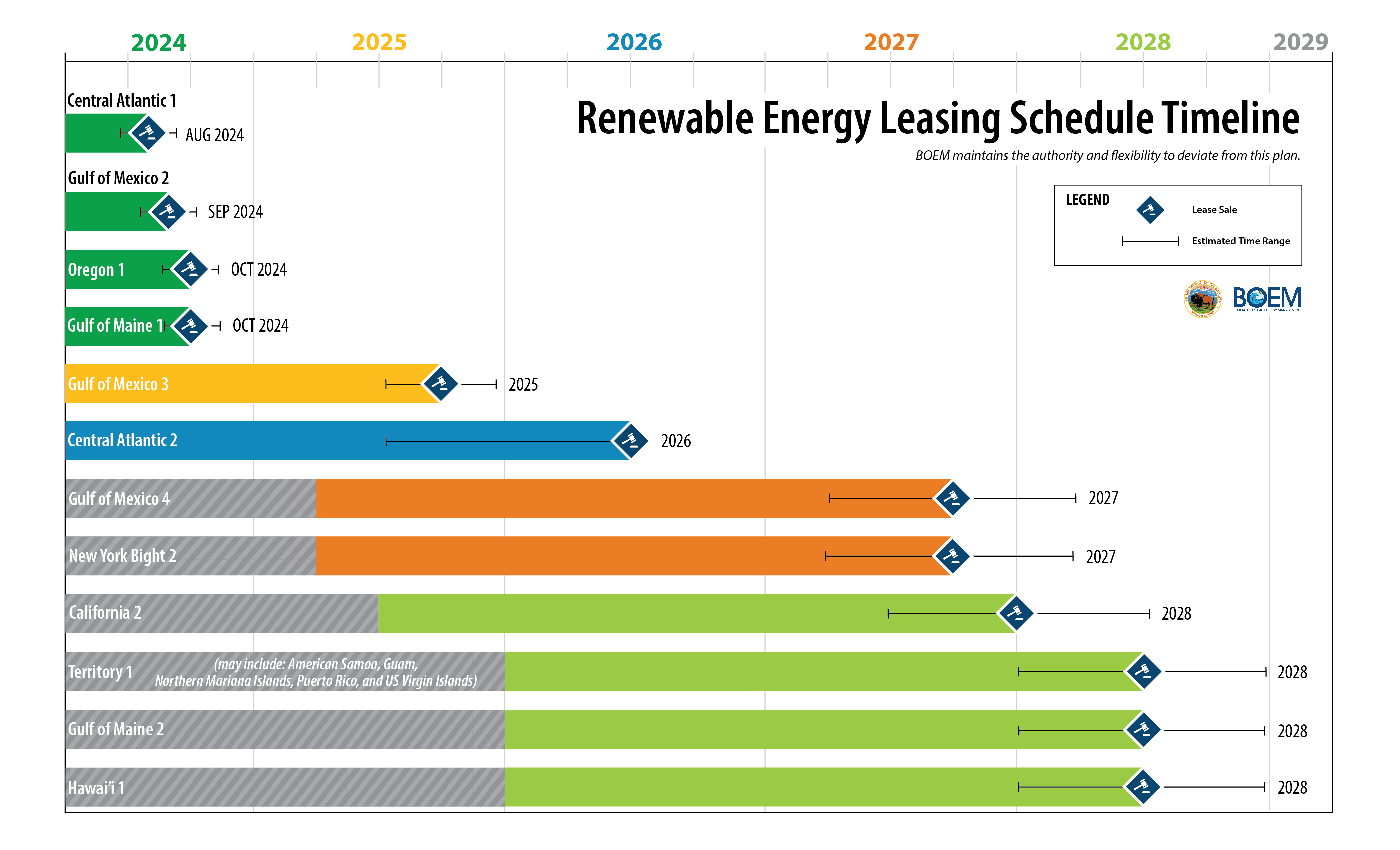
Per the leasing schedule below, BOEM intends to hold 4 wind sales during the remainder of 2024, all within a 3 month period. Only 1 sale is scheduled for each of the following 2 years. Deferring the 2024 sales until the investigations are complete would assist potential lessees by ensuring that the issues of concern were fully understood.

Unfortunately, BOEM’s failure to conduct a 2024 oil and gas lease sale has boxed in the wind program. The Inflation Reduction Act prohibits BOEM from issuing wind leases unless an oil and gas sale has been held within the previous year. Lease Sale 261 was held on 12/20/23 meaning that no wind leases may be issued after 12/20/24. BOEM has compressed the wind leasing schedule, presumably to beat the legislative deadline. It would have been better for both the oil and gas and the wind programs if at least one oil and gas sale had been held in 2024 as has been customary since the 1950s.
Read Full Post »

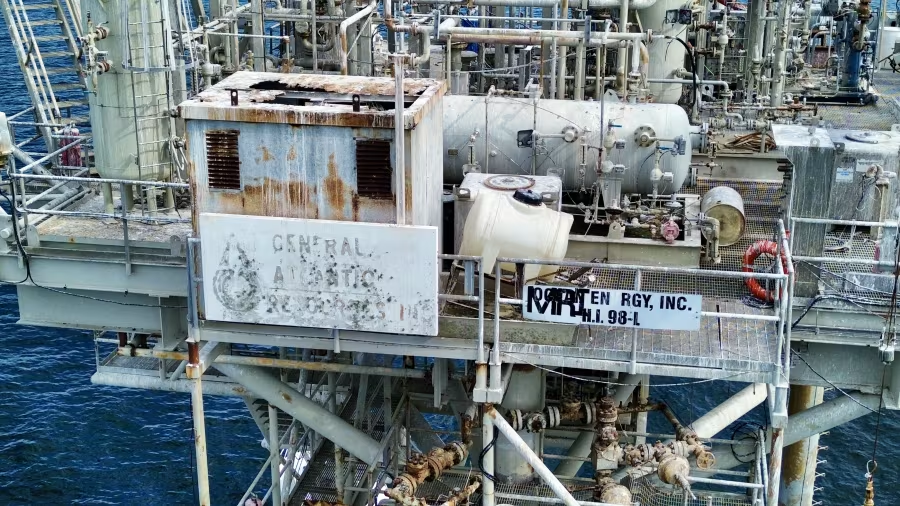
Pictures from Click2Houston:

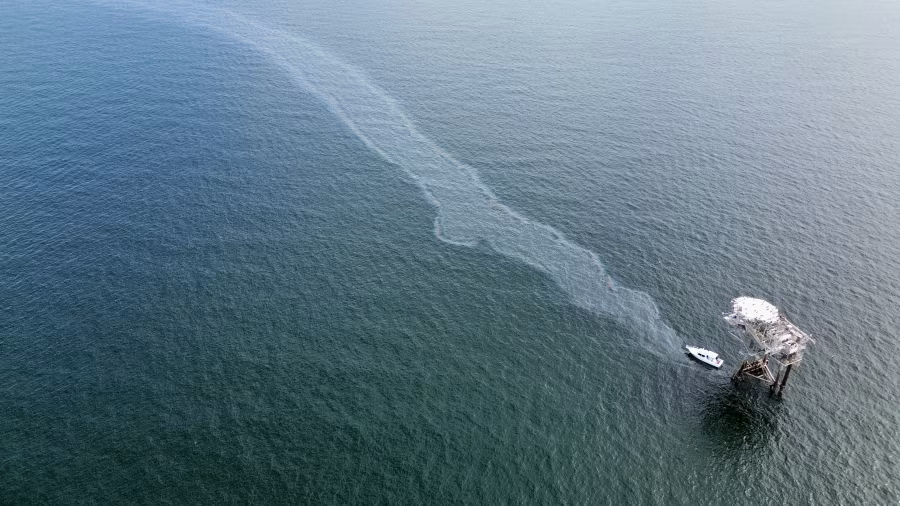
This is yet another example of the importance of proper well plugging, platform removal, and decommissioning financial assurance. It’s noteworthy that Texas is among the states suing to block BOEM’s financial assurance rule for Federal waters. A serious collaborative Federal, State, and industry effort to address decommissioning issues is long, long overdue.

Key points from the Facebook post by State Representative Terri Leo Wilson (full post pasted below):

  • 8 miles offshore Galveston County (TX State waters extend 3 marine leagues/9 nautical miles/10.35 statue miles offshore)
  • flowline riser leaking natural gas and condensate (badly corroded platform)
  • no recoverable oil
  • abandoned platform
  • additional research is needed to fully determine ownership of the leak source (???)

HIGH ISLAND BLOCK 98-L INCIDENT :

The Texas General Land Office (GLO) is sharing the following information:

On Sunday, July 14, 2024, at 8:00 pm, the Oil Spill La Porte Office Response Officer received notification of a natural gas/oil discharge off the coast of Crystal Beach, Galveston County. The spill was reported to be from a platform in High Island Block 98-L, about eight miles offshore in the Gulf of Mexico. Oil Spill personnel traveled via response boat to investigate on Monday morning and determined the discharge to be from a flowline riser leaking natural gas and condensate. Although the leak can be seen from the water, no recoverable oil was visible. The platform is abandoned, as defined by the Texas Railroad Commission, placing it within the Railroad Commission’s statutory authority for administration. The wells are not covered as part of the GLO’s current well plugging MOU with the Railroad Commission. The platform and associated wells are documented in the Oil Spill program’s abandoned well listings.

On Wednesday, July 17, La Porte office staff, with US Coast Guard and Railroad Commission personnel, inspected the platform area again. The leak is still present but has not increased. Railroad Commission staff stated that additional research is needed to fully determine ownership of the leak source.

The Coast Guard reports receiving a call from Channel 2-KPRC (NBC) in Houston regarding the leak and also seeing social media posts by a local area fishing group.

At this time: No injuries reported, No impact to commerce, No impact to wildlife.

Read Full Post »

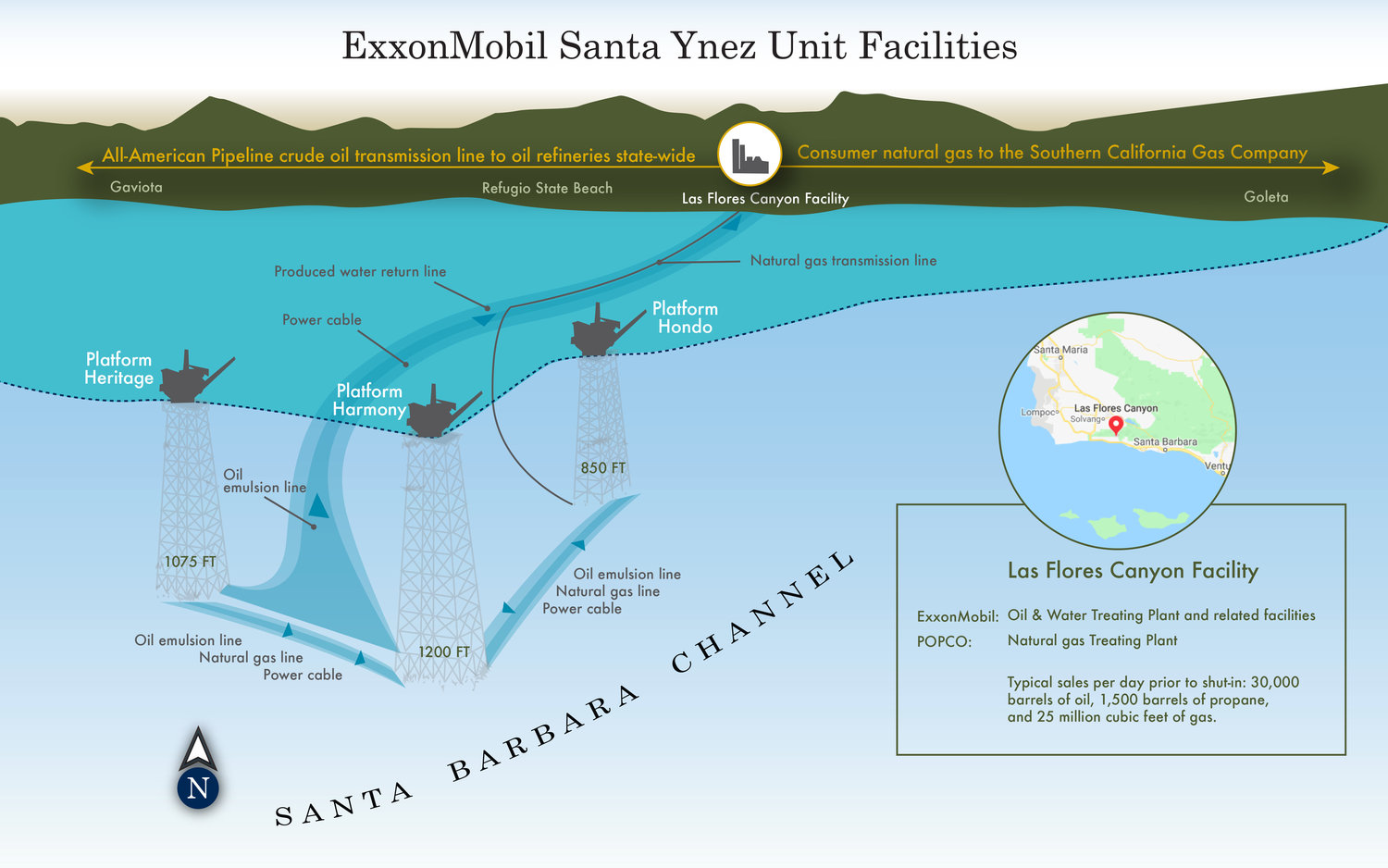
Earlier this month we awarded a Chutzpah Award to groups that helped block every attempt to resume production in the Santa Ynez Unit and are now suing to terminate the leases for non-production. 

We now learn that the State Fire Marshall has rejected the resumption of production because Sable, the current operator, is not installing automatic shutdown valves on the oil pipeline. The catch is that Sable was denied permits needed to install the valves. So, on the one hand the Fire Marshall is requiring shutdown valves (a reasonable requirement), and on the other hand the County is prohibiting the installation of those valves!

According to the Fire Marshall’s office, this is the first time a company has been denied permits to install valves mandated by the State – yet another dubious distinction for the Santa Ynez Unit.

Read Full Post »

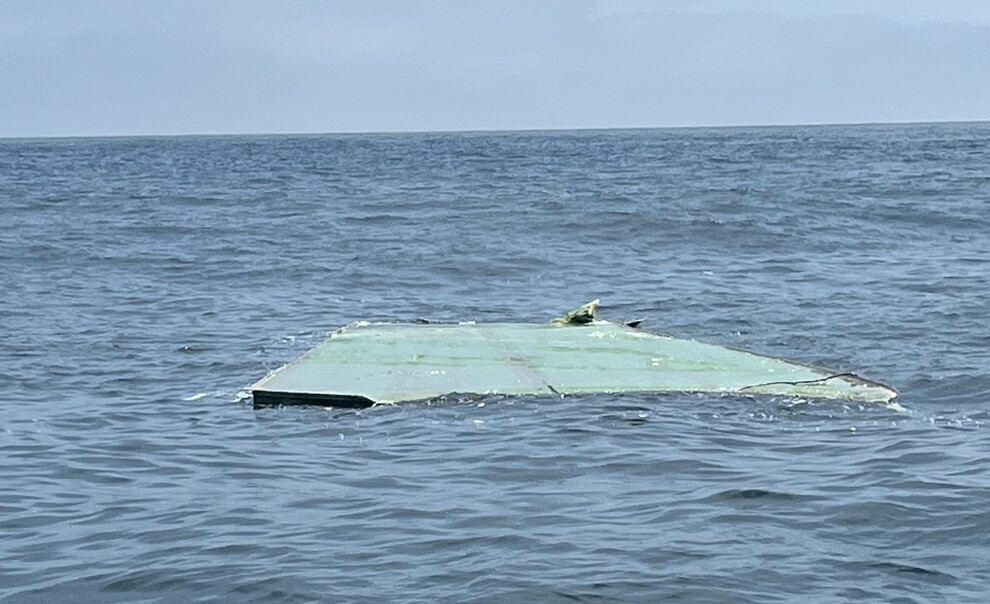
Photo by Capt. Carl Bois shared with the Nantucket Current
Ack4whales photo of the damaged turbine

On Sunday (7/14), Capt. Carl Bois, of the fishing charter Topspin out of Nantucket, told the Current he noticed a significant amount of debris in the Vineyard Wind lease area.

“There was so much debris at the wind farm,” Bois said. “We covered many miles and only saw the debris at the wind farm site: big sheets of fiberglass with foam core and lots of loose foam.”

On Saturday night (7/13) the Coast Guard warned Mariners as follows: “Coast Guard received a report of 03 floating debris 10 meters by 2 meters in the vicinity of approximately 26 NM SE of Marthas Vineyard and 22 NM SW of Nantucket in position 40 59.559N 070 25.404W. All marines are requested to use extreme caution while transiting the area.

On Monday (7/15), Vineyard Wind confirmed that a turbine blade incident occurred on 7/13: “On Saturday evening, Vineyard Wind experienced blade damage on a wind turbine in its offshore development area. No personnel or third parties were in the vicinity of the turbine at the time, and all employees of Vineyard Wind and its contractors are safe and secure.”

On 7/16, Vineyard Wind issued another statement advising that they were deploying teams to Nantucket to clean up debris from the incident.

Comments:

  • Not a good look for the first large-scale offshore wind project in the US.
  • It’s unclear what the status of operations was at the time of the incident.
  • Vineyard Wind seems to be passing the buck a bit when they note that “GE, as the project’s turbine and blade manufacturer and installation contractor, will now be conducting the analysis into the root cause of the incident.” While GE’s findings are critical, Vineyard Wind, as operator, is fully responsible and accountable for the incident and should be leading the analysis.
  • Was their a third party review of the turbine design?
  • Was the incident reported to BSEE, the safety regulator for offshore wind? State and local government?
  • BSEE and the Coast Guard should ensure that Vineyard Wind’s findings and their own independent report are made publicly available in a timely manner. Ditto for Safety Alerts.
  • What other incidents have occurred during offshore wind facility construction and operations?
  • In 2017, Vineyard Wind requested to defer providing the full amount of the required financial assurance until year 15 of actual operations. That request was denied, but was approved when resubmitted in 2021. The regulations have now been revised to allow such deferrals of financial assurance on all offshore wind projects.

Vineyard Wind is a joint venture between Avangrid, a Spanish company, and Copenhagen Infrastructure Partners. They were

Read Full Post »

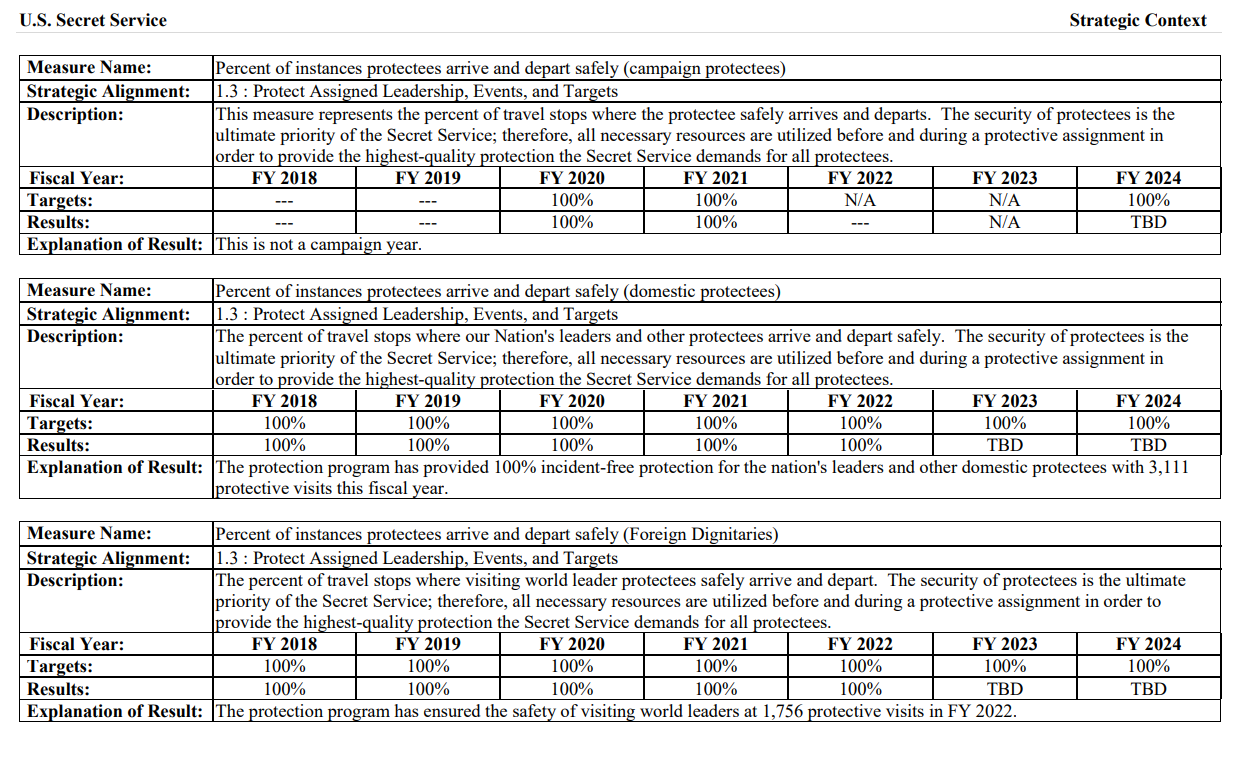
As is the case with many Federal and corporate entities, the Secret Service website is long on promotion and short on substantive details and performance data. The limited “Measurable Impact” statistics on their webpage advise that the Secret Service protected 6623 foreign and domestic visits “without incident” in Fiscal Year 2022, which ended 22 months ago.

Their 2024 budget request overview includes a bit more information (pasted below). The Secret Service gives themselves a perfect score if protectees arrive and depart safely. When your scores are always 100%, your performance measures are clearly inadequate.

Like drilling blowouts, assassinations are low frequency, high consequence events. Prevention requires gathering data on lesser events, identifying leading indicators, and tracking high-potential precursors. You don’t prevent high consequence events by only tracking high consequence events.

Inspections are also critical. Does the Secret Service inspect events to assess protective measures such as verifying that the surrounding areas are cleared and being observed? If so, what do those numbers look like.

BSEE, the OCS safety regulator, does a good job of collecting data, but fails to compile and post updates in a timely manner. Their latest incident tables are for 2022, and even those data are incomplete. Panel investigations, which are conducted for the more serious incidents, now take 2.5 years to complete. This is unacceptable for an organization with BSEE’s talent, resources, and safety mandate.

Read Full Post »

Some of us remember the Brent Spar saga (1995). The subsequent Brent field decommissioning activities have been less controversial, including the removal of the Brent C topsides on July 9. The Allseas single lift technology is most impressive. Check out the video!

Read Full Post »

Jean-Louis Daeschler, is an artist and pioneering subsea engineer. A native of France (Brittany), he has worked in the offshore industry worldwide and lives in Scotland. His wife is from Singapore and his children and grandchildren live in England and Canada.

Before beginning his engineering career, JL had the distinct honor of exhibiting his artwork at the French National Assembly (Parliament) in Paris (article below). How many offshore engineers can say that? None would be a good guess.

JL also exhibited in le Havre, Singapore, Houston, Edinburgh, Calgary, and elsewhere. He works mainly with acrylics, and his preferred subjects are boats, maritime scenes, harbors and the working environment associated with the sea. Of course!

JL worked on an early semi-submersible rig offshore Malaysia in 1969 (see his account of a serious near-miss), met with George HW Bush when he was building a new rig for Zapata Offshore, was instrumental in the first production in the UK sector of the North Sea (1975) from a converted semi-submersible drilling rig in the Argyll Field, designed a new BOP concept, and holds patents for seabed drilling templates and subsea control systems.

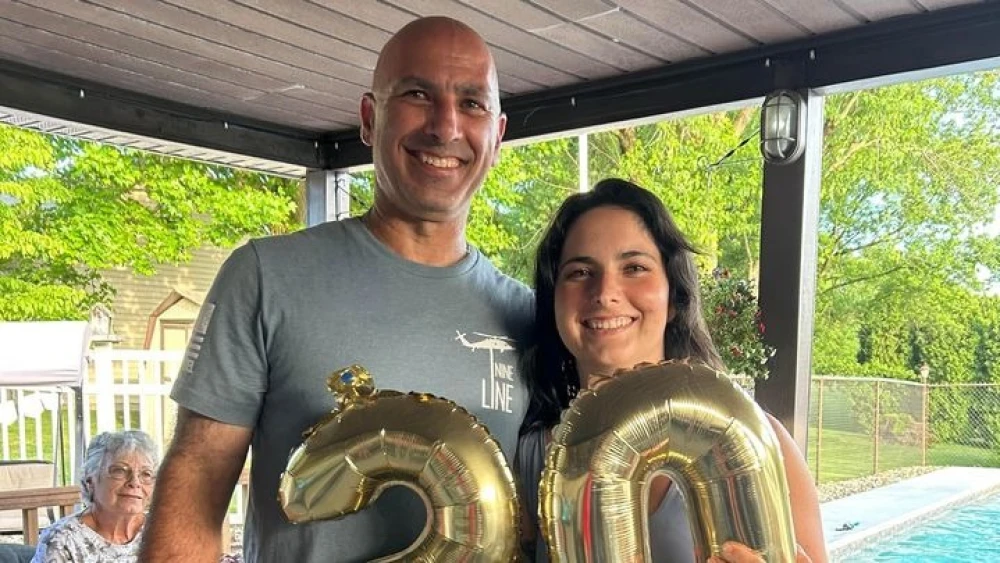
When he was called upon to work in Total’s onshore office, his boss told him “the best offshore job is in the office!” The photo below suggests that JL made the most of those onshore assignments! 😀

JL Daeschler, part of Total’s subsea team, enjoying his onshore assignment in 1985

Congratulations to JL on his many contributions to the offshore industry, art, and society!

Read Full Post »

For decades, Gulf of Mexico operators have reported facility evacuation and production curtailment data to MMS/BSEE as tropical storms or hurricanes approached. Requirements for this reporting are found in the regulations (30 CFR 250.192(a)) supplemented by NTL 20I5-G02.

Operators must submit reports by 11:00 a.m. (CT) daily throughout the period of evacuation and shut-in with the understanding that BSEE will post the compiled data by 1 pm CT. This reporting has been diligently accomplished for decades and MMS/BSEE posted the data each day, including weekends and holidays, without fail. Everyone in industry and government understood the importance of safely evacuating personnel, shutting down production, and ensuring that these hurricane data were made available to the public each day. (All of the daily updates for 2011 onward can be found here.)

On Wednesday, July 3, Shell informed the media that they had begun evacuating non-essential personnel and shutting-in production at certain facilities. Both Shell and Chevron issued general statements on the status of their operations on Thursday, July 4. Both companies no doubt submitted the required reports to BSEE, as did other companies with operations near the projected path of the storm.

BSEE failed to post any evacuation and shut-in data on any date from July 3 through today (July 8).

Beryl missed the heart of the Gulf of Mexico basin, but Shell and other companies with facilities in the more westerly areas evacuated personnel and curtailed production. BSEE’s unprecedented failure to post this information needs to be addressed before more significant storms threaten offshore personnel and production in the Gulf.

Shell evacuated non-essential personnel and shut-in production at Perdido (pictured)

Read Full Post »

Winterfell from the water surface (5400′ water depth). The field is produced with subsea wells tied back to Oxy’s Heidelberg platform, which is 13 miles away. Deepwater development is characterized by high energy density and low facility density.

Beacon Offshore Energy (BOE, but not this blog 😉) and its partners, all independent producers, have initiated production at the Winterfell project in the Green Canyon area of the Gulf of Mexico. The 3 initial wells are expected to produce 20,000 bbls of oil equivalent (again BOE 😉) per day. The Winterfell partners are:

  • Beacon Offshore Energy, operator
  • Kosmos Energy
  • Westlawn Americas Offshore
  • Red Willow Offshore
  • Alta Mar Energy
  • CSL Exploration

Read Full Post »

On July 1, U.S. Federal Judge James Cain Jr. (Western District of Louisiana) issued a preliminary injunction suspending DOE’s LNG exports “pause.” The judge’s full ruling is attached.

Judge Cain: It appears that the DOE’s decision to halt the permit approval process for entities to export LNG to non-FTA countries is completely without reason or logic and is perhaps the epiphany of ideocracy.”

Nothing subtle about that comment 😉

Despite the court order, the Administration seems intent on keeping the “pause” in place. Per White House spokesperson Angelo Fernández Hernández, “We remain committed to informing our decisions with the best available economic and environmental analysis, underpinned by sound science.” ????

Nearly 80% of current OCS gas production is from deepwater leases. This production is primarily associated (oil-well) gas that operators are rightfully required to market for resource conservation and environmental reasons. Expanding LNG marketing opportunities could thus improve the economics of deepwater development.

The other 20% of OCS gas production is largely from gas-well (non-associated) gas produced by independent companies that continue to operate in the shallower waters on the shelf. LNG sales could improve the challenging economics for these producers and increase the ultimate recovery of shelf resources.

Read Full Post »

« Newer Posts - Older Posts »