The attached comments were submitted to Regulations.gov on 9/8/2025.
Legislatively dictating downhole commingling approvals, as per Section 50102 of the One Big Beautiful Bill, is a reckless precedent from both technical and regulatory policy standpoints.
This type of legislative maneuver compromises the integrity of the OCS oil and gas program and the companies that participate in it. Shaving the maximum royalty rate was one thing; mandating well completion approvals is quite something else. Disappointing. ☹
John Borne was an exceptional engineer and offshore safety leader in our OCS oil and gas program during the US Geological Survey (Conservation Div.) and Minerals Management Service (MMS) eras.
Some thoughts on John’s leadership followed by tributes from distinguished colleagues:
John’s Houma District office was a model for the rest of the OCS program. Houma was the program’s busiest district in terms of operational activity, and the most effective in meeting permitting, inspection, and investigation targets.
The few serious accidents that occurred in the District were carefully investigated and the findings were shared in a timely manner with the goal of preventing their recurrence. If John signed a report, you knew it was complete and accurate.
John was knowledgeable about the complex offshore oil and gas operations he regulated, and was an outstanding teacher and mentor.
John treated all companies the same from the super-majors to the small independents – no biases, no favors, and no ethics issues.
John expected companies to fully comply with the regulations. Any departures had to be clearly in the best interest of safety and the environment.
From Ken Arnold (ex-Shell engr, Paragon Engineering President, NAE): As part of the Shell Training program in 1964 I was assigned to trail John in East Bay for a week. One night I was talking to another trainee on a logging barge tied up to a posted barge rig in SP Blk 24. John was also on the barge. Without warning the barge started pulling away from the rig. The three of us jumped from the barge to the rig but I slipped and fell in the canal. I don’t think I was in the water long enough to get wet, when John and a rig hand fished me out. Unfortunately my glasses fell off and were in the mud. John got a scissors device and retrieved my glasses in a matter of minutes.
I greatly appreciated my week with John. What he took the time to teach me about field work was critical to my subsequent successful career in Shell and in Paragon. He was a gentleman and a first class teacher. I was lucky to have known him.
Jodie Connor (founder and retired President of J. Connor Consulting): John was an excellent representative of the MMS, always fair in his decision-making and approvals. I endearingly called him “By the Book Borne”. He enforced the regulations as they were written, which was fair to all operators. Always kind and willing to explain MMS policies.
Lars Herbst (retired MMS/BSEE Regional Director, Gulf of Mexico): What a legend at MMS! A testament to his leadership are the number of Regional leaders that came out of Houma District. Just to name a few: Mike Saucier, Bryan Domangue, Troy Trosclair, and even Jack Leezy! That work ethic that John instilled has continued even to the next generation of leadership! I was fortunate that John let me act as Drilling Engineer when Saucier went hunting each December. My career at MMS was never the same after that opportunity!
Jack Leezy: (President, Avenger Consulting, retired MMS): John served in the Marine Corp during the Korean war. Upon discharge from the Marine Corp John attend the University of Lafayette and earned a BS degree in Petroleum Engineering. John started his oilfield career when he went to work for Shell Oil in 1960 until 1970 as a Petroleum Engineer.
John joined U.S.G.S. In 1970 as a Petroleum Engineer in the Lafayette District. John accepted a promotion in 1972 in the Regional office and was selected as the first District Supervisor in the newly formed Houma District office in October1974. John remained as the District Supervisor until his retirement in 1995. John was instrumental in developing Bureau policies of which some are still in place as of today. John served on countless MMS and industry committees alike during his career. John was looked upon as professional and highly respected by MMS and industry alike. He performed is duties in such a way that even if you may not have liked his decision, you respected it. John’s demeanor never changed as he never lost his composure and worked evenly though all the trials and tribulations during his career at MMS. John even won MMS’s Engineer of the Year award. I owe a lot to John in helping me form my career at MMS as I tried to handle my supervisory duties in the same manner in which John did.
RIP John. You were a superstar! As an engineer, regulator, leader, teacher, and colleague, no one did it better!
The latest Baker Hughes Rig Count Report shows only 10 rigs actively drilling in the Gulf. All are at deepwater locations – 7 in the Mississippi Canyon area, 2 in Green Canyon, and 1 in Alaminos Canyon. Per the BSEE borehole file, Shell accounts for most of the current MS Canyon wells and the Alaminous Canyon well. Beacon is also drilling in the MS Canyon, and the Green Canyon well appears to be a Chevron operation.
Only Anadarko/Oxy, Beacon/BOE, BP, Chevron/Hess, Shell, and Talos have spudded deepwater exploratory wells in 2025 YTD. Arena and Cantium are the only shelf drillers – all development wells.
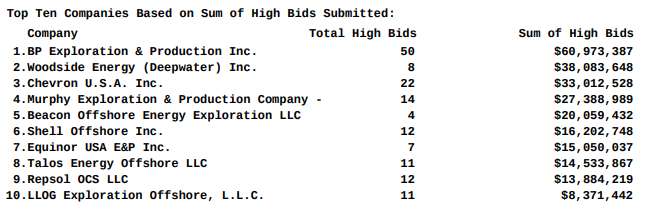
Technological advances and extensions of past discoveries have sustained Gulf production, but declines are certain over the longer term if drilling activity doesn’t increase. Oil price uncertainty is an issue, but that’s always the case. Semiannual lease sales are now legislatively required and the terms will be attractive, so those issues are off the table. Let’s see what the bidding looks like at the upcoming sale.
The decline in deepwater discoveries (BOEM data below) is particularly discouraging. Per BOEM, the last deepwater field discovery was in March 2023.
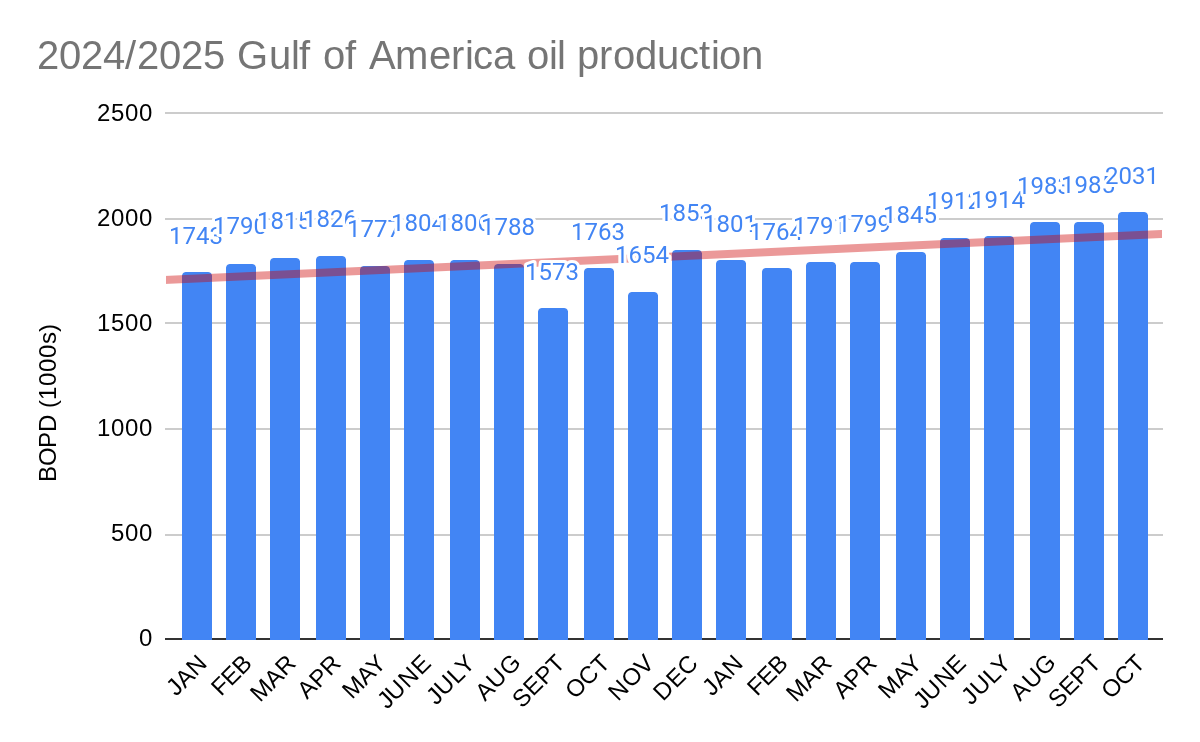
The average oil production rate for the Gulf OCS was 1.915 million bopd in June, the highest rate since Oct. 2023 and thus the highest in the history of the Gulf of America 😉.
Natural gas production, which is now primarily from oil wells (i.e. associated gas) and is thus more closely linked to oil production rates, increased by >10% in June to over 60 bcf. As was the case for oil, gas production was the highest since Oct. 2023.
It is now peak hurricane season, so the eyes of production forecasters are focused on the tropics. Few need to be reminded about what happened 20 years ago when Hurricanes Katrina and Rita roared through the Gulf, preceded by Hurricane Ivan “The Terrible” one year earlier. Those 3 hurricanes triggered major improvements in hurricane preparedness, particularly with regard to stationkeeping capabilities.
The “One Big Beautiful Bill Act of 2025” (OBBB), Public Law 119-21, which was signed into law on July 4, 2025, includes a significant offshore production directive (section 50102) that has received little public attention:
“The Secretary of the Interior shall approve a request of an operator to commingle oil or gas production from multiple reservoirs within a single wellbore completed on the outer Continental Shelf in the Gulf of America Region unless the Secretary of the Interior determines that conclusive evidence establishes that the commingling—(1) could not be conducted by the operator in a safe manner; or (2) would result in an ultimate recovery from the applicable reservoirs to be reduced in comparison to the expected recovery of those reservoirs if they had not been commingled.”
This is, to the best of my knowledge, the first time in the history of the OCS oil and gas program that Congress has directed the safety regulator to approve well completion practices that could increase safety, environmental, and resource conservation risks.
Rather than calling for the operator to demonstrate that a downhole commingling plan is safe and optimizes resource recovery, the plan must be approved unless BSEE proves conclusively that the operation could not be conducted safely or that resource recovery would be reduced. This is the antithesis of the operator responsibility doctrine, a fundamental principle of the OCS regulatory program, and safety management principles that call for the operator to demonstrate that safety, environmental, and resource conservation risks have been effectively addressed.
Only 40 days after the OBBB was signed, BSEE published a direct final rule implementing the downhole commingling directive. This is warp speed for promulgating a Federal regulation! In keeping with the rush to finalize the rule, the preamble asserts that “notice and comment are unnecessary because this rule is noncontroversial; of a minor, technical nature; and is unlikely to receive any significant adverse comments.”
I intend to submit comments prior to the Sept. 12 deadline. These comments will assert that the rule does not qualify for an exemption from the Administrative Procedures Act’s public review and comment requirement. I will also recommend that BSEE consider hosting a public forum during the comment period to present their research on downhole commingling and discuss the risk mitigations.
Below are some of the issues/questions that should be considered during the public comment period:
BSEE’s own fact sheet acknowledges the well-known pressure differential, crossflow, and fluid compatibility risks associated with downhole commingling. The public should have the opportunity to provide input on the extent to which “intelligent completions” and other production technology are effective in mitigating these risks.
The industry-funded Univ. of Texas (UT) study, which led to a relaxation of downhole commingling restrictions, was specific to the “unique Paleogene Gulf of Mexico fields.” Does BSEE have evidence that supports the applicability of the study to other fields?
The authors of the UT study acknowledged that their findings were based on a “simple but reasonable geological base case model.” They also acknowledged the need for “a more comprehensive study using advanced geological models to explore additional geological features.” What are BSEE’s plans for additional research?
Should an independent assessment of Gulf of America downhole commingling safety and resource recovery risks be conducted before finalizing a rule that essentially mandates approval of all applications?
BSEE’s April 2025 policy change raised the allowable pressure differential for commingling production in Paleogene (Wilcox) reservoirs from 200 psi to 1500 psi. Unlike the policy update, the new rule includes no boundaries whatsoever.
What criteria will BSEE use in determining that there is “conclusive evidence” that a commingling request would be unsafe or would reduce ultimate resource recovery? Will BSEE disapprove any requests outside the parameters in the current policy guidance or subsequent updates?
There are many more issues that remain to be discussed, which is why the downhole commingling rule should be published in draft form, with a comment period of at least 90 days.
Talos announced successful drilling results at the Daenerys prospect (Katmai West #2) in the Gulf of America (Walker Ridge blocks 106, 107, 150, and 151).
Daenerys is a good example of the evolution of deepwater project ownership, which was once exclusively the domain of major international oil companies. Over the past 20 years, participation by independents increased gradually, followed by smaller independents and informed investment companies.
Impressively, the Daenerys partnership (table below) includes a tribe that has the same % ownership as a super-major, and a highly efficient investment company owned by a single person.
Talos (operator)
large US independent
27.0% share
Shell
international supermajor
22.5%
Red Willow
private company owned by the Southern Ute Tribe
22.5%
Houston Energy
private independent focused on deepwater energy resources
I never liked the label “slips, trips, and falls” (STFs) because the words “slips and trips” trivialize the most common cause of serious offshore casualties. Perhaps, the name of this category should be simplified to “falls,” because that is the consequence of concern.
Unfortunately, STFs persist at an unacceptably high rate. In the attached Safety Alert, BSEE informs that between May 2024 and April 2025, 22% of all injuries were attributed to STFs. Many of these injuries were classified as major.
BSEE conducted focused inspections of 19 facilities (17 different operators) to better assess the STF problem. They found common deficiencies in training, hazard identification, and other preventive measures. These deficiencies and the associated safety management recommendations are listed in the Safety Alert.
Kudos to BSEE for their excellent Safety Alert program. Unfortunately, unacceptable delays in updating their incident tables and OCS performance measures data make it difficult to assess industry wide safety performance trends. The most recent data are for 2023, and some of those data raise concerns. For example, the number of fires (152) was the highest in the history of the performance measures data set (dates back to 1996) by some margin. What happened in 2024 and the first half of 2025? These data should be readily available and posted in a timely manner. No offshore facility fire is trivial.
NRW contracted with Array Petroleum to operate the former Cox Assets. Array subsequently sued NRW, asserting that NRW received $78,000,000 in revenue, but disbursed only about $48,000,000 to pay Array’s invoices and those of the subcontractor.
The court filing claimed that NRW failed to pay Array $2.5 million, the subcontractors $10.7 million, and the United States $12 million. A large share of the subcontractor costs were probably for well operations given that 21 Array workover applications were approved in 2024 and 2025. The $12 million due to the Federal government is reportedly for royalty payments. Were any revenues set aside for decommissioning liabilities?
Array’s lawsuit was dismissed by the court on January 3, 2025, after a joint motion to dismiss was filed by the defendants. Information on the reasons for the dismissal is not publicly available.
Old platforms: According to BOEM records, Array operates 154 platforms previously owned by Cox. These platforms are in the Ship Shoal, South Marsh Island, and West Delta areas of the Gulf of America. Most are >30 years old and four are more than 70 years old (see chart below). 41 are classified as major structures including 15 of the 26 platforms installed in the 1950s and 1960s. 44 are manned on a 24 hour basis. 79 have helidecks. Massive decommissioning liabilities loom.
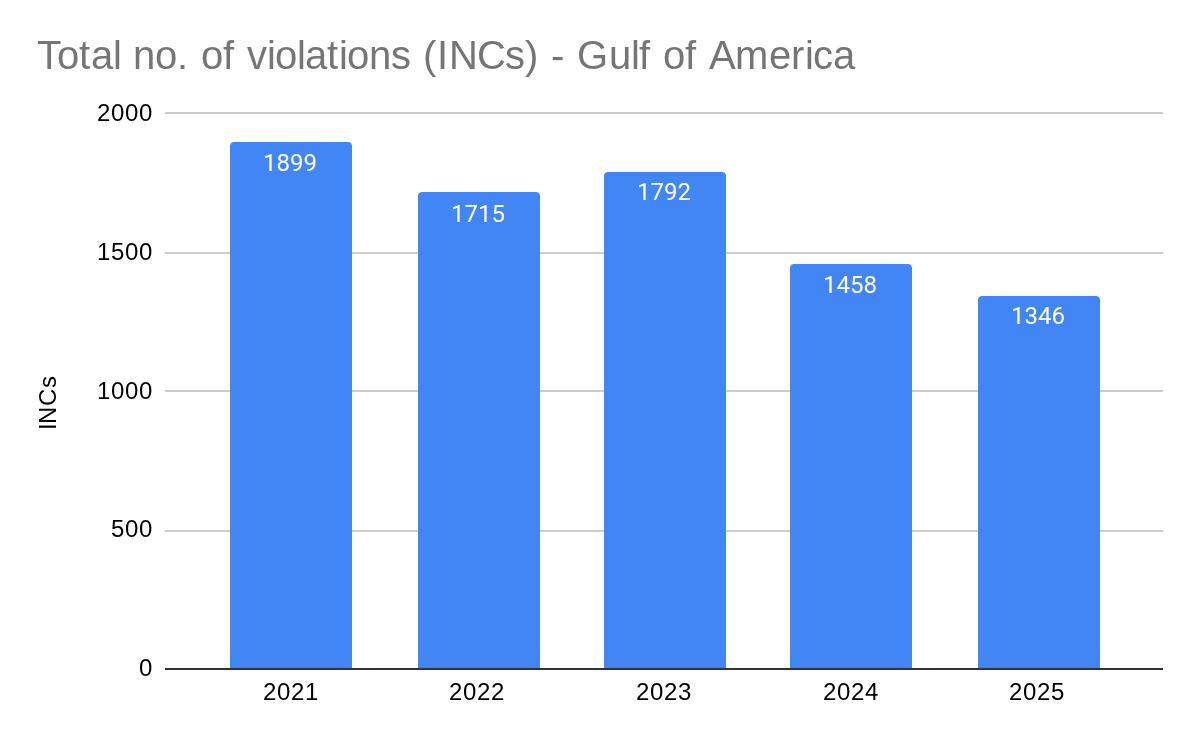
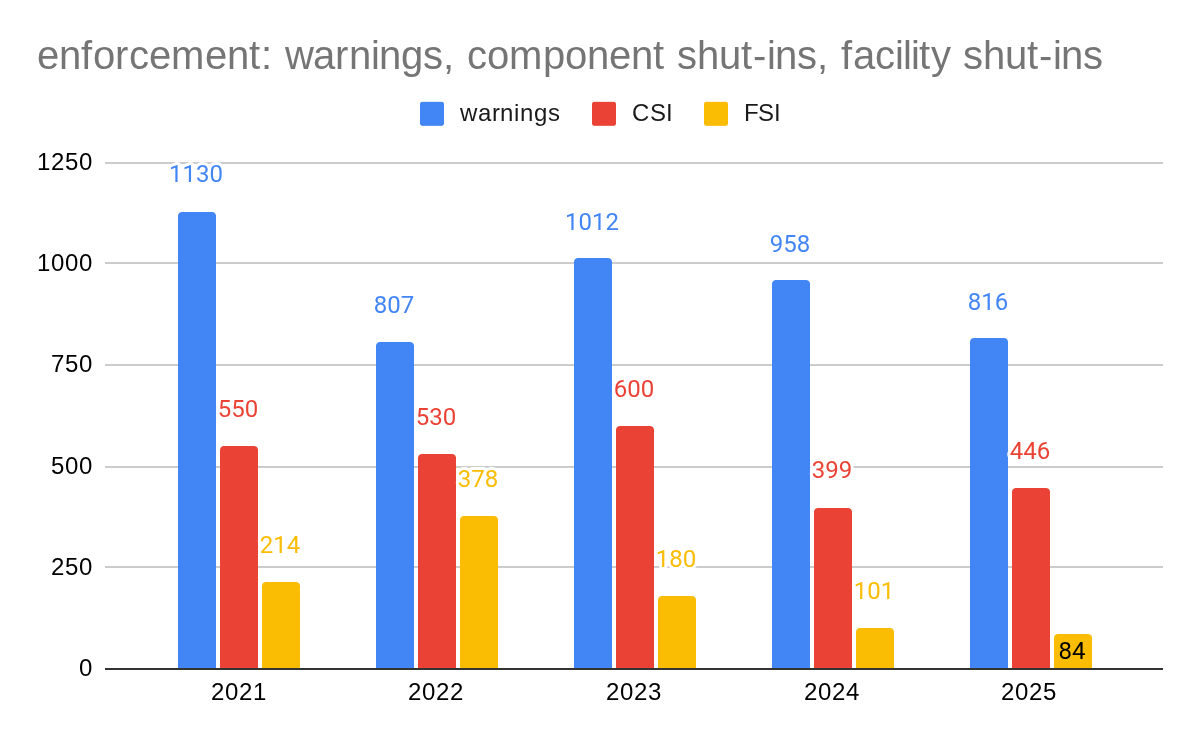
Violations: NRW/Array ranks 37th out of 42 companies in GoA oil production (2025 YTD) and 36th out of 42 companies in gas production, but leads the pack in Incidents of Noncompliance (INCs):
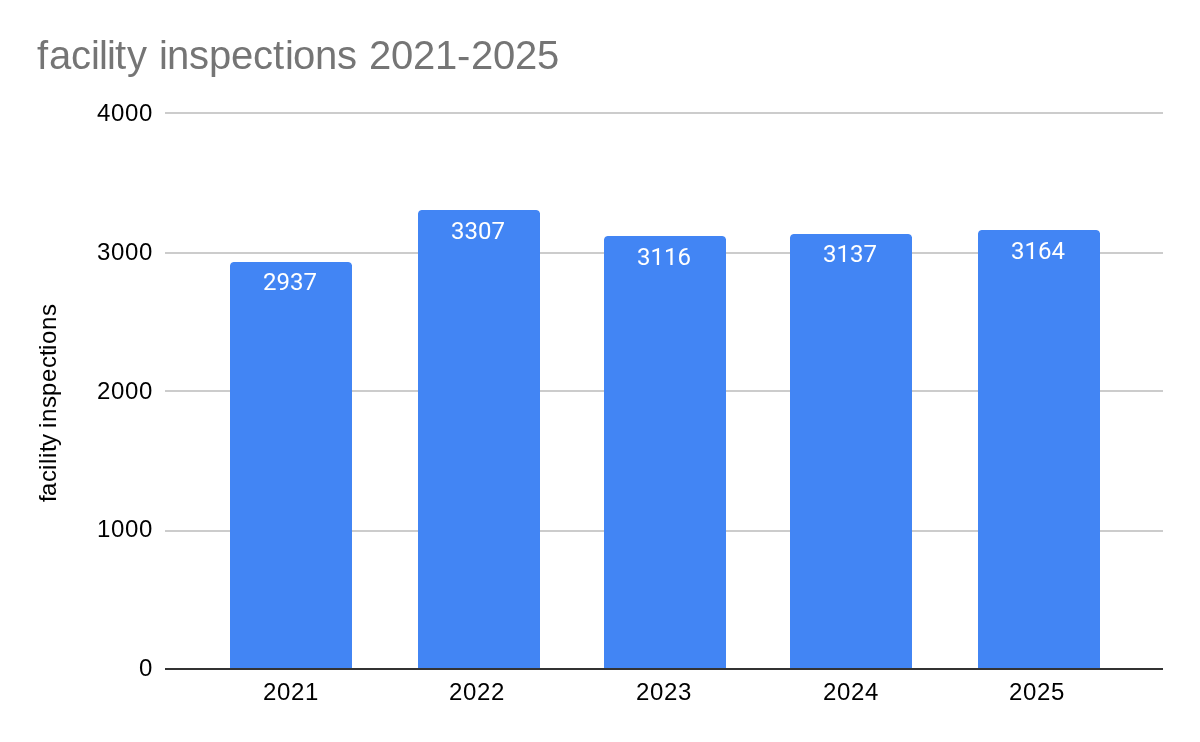
Array accounted for nearly half of all GoA INCs issued in the first half of 2025 (chart below).
Array was issued 9 times more warning INCs (311) than any other operator. Apache was second with 34.
There are many small and mid-sized companies that are responsible operators. Their participation in the OCS program should be encouraged. However, others have demonstrated, by their inattention to financial and safety requirements, that they are not fit to operate OCS facilities.
The growth of Fieldwood, Cox, Signal Hill, and Black Elk was in part facilitated by lax lease assignment and financial assurance policies.
Operating companies should have to demonstrate that they can operate safety and comply with the regulations before they are approved to acquire more properties.
Expect the ultimate public cost of the Cox bankruptcy, in terms of decommissioning liabilities and the need for increased oversight, to be large.
The Federal govt (Justice/Interior) should strongly oppose bankruptcy court asset sales that increase public financial, safety, and environmental risks.