- The flaring provision complicates compliance and may increase safety risks: (p. 649) Exception 1 exempts “gas vented or flared for not longer than 48 hours in an emergency situation that poses a danger to human health, safety, or the environment.” This is inconsistent with the carefully constructed BSEE regulations which allow limited (48 hours cumulative) flaring for certain operations (e.g. during the unloading or cleaning of a well, drill-stem testing, production testing, and other well-evaluation testing). Such flaring is essential but not normally “an emergency situation.” The bill could thus compromise safety by unnecessarily restricting or complicating well operations and by limiting flaring in circumstances where such flaring reduces safety risks.
- Time for BOEM to get to work 😉: (p. 650): Per our previous post, the highlight section of the bill (from an offshore oil and gas standpoint) reinstates Lease Sale 257 (GoM) and requires that the scheduled 2022 lease sales 258 (GoM) and 259 (Cook Inlet) be held by 12/31/2022. Lease Sale 261 (GoM) must be held by 9/30/2023.
- Petty but perhaps necessary: p. 655: The provision restricting wind leasing when no oil and gas lease sale has been held in the prior year is in the final bill.
Archive for the ‘Gulf of Mexico’ Category
Inflation Reduction Act: BOE’s top 3 takeaways
Posted in climate, energy policy, Gulf of Mexico, Offshore Energy - General, tagged flaring, Inflation Reduction Act, Lease Sale 257, offshore oil, Offshore Wind on August 15, 2022| Leave a Comment »
Shell restarts Mars pipeline
Posted in accidents, Gulf of Mexico, Offshore Energy - General, pipelines, tagged Gulf of Mexico oil production, Mars pipeline, Shell on August 13, 2022| Leave a Comment »
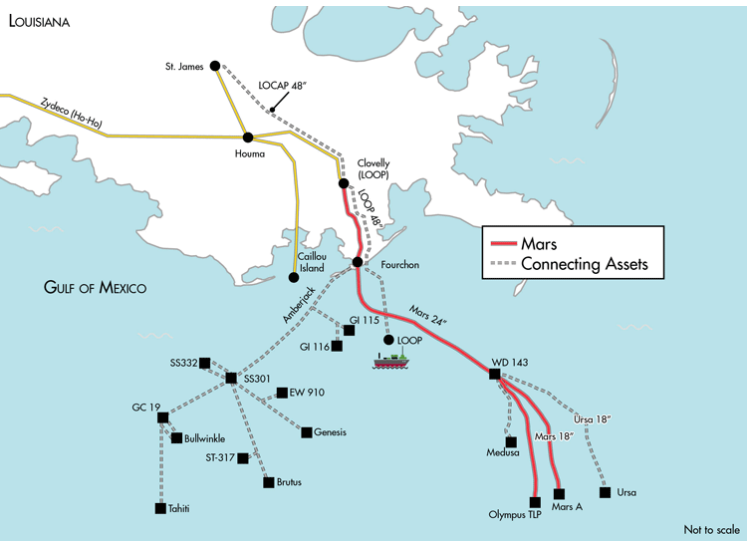
Assuming no significant tropical storm shutdowns this month, we should get a good read on the impact of the pipeline outage when the EIA production data for August are posted.
Shell pipelines expected to be back in service today
Posted in accidents, Gulf of Mexico, Offshore Energy - General, pipelines, tagged Chevron, Equinor, Gulf of Mexico production, Mars, Olympus, Shell pipeline, Ursa on August 12, 2022| Leave a Comment »
But late Thursday, a Shell spokesperson said that repairs were underway and that the company expected both pipelines to be back in service Friday.
CNN
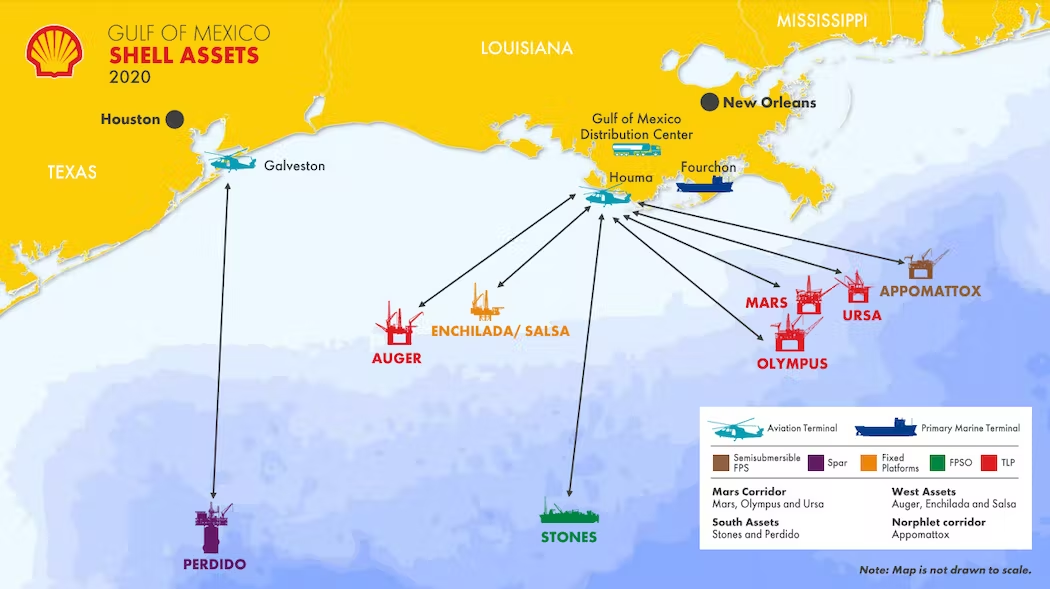
This is a good example of the interconnectivity of deepwater projects with major Shell, Chevron, and Equinor facilities shut-in as a result of a relatively minor downstream pipeline incident.
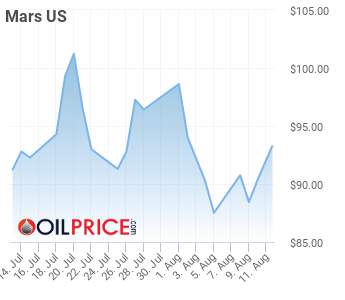
Mars crude price appears to have reacted to the shut-in news:
Onshore pipeline leak shuts-in major Gulf of Mexico assets
Posted in accidents, Gulf of Mexico, Offshore Energy - General, tagged Gulf of Mexico, Mars, Olympus, pipeline, production shut-in, Shell, Ursa on August 11, 2022| Leave a Comment »
A small pipeline leak (estimated 2 bbl spill) at an onshore booster station is having a major impact on Gulf of Mexico production. Per Reuters, as much as 600,000 bopd could be temporarily shut-in. GoM production averaged 1.6 million bopd in May.
These major platforms are reported to be shut-in:
- Shell: Mars, Ursa, and Olympus
- Chevron: Jack/St. Malo, Tahiti, and Big Foot
- Equinor: Titan
Shell, the pipeline operator, did not provide an estimate on the resumption of production.
Alarmist leasing rhetoric resurfaces as Sale 257 nears reinstatement
Posted in CCS, energy policy, Gulf of Mexico, Offshore Energy - General, tagged Lease Sale 257, Manchin, Schumer on August 7, 2022| 1 Comment »
Tucked into the end of the nearly $370 billion deal struck last week by Senate Majority Leader Chuck Schumer (D-N.Y.) and Senate Energy and Natural Resources Chair Joe Manchin (D-W.Va.) is a requirement for the Interior Department to reinstate a massive 80 million-acre Gulf of Mexico lease sale that a federal judge blocked earlier this year for violating NEPA.
E&E News
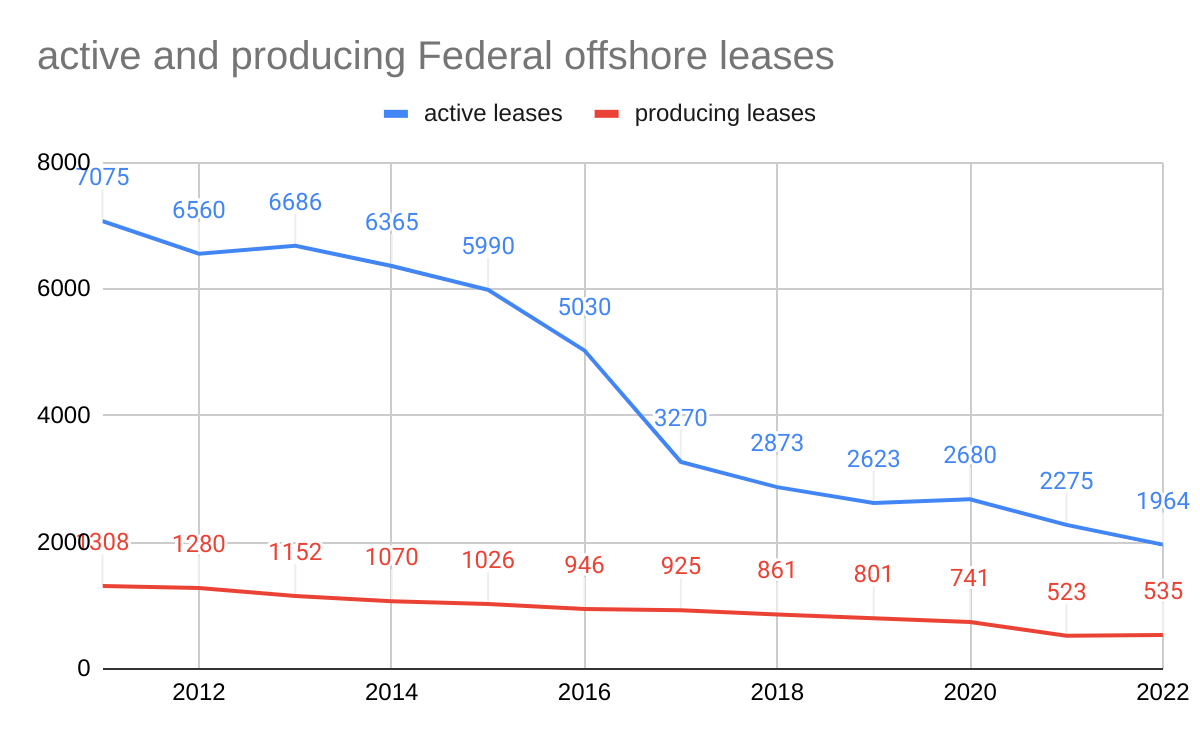
Tracts covering 1.7 million acres received bids at Lease Sale 257. 30.5% of those tracts received bids for CCS purposes, leaving about 1.2 million acres receiving bids for oil and gas exploration. Nonetheless, some continue to distort the magnitude of this rather ordinary lease sale. It’s also important to note that the number of active US offshore leases has declined by 72% since 2011, and is now under 2000 for the first time in decades.
An example of why it is important for the Lease Sale 257 decision to be reversed, either by appeal or legislation
Posted in energy policy, Gulf of Mexico, Offshore Energy - General, tagged BHP, East Breaks, Hoodoo, Lease Sale 257, Westwood on August 5, 2022| Leave a Comment »
Westwood has highlighted 13 wells planned for the remainder of 2022 as ‘key wells to watch’. These include a number of frontier play tests, for example Raia offshore Mozambique, and Pensacola, offshore UK; extensions of proven plays, including Zanderij offshore Suriname and Hoodoo, US Gulf of Mexico; and large prospects in proven plays, such as Wei, offshore Guyana.
Westwood
The Hoodoo prospect cited by Westwood is operated by BHP and is in East Breaks Blocks 699 and 700. At Sale 257 (11/17/2021), BHP was the sole bidder on 4 blocks just to the north of this prospect. The lease sale was vacated by a Federal judge in January. If the vacature of Sale 257 is not reversed, either by appeal or legislation, one or both of the following outcomes could easily occur:
- BHP loses the opportunity to potentially develop those blocks as part of or in conjunction with the Hoodoo project.
- Based on their knowledge of the BHP bids, which are public information, other companies could submit bids for these blocks in a future sale. BHP would have to defensively raise their bids or lose the blocks to another company.
Either outcome would be unfair to BHP and would discourage investment in OCS exploration and development.
75 years of GoM OCS operations by the numbers
Posted in Gulf of Mexico, Offshore Energy - General, tagged 75 years, drilling, Gulf of Mexico, leasing, production on August 3, 2022| Leave a Comment »
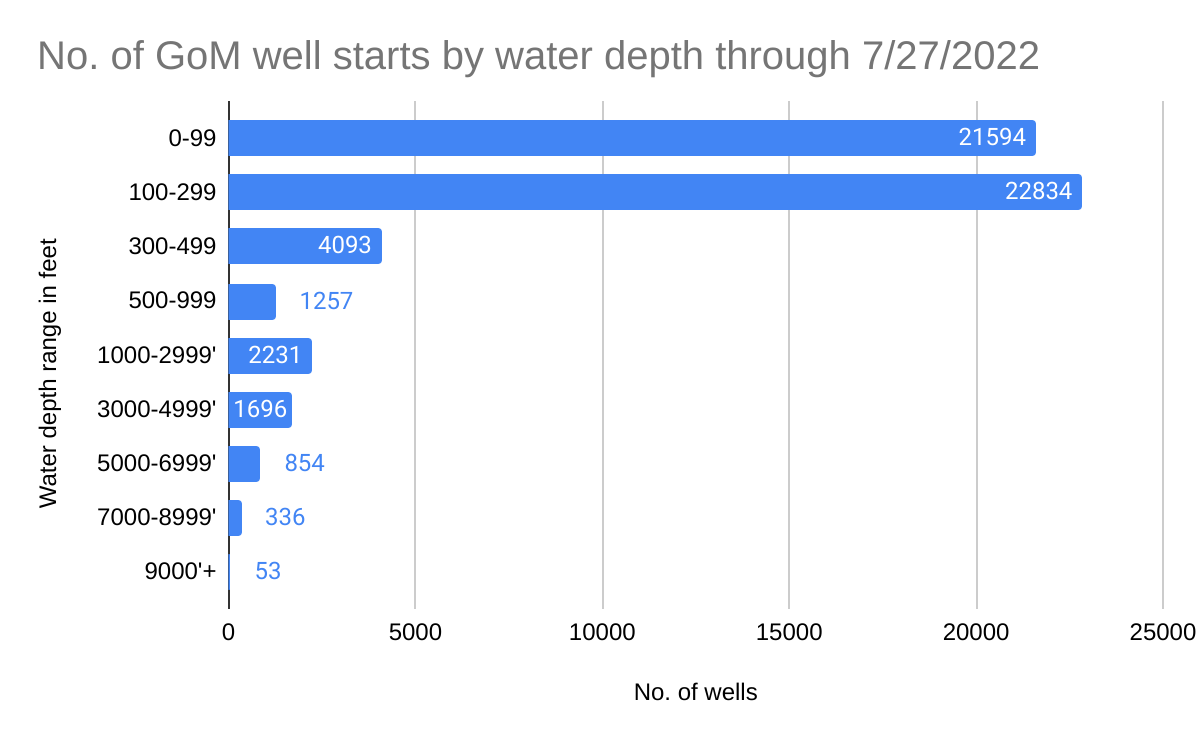
Per our post on the first Gulf of Mexico OCS production, here is what has happened since:
- 54,948 wells drilled
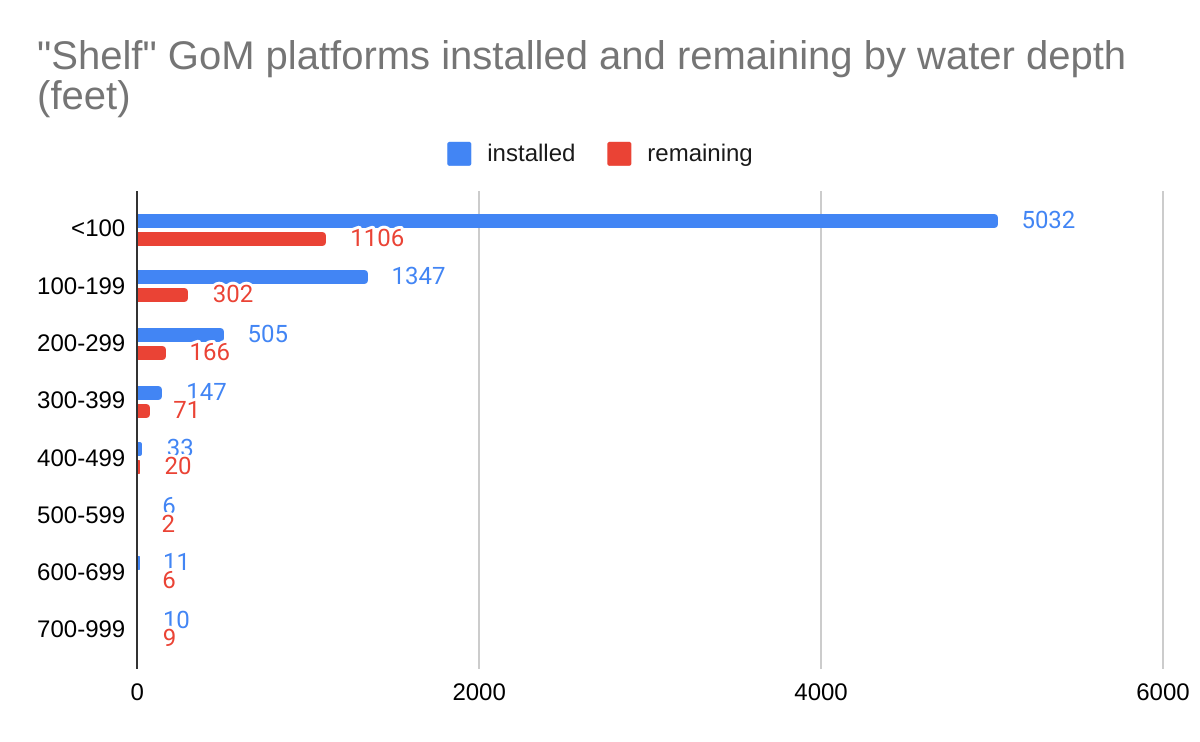
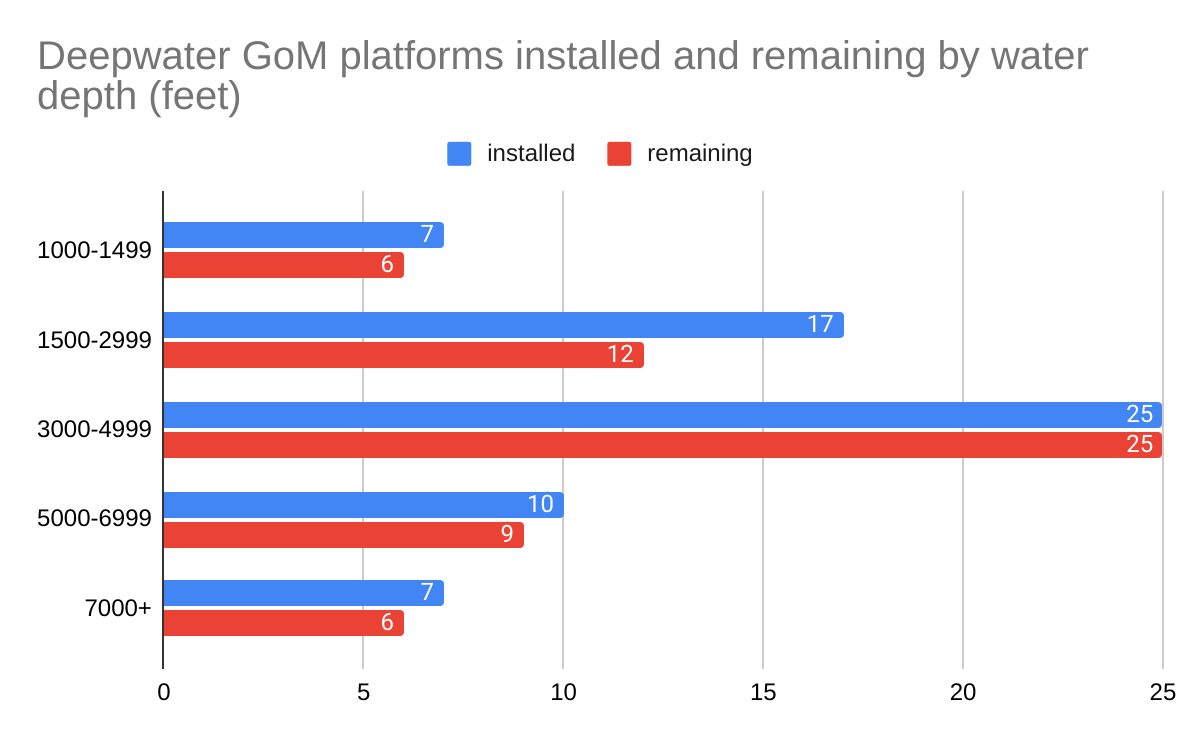
- 7159 platforms installed; 1743 remain in place
- 40,000 miles of pipeline installed (per GAO)
- Deepest water depth well: 10141 feet, Murphy (2008)
- Deepest water depth platform: 9560 feet, Stones (Turritella) FPSO, Shell
- Total oil production: 1947-2022 YTD = 23.6 billion bbls
- Total gas production: 1947-2022 YD = 190.1 trillion cubic feet
- Max. annual oil production: 693 million bbls (2019)
- Max. annual gas production: 5.15 trillion cu ft (1997)
- 131 lease sales
- 28,482 tracts leased
Except for the GAO pipeline estimate, all numbers are from BSEE and BOEM online data centers.
If the Schumer-Manchin bill is enacted, what happens to the Sale 257 CCS bids?
Posted in CCS, energy policy, Gulf of Mexico, Offshore Energy - General, tagged carbon sequestration, CCS, Exxon, infrastructure bill, Lease Sale 257, Manchin, Schumer on August 2, 2022| Leave a Comment »
The subject legislation requires the Secretary of the Interior to accept the highest valid bid that was received for each tract offered in OCS Lease Sale 257. Exxon was the sole bidder on 94 tracts on the nearshore Texas shelf. The leases were to be acquired for carbon sequestration purposes.
The CCS bids should not be considered valid given that:
- Sale 257 was an oil and gas lease sale. The Notice of Sale said nothing about carbon sequestration and did not offer the opportunity to acquire leases for that purpose. Therefore, the public notice requirements for CCS leasing (30 CFR § 556.308) were not fulfilled.
- Because there was no draft or final Notice of Sale, interested parties and the public did not have the opportunity to consider and comment on CCS leasing, tract exclusions, bidding parameters, and other factors.
- 30 CFR § 556.308 requires publication of a lease form. No CCS lease form was posted or published for comment.
- CCS operations were not considered in the environmental assessments conducted prior to the sale.
- No evaluation criteria for CCS bids have been published.
Unexpectedly, the Infrastructure Bill, signed on 11/15/2021 (just 2 days before Sale 257) included a provision for OCS carbon sequestration. However, that legislation did not require CCS leasing or authorize DOI to sell CCS leases as part of an oil and gas lease sale; nor did it exempt DOI from complying with its leasing regulations. Instead, It gave the Secretary a year (until 11/15/2022) to promulgate necessary implementing regulations. If carbon sequestration in the Gulf of Mexico is deemed to be desirable, a separate CCS sale should be held when the regulatory framework has been established.
Wind vs. oil and gas: Is this necessary?
Posted in climate, energy policy, Gulf of Mexico, Offshore Energy - General, Wind Energy, tagged Manchin, offshore oil, Offshore Wind, Schumer on August 1, 2022| Leave a Comment »
When we (MMS) drafted the OCSLA amendments (incorporated into the Energy Policy Act of 2005) that authorized offshore wind operations, we envisioned complementary and synergistic programs. Offshore wind and oil/gas development have many similarities and a common purpose – energy production. There is considerable overlap among the operating companies and contractors.
Unfortunately, politicians are better at dividing than uniting, and a provision in the Schumer-Manchin legislation pits the offshore wind and oil/gas programs against each other. The text (pasted below) from p. 646 of the bill restricts wind leasing when no oil and gas lease sale has been held in the prior year.
I share the concerns about the OCS program evolving into a wind-only program, as has already happened in the Atlantic (more on this at a later date). However, oil and gas sales should be held because they make economic and environmental sense, not because they are a condition for holding wind sales. Oil and gas sales are not punishment and wind sales are not rewards, and holding a single GoM lease sale each year does not balance the offshore program.
(b) LIMITATION ON ISSUANCE OF CERTAIN LEASES OR RIGHTS-OF-WAY.—During the 10-year period beginning on the date of enactment of this Act—
(2) the Secretary may not issue a lease for offshore wind development under section 8(p)(1)(C) of the Outer Continental Shelf Lands Act (43 U.S.C.1337(p)(1)(C)) unless—
(A) an offshore lease sale has been held during the 1-year period ending on the date of the issuance of the lease for offshore wind development; and (B) the sum total of acres offered for lease in offshore lease sales during the 1-year period ending on the date of the issuance of the lease for offshore wind development is not less than 60,000,000 acres.
May GoM production slides 9%
Posted in Gulf of Mexico, Offshore Energy - General, tagged EIA, Gulf of Mexico production, production decline on July 29, 2022| Leave a Comment »
If last fall’s Hurricane Ida dip is excluded, the latest production figure in 2021/2022. New projects should boost production over the next 2 years, but not enough to reach the August 2019 peak of 2.044 million bopd.

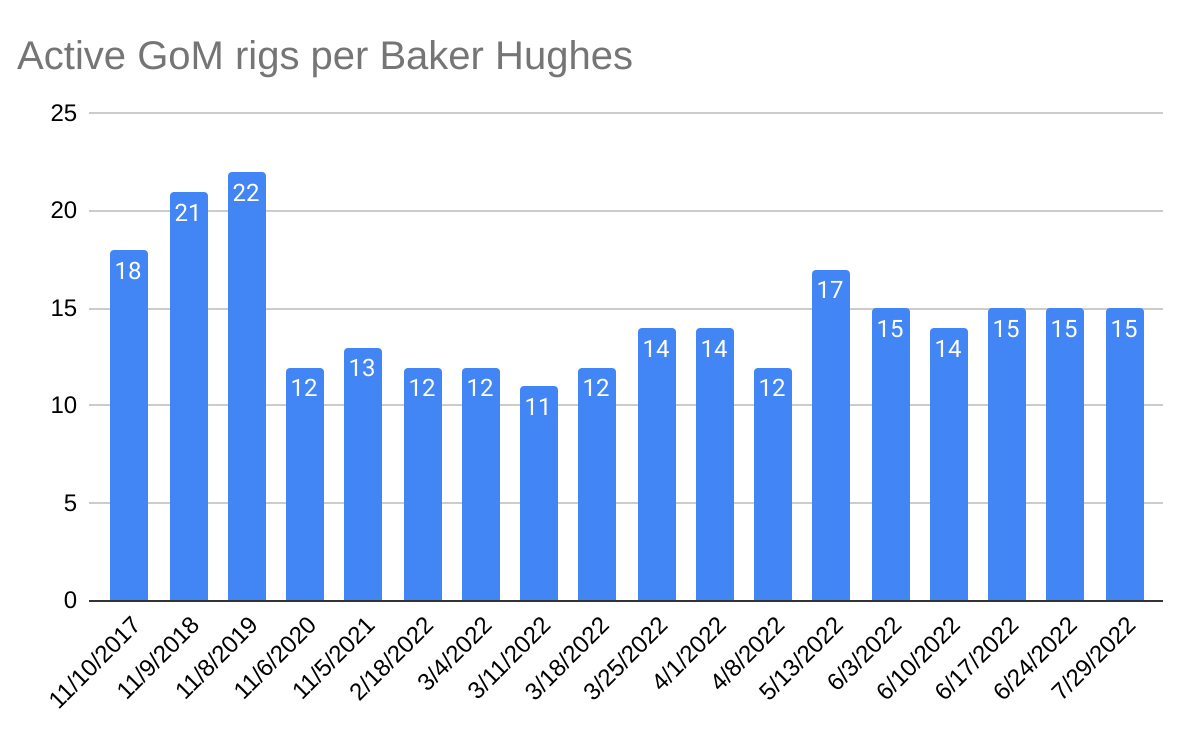
Meanwhile the GoM rig count remains sluggish at 15.
 Bud's Offshore Energy (BOE)