Feeds:
Posts
Comments

Archive for the ‘Gulf of Mexico’ Category

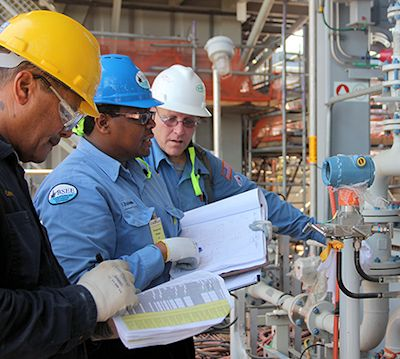
The Safety Alert is attached. Per BSEE, the fires resulted from an accumulation of gas caused by improperly installed or disconnected exhaust vent piping on gas starters.

Incident 1: Two workers sustained burns to the hands, arms, and face. BSEE investigators discovered that the engine’s air intake hose was disconnected, which may have allowed gas-enriched air to be drawn into the carburetor causing the backfire.

Incident 2: While attempting to start the gas engine of a pipeline pump, the lead mechanic sprayed ether into the engine’s carburetor. The exhaust vent piping for the starter had not been installed. The combination of the gas-rich atmosphere and ether caused the engine to backfire and ignited the
accumulated gas. The lead mechanic, sustained burns to his face, arms, and hands.

The Alert includes important recommendations for proper venting, mechanical integrity awareness training, maintenance, and the use of gas detectors and a temporary fire watch during engine startup.

Read Full Post »

This week Total announced the acquisition of a 25% working interest in 40 Chevron leases in the Gulf of America. Total already owned interest in Chevron’s producing Ballymore (40%), Anchor (37.14%), Jack (25%), and Tahiti (17%) fields. Ironically, Federal regulations prohibited Total from jointly bidding with Chevron for any of those leases at the time of the sales. How does that make sense?

Restrictions limiting joint bidding by major oil companies date back to the Energy Policy and Conservation Act of 1975. Although these restrictions were intended to increase competition and revenues, OCS program economists have asserted, and studies have shown, that the ban results in fewer bids per tract and lower bonuses to the government.

Total did not submit a single bid in any of the past 4 Gulf of America lease sales. Perhaps they prefer to acquire interest in blocks previously leased to companies like Chevron. That is a reasonable acquisition strategy. However, farm-in acquisitions yield no bonus dollars to the Federal government. Wouldn’t it have been in the government’s best interest if some of those acquisition dollars were spent at lease sales where the bonus bids go to the US Treasury? It’s long past time to remove the joint bidding restrictions!

Read Full Post »

As explained in the attached Safety Alert, BSEE’s risk-based inspection program has identified deficiencies in safety device bypass practices including:

  • inadequate documentation
  • inoperative data history software
  • bypassing more devices than is necessary
  • bypassing devices for longer than necessary
  • missing audit documentation
  • mistakenly bypassing the entire safety system during production

The regulations restricting the bypassing of safety devices are core elements of OCS regulatory and operator management programs. Because they are critical to process safety, these requirements are widely supported and strictly enforced.

Read Full Post »

Attached is the full NTSB report. Here’s what happened:

  • In May 2024, the Baylor J. Tregre tugboat was towing a platform on the barge MARMAC 27 to Brazos Block 538 in the Gulf of America.
  • The tug capsized in stormy conditions.
  • The 4 crew members were rescued by the Coast Guard.
  • The NTSB determined that the probable cause of the capsizing was “the mate’s inability to maneuver the tow into the wind due to the overwhelming towline force generated by the towed barge during the sudden onset of severe weather, resulting in unrecoverable heeling.”

Comments:

  • Who knew? When a tugboat capsizes while towing a platform on a barge, endangering the crew, that’s a very serious incident. Yet there was no public announcement by the companies involved or the Coast Guard, and there was no media coverage following the incident (May 2024). The NTSB docket includes only the final investigation report.
  • The NTSB report says a production platform was being towed, but it was actually a gas transmission platform owned by Transco Gas Pipe Line Co. There is no production in Brazos Area Block 538, an unleased block.
  • Here and here are bits of information on the Transco’s Brazos Area 538 Platform modification project.
  • Per a 2007 article, Williams’ Seahawk gathering system, which collects deepwater gas production, connects at Brazos Block 538 with a pipeline that transports gas to the Transco processing plant in Markham, TX (see map below).
  • The NTSB report lacks context needed to understand the planning process, organizational factors, and timing/urgency of the project.
  • The NTSB report attributes the failure to the mate’s inability to respond to the weather conditions, but provides no information on the safety management system, risk assessment, job safety job planning process, crew training, and other project management factors.
  • Two of the crew members are suing Trinity Tugs alleging that they suffered personal injuries resulting from the negligence of Trinity and the unseaworthiness of the M/V BAYLOR J. TREGRE.
Deepwater gas gathering system connects with Brazos 538 transmission platform at the “Y” in the center of the screen.

Read Full Post »

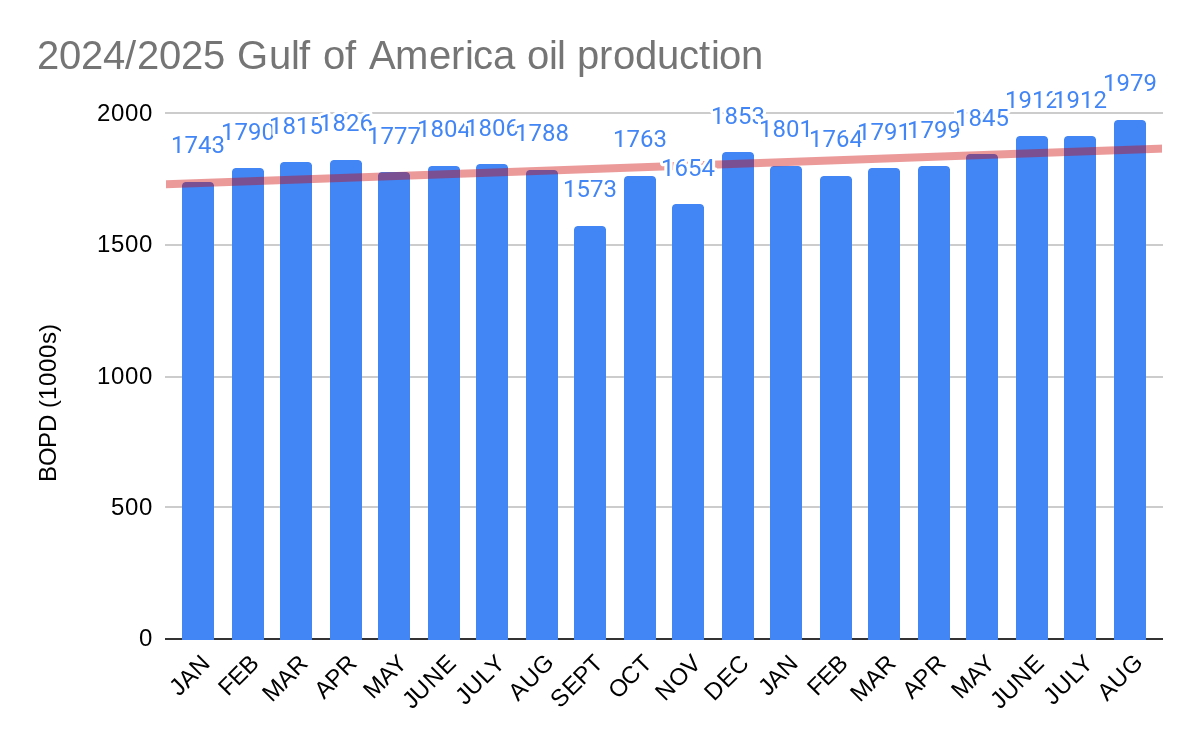
March Gulf of America oil production was nearly identical to the 2024/2025 average, and the trend line (red) is remarkably flat. However, production remains below the volumes forecasted by EIA and well below those forecasted by BOEM.

It appears that new deepwater production is replacing Gulf-wide production declines, but is not yet sufficient to increase total production. We will see if that changes as the year progresses.

  • March 2025 Gulf of America production: 1.793 million bopd
  • 2024/2025 average production: 1.77 million bopd
  • 2024/2025 average omitting Sept. 2024 (tropical storms): 1.784 million bopd
  • EIA forecast for 2025 (published 9/16/2024): 1.9 million bopd
  • BOEM forecast for 2025 (published in 2022, table below): 2.052 million bopd

Read Full Post »

Part VIII, Offshore OIl and Gas Leasing, is a good read for those interested in OCS leasing policy. This cleverly crafted part of the bill specifies leasing schedules, streamlines the leasing process, and minimizes litigation risks. Highlights:

  • Minimum royalty rates return to 12.5% from 16.67% post-IRA. (This is good for small, shelf producers.) The maximum rate remains 18.75%.
  • Requires a Gulf of America lease sale by 8/15/2025, a sale by 3/15 and 8/15 in each of the following 14 years (2026-2039), and a sale by 3/15/2040. 80+ million acres must be offered at each sale unless that amount of acreage is no longer available for leasing.
  • The lease form, lease terms, economic conditions, and stipulations 4 through 10 must be the same as for Lease Sale 254 (3/18/2020). Stipulations 1-3 may be updated.
  • Requires seven 1+ million acre (if available) Cook Inlet lease sales from 2026 – 2032. Beginning in 2035, 90% of the revenues go to the State of Alaska.
  • The required lease sales may be in addition to the lease sales held under the 2024-2029 National Outer Continental Shelf Oil and Gas Leasing Program.
  • Adherence with the Biological Opinion shall satisfy the Secretary’s obligations under the Endangered Species Act of 1973 and the Marine Mammal Protection Act of 1972
  • Previous EIS’s for the Gulf of Mexico shall satisfy the Secretary’s NEPA obligation.
  • Consistency determinations prepared by BOEM for Lease Sale 261 for the States of Texas, Louisiana, Mississippi, Alabama, and Florida will satisfy the Secretary’s CZMA obligations.
  • The Secretary may waive any requirement under the Outer Continental Shelf Lands Act that the Secretary determines would delay issuance of a lease.
  • A lease must be issued to the highest responsible qualified bidder not later than 90 days after the sale date.
  • The Secretary shall establish a process through which a Governor may nominate for leasing under a lease sale held under this section an area of the OCS that is adjacent to the waters of the State; and is unleased and available for leasing. If the Governor of a State nominates an area, the Secretary shall include the area in the next scheduled sale. (It appears that this provision applies only to the Gulf of America. Objective?)
  • G&G surveys must be approved within 30 days after a complete application is received.
  • A lease awarded under Lease Sale 259 or Lease Sale 261 shall not be set aside, vacated, enjoined, suspended, or cancelled except in accordance with section 5 the Outer Continental Shelf Lands Act (43 U.S.C. 1334). Also, new terms or conditions may not be added to these leases. (This protects lessees from pending litigation related to these leases).
  • Any action to approve, require modification of, or disapprove any exploration plan, development and production plan, bidding procedure, lease sale, lease issuance, or permit or authorization related to oil and gas exploration, development, or production, or any inaction resulting in the failure to hold a lease sale shall be subject to judicial review only in a United States court of appeals for a circuit in which an affected State is located.

Read Full Post »

Their filing is attached. I found the following points to be particularly compelling:

p.3: “Despite no evidence that an Oil and Gas Program vessel has ever struck a Rice’s whale, the 2025 BiOp projects that Oil and Gas Program vessels will lethally strike numerous Rice’s whales over the term of the 2025 BiOp. On that basis alone, the Service found that the Oil and Gas Program will jeopardize the continued existence of the Rice’s whale, and developed a multi-step reasonable and prudent alternative which it asserts will reduce projected vessel strikes to zero.

p. 4: “The Rice’s whale is a rarely found animal that the Service first identified as a new species (separate from the non-endangered Bryde’s whale) in 2021. 86 Fed. Reg. 47,022 (Aug. 23, 2021). There is no evidence that an Oil and Gas Program vessel has ever struck a Rice’s whale (or a Bryde’s whale) despite continued operation in the Gulf over many decades.”

p. 5: “The 2025 BiOp disregards the Bureaus’ logical, fact-based conclusion. Instead, the Service’s 2025 BiOp engages in speculation and guess-work to surmise that Oil and Gas Program vessels could be striking and killing Rice’s whales on a regular basis. The Service ignores the best available data (i.e., showing no recorded observations of an oil and gas vessel striking a Rice’s whale) and instead presumes that forceable and lethal collisions between oil and gas service vessels and 60,000-pound whales are regularly occurring but somehow going unnoticed by the vessels and their crews and that the carcasses silently disappear into the water, never to be seen again.

Read Full Post »

National Marine Fisheries Service (NMFS) biological opinion dated 5/20/2025

Background:

  • Section 7(a)(4) of the Endangered Species Act (ESA) requires federal agencies to confer with NMFS on any action that is likely to jeopardize the continued existence of proposed species or result in the destruction or adverse modification of proposed critical habitat.
  • Section 7(b)(3) of the ESA requires that at the conclusion of consultation, NMFS provides an opinion stating whether the Federal agency’s action is likely to jeopardize ESA-listed species or destroy or adversely modify designated critical habitat.
  • Last year, the U.S. District Court for the District of Maryland vacated the NMFS 2020 Biological Opinion for Gulf of Mexico Oil and Gas activities effective May 21, 2025, so failure to complete the opinion by that date would have jeopardized oil and gas operations in the Gulf.

Key points in the biological opinion:

  • p. 598: The proposed action is not likely to jeopardize the continued existence of sperm whale, Northwest Atlantic loggerhead sea turtle, Kemp’s ridley sea turtle, North Atlantic DPS green sea turtle, leatherback sea turtle, hawksbill sea turtle, or Gulf sturgeon.
  • The proposed action is not likely to destroy or adversely modify loggerhead or Gulf sturgeon designated critical habitat, or proposed critical habitat for green sea turtle North Atlantic DPS or Rice’s whale.
  • p. 599: The operation of oil and gas vessels in the Gulf of America, in an area where the endangered Rice’s whale occurs, is likely to jeopardize the continued existence of the whale due to the risk of vessel strike.

According to NMFS, the reasonable and prudent alternative (see below) reduces or avoids the primary threat to Rice’s whales, the risk of injurious and lethal vessel strike interaction. The impacts of other stressors are more limited in space and time, diffuse, or not likely to result in adverse effects to Rice’s whale.

The reasonable and prudent alternative (RPA) requires the following as it relates to vessel activity in the action area. More detail on p. 601:

  1. Immediately begin to use technology to enable Rice’s whale vessel strike avoidance and monitoring of presence of Rice’s whale.
  2. Establish an expert working group to support development and implementation of a Rice’s whale vessel strike avoidance technology plan (RW Tech Plan)
  3. Improve understanding of Rice’s whale vessel strike risk associated with the proposed action
  4. Develop a Rice’s whale vessel strike avoidance technology plan (RW Tech Plan)
  5. Undertake independent peer review
  6. Implement Rice’s whale vessel strike technology plan
  7. Monitor Rice’s whales to ensure no likelihood of jeopardy during RPA implementation

Comment: Because the risk to the Rice’s whale in the central and northwestern GoA is highly speculative (see analysis by Darren Ireland), the RPA is arguably excessive. However, I like the RPA’s technological and management system focus.

Unsurprisingly, Earth Justice et al found the NMFS opinion inadequate and filed a suit (attached) in Maryland calling on the court to vacate the opinion and grant injunctive relief.

How can they sue in a Federal court in Maryland, far away from the Gulf? The venue was ostensibly chosen because NMFS headquarters are located in a Maryland suburb of DC. The Maryland court is also likely to favor the plaintiffs, which may have been a factor in the choice of venue. It’s a great country! 😉

Read Full Post »

Coast Guard photo. Thanks to Lars Herbst for bringing this incident to my attention.

In what the Coast Guard is describing as an “uncontrolled discharge” (euphemism for blowout), an 82-year-old oil well has been spewing oil, gas, and water into the coastal marshes of southern Plaquemines Parish, Louisiana, for more than a week.

In hopes of future production, prior and current owners had elected not to permanently plug the well, apparently with the State’s acquiescence.

The well is currently operated by an affiliate of Spectrum Energy. Typical of these situations, the previous owner, Whitney Oil and Gas, was in bankruptcy.

The Coast Guard has taken over the response and has accessed the Oil Spill Liability Trust Fund.

We don’t need relaxed decommissioning and financial assurance requirements. We need a cooperative Federal, State, and industry effort to ensure that wells are plugged in a timely manner and that financial assurance is provided to protect the public interest.

Read Full Post »

  • 2024/25 monthly average: 1767 bopd
  • 2024/25 monthly average minus hurricane reduced month (SEPT 2024): 1782 bopd
  • FEB 2025 ave. production: 1755 bopd

Read Full Post »

« Newer Posts - Older Posts »