…especially when the market price is higher than the price the government wants to pay. Per EIA data, the “tank” has been flat-lined at half-full for the past month.
So far, the agency has not repurchased any barrels. The DOE announced earlier this month (Jan.) that it would not finalize a proposed buyback of 3 million bbl, because it did not receive offers that met its terms for price or quality.
The National Academies of Sciences, Engineering, and Medicine will establish a standing committee to provide ongoing assistance to the Department of the Interior’s Bureau of Ocean Energy Management (BOEM) in its efforts to manage development of the nation’s offshore wind energy resources and their potential effects on fisheries
This seems to be a positive step and the committee members have excellent credentials, but how do you establish such a committee without any representation from the wind industry? Here are the 12 members of the committee.
Last June, the Navy divers, operating under the cover of a widely publicized mid-summer NATO exercise known as BALTOPS 22, planted the remotely triggered explosives that, three months later, destroyed three of the four Nord Stream pipelines, according to a source with direct knowledge of the operational planning.
Victoria Nuland’s glee over the Nord Stream damage (video clip below) is particularly galling to those responsible for offshore production, worker safety, and environmental protection. Does she realize that the Gulf of Mexico has more than 13,000 miles of active offshore pipeline that could be similarly targeted, and that the US has 2.6 million miles of onshore pipelines?
Whether or not the US was involved in the Nord Stream sabotage, Ms. Nuland’s schadenfreude is disturbing given the economic and security implications of the attack.
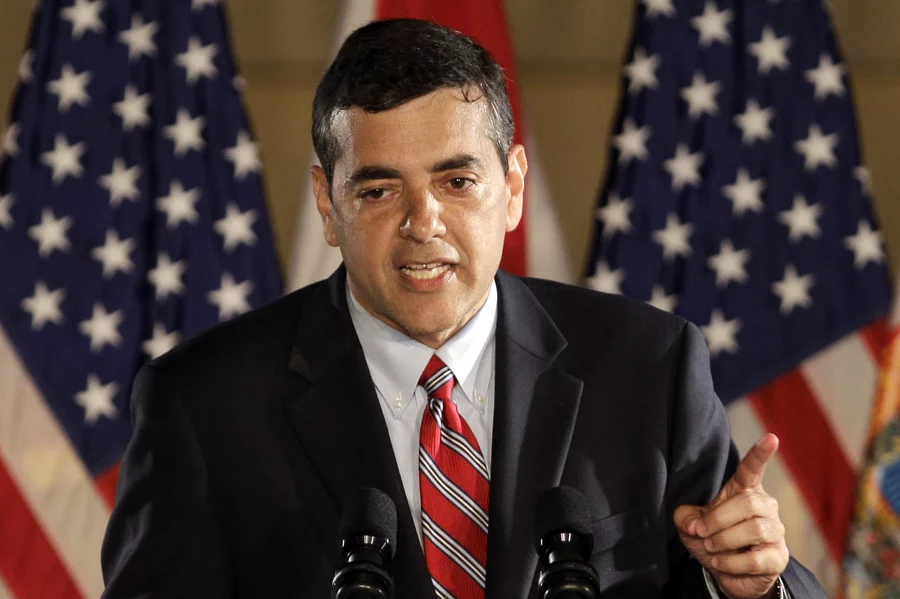
“Former U.S. Rep. David Rivera, a well-connected Florida Republican, has been arrested on federal charges that include failing to register as a foreign agent. The case centers on Rivera’s signing of a $50 million contract with Venezuela’s government in early 2017, and his subsequent attempts to thaw Venezuela’s icy relationship with the U.S.”
Perhaps Mr Rivera’s conduct at a 2012 hearing on Cuban offshore drilling was a hint of things to come. Mr. Rivera inappropriately pressed BSEE, represented by Lars Herbst, to find ways to “bleed” Repsol should there be an incident while they were drilling in Cuban waters.
“So, we need to figure out what we can do to inflict maximum pain, maximum punishment, to bleed Repsol of whatever resources they may have if there is a potential for a spill that will affect the U.S. coast. So, I hope you will look into that and verify that for us.”
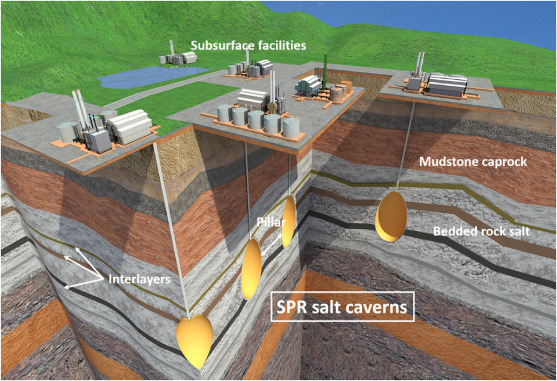
For the first time in 71 weeks the Strategic Petroleum Reserve has not declined. DOE reports that the SPR was unchanged during the week ending 1/20/2023. The reserve remains at 371.6 million bbls, about 51% of capacity.
Bob McNally, founder and president of the consulting firm Rapidan Energy Group, said any effect on pump prices has been modest.
“Pump prices are largely driven by global crude oil prices,” McNally said in an email. “SPR releases have at most temporary and small impacts on global crude oil prices. Therefore the SPR is a bad tool for trying to manage pump prices.”
This week’s loss was by a small margin, only 800,000 barrels (down to 371.58 million barrels total), suggesting that the record losing streak may end soon. EIA data
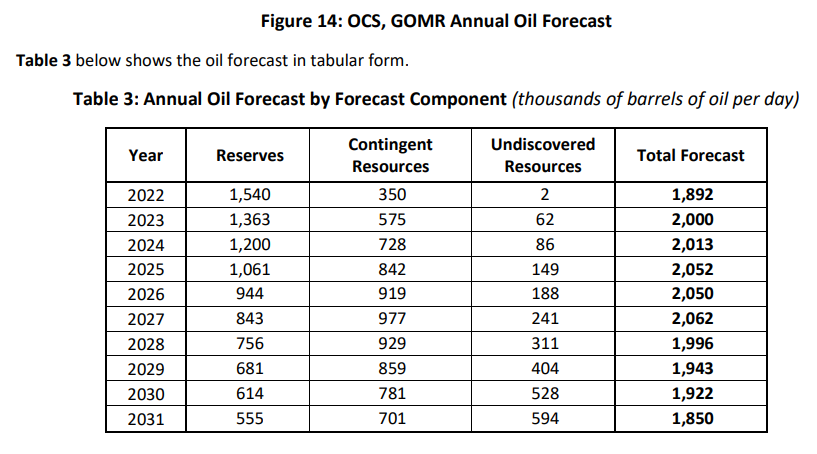
The EIA 2022 figure is spot-on, as it should be given that 10 months of 2022 production data are now in hand. However, BOEM’s 2022 forecast (published in July) missed the mark considerably. (In fairness to BOEM staff, their work was probably completed months before publication pending internal reviews.)
Of greater concern, given the policy implications, is the rosy BOEM forecast for the out-years. Despite historically low levels of leasing and exploratory drilling, BOEM forecasts oil production to exceed 2 million BOPD through 2027 and to remain well above the current (2022) level through 2031 (second table below).
Offshore gas has important environmental advantages, particularly nonassociated gas-well gas (GWG). While the GoM production chart (below) is not pretty, there are signs that gas production may have bottomed and is slowly rising. This is largely due to growth in oil-well gas (OWG) associated with deepwater oil production.
A successful offshore program requires a mix of strategies, and it is encouraging that companies are still pursuing natural gas on the GoM shelf. The second chart (below), based on BOEM data, shows 2022 YTD (probably through Oct.) GWG production for the 11 companies that (1) produced more GWG than OWG and (2) produced more than 1 BCF of GWG.
Interestingly, 100% of the gas produced by Contango, Samchully, and Helis in 2022 was from gas wells. Contrast this with bp, the third largest GoM gas producer. None of bp’s gas production was from gas wells.




 Bud's Offshore Energy (BOE)