Feeds:
Posts
Comments

Archive for the ‘energy policy’ Category

Bayou Bend CCS LLC commenced drilling an offshore (Texas State waters) and an onshore stratigraphic well for carbon sequestration in the first quarter 2024.

Talos

Is offshore carbon disposal ocean dumping? One of the provisions that was slipped into the “2021 Infrastructure Bill” exempted carbon sequestration from the Marine Protection, Research, and Sanctuaries Act of 1972 (Ocean Dumping Act). This exemption revises the OCS Lands Act and thus does not apply to State offshore lands. The Texas offshore wells must therefore be permitted by EPA as “Class VI wells,” as is the case for onshore disposal wells. However, Texas and Louisiana have asked the EPA for “primacy,” which would allow state agencies to approve and oversee these operations.

Meanwhile, the regulations for carbon disposal on the OCS, which the Infrastructure Bill mandated by November 2022, have yet to be published for comment. The latest Federal regulatory agenda indicates a publication date of 12/00/2023 for these regulations. Presumably the staff work has been completed and the rule is stalled in the review process.

Despite the absence of a regulatory framework, BOEM has accepted sequestration bids at the last three oil and gas lease sales. These bids were evaluated as if the leases were being acquired for oil and gas exploration and production, even though the bidders’ intentions were widely known. Why was BOEM a willing participant in this charade, not just at one sale, but at three sales in succession?

Given that the perceived carbon disposal bonanza is dependent on mandates and subsidies, one has to wonder about the massive revenue projections for this industry and raise concerns about the associated public and private financial risks. What is the long term business plan for this industry? Who will be monitoring the offshore wells (in perpetuity)? How will the public be protected from financial assurance and leakage risks? We will see how the myriad of carbon sequestration issues are addressed in the proposed regulations.

Read Full Post »

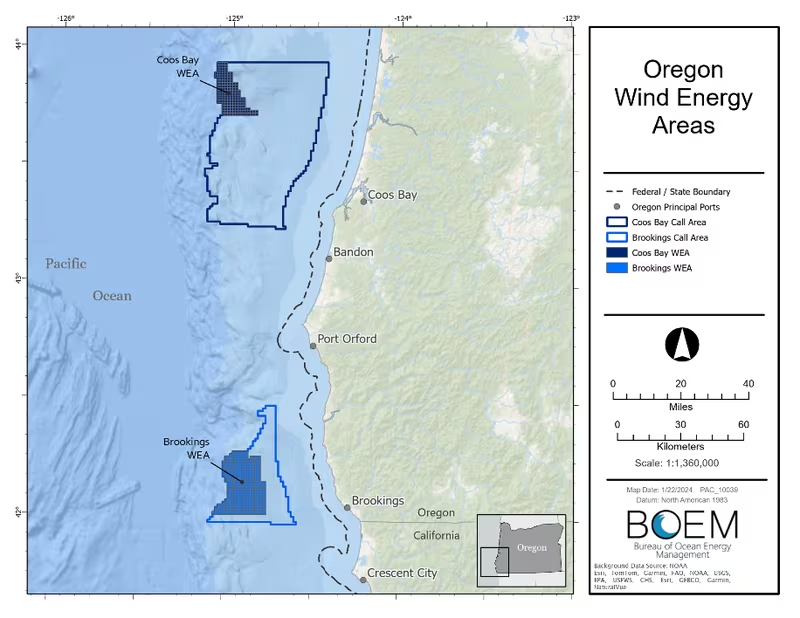
As concerns about wind leasing mount, it is becoming increasingly apparent that the rush to hold auctions may not be in the best long-term interest of the wind program. The primary objective should be cost-effective and responsible development, not gigawatt deadlines. The administration’s vision for wind energy capacity, particularly the 15 GW goal for floating turbines by 2035, is unlikely to be achieved and rushing the process is not helpful.

The current wind program is reminiscent of James Watt’s ill-fated approach to oil and gas leasing. Watt’s “lease-everything now” agenda had the opposite effect of that which was intended, the result being that 96.3% of our offshore land is now off-limits to oil and gas leasing.

Affected parties in Oregon have not held back in voicing their displeasure with BOEM’s wind energy announcement.

BOEM wants offshore wind come hell or high water and they don’t care who they harm to get it.

Heather Mann, executive director of Midwater Trawlers Cooperative

The Confederated Tribes of Coos, Lower Umpqua and Siuslaw tribal council unanimously passed a resolution opposing offshore wind energy development off the Oregon coast.

The federal government states that it has ‘engaged’ with the Tribe, but that engagement has amounted to listening to the Tribe’s concerns and ignoring them and providing promises that they may be dealt with at some later stage of the process. The Tribe will not stand by while a project is developed that causes it more harm than good – this is simply green colonialism.

Coos, Lower Umpqua and Siuslaw tribal council Chair Brad Kneaper

Read Full Post »

Expected appeals by API (first attachment) and Earth Justice et al (second attachment) were filed on 12 Feb, 60 days after Secretary Haaland approved the 5 year plan and thus the first day appeals could be filed pursuant to 43 U.S. Code § 1349.

The statute (language below) requires that leasing program appeals be filed in the DC Court of Appeals. API would have undoubtedly rather filed in Louisiana while Earth Justice is likely content with the DC venue.

43 U.S. Code § 1349 (c)(1) Any action of the Secretary to approve a leasing program pursuant to section 1344 of this title shall be subject to judicial review only in the United States Court of Appeal for the District of Columbia.

The filings don’t include any arguments except for API’s general assertion that “the Record of Decision and Approval is arbitrary, capricious, and not in accordance with law.”

Earth Justice presumably filed for defensive reasons given that the 5 year plan has the fewest lease sales in history and would seem to be favorable to their point of view.

API will likely contend that the plan is not balanced as require by the statue:

43 U.S. Code § 1344 (a)(3)The Secretary shall select the timing and location of leasing, to the maximum extent practicable, so as to obtain a proper balance between the potential for environmental damage, the potential for the discovery of oil and gas, and the potential for adverse impact on the coastal zone.

We’ll see how this plays out.

Read Full Post »

Energy experts like Dan Yergin have a different, and far more credible view. Yergin explains that energy transitions don’t happen on command, noting that the world uses almost three times as much coal today as in the 1960’s when oil finally surpassed coal as the world’s primary energy source.

Oxy CEO Vicki Hollub’s recent remarks should serve as a reality check for the 5 Year Plan authors and their counterparts elsewhere in western governments. More oil and gas exploration and production are needed, not less. Leading Oxy investor Warren Buffet agrees.

Crude reserves are being found and developed at a much slower pace than they’ve been in the past. Specifically, she said the world has only newly identified less than half the amount of crude it’s consumed over the course of the past 10 years. Given the current trends, this means demand will exceed supply before the end of 2025.

Oxy CEO Vicki Hollub per the Motley Fool

Recent trends in the Gulf of Mexico, where Hollub’s Anadarko unit is one of the more active and successful operators, reflect Hollub’s concern. Note below the sharp decline in discoveries, as determined by BOEM, over the past 20 years. Effective development of older discoveries and improved resource recovery practices are sustaining GoM production, but declines are inevitable without consistent leasing and increased exploration.

Read Full Post »

Still waiting for:

Read Full Post »

Here is the entire interview. The Nord Stream sabotage discussion begins just after the 1:11 mark.

Putin suggests that people consider who had an interest in sabotaging the pipelines and who had the capability. He also asks why Germany isn’t allowing gas to flow through the one Nord Stream line that wasn’t damaged. 

Read Full Post »

NAE announcement

As the Minerals Management Service’s liaison to the Marine Board of the National Academies and subsequently as a Marine Board member, I had the privilege of working with many outstanding engineers on matters related to offshore safety and environmental protection. Dr. Martha Grabowski was a clear standout because of her exceptional leadership and communications skills, modest ego, and willingness to assist.

Dr. Grabowski excels in analyzing and mitigating operational risks including those associated with human and organizational factors. As such, she was a great resource in our work on safety management and culture.

Congratulations to Dr. Grabowski!

Read Full Post »

A previous post commented on the bonding waiver for the Vineyard Wind project’s offshore facilities. According to this presentation by Cliff Carroll at the “Close to the Wind Summit” (Jan. 27 in Hyannis, MA), certain onshore bonding requirements are also being waived. Per Mr. Carroll, the Massachusetts Energy Facilities Siting Board has overruled the Town of Barnstable’s objections to bonding waivers for large transformer substations to be located withing the town.

Now there is no Federal bonding on decommissioning and now we have no bonding as a town.

Cliff Carroll

Mr. Carroll’s brief bonding comments begin at the 11:30 mark. Prior to that he considers some of the environmental risks associated with these substations.

Read Full Post »

At Oil and Gas Lease Sale 261, Repsol was the sole bidder for 36 nearshore Texas tracts in the Mustang Island and Matagorda Island areas (red blocks at the western end of the map above). Exxon acquired 163 nearshore Texas tracts (blue in map above) at Sales 257 and 259. All 36 of the Repsol bids have now been accepted.

As previously posted here and here, carbon disposal bidding at the last 3 oil and gas lease sales has made a mockery of the leasing process and the regulations that guide it.

Hopefully, the carbon sequestration regulations that are under development will preclude conversion of leases acquired at Sales 257, 259, and 261. At a minimum, these regulations should require a competitive process for converting any oil and gas leases.

Read Full Post »

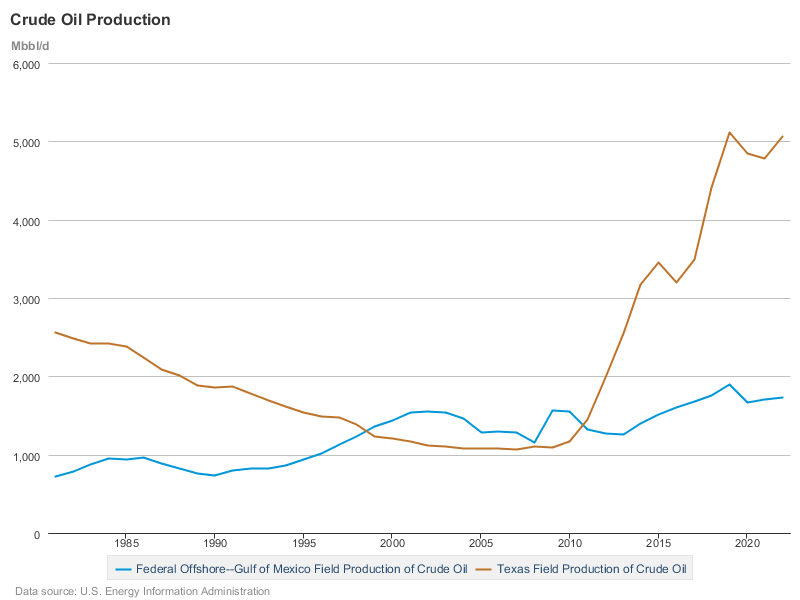
A friend owns land in the Texas Permian. His family gets a nice royalty check every month that has helped them get through some difficult times. Texas Permian production is almost entirely from private land, which is a big part of the success story. Payments to private land owners by responsible producers engender public support, access to resources, and growth in production. Add to that the continuous improvements in horizontal drilling, well stimulation and completion practices, and you have the success story that is the Texas Permian.

Similarly, private and state land plus technology launched the natural gas boom in my native state of Pennsylvania. When I was a student, we looked back at the Titusville/Colonel Drake glory days, and no one dreamed that the state would become a major natural gas exporter. Today, pipeline constraints, particularly in NJ and NY (which has managed to prevent access to the state’s substantial Marcellus and Utica shale resources) are preventing PA from further increasing gas sales.

The offshore lands on the US Outer Continental Shelf are a different story. Unfriendly, bordering on hostile, leasing policy (and not just during the current administration) has been partially overcome by advances in deepwater well and facility design that have lowered costs and increased productivity. However, OCS oil production is a fraction of what it could be.

OCS gas production has fallen dramatically since the turn of the century. Ultradeep (subsurface) gas production was not economically viable and production was fading even before onshore shale gas began to dominate US gas markets. Most of the current OCS gas production is associated with deepwater oil production.

The charts below tell the story.

Read Full Post »

« Newer Posts - Older Posts »