Feeds:
Posts
Comments

Archive for the ‘drilling’ Category

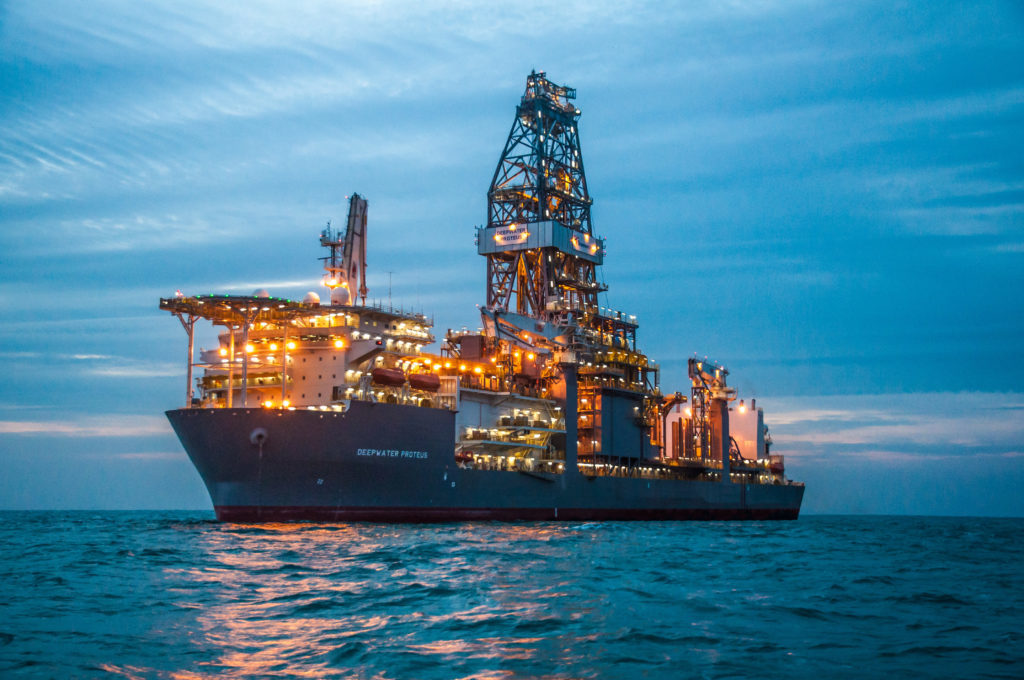
Pictured: Transocean’s Deepwater Proteus. T/O should name one of their drillships Deepwater Diligence πŸ˜‰

Seven of the deepwater exploratory wells drilled in the Gulf of Mexico in 2023 (YTD) were spudded within 4.5 years of the effective date of their leases. Three of these wells were spudded within 3 years of their lease effective dates (see table below).

These are impressive achievements when you consider the time required for consultation with partners (if any) and contractors, site surveys, exploration plan development and approval, well planning, and drilling permit preparation and approval.

The subject wells accounted for 28% of the deepwater exploratory well starts in 2023 (25 net YTD wells after subtracting restarts at the same location).

date lease
effective
spud dateelapsed time
(months)
water
depth (ft)
operator
3/1/20218/27/2023306498Shell
8/1/20205/21/2023342211Talos
8/1/20203/15/2023313338Talos
12/1/20196/5/2023424228Chevron
11/1/20196/1/2023434603Hess
7/1/20197/11/2023487486Kosmos
12/1/20186/6/2023544127bp

Below are the exploration plan (EP) and permit (APD) approval timeframes for these 7 wells. With the exception of the Kosmos EP which required a number of modifications, the regulator actions appear to have been timely. For the bp, Shell, and Chevron wells, only 4-6 months elapsed between EP submittal and APD approval.

operatorblockdate EP
received
date EP
approved
APD
received
APD
approved
ShellWR 3653/1/20235/17/20235/11/20238/8/2023
TalosGC 781/19/20214/16/20213/8/20235/26/2023
TalosMC 1624/1/20227/13/20228/2/20223/2/2023
ChevronMC 93712/7/20225/19/20234/21/20235/21/2023
HessMC 7278/30/202211/3/202212/21/20224/24/2023
KosmosKC 9641/3/202010/12/20224/18/20237/3/2023
bpGC 4361/18/20234/14/20233/29/20236/5/2023
Notes: EP=Exploration Plan, APD=Application for Permit to Drill, WR=Walker Ridge, GC=Green Canyon, MC=Mississippi Canyon, KC=Keathley Canyon

Read Full Post »

As has been previously discussed on this blog, the renewable energy source that shows the greatest promise for generating the power needed to support economic growth is ultradeep geothermal.

This JPT article nicely describes the opportunities and challenges

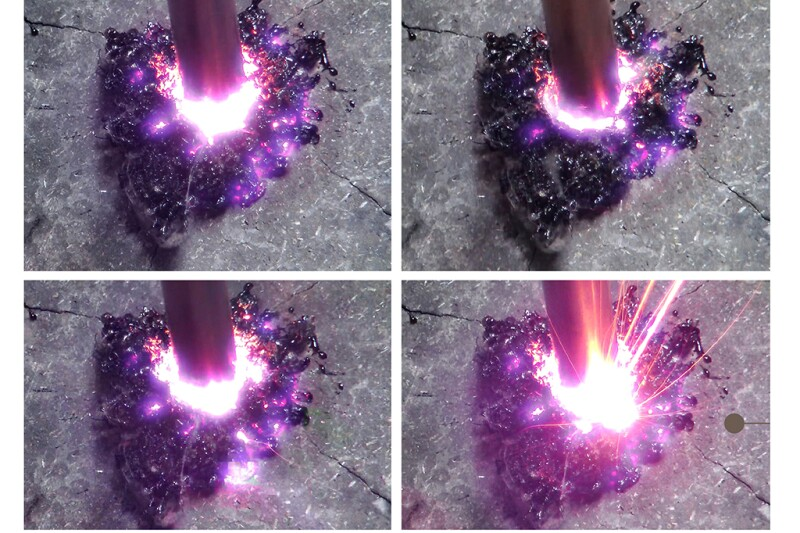
Microwave drilling test. Source JPT/Quaise Energy

Good comparison of drilling into hard basement rock with conventional and millimeter wave (microwave) technologies:

The technical readiness level (TRL) for microwave drilling reflects that it has yet to be field tested. The drilling rate includes an estimated amount of flat time. The levelized cost of energy (LCOE) is an all-in estimate of the cost per megawatt-hour (MWh). Source: JPT/Quaise Energy.

Quaise Energy’s first full-scale testing of a hybrid drilling rig combining conventional rotary drilling and millimeter wave drilling capabilities is scheduled for 2024.

Read Full Post »

Newfoundlander Howard Pike shared this interesting video.

BP’s Ephesus well – why was it a failure?

Read Full Post »

Published today.

Comments on the proposed rule.

Read Full Post »

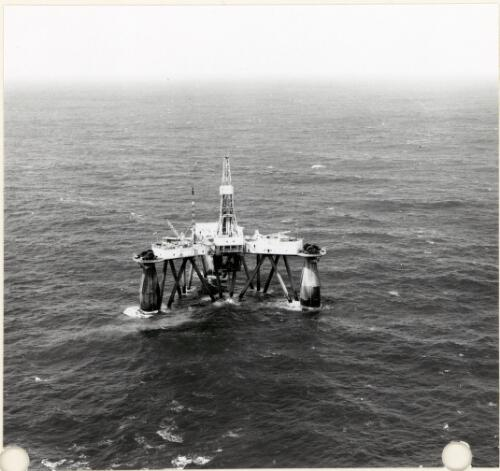
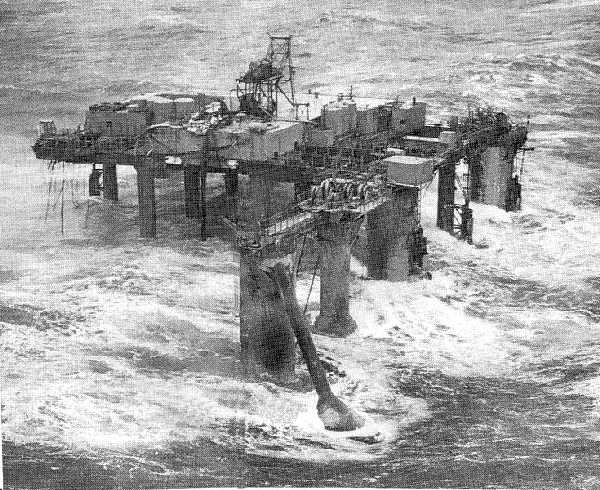
Offshore veteran JL Daeschler brought the historic destruction of the Ocean Prince to my attention.

At about 2 am on the day of the storm, the rig’s superstructure was torn off during a gale. By 7:10 am about a third of the drilling plattform had dissapared under 60 feet water.”

I didn’t realize that some early North Sea wells were drilled with semisubmersible rigs that were sitting on bottom, ala submersibles.

Per JL Daeschler, “the barge master on Ocean Prince was unsettled about sitting on a sandbank in the North Sea with waves as deep as the water depth, hence accelerating the scouring around the pontoon on the sea bed and distorting the forces on an unsupported hull. On a semisubmersible floating rig there is a great level of compliance between the mooring system and the forces on the leg and bracing. Worst case, you let the mooring go and drift. 

It’s noteworthy that: “During the same storm which claimed the ”Ocean Prince,” the rig’s sister ship ”Ocean Viking,” while drilling afloat, withstood winds and waves of equal force.”

The entire crew of the Ocean Prince was safely evacuated. The helicopter pilot’s last name was fitting given his bravery during the rescue!

Hero of the rescue effort was Capt. Robert Balls, 32, a former naval pilot who was alerted to remove the stranded crewmen. Within 45 minutes after he was awakened at Scarborough Hotel at 6 a.m., he was piloting a Wessex 60 helicopter across the North Sea fighting gale winds 400 feet up.”

“Captain Balls flew the copter with a minimum load of fuel in order to carry more than a full passenger load to the oil rig ”Constellation,” which was drilling about 20 miles south of the ”Ocean Prince.” On the first lift he transported 19 men. Usually, the capacity of the Wessex 60 is 16. On the second trip he took 18 crewmen. The final trip, he flew eight men directly to Scarborough.”

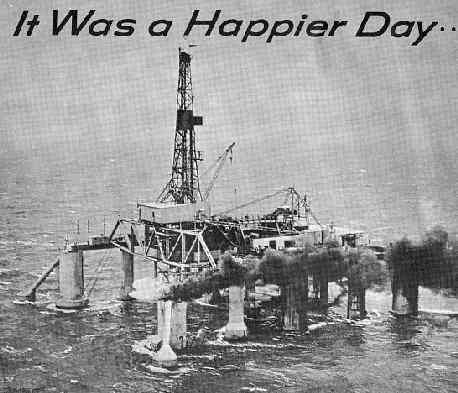
Before the storm:

Read Full Post »

For those interested in offshore history:

Read Full Post »

Jean-Louis Daeschler, a pioneering offshore engineer, has shared this very interesting story about his interaction with George HW Bush (pictured):

One day I was driving in Kennebunkport and told my wife that I met the man who lived in that house on the coastal road – the President George HW Bush!

Early in my career, a new drillship was being built in Port Arthur TX for Zapata Offshore. One morning, the entrance to the shipyard was closed off. A peaceful group of picketers told us we could not enter. Many of us had left work clothes, file drawings, and even passports and money at our camp in the yard. This was before mobile phones and the internet! So we went back home to wait for guidance. 2-3 days later we had to attend a meeting in Houston (a 2 hr drive) at the Pennzoil Tower, and we met Mr Bush. He was very cool and calmed us down. He advised us not to cross the picket line or get into an argument with the workers. He had already made arrangements to use 4-5 rooms at a Holiday Inn near Beaumont. They removed the hotel furniture and provided desks, pencils, and phones. Our personal effects had been collected from the yard and delivered to the our temporary workplace at the Holiday Inn.

My colleagues and I had a great chat with Mr. Bush. In particular he asked me questions about the D-Day invasion at Normandy. However, although I was born there, it was at the end of the war in 1945, so I did not personally experience the invasion. We left the meeting relaxed and with directives on what not to do. He kindly gave me one of his gold Cross pens, before we shook hands and departed.

Years later at a dinner in Aberdeen with Total Fina Elf, I gave that pen to the wife of the Project Manager (without the story). So there we go; a pen from Houston goes to Paris via Aberdeen in 17 years! Sometimes you smile in the oil patch!

JL Daeschler photo: Red Adair belt with a diamond drill bit from the Beaufort sea, a hardhat from Indonesia, and 2 new Cross pens! Life is good πŸ˜€

Read Full Post »

Because space requirements and intermittency limit the ultimate potential of other renewable energy super-sources, ultradeep geothermal may be the most exciting energy alternative on the horizon. However, ultradeep geothermal’s enormous potential can only be achieved if we can reliably drill deep beneath the surface and tap into superheated rock. As Quaise Energy’s Carlos Araque, formerly a Schlumberger engineer, has noted: “A lot of the challenges are the same as for oil and gas.”

This short video provides a good summary of the drilling technology that is under development.

Read Full Post »

Linking an excellent article on a renewable energy alternative that BOE has been following closely.

Good assessment:

I’m confident because the externalities that come with wind, solar and batteries, which are the other top candidates, are too large to bear at multi-terawatt scale: too much land, too many minerals, too much labour per unit of energy. Geothermal is very different: it is more like fossil fuels without the carbon. It’s more like nuclear β€“ except fusion doesn’t work yet and fission is controversial.

Carlos Araque

Challenges:

A lot of the challenges are the same as for oil and gas. The subsurface is an uncertain environment. The deeper you go, the more extremes you have, but we’ve come a long way with the oil and gas industry to develop a whole suite of technologies, techniques and measurement systems to minimise that risk. The main challenge is maintaining wellbores from closing in on themselves as you go deeper. There’s a lot of pressure in the rock and these holes eventually will collapse. The way we answer that is by creating a glass wall in the rock as we burn it. When our technology vaporises the rock, it creates a glass wall and that remains on the walls and prevents the hole from collapsing.

Related posts:

Read Full Post »

Per the BSEE borehole file, there were 2 deepwater exploratory well starts since 4/1/2023. The Shell well is another GoM milestone in that it is the 150th well spudded in >8000′ of water. The first was in the year 2000.

Operatorspud datelocationwater depth
Chevron5/5/2023Mississippi Canyon 6086678′
Shell4/13/2023Alaminos Canyon 7288660′

Arena and Cantium continue to drive shelf drilling. Below are the shelf development wells since 4/1/2023:

Operatorspud datelocationwater depth
Arena5/6/2023Eugene Island 261160′
Cantium4/8/2023Main Pass 3860′
Cantium4/1/2023Main Pass 299217′

Read Full Post »

« Newer Posts - Older Posts »