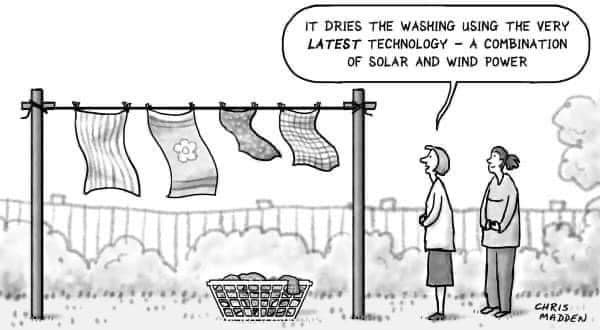
My mother was a hard-working Quaker farm girl who hung the wash outside until her final days and otherwise conserved energy in a manner that was consistent with her values – thrift, simplicity, and love of fresh air. While there are still many common sense conservationists, professional alarmists have gained control of environmental messaging and dominate fundraising. It may be time for the environmental community to reassess its direction.
On 2/11/2022 Judge Cain (Western District of Louisiana) issued ruled that a Biden executive order contradicts Congress’ intent regarding the consideration of global effects:
The Court finds that EO 13990 contradicts Congress’ intent regarding legislative rulemaking by mandating consideration of the global effects. The Court further finds that the President lacks power to promulgate fundamentally transformative legislative rules in areas of vast political, social, and economic importance, thus, the issuance of EO 13990 violates the major questions doctrine.
Judge Cain’s order seems, at least to this non-lawyer, to contradict the 1/27/2022 ruling by Judge Contreras, DC Federal Court, that BOEM “acted arbitrarily and capriciously in excluding foreign consumption from their greenhouse gas emissions calculation.” The plaintiffs had asserted that BOEM failed to consider the effect that reduced US offshore production (and higher prices) would have on foreign consumption and the associated GHG emissions. (Poverty is good?)
This interesting Time Magazine interview with Saudi Arabia’s Energy Minister includes a discussion of the Kingdom’s decision to increase production capacity by 3 million bopd. A few excerpts follow:
Abdulaziz insists Saudi Arabia can roll out multibillion-dollar solar, wind, and hydrogen projects at home, even while remaining a giant oil producer. Choosing between the two is absurd, he says, and those who predict the inevitable decline of fossil fuel use are “living in a fantasy land.”
We believe oil consumption will continue to grow. The demand for oil will continue growing. At what level, I do not know, because the jury is out. Anyone who tells you that they have a good grasp of where and when and how much is certainly living in a fantasy land. We are human, and we could prove to be wrong, but that is exactly what we believe.
Three billion people lack any meaningful energy source, any clean energy, just for cooking. These people use biomass, everything, to burn, including cutting trees. Just to get through the day, they expose themselves to all sorts of hazards, including sickness and even death. For $500 million you would be able to give energy to 750 million people, in order to cook using clean energy, using propane energy, giving them a stove.
BOEM had correctly determined that, from a GHG standpoint, US offshore production was preferable to more carbon intensive foreign production.
The plaintiffs, who are seemingly intent on stopping all oil and gas production regardless of the economic consequences, argued that BOEM failed to consider the “positive” effect that higher prices (the logical result of lower production) would have on reducing demand.
In particular, the plaintiffs asserted that BOEM failed to consider the effect that reduced production (and higher prices) would have on foreign consumption and the associated GHG emissions.
The judge not only decided in favor of the plaintiffs, but ruled that BOEM’s omission was so serious that the lease sale had to be vacated.
The judge reached this decision even though (1) the five year leasing plan expires in June leaving the timing of any future sale very much in doubt and (2) all of the sale 257 bids are now public information compromising the integrity of the leasing process at the next sale (if and when that occurs).
So, if BOEM has to consider the environmental benefits of higher oil and gas prices, shouldn’t they also have to consider the negative economic and environmental effects from the resulting price inflation and energy poverty? Are higher prices, which are most detrimental to the poor and to developing nations, “energy justice?”
If your only objective is the destruction of the US offshore oil and gas program, this was a great decision. For everyone else, this is yet another reason to be concerned about our energy future.
That’s right – a leasing plan with no leasing, a program that is about nothing.
Unfortunately for the proponents, this creative proposal would seem to have some significant legal obstacles, most notably its inconsistency with the statute and the legislative history. The idea was to have an organized approach to leasing, not to eliminate it. Per OCSLA:
The leasing program shall consist of a schedule of proposed lease sales indicating, as precisely as possible, the size, timing, and location of leasing activity which he determines will best meet national energy needs for the five-year period following its approval or reapproval.
How does zero leasing help meet national energy needs? Security? Price stability? Supply chain? Are these groups funded by OPEC+ members and nations that hate us the most? If not, they should be, because they are certainly doing their bidding.
As Daniel Yergin’s excellent Atlantic piece explained, the energy transition will take time and be enormously complex. He quoted French economist Jean Pisani-Ferry who warned that “going into overdrive on transitioning away from fossil fuels would lead to major economic shocks similar to the oil crises that rocked the global economy in the 1970s.”
Empty five year leasing programs are not an option for a diverse nation of 330+ million people that will continue to need oil and gas well into the future. We should and are adding new energy alternatives to the mix, and many of us were involved in developing the framework for these alternatives, but eliminating important sources of oil and gas at this time would be sheer folly.
By the end of 2022, Germany will have switched off its last 8.1 GW of nuclear power. Another 6.4 GW of coal capacity are scheduled for shuttering by 2023. Recent events and publications have given ammunition to those who fear a collapse of the system.
In 2018, Germany’s influential energy industry association BDEWsaid that Germany would run into a “shortfall in secured capacity by 2023 at the latest”, and that the country shouldn’t rely on its neighbors to make up the difference. Three years later and a lot closer to the nuclear phase-out, BDEW head Kerstin Andreae says: “For a secure energy supply, we also need new gas-fired power plants, as this is the only way to obtain the required controllable power.”
Germany will need back-up and supplemental power from gas plants, but the EU has excluded gas-fired energy generation from the list of sustainable investments and the associated incentives. Per Kerstin Andreae of the BDEW:
“We need to build these new power plant capacities now. Although they will initially run on natural gas, they are already capable of using hydrogen as an energy source in the future and will thus ultimately become climate neutral,” she said. But without a clear decision from the Commission „ important energy transition investments are at risk”
Meanwhile, oilprice.com reports that “UK peak-hour power prices for Monday evening through 6 p.m. surged to the highest level in a month due to low wind power generation during the weekend.” In what is becoming a familiar story:
Coal closures and no immediate replacements for nuclear power have exposed the UK’s vulnerabilities to the whims of the weather, with cold winters stoking natural gas demand and still weather lowering wind power generation.
Daniel Yergin reminded us that energy transitions take time. Countries that ignore those realities are likely to suffer the consequences, both economically and environmentally. Per Aissatou Sophie Gladima, the energy minister of Senegal:
Restricting lending for oil and gas development, she said, “is like removing the ladder and asking us to jump or fly.”
DOE provided nearly $684 million to eight coal projects, resulting in one operational facility. Three projects were withdrawn—two prior to receiving funding—and one was built and entered operations, but halted operations in 2020 due to changing economic conditions. DOE terminated funding agreements with the other four projects prior to construction.
DOE provided approximately $438 million to three projects designed to capture and store carbon from industrial facilities, two of which were constructed and entered operations. The third project was withdrawn when the facility onto which the project was to be incorporated was canceled.
So DOE’s actual success ratio was 0.182 (2 for 11) – not very compelling.
With regard to proposals for offshore carbon sequestration, who will be liable for future cost overruns, operating losses, infrastructure failures including pipeline and well leaks, and decommissioning costs? Who ensures that there will never be any leakage from CO2 disposal reservoirs? Does all of this fall on the Federal government?
Corporations that want to engage in carbon sequestration for commercial or other purposes should fund the projects with their own revenues or fees charged to the companies whose emissions they are collecting. The Outer Continental Shelf is publicly owned and those wishing to dispose of substances should pay a usage fee, be responsible for all costs, and be liable for pollution and damages.
Several actors have approached the ministry with a desire to be allocated two specific areas for storage of CO 2 . One area in the North Sea and one in the Barents Sea were therefore announced on 10 September in accordance with the storage regulations.
By the application deadline of 9 December, the ministry had received applications from five companies. The Ministry will process the received applications and allocate area in accordance with the storage regulations during the first half of 2022.
Contrast the situation in Norway with Exxon’s apparent attempt to acquire 94 Gulf of Mexico leases at Oil and Gas Lease Sale 257 solely for CCS purposes. BOEM’s Notice of Sale made no mention of CCS, and there had been no environmental or economic assessment of CCS activity.
And how much will the public pay for grand CCS ventures that (although interim measures) will take years to initiate, add new safety and environmental risks, and may never achieve their objectives? The public burden will no doubt include direct subsidies, tax credits, increased petrochemical prices, and the erosion of purchasing power associated with the resulting inflation pressures.
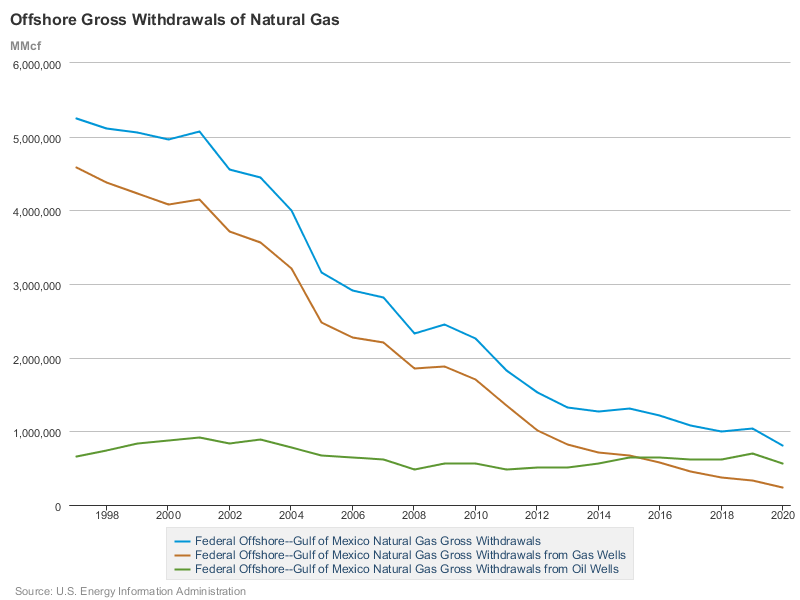
Offshore gas production (see chart below) has declined for the past 20 years and now accounts for only 4% of total US gas production, down from 20% in 2005 and 25% in the 1990s. Associated gas production (oil-well gas) has remained relatively constant owing to the strength in deepwater GoM oil production. 73% of 2020 gas production was from deepwater wells, and was mostly oil-well gas. Associated gas production surpassed nonassociated gas production (gas-well gas) in 2016 and the latter has continued to decline.
The case for natural gas has been well documented (see the EQT letter linked below). Recent natural gas advocacy has emphasized the carbon/GHG advantages given that methane (CH4) is essentially a hydrogen transporter that emits far less CO2 than other fossil fuels when burned. However, natural gas’s other important air quality advantages – low NOx. SO2, and particulate emissions – have greater local significance from a human health standpoint. Those who have ridden a bike behind a natural gas powered bus have no doubt experienced the natural gas advantage firsthand. These buses are literally a breath of fresh air!
Other environmental advantages of offshore natural gas, particularly nonassociated gas, receive less attention but are nonetheless significant. Advantages of nonassociated offshore gas include the following:
Fewer wells required than for shale gas
No risk of fresh water contamination
Platforms provide beneficial reef effects
Minimal space preemption and land disturbance relative to onshore gas production and wind/solar operations
Low facility density and navigation risks relative to wind operations;
Lower elevation and fewer view-shed, aesthetic, and aviation issues than for wind
Minimal avian risks relative to on- and offshore wind operations
Minimal spill risk relative to oil and associated gas production
Significantly less flaring than for oil well gas. While the overall % of US offshore gas production that is flared is low (approx. 1.0 -1.5% from 2016-2020 per EIA data), the % of gas-well gas that is flared has historically been less than 0.5%.
Low natural gas prices and competition from nimble and efficient shale operations have constrained offshore gas exploration. Ultradeep (subsurface) drilling has shown promise from a gas resource perspective but has proven to be expensive and operationally challenging. Some independent producers are still acquiring gas prone shelf tracts and that needs to be encouraged. Consideration should be given to incentives such as making nonassociated gas production royalty free. That would certainly seem preferable to subsidizing complex, expensive, and uncertain carbon disposal operations on offshore leases.


 Bud's Offshore Energy (BOE)