Feeds:
Posts
Comments

Archive for the ‘climate’ Category

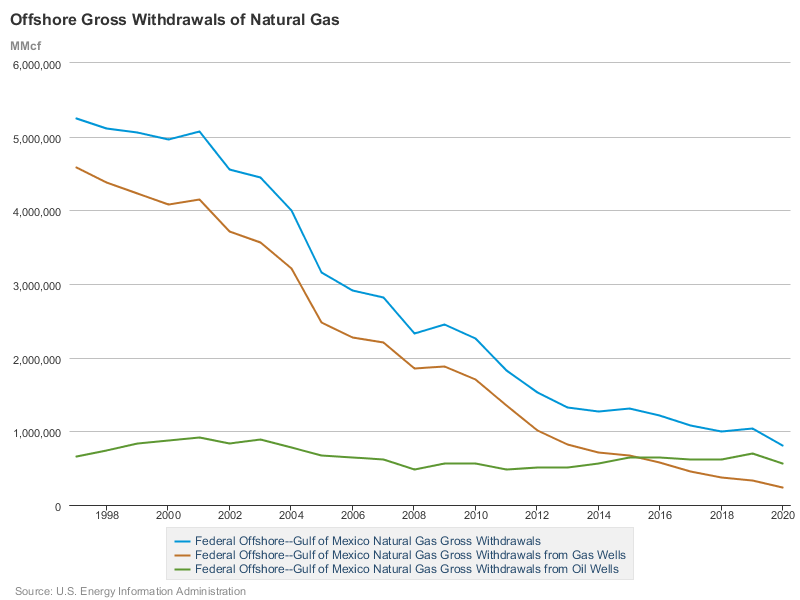
Offshore gas production (see chart below) has declined for the past 20 years and now accounts for only 4% of total US gas production, down from 20% in 2005 and 25% in the 1990s. Associated gas production (oil-well gas) has remained relatively constant owing to the strength in deepwater GoM oil production. 73% of 2020 gas production was from deepwater wells, and was mostly oil-well gas. Associated gas production surpassed nonassociated gas production (gas-well gas) in 2016 and the latter has continued to decline.

The case for natural gas has been well documented (see the EQT letter linked below). Recent natural gas advocacy has emphasized the carbon/GHG advantages given that methane (CH4) is essentially a hydrogen transporter that emits far less CO2 than other fossil fuels when burned. However, natural gas’s other important air quality advantages – low NOx. SO2, and particulate emissions – have greater local significance from a human health standpoint. Those who have ridden a bike behind a natural gas powered bus have no doubt experienced the natural gas advantage firsthand. These buses are literally a breath of fresh air!

Other environmental advantages of offshore natural gas, particularly nonassociated gas, receive less attention but are nonetheless significant. Advantages of nonassociated offshore gas include the following:

  • Fewer wells required than for shale gas
  • No risk of fresh water contamination
  • Platforms provide beneficial reef effects
  • Minimal space preemption and land disturbance relative to onshore gas production and wind/solar operations
  • Low facility density and navigation risks relative to wind operations;
  • Lower elevation and fewer view-shed, aesthetic, and aviation issues than for wind
  • Minimal avian risks relative to on- and offshore wind operations
  • Minimal spill risk relative to oil and associated gas production
  • Significantly less flaring than for oil well gas. While the overall % of US offshore gas production that is flared is low (approx. 1.0 -1.5% from 2016-2020 per EIA data), the % of gas-well gas that is flared has historically been less than 0.5%.

Low natural gas prices and competition from nimble and efficient shale operations have constrained offshore gas exploration. Ultradeep (subsurface) drilling has shown promise from a gas resource perspective but has proven to be expensive and operationally challenging. Some independent producers are still acquiring gas prone shelf tracts and that needs to be encouraged. Consideration should be given to incentives such as making nonassociated gas production royalty free. That would certainly seem preferable to subsidizing complex, expensive, and uncertain carbon disposal operations on offshore leases.

Read Full Post »

This letter from EQT CEO Toby Rice to Senator Elizabeth Warren summarizes data demonstrating the importance of shale gas in dramatically reducing US GHG emissions. A few excerpts:

In 2019, the United States emitted 970 million metric tons less than in 2005, with 525 million metric tons of that emissions reduction resulting from replacing coal with natural gas in power generation. Said another way: since 2005, in the United States, all emissions reduction efforts combined have had less impact than coal to gas switching alone.

The emissions associated with the production of natural gas are dwarfed by the emissions reduction of switching from the consumption of coal to gas.

Meanwhile, China, which produced only 3% of the world’s natural gas but the majority of the world’s coal, saw its methane emissions increase by an amount roughly equivalent to adding a second Europe to the world.

Letter from EQT to Senator Warren

Meanwhile, natural gas prices have soared to record levels in Europe and a predicted polar vortex may spike US demand. This OilPrice.com chart illustrates the remarkable divergence between US and European gas prices.

OilPrice.com

Will natural gas demand lead to a resurgence in US offshore gas-well drilling?

Read Full Post »

What, if anything, will the Judge say about the leases that are intended to be carbon sequestration sites? How can BOEM sell OCS leases for purposes that were neither announced nor environmentally assessed? What do EarthJustice and the other plaintiffs think about the sequestration bids given that the environmental community is split on CCS?

Who is going to pay the enormous cost of sequestration on the Outer Continental Shelf – platforms, wells, pipelines, processing equipment, maintenance, monitoring, decommissioning, and more? The Federal government (i.e. taxpayers) features large in this grand scheme, and will no doubt be assuming most of the economic and performance risks. And all of these costs are for disposal purposes, not for offshore energy production of any kind.

Together with the bipartisan infrastructure bill enacted in November, which included more than $12 billion in funding for carbon capture and carbon removal technologies, the Build Back Better legislation would hand fossil fuel companies nearly every item on their carbon capture wishlist.

Inside Climate News

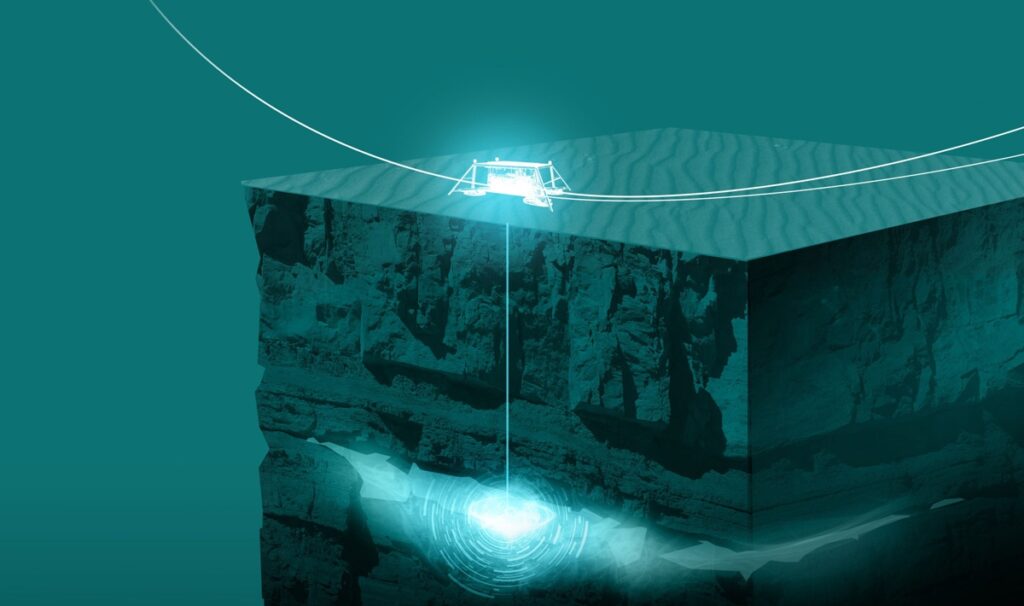
The reality of offshore CCS is not anywhere near as simple as portrayed in the slick graphic below:

houston ccs hub
ExxonMobil

Read Full Post »

More than 400 private jets carrying world leaders and business executives to Cop26 will blast 13,000 tonnes of CO2 into the atmosphere.

Matt Finch, of the Transport and Environment campaign group, said: “The average private jet, and we are not talking Air Force One, emits two tons of CO2 for every hour in flight.

It can’t be stressed enough how bad private jets are for the environment, it is the worst way to travel by miles.Our research has found that most journeys could easily be completed on scheduled flights.

“Private jets are very prestigious but it is difficult to avoid the hypocrisy of using one while claiming to be fighting climate change.

Daily Record UK

For the record, BOE does not own a private jet. Our Air Force 1 is pictured below 😃

Nike Air Force 1 Low OFF-WHITE University Gold Metallic Silver - DD1876-700

Read Full Post »

« Newer Posts