What a completely pointless exercise! £20 Billion on a Carbon Capture Storage Plan.
— Lois Perry (@LoisPerry26) March 27, 2023
I wonder which private companies and individuals are being awarded these insane contracts
I really do feel like Alice at times like these, except this is no Wonderland!
1984 more like…. pic.twitter.com/PCVTgETM1W
Archive for the ‘CCS’ Category
Government money down the rathole – literally
Posted in CCS, climate, drilling, energy policy, UK, tagged carbon sequestration, CCS, UK on March 27, 2023| Leave a Comment »
Bid rejection and lingering Lease Sale 257 mysteries
Posted in CCS, energy policy, Gulf of Mexico, Offshore Energy - General, tagged BHP, BOEM, bp, carbon sequestration, Chevron, Exxon, Lease Sale 257, Lease Sale 259, rejected bid, Talos on February 27, 2023| Leave a Comment »

BOEM published their Sale 257 Decision Matrix on Friday (2/24/2023), and my previous speculation regarding the rejected Sale 257 high bid has proven to be partially incorrect. The rejected high bid was submitted by BP and Talos and was for Green Canyon Block 777. BOEM’s analytics assigned a Mean of the Range-of-Value (MROV) of $4.4 million to that tract, which tied for the highest MROV for any tract receiving a bid. The BP/Talos bid was $1.8 million or just 40% of BOEM’s MROV. BOEM’s tract evaluation is interesting given that the other bid on this wildcat tract (by Chevron, $1.185 million) was considerably lower than the rejected BP/Talos bid.
The Sale 257 bid that I thought might have been rejected was for lease G37261. This lease was never issued per the lease inquiry data base and the final bid recap. BHP’s bid of $3.6 million for that tract (Green Canyon Block 79) was more than 5 times BOEM’s MROV of $576,000, and was accepted per the decision matrix. Why was the lease never issued?
Both Green Canyon 79 and 777 should again be for sale in legislatively mandated Sale 259, which will be held in just a few weeks on March 29, 2023, just 2 days prior to the deadline. It will be interesting to see what the bidding on those tracts looks like.
Meanwhile, Exxon and BOEM are still mum about the 94 Sale 257 oil and gas leases that Exxon acquired for carbon sequestration purposes. Note the large patches of blue just offshore Texas on the map above. These leases were all valued by BOEM at only $144,000 each, which is equivalent to the minimum bid of $25/acre. This valuation reflects the absence of perceived value for oil and gas production purposes. Exxon bid $158,400 for each tract, $27.50/acre or 10% higher than the minimum bid. Given that (1) the Notice of Sale only provided for lease acquisition for oil and gas exploration and production purposes, and (2) it was common knowledge that these tracts were acquired for carbon sequestration, should these bids have been rejected?
Which Sale 257 bid was rejected?
Posted in CCS, Gulf of Mexico, Offshore Energy - General, tagged BHP, CCS, Gulf of Mexico, Lease Sale 257, rejected bid on November 21, 2022| Leave a Comment »
On September 14, 2022, BOEM announced that 307 high bids from Lease Sale 257 in the Gulf of Mexico were accepted. BOEM also announced that one high bid was rejected for not providing the public with fair market value. BOEM has not identified the rejected bid.
Per BOEM’s Lease Area Block Online Query file, 306 Sale 257 leases were effective on Oct. 1, 2022. A comparison of these data with the sale results identified 2 Sale 257 leases that have not been awarded:
| lease | block | high bidder(s) | bid | comments |
| G37261 | GC 70 | BHP | $3.6 million | lone bid; 7th highest bid in sale |
| G37294 | GC 777 | BP (75%), Talos (25%) | $1.8 million | 2 bids; next highest $1.185 million |
So one of these 2 bids was rejected and the other has lease not yet been awarded for some reason (or perhaps there has been a clerical/IT issue).
Which bid was rejected? I would guess it was the BHP bid even though that bid was the 7th highest bid in the entire sale. The fact that this bid was $2.5 to $3 million higher than the other 7 BHP bids (all of which were accepted) tells us that the company valued this tract highly. Perhaps BOEM, which has all of the geologic data, thought the value was even higher, which is why the bid may have been rejected.
There was another bidder (Chevron) for the BP/Talos tract, so the competition makes it less likely that the bid would have been rejected.
Ironically, the 94 carbon sequestration bids, which made something of a mockery of the lease sale, could not be rejected on fair market grounds. The bids exceeded the minimum required, and the tracts have little or no value from an oil and gas production standpoint. A competitive process would be require to repurpose these leases for carbon sequestration.
“Deep Geothermal Is Closer Than You Think”
Posted in CCS, climate, energy, tagged gyrotron, Quaise Energy, renewable energy, ultradeep geothermal on November 17, 2022| Leave a Comment »
Update on the most promising renewable energy alternative:
Quaise has received a grant from the Department of Energy to scale up Woskov’s experiments using a larger gyrotron. With the larger machine, the team hopes to vaporize a hole 10 times the depth of Woskov’s lab experiments by the end of this year. After that, the team will vaporize a hole 10 times the depth of the previous one — what co-founder Matt Houde calls a 100-to-1 hole.
“That’s something [the DOE] is particularly interested in, because they want to address the challenges posed by material removal over those greater lengths — in other words, can we show we’re fully flushing out the rock vapors?” Houde explains. “We believe the 100-to-1 test also gives us the confidence to go out and mobilize a prototype gyrotron drilling rig in the field for the first field demonstrations.”
Rather than getting deep in the weeds of carbon capture, imagine powering those existing facilities with steam generated without carbon emissions at all.
The key is that ultradeep geothermal has the power density and scalability of fossil fuels.
What’s next for Exxon’s sequestration leases?
Posted in CCS, Gulf of Mexico, tagged BOEM, carbon sequestration, Exxon, Sale 257 on October 25, 2022| Leave a Comment »

Per BOEM’s leasing data base, all 94 of the Sale 257 “carbon sequestration leases” (blue) were issued with an effective date of 10/1/2022. However, Sale 257 was an oil and gas sale, and the leases do not convey carbon sequestration rights. Each lease will expire in 5 years absent oil and gas production or ongoing drilling operations.
These oil and gas leases may not be repurposed for sequestration or other purposes unless an alternate use RUE is issued competitively in accordance with 30 CFR § 585.1007.
So what’s next for these 94 leases, 31% of the entire sale?
Action by DOI on Lease Sale 257 required in 15 days
Posted in CCS, climate, energy policy, Gulf of Mexico, Offshore Energy - General, tagged CCS, fair market value, Inflation Reduction Act, Lease Sale 257 on August 31, 2022| Leave a Comment »
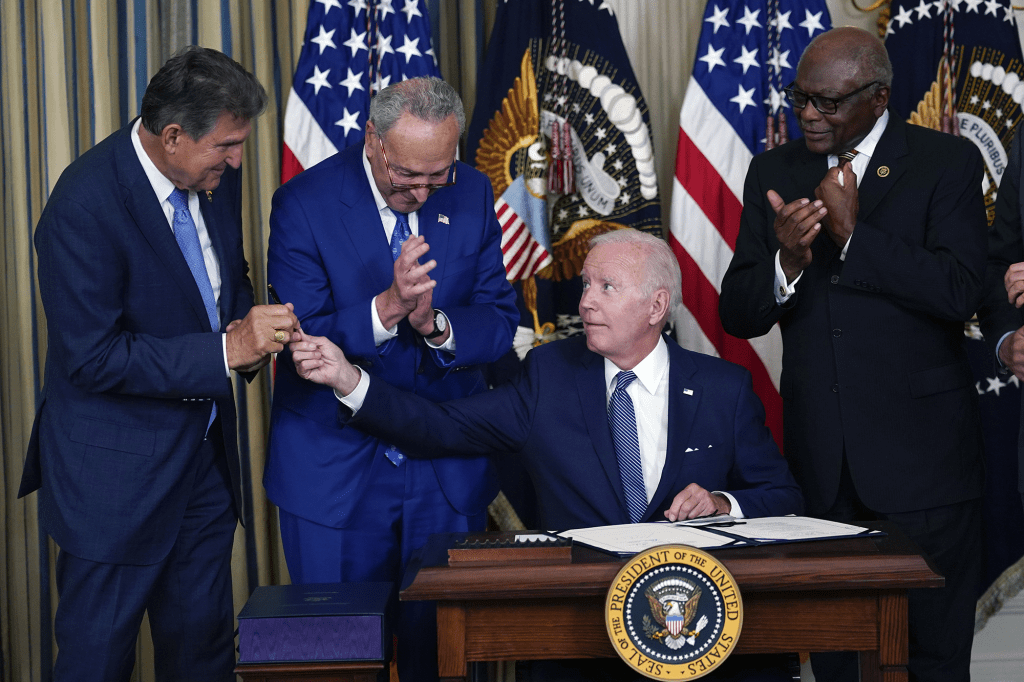
Per legislation signed by the President on Aug. 16, 2022:
(b) LEASE SALE 257 REINSTATEMENT.—
(1) ACCEPTANCE OF BIDS.—Not later 30 days after the date of enactment of this Act, the Secretary shall, without modification or delay—
(A) accept the highest valid bid for each tract or bidding unit of Lease Sale 257 for which a valid bid was received on November 17, 2021; and
(B) provide the appropriate lease form to the winning bidder to execute and return.
The Department of the Interior has been silent on their implementation of this provision. We are particularly interested in:
Is the Sale 257 victory dance premature?
Posted in CCS, energy policy, Gulf of Mexico, Offshore Energy - General, tagged BOEM, CCS, DOI, Inflation Reduction Act, Lease Sale 257 on August 22, 2022| 1 Comment »

Contrary to some media reports and industry comments, the Inflation Reduction Act does NOT require the Department of the Interior (DOI) to award leases to the high bidder on each Sale 257 tract. The legislation requires DOI to accept the highest valid bid for each tract.
As BOE has previously explained, the 94 carbon sequestration bids were clearly not valid, and leases should not be awarded. These bids accounted for 30.5% of the entire sale in terms of the number of tracts receiving bids. (More on the CCS bids.)
There is also the matter of fair market value. Only 9 of the 214 (non-CCS) tracts received more than one bid and none received more than 2 bids. DOI/BOEM may determine that some of the bids did not pass the fair market value test. Are such bids “valid” under the terms of the IRA legislation? Note that 7 of the 93 high bids submitted at the previous sale (Lease Sale 256, November 2020) were rejected on fair market value grounds. All 7 were single bid tracts.
Lastly, there is the unresolved matter of the decision by Judge Contreras to vacate Sale 257. While the legislation seems to clearly supersede that decision, who knows what might happen next on the litigation front.
Still waiting for…
Posted in accidents, CCS, decommissioning, Offshore Energy - General, pipelines, Regulation, tagged aban pearl, BSEE, CCS, flaring, Hogan and Houchin, Huntington Beach, incident data, offshore pipelines, Russell Peterson, Trinity Spirit, USCG on August 11, 2022| Leave a Comment »
- 2021 (entire year) and 2022 (first half) BSEE incident tables. If safety is the highest priority, these data should be updated quarterly.
- IRF 2021 safety performance data
- An international treaty (accompanied by a standard) on disclosing major offshore accidents and the collection and release of incident data. (Also, see this related post.)
- Hogan and Houchin decommissioning update, most notably the financial responsibility aspects
- Huntington Beach pipeline spill report
- Workable California decommissioning legislation
- ONRR flaring and venting data (update: ONRR advises that they anticipate publication of these data in September.)
- DOI statement on the Sale 257 carbon sequestration bids
- Definitive casualty information and report on the 2-2-2022 Trinity Spirit FPSO fire
- Updated DOI-DOT offshore pipeline regulations
- Coast Guard report on the May 2008 Russell Peterson liftboat tragedy
- Updated US Coast Guard Subchapter N regulations
- Information on the mysterious sinking of the Aban Pearl semi-submersible in May 2010.
Alarmist leasing rhetoric resurfaces as Sale 257 nears reinstatement
Posted in CCS, energy policy, Gulf of Mexico, Offshore Energy - General, tagged Lease Sale 257, Manchin, Schumer on August 7, 2022| 1 Comment »
Tucked into the end of the nearly $370 billion deal struck last week by Senate Majority Leader Chuck Schumer (D-N.Y.) and Senate Energy and Natural Resources Chair Joe Manchin (D-W.Va.) is a requirement for the Interior Department to reinstate a massive 80 million-acre Gulf of Mexico lease sale that a federal judge blocked earlier this year for violating NEPA.
E&E News
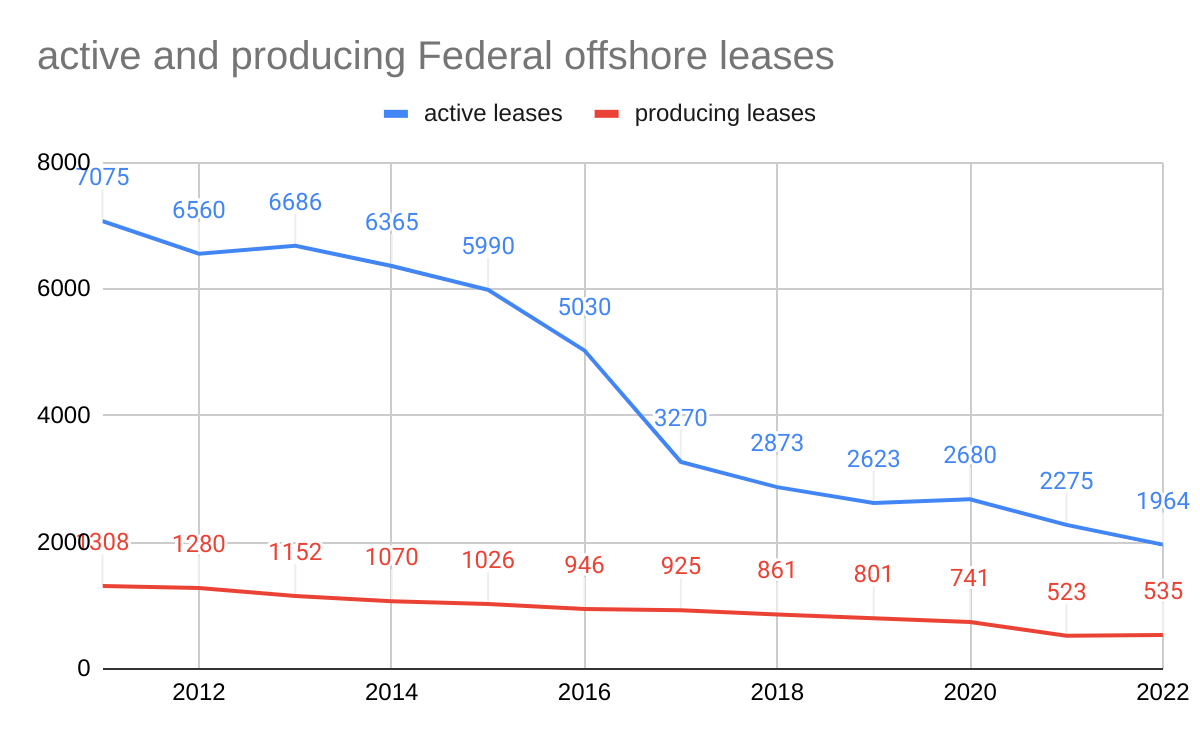
Tracts covering 1.7 million acres received bids at Lease Sale 257. 30.5% of those tracts received bids for CCS purposes, leaving about 1.2 million acres receiving bids for oil and gas exploration. Nonetheless, some continue to distort the magnitude of this rather ordinary lease sale. It’s also important to note that the number of active US offshore leases has declined by 72% since 2011, and is now under 2000 for the first time in decades.