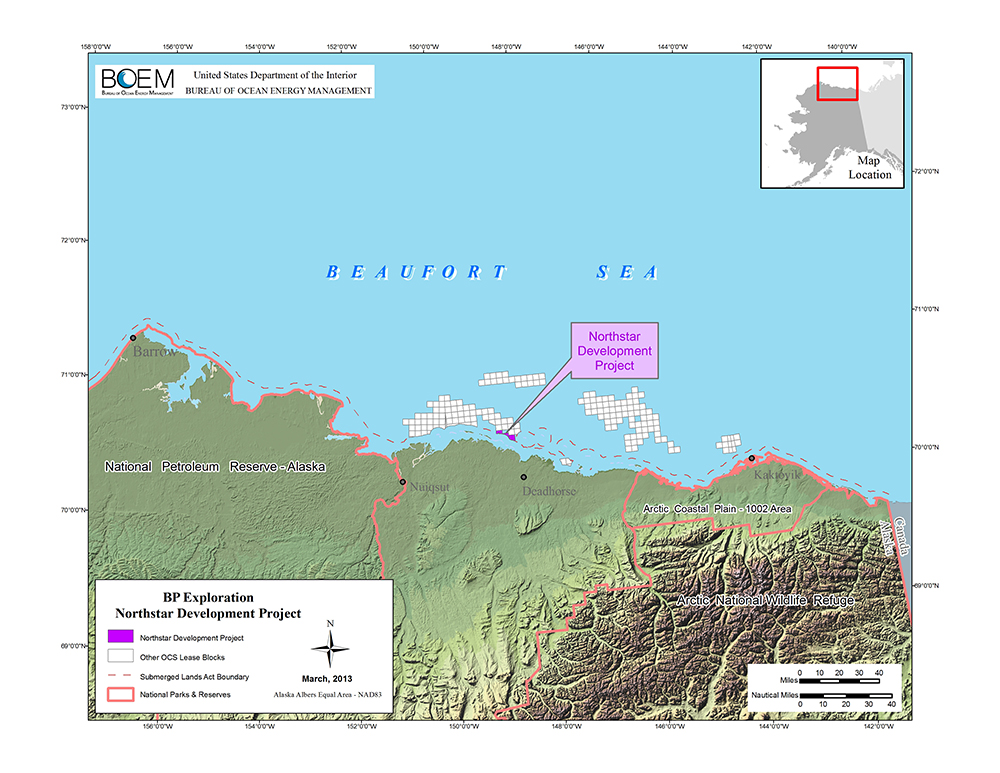
The only current Alaskan OCS production is from Northstar, a joint State-Federal Unit in the Beaufort Sea. The production island is in State waters, but 7 of the wells produce from the Federal sector. The field was originally developed by bp, but Hilcorp is the current operator. To date, BSEE has conducted 5 inspections of the facility in 2022, and no incidents of noncompliance (INCs) were identified.
Per BOEM records, 4 companies operate Pacific (California) OCS facilities that are currently producing. Three of those operators have superior 2022 inspection records. No INCs were issued to either Exxon (11 Santa Ynez Unit inspections) or Freeport-McMoRan (24 Platform Irene inspections). Only 2 warning INCs were issued during 12 inspections of Beta Operating Co. platforms Ellen, Elly, and Eureka in the Beta Unit offshore Long Beach.
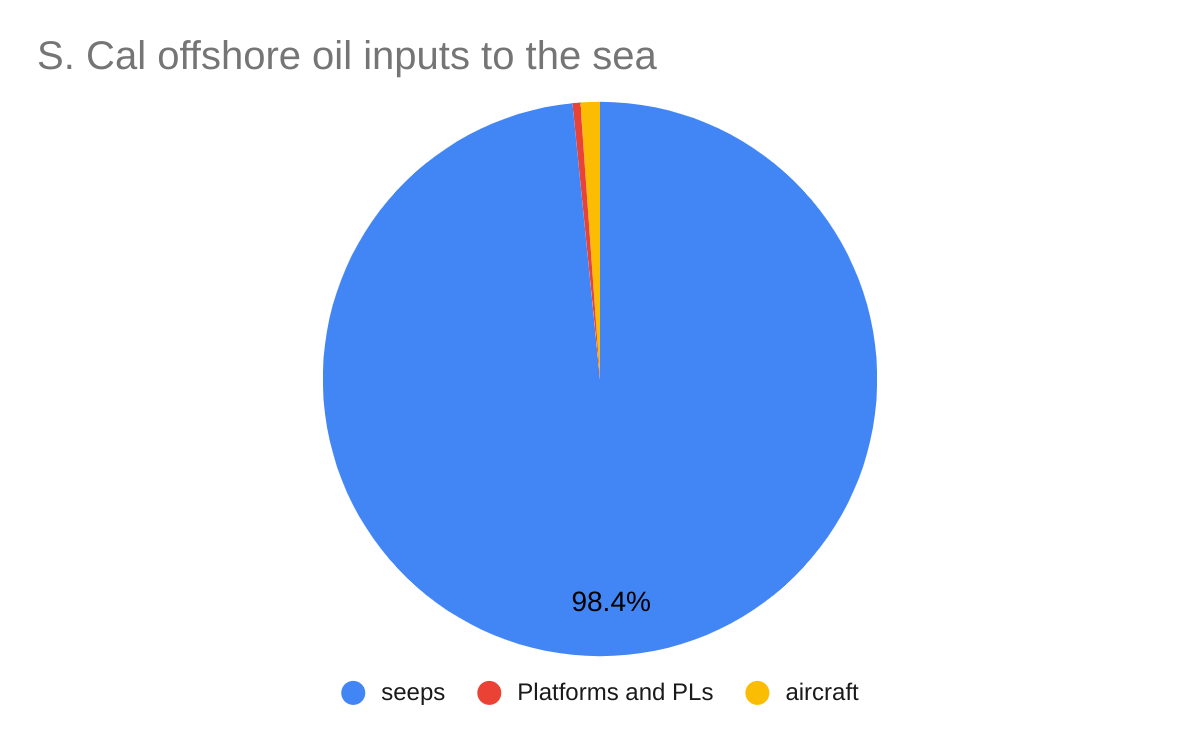
One of our very savvy BOE readers shared data (attached) from Oil in the Sea III, a National Academies report that is the best source of information on oil inputs into US waters. The data for Southern California are presented below in 3 charts. The first chart shows that natural seeps are overwhelmingly the leading offshore source of oil entering SoCal waters, with offshore platforms and pipelines accounting for <0.5% of the oil.
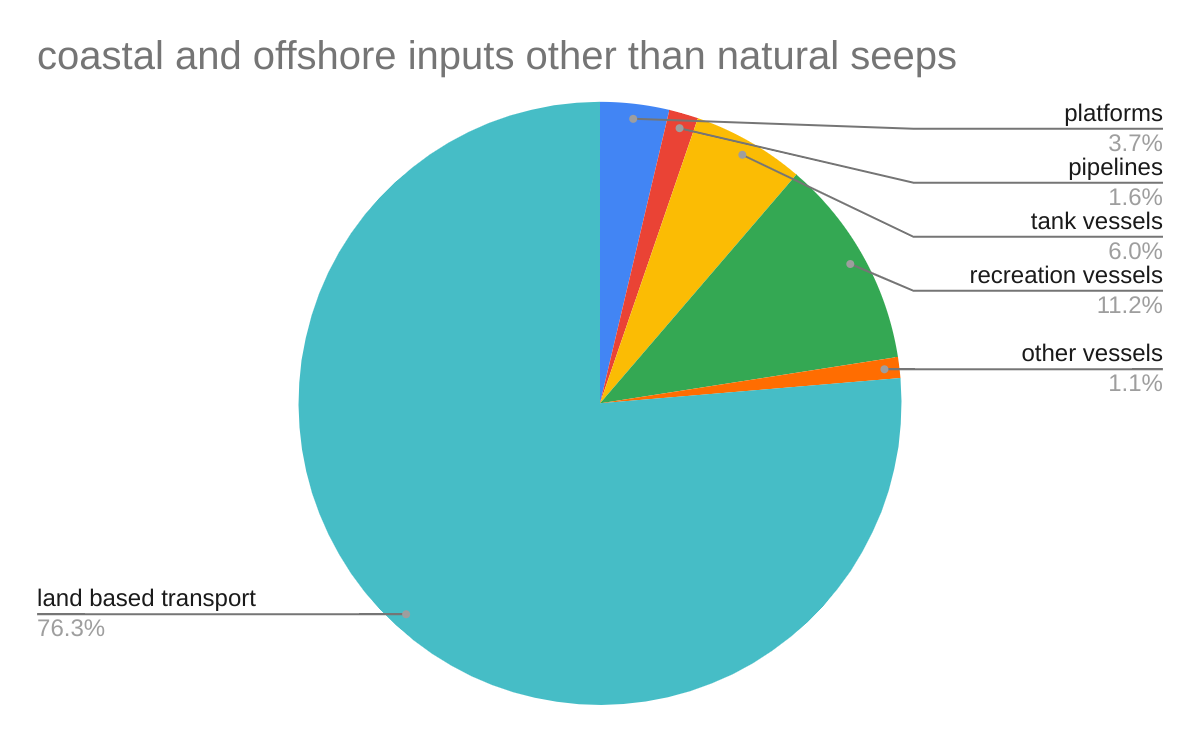
The second and third charts exclude natural seepage and compare the coastal and offshore oil inputs from the other sources. When land based transportation inputs are included (chart 2), platforms and pipelines (combined) account for 5.3% of the oil.
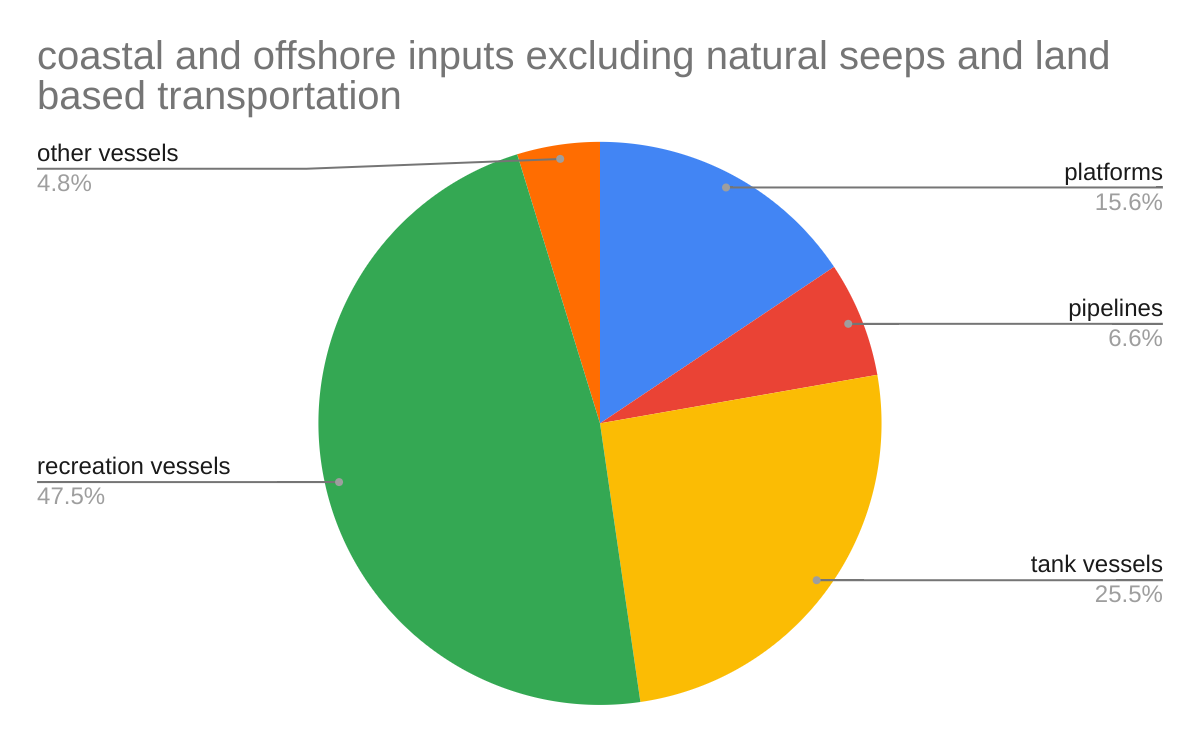
Excluding natural seepage and land based transportation inputs (chart 3), recreation vessels are by far the leading source of oil (47.5%), with platforms and pipelines (combined) accounting for less than half that volume (22.2%).
These data add important perspective, but are not intended to discount platform and pipeline spills. These spills can have significant localized impacts, and every effort must be made to prevent their occurrence.
“While attending USC, Jim met his future wife and love of his life, Sarah Ann Mason, a fellow geology student. It was crystal clear from the moment he met her in the Mineralogy lab, Sarah was a gem and despite all his faults he wouldn’t take her for granite.“
After high school, Jim worked as a cook on the Glomar Challenger scientific drilling vessel, which no doubt inspired him to study geology. As part of the Deep Sea Drilling Program, the Challenger recovered cores that provided conclusive evidence of plate tectonics, which until that time was just a theory. From 1968 to 1983, the Challenger recovered over 19,000 cores in water depths up to 7044 m!
Jim became a leading expert on oil and gas resources offshore California, which were once (and still should be) considered nationally important. Much respect for his many contributions to our understanding of Pacific geology!
There have been 24 well stimulation treatments (21 of which involved hydraulic fracturing) on the OCS offshore California between 1982 and 2014, and these were conducted on four of the 23 platforms. Reservoirs on the OCS off Southern California tend to be much more permeable than onshore reservoirs, and are already highly naturally fractured. Therefore, little permeability enhancement has been required for their development. As described in the scenario evaluated in the EA, the future use of Well Stimulation Treatments is expected to continue to be occasional rather than essential to hydrocarbon production from these platforms.
Offshore California, the best that most facility operators and their predecessors (to the extent they continue to hold decommissioning liabilities) can hope for is a graceful exit with manageable financial losses. (The situation is a bit different for Exxon’s Santa Ynez Unit, which has been shut-in since 2015 while the company seeks to resolve oil transportation issues resulting from an onshore pipeline rupture. Here is the latest episode of that amazing saga.)
California’s Federal offshore, where 9 mobile drilling units (MODUs) were operating concurrently in the early 1980s, hasn’t seen a MODU in over 30 years. However, 23 production platforms, some of which are massive structures, remain (see the presentation below). At this point, these platforms are expensive monuments given that their combined production (per EIA) is only 7000 BOPD.
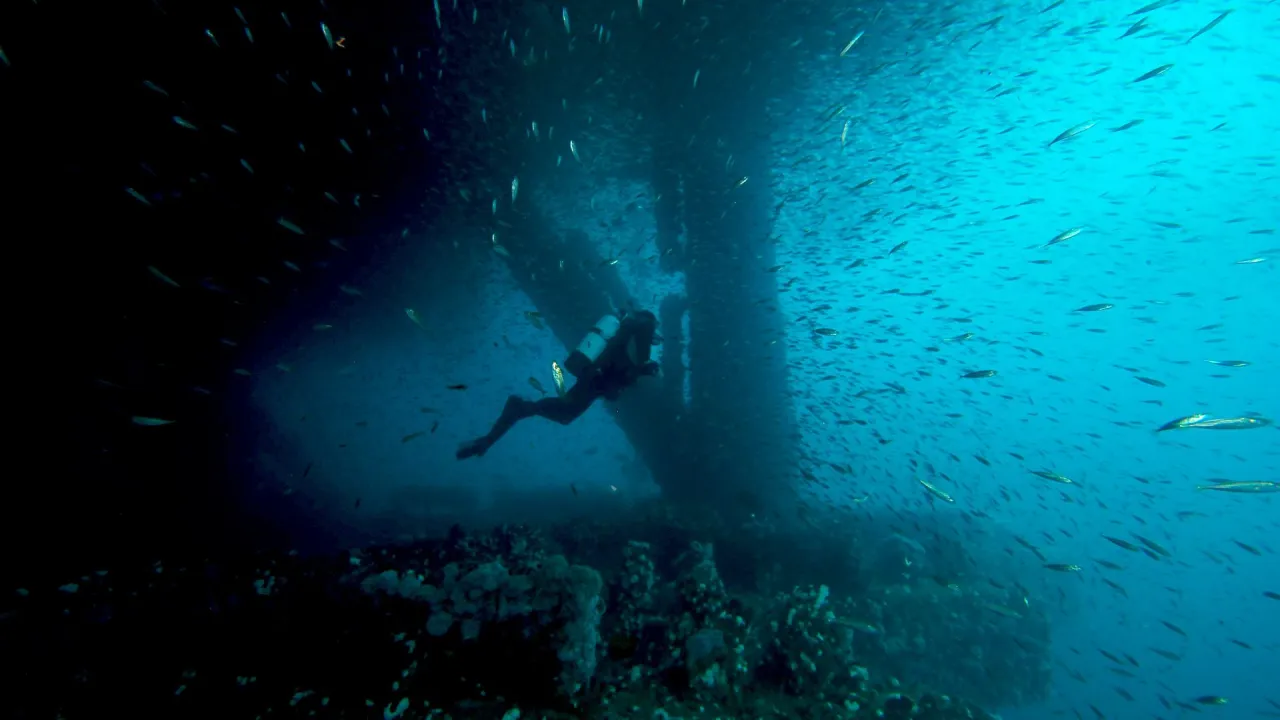
Regardless of their production status, the California offshore platforms continue to be ecologically significant. Dr. Jerry Schubel is among the many marine scientists who understand the importance of the life that has grown on and around these structures. The scientific community also sees other research, educational, and recreational uses for these platforms as per our Rigs-to-Reefs +++ page.
To their credit, State and Federal agencies, trade organizations, and interested third parties continue to discuss the issues and consider alternatives. A recent workshop was helpful in that regard. Attached is the excellent presentation by Bob Byrd and John Smith, who have been at the vanguard in addressing California decommissioning issues. Embedded below is the YouTube video of the presentations from their session. These are excellent updates for those who have an interest in decommissioning issues.
Not really, but current economic and energy security realities doomed a bill to prohibit drilling and production in State waters. Strong quotes from bill opponents:
“SB 953 was held because it didn’t work — it was going to cost the state billions of dollars for a symbolic victory,” Andrew Meredith, president of the State Building and Construction Trades Council of California, said in a statement. “The California Senate is rightfully more concerned with actually improving the plight of workers and our environment than chasing headlines.”
“I think most legislators understand that every barrel of oil we don’t produce here under our strict environmental rules must be imported by foreign tankers floating offshore in our crowded ports from Iraq, Saudi Arabia, or the Ecuadorian rainforest,” California Independent Petroleum Association CEO Rock Zierman said in a text message.
Excerpts from a good OC Register article on the ecological significance of the 27 platforms in State and Federal waters offshore California:
“All the (California) platforms having booming ecosystems underwater,” marine scientist Amber Sparks said at an Aquarium of the Pacific lecture in Long Beach on Wednesday, March 2.
“There’s a lot of real estate; a lot of nooks and crannies for marine life,” she said. “Scientists at the National Academy for the Sciences have found California’s platforms are some of the most productive marine habitat in the world.”
The Gulf of Mexico is the poster child for rigs-to-reefs, with more than 500 decommissioned oil platforms turned into full-time artificial reefs over the past 30 years. It’s bold testament to the habitat potential of the rigs, transforming the relatively sterile, sandy bottom ecosystem there into one with hundreds of prime locations for marine life.
A federal investigation into the October oil spill that paved the Orange County coast has been stalled for several months as authorities await approval to cut, remove and analyze part of the ruptured pipeline.
Coast Guard and National Transportation Safety Board investigators currently have to rely on video captured during underwater pipeline inspections. Without a more detailed forensic examination of the damage in a lab, investigators won’t know whether to continue with their original investigation or move the investigation in a new direction.
It’s not good when bureaucratic processes stall an important investigation. Hopefully the responsible agencies will be sufficiently embarrassed to get the investigation moving.
On January 28, 1969, well A-21, the 5th well to be drilled from Union Oil Company’s “A” platform began flowing uncontrollably through fractures into the Santa Barbara Channel.
The absence of any well casing to protect the permeable, fractured cap rock meant that the operator couldn’t safely shut-in a sudden influx of hydrocarbons into the well bore (i.e. a “kick”). Shutting-in the well at the surface would create well bore fractures through which oil and gas could migrate to shallow strata and the sea floor. The probability of an oil blowout was thus essentially the same as the probability of a kick (>10-2). Compare this with the historical US offshore oil blowout probability (<10-4) and the probability of <10-5 for wells with optimal barrier management.
Here, in brief, is the well A-21 story:
Well drilled to total depth of 3203′ below the ocean floor (BOF).
13 3/8″ casing had been set at 238′ BOF. The well was unprotected from the base of this casing string to total depth.
Evidence of natural seeps near the site suggested the presence of fracture channels
The well was drilled through permeable cap rock and a small high pressured gas reservoir before penetrating the target oil sands.
When the well reached total depth, the crew started pulling drill pipe out of hole to in preparation for well logging.
The first 5 stands of drill pipe pulled tight; the next 3 pulled free suggesting the swabbing of fluids into the well bore..
The well started flowing through the drill pipe. The crew attempted to stab an inside preventer into the drill pipe, but the well was blowing too hard. The crew then attempted unsuccessfully to stab the kelly into the drill pipe and halt the flow.
The crew dropped the drill pipe into the well bore and closed the blind ram to shut-in the well.
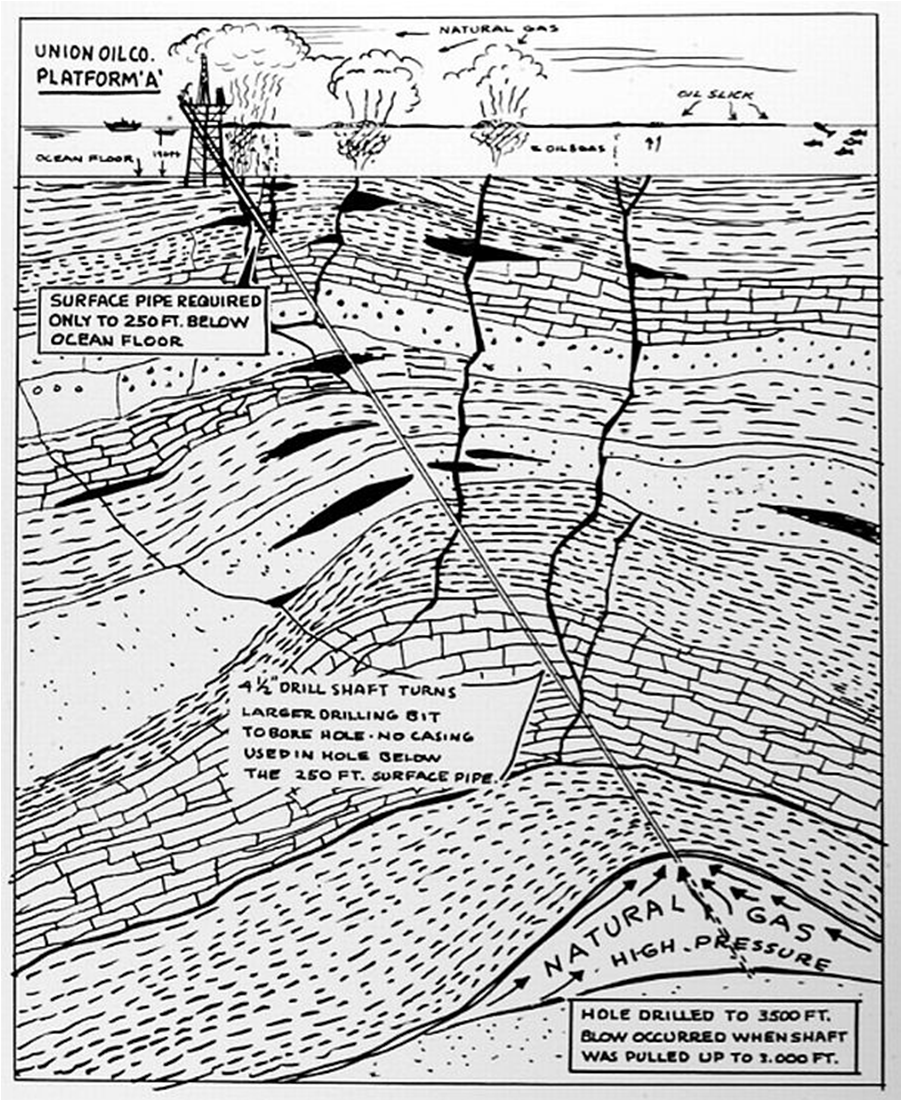
Boils of gas began to appear on the water surface. Oil flowed to the surface through numerous fracture channels. The sketch below by a former colleague depicts the fracturing, which greatly complicated mitigation of the flow.
We need to continue studying these historically important incidents, not just the technical details but also the human and organizational factors that allowed such safety and environmental disasters to occur. The idea is not to shame, but to remember and better understand.