Feeds:
Posts
Comments

Archive for the ‘California’ Category

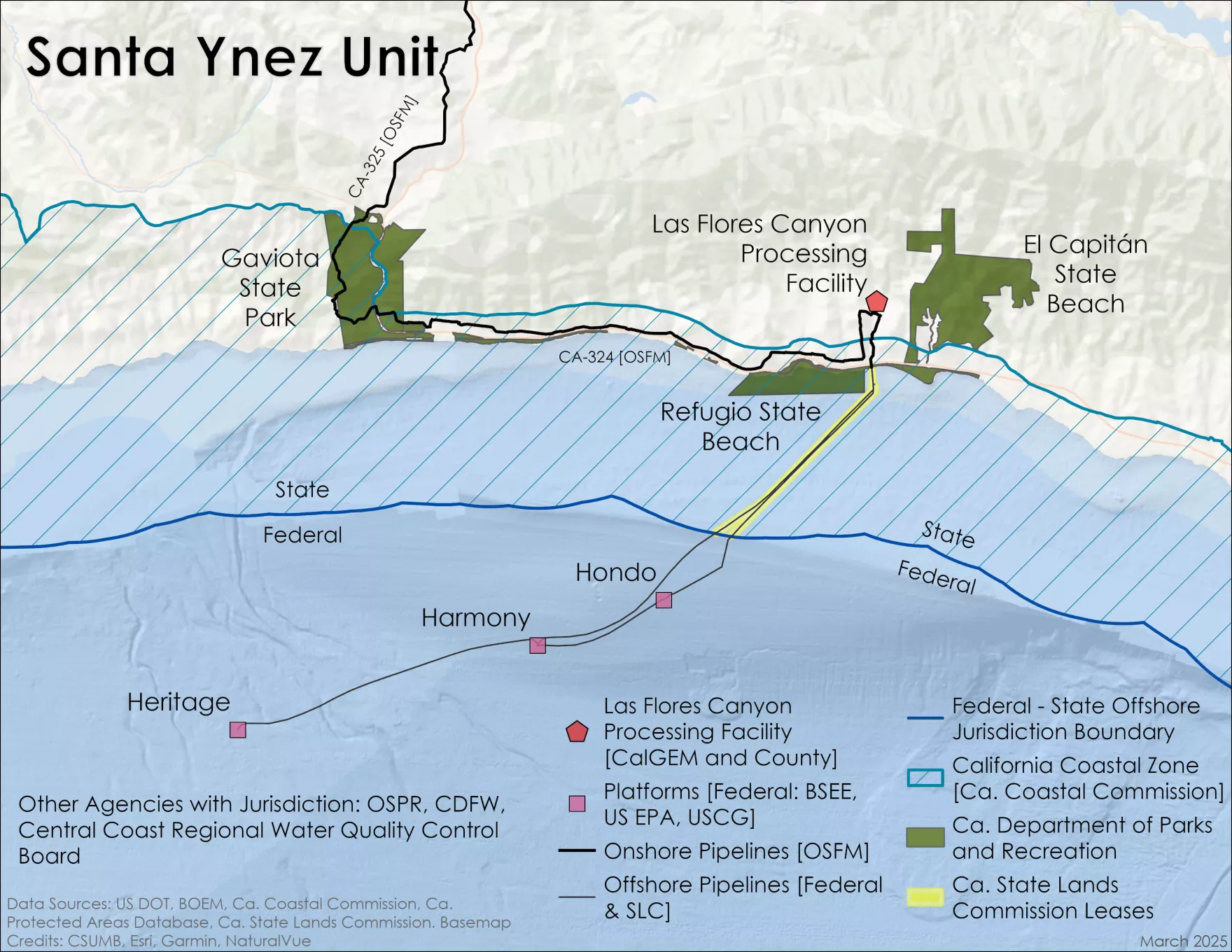
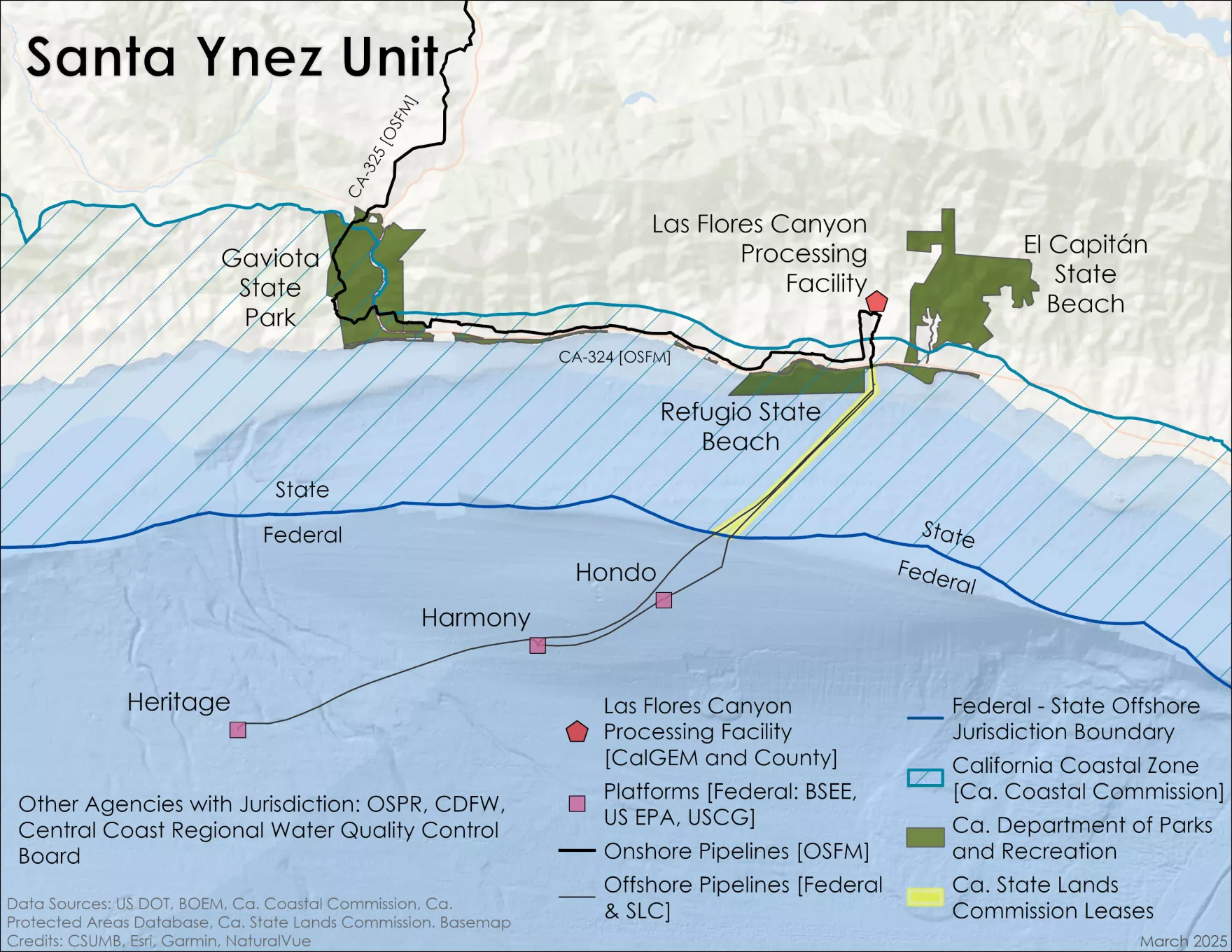
The anticipated State-Federal jurisdictional battle over Sable’s Las Flores Canyon Pipeline is on! See the attached letter from the Pipeline and Hazardous Materials Safety Administration (PHMSA) declaring that the pipeline is under Federal jurisdiction.

The major hurdle for PHMSA/Sable is the court approved Consent Decree that was executed following the 2015 Refugio pipeline spill. The Decree, which designates the California Fire Marshal as the sole regulator for the pipeline, is not mentioned in the PHMSA letter. Needless to say, another major legal battle looms.

Excerpt from the PHMSA letter:

PHMSA’s evaluation of the Las Flores Pipeline confirms that it transports crude oil from the OCS to an onshore processing facility at Las Flores Canyon and continues the transportation of crude oil from Las Flores Canyon to Pentland, California. Consistent with Appendix A, the Las Flores Pipeline is an interstate pipeline. As portions of the Las Flores Pipeline were previously considered to be intrastate and regulated by OSFM, PHMSA is notifying OSFM that the Las Flores Pipeline is subject to the regulatory oversight of PHMSA.

Read Full Post »

The vote on the transfer of Santa Ynez Unit (SYU), Pacific Offshore Pipeline Company (POPCO) Gas Plant, and Las Flores Pipeline System permits from Exxon to Sable Offshore was the last item on the Board’s agenda, so those of us who were streaming the meeting for that topic had to be patient.

The Sable session began with a surprise announcement that opened the possibility that perhaps the outcome might not be as expected. Supervisor Hartmann, who owns property close to the pipeline, had once recused herself from voting on this matter. When it was thought that her property was ~900′ from the pipeline, the Fair Political Practice Commission (FPPC) cleared her participation. However, after a 12/3/2025 letter from Sable informed that her property was as close as 8′ from the pipeline, the FPPC reversed its position and Supervisor Hartmann again recused herself.

Supervisor Hartmann’s re-recusal added some drama to the session given that there were two sure votes against Sable and one sure vote in favor. The swing vote would be that of Supervisor Lavagnino, who was very much supportive of the oil industry, but not Sable.

After strong but predictable presentations by the Environmental Defense Center/Center for Biological Diversity team and Sable, the floor was open to public comments. Although there were more speakers opposed to the Sable position (13), this observer found the Sable supporters (7) to be more compelling. Most were California natives who worked on the project and demonstrated a sincere commitment to the safety and environmental values that we all support. One aptly noted that California unnecessarily imports 2/3 of its oil from foreign sources, some of which aren’t particularly friendly.

As an aside, a County staffer pointed out that 400,000 barrels of SYU oil were in storage as a result of the resumption of production in May prior to receiving the necessary approvals to transport oil through the onshore pipeline.

The vote opened with Supervisor Nelson supporting the transfer of permits to Sable. His commented that the County was “attacking Sable’s finances at the same time they were trying to bankrupt them.”

Sable opponents held serve with Supervisors Capps and Lee opposing the transfer. Ms. Capps deserves credit for the sincere respect she showed for the Sable workers who were present.

So Supervisor Lavagnino would cast the deciding vote. He once again voted against the transfer noting that he was a long time supporter of the oil industry, but that he had lost confidence in Sable.

Bottom line: The outcome was as expected, but the recusal drama and strong presentations made the stream worth watching.

Read Full Post »

Sable Offshore is attempting to restart the same pipeline that caused the Refugio Oil Spill in 2015. | Credit: Paul Wellman File Photo

Sable Offshore oil believes the federal Pipeline and Hazardous Materials Safety Administration (PHMSA) , not the California Fire Marshal, should have jurisdiction over the company’s onshore pipeline.

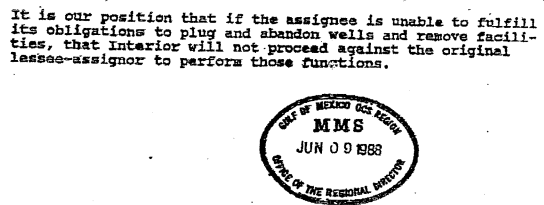
I once had the same opinion as Sable. Their pipeline is, by definition, an interstate line because it carries OCS production. Then I read Appendix D of the court approved Consent Decree that was executed following the 2015 Refugio pipeline spill. That Decree is quite clear regarding regulatory jurisdiction, and would have to be overturned to transfer authority to PHMSA.

The full Consent Decree is attached. Pasted below is an excerpt from Appendix D:

Read Full Post »

Kayla Bartkowski/Los Angeles Times/Getty Images

WSJ article on Sable Offshore:

“Oil giants have fled California, but James Flores is desperate to get in, even if it means crossing swords with the state.”

Read Full Post »

The press release and full program are linked. It looks like the most recent leaks were accurate. See the maps below with the locations and dates. This will stir the pot!

Read Full Post »

The pipeline spill just north of Refugio State Beach on May 19, 2015, coated miles of shoreline and marine habitat, and dolphins, elephant seals, sea lions, pelicans and other birds. | Santa Barbara Independent

We can scream all we want (with some justification) about the California Coastal Commission, Santa Barbara County, and intractable environmental organizations, but the Santa Ynez Unit would still be producing today were it not for an ugly, preventable pipeline spill.

What happened:

At approximately 10:55 a.m. Pacific Daylight Time (PDT) on May 19, 2015, the Plains Pipeline, LP (Plains), Line 901 pipeline in Santa Barbara County, CA, ruptured, resulting in the release of approximately 2,934 barrels (bbl) of heavy crude oil. An estimated 500 bbl of crude oil entered the Pacific Ocean.

Why it happened:

1) Ineffective protection against external corrosion of the pipeline
 The condition of the pipeline’s coating and insulation system fostered an environment that led to the external corrosion.
 The pipeline’s cathodic protection (CP) system was not effective in preventing corrosion from occurring beneath the pipeline’s coating/insulation system.
2) Failure by Plains to detect and mitigate the corrosion
 The in-line inspection (ILI) tool and subsequent analysis of ILI data did not characterize the extent and depth of the external corrosion accurately.
3) Lack of timely detection of and response to the rupture
 The pipeline supervisory control and data acquisition (SCADA) system did not have safety-related alarms established at values sufficient to alert the control room staff to the release at this location.
 Control room staff did not detect the abnormal conditions in regards to the release as they occurred. This resulted in a delayed shutdown of the pipeline.
 The pipeline controller restarted the Line 901 pipeline after the release occurred.
 The pipeline’s leak detection system lacked instrumentation and associated calculations to monitor line pack (the total volume of liquid present in a pipeline section) along all portions of the pipeline when it was operating or shut down.
 Control room staff training lacked formalized and succinct requirements, including emergency shutdown and leak detection system functions such as alarms.

Plains Pipeline was the responsible party, but that doesn’t absolve the companies that were dependent on Plains to transport their production. Given the organized opposition that emerged following the Santa Barbara blowout in 1969 (the result of a reckless well plan), the integrity of that pipeline was critical to their business strategy and they should have exercised some oversight.

Offshore disasters have had enormous consequences for the oil and gas industry in terms of lost opportunities. Think about this: prior to the Macondo blowout, the Obama administration had proposed an oil and gas lease sale in the Atlantic and the Florida Senate was holding hearings about leasing in Florida State waters. Such lease sales are now completely out of the question.

Regulations and standards are not enough. We need open discussion about incidents, large and small, and a willingness to be critical of the responsible parties.

Read Full Post »

Excerpts from a stunning Sable update issued by Hunterbrook Media LLC (“Hunterbrook“) on November 14, 2025:

  • SEC filing reveals Sable entered October about a month from potential bankruptcy. The company had $41.6 million as of September 30, with $39.7 million in average monthly burn in 3Q25.  
  • When Sable announced its $250 million financing on November 10 at $5.50 per share, the company likely had single digit millions in the bank based on its reported burn, against over $163 million in accounts payable and accrued liabilities. Sable does not generate any revenue.
  • Sable needs to raise significantly more money: According to leaked audio of Sable’s CEO briefing for select investors, the company will require $2.3 billion to achieve commercial production of oil and gas from its three platforms off the coast of Santa Barbara.
  • That includes at least $900 million to buy out Exxon, to which Sable must pay 15% interest on debt due by March 31, 2027. By then, the loan would be about $1.1 billion, accruing $200 million in added debt.
  • One of Sable’s only known assets other than the oil and gas project is a private plane the company purchased from its CEO, Jim Flores. The plane recently flew round-trip from Houston, where Flores lives, to Louisiana, in time for a football game at the CEO’s alma mater.

Comments from Santa Barbara County Supervisor Steve Lavagnino, an oil industry supporter, that explain his opposition to the transfer of Exxon’s pipeline permit to Sable:

“The final straw for me was a Hunterbrook article, which was as disturbing as anything I’ve read. I have many friends in the oil industry and I will continue to support efforts to access our natural resources, but it has to be done responsibly by operators who put safety above profits.”

Sable’s limited response to the Hunterbrook report includes information on decommissioning financial assurance:

  • Sable’s original SYU Purchase and Sales Agreement (PSA) with Exxon required Sable to post a $350 million decommissioning bond “150 days following the resumption of production from the wells.”
  • According to Sable, production resumed on May 15, 2025. The bond would have thus been required in October. (SYU production was halted by court order on June 6, so that “resumption date” may be irrelevant. Regardless, the Oct. financial assurance deadline is immaterial given the recent update to the PSA.)
  • The PSA update extended the date for posting the decommissioning bond to three business days following the new Exxon Loan Maturity Date of March 31, 2027 or 90 days after first sales of hydrocarbons, whichever comes first. (Note the change in language from “resumption of production” to “first sales.” Brief well test production does not trigger posting of the decommissioning bond.)
  • Under certain circumstances after the bonding is in place Exxon may seek an increase in the bonding amount to $500 million.

The decommissioning obligations are moot if Sable runs out of funds or is unable to resume SYU production prior to the 3/31/2027 PSA deadline. Exxon would remain fully responsible for SYU decommissioning.

Is it time for a public statement from Exxon on the SYU and Sable?

Read Full Post »

International Bird Rescue photo: seabirds coated in oil off the Santa Barbara coast

Noozhawk: “A natural oil seep off the Santa Barbara coast has coated more than 100 seabirds in oil, leaving them in a life-threatening state, according to the nonprofit International Bird Rescue.”

For more about natural seeps, see “Slick Talk About Seeps.” The attached Oil Spill Fact Sheet (2002) by Cheryl Anderson, the world’s foremost authority on oil spill occurrence rates, and a 2012 update, may also be of interest.

Read Full Post »

Attached is John Smith’s comprehensive summary of lawsuits related to Sable Offshore’s attempts to restart Santa Ynez Unit production.

If you are keeping score, there are 10 separate cases including a class action lawsuit filed by investors. New legal battles are sure to follow given Sable’s OS&T strategy. Per John:

The combined legal challenges, injunctions, and restraining orders have significantly delayed Sable’s restart plans and prompted the company to pursue an Offshore Storage and Treatment Vessel (OS&T) strategy, which was utilized to process SYU production in federal waters from 1981 – 1994, and transport oil to markets using tankers.

Read Full Post »

Tyler Priest, the leading historian on US offshore oil and gas operations, has published another gem. His book, Offshore Oildom, is a fascinating account of the history of the technologically innovative and economically important, yet highly controversial, OCS Oil and Gas program. His book is highly recommended.

Consider this recommendation by Daniel Yergin:

“Tyler Priest, a preeminent historian of energy and the environment, explores how a single well drilled off a pier near Santa Barbara in 1898 gave rise to a major American industry—offshore oil and gas. In spirited prose, Priest demonstrates how this U.S. industry was created not only by innovation, creative engineering, and complex execution; it was also the result of fierce political battles.” ~Daniel Yergin, Pulitzer Prize–winning author of The Prize: The Epic Quest for Oil, Money, and Power and The New Map: Energy, Climate, and the Clash of Nations

You can learn more here.

Read Full Post »

Older Posts »