Feeds:
Posts
Comments

Archive for the ‘accidents’ Category

Giant metal shears successfully sliced and closed pipe full of runaway crude in the early moments of last April’s Deepwater Horizon disaster, but the oil blasted through rubber gaskets around the blades and unleashed the nation’s largest spill, according to sources familiar with an ongoing investigation. Houston Chronicle

That would be consistent with the video evidence recorded on the Q4000, but we still need a lot more information about the timing of the shear ram closure, the position of the ram and drill pipe before and after shearing, maintenance, and other important BOP issues.

Kudos to the Chronicle for their ongoing coverage of Macondo issues.

Read Full Post »


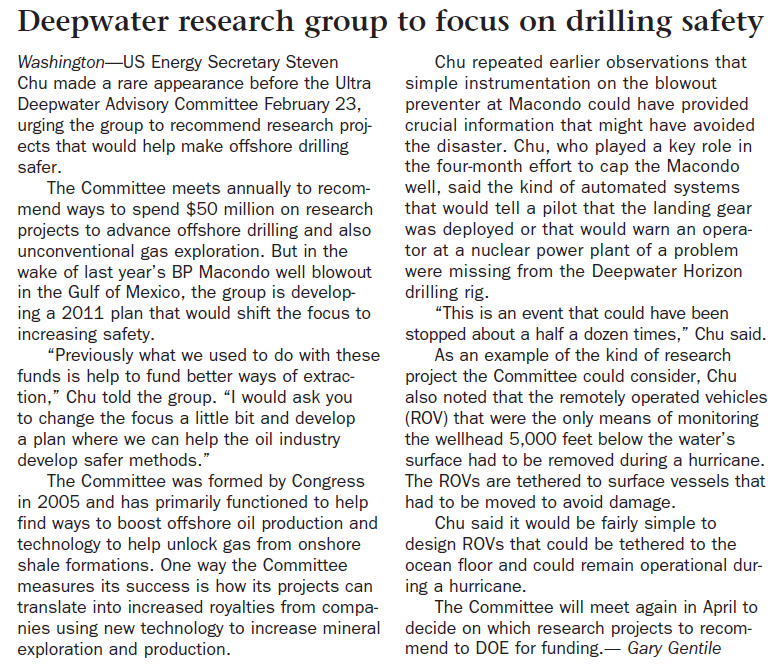
Few Cabinet Secretaries are scientists or engineers, and none has been a Nobel Prize winner. We expect Secretary Chu to be different and yesterday’s meeting with DOE’s Ultra-Deepwater Advisory Committee was not your typical Washington “hit and run” performance. Rather than making a quick speech and running along to his next appointment, Secretary Chu engaged in technical dialogue with our committee for a full hour, offering insights and responding to questions. Among the topics discussed were BOP instrumentation and monitoring, well integrity, ROV/AUV issues, and Macondo findings.

Kudos to Secretary Chu for his commitment to offshore safety.

Gary Gentile published this report on the meeting in Platts Oilgram News. (click on the story to enlarge)

Read Full Post »

“Our internal investigation into the events of that tragedy is nearing completion,” Newman told investors during a conference call to discuss Transocean’s fourth-quarter earnings. “In light of continuing delays and obtaining information on the third-party testing of the Horizon’s (blowout preventer), we expect to release findings in the next month or two.” Fox Business


Read Full Post »

No deepwater horizons in Russian arctic:

Developed by SevMash, the first Barents Sea oil rig will be a steel table the size of a football pitch and capable of withstanding temperatures of down to minus 50 Celsius. The whole point of it is that standing on the seabed, it will allow drilling and pumping the way they are done of firm land. This is a very far cry from the Deepwater Horizon. That platform was semi-submersed, positioned dynamically and designed to pump oil from beneath a mile of sea. When the oil gushed, the spill proved almost unstoppable. The Barents Sea platform will employ a very different production technology, which involves the use of powerful pumps. Chief Technology Officer of the Gazpromneft Shelf company Dr Alexander Kisser

Comment:

  1. Don’t demonize deepwater production to promote the arctic (or vice versa). The world needs responsible production from both.
  2. “Can’t happen here (or to me)” talk impresses no one. Explain how a disasters can happen to you and what you are doing to prevent them.
  3. Identify the special risks at your site and how they will be mitigated. Don’t tell us why the arctic isn’t the Gulf of Mexico.
  4. Perhaps we should present Can’t Happen Here awards as part of the Not My Job awards program.

Read Full Post »

The PSA established a project team on 7 May 2010 with some 20 members drawn from relevant disciplines to follow up the Deepwater Horizon disaster.

Its overall goal is to systematise and assess experience and investigations in the wake of this incident, so that appropriate lessons can contribute to learning and improvement on the NCS.

The project will identify areas where enhancements can be made to the requirements in Norway’s regulations and/or other types of measures related to Norwegian petroleum operations. PSA.no

Read Full Post »

from Nola.com:

The Bureau of Ocean Energy Management says it is looking into an incident on Apache Corporation’s natural gas production platform WC 575A, about 150 miles south of Lake Charles that led to the death of an offshore worker.

The incident occurred at approximately 7:45 a.m. Wednesday, the bureau said. The worker fell into the water, apparently while transferring from a vessel to the platform.

Other crew members were able to get the worker back on the platform, but shortly thereafter he became unresponsive and was subsequently pronounced dead.


Read Full Post »

Anthea Pitt, Executive Editor of the Petroleum Economist and a native Australian, recently wrote about her country and its historical dependence on natural resources:

Australia is well aware it relies on primary industries for its wealth. In the 19th century, the country proudly “rode on the sheep’s back”. More recently, iron ore, coal, bauxite and gold helped keep the worst of the sub-prime crisis at bay. Soon, a slew of large hydrocarbon developments off the country’s remote northwest coast will come on line, another rich seam flowing into Australia’s resources revenue stream.

The blowout at Montara was well-earned, and Australian and PTTEP were lucky even during a massive disaster. No one was injured, the well was at a remote location, and international attention was soon diverted to the spectacle of Macondo.

Evidence given to the inquiry showed exactly how fortunate Australia had been. It emerged that wells drilled at Montara failed to meet PTTEP AA’s internal well-construction standards, let alone satisfy regulatory requirements. The H-1 well, which had been suspended as a future producer during batch drilling operations, was open to surface for around a week before it blew out. Its downhole cementing job was flawed; there were no mechanical barriers in place. The rig’s blowout preventer was over another well at the time of the incident.

Although PTTEP has been given a pass by Australian Resources Minister Ferguson, the lessons of Montara must not be ignored. Deepwater drilling is not the problem; Montara was in 80m of water. Poor planning and execution are the problem, whether the well is in the Timor Sea, the Gulf of Mexico, the arctic, the North Sea or anywhere else in the world.

Read Full Post »

Toronto Sun

“If the sea state is too rough for a successful emergency ditching, then a helicopter shouldn’t be operating, period,” TSB’s Wendy Tadros said at a press conference in St. John’s Wednesday afternoon.

On Friday, the Canadian Association of Petroleum Producers said Newfoundland’s three offshore oil operators — Hibernia, Terra Nova and White Rose — would adopt the TSB’s recommendation.

Read Full Post »

Courtesy of BOE’s Cheryl Anderson and Gary Gentile of Platts Oilgram News:

The Gryphon FPSO will remain shut-in after 4 mooring line failures on 0n 4 February. 74 workers were safely evacuated; 43 remain onboard.

Draft Administration comments on the National Commission’s legislative recommendations.

Michael Bromwich speech at Baker Institute, Rice University on 11 February.

House testimony of Commissioners Don Boesch and Terry Garcia on 11 February.

Read Full Post »

Area map with helicopter track and impact position

BOE’s Cheryl Anderson has been tracking this story. Click here for the full TSB report.

Occurrence Summary:

On 12 March 2009 a Cougar Helicopters’ Sikorsky S-92A on a flight to the Hibernia oil production platform had a total loss of oil in the transmission’s main gear box. The flight crew descended to 800 feet and headed towards St. John’s. Approximately 35 nautical miles from St. John’s, during an attempted ditching, the helicopter struck the water in a high rate of descent. One passenger survived with serious injuries and the other seventeen occupants of the helicopter died of drowning.

Safety Issues

  • Category A rotorcraft certified under the “extremely remote” criteria may not be capable of continued operation for 30 minutes with only residual main gear box lubrication.
  • Given today’s operating environments, it may now be technically feasible and economically justifiable to produce a helicopter that can operate in excess of 30 minutes following a massive loss of main gear box lubricant.
  • Helicopter crews and passengers in Canada remain at risk where helicopters are operated over sea states exceeding the capability of their Emergency Flotation Systems.
  • Without a supplemental breathing system, occupants have very little time to egress from a submerged or capsized helicopter before breaking their breath-holds in cold water.

TSB Recommendations

  • The Federal Aviation Administration, Transport Canada and the European Aviation Safety Agency remove the “extremely remote” provision from the rule requiring 30 minutes of safe operation following the loss of main gearbox lubricant for all newly constructed Category A transport helicopters and, after a phase-in period, for all existing ones.
  • The Federal Aviation Administration assess the adequacy of the 30 minute main gearbox run dry requirement for Category A transport helicopters.
  • Transport Canada prohibit commercial operation of Category A transport helicopters over water when the sea state will not permit safe ditching and successful evacuation.
  • Transport Canada require that supplemental underwater breathing apparatus be mandatory for all occupants of helicopters involved in overwater flights who are required to wear a Passenger Transportation Suit System.


Read Full Post »

« Newer Posts - Older Posts »