Feeds:
Posts
Comments

Archive for the ‘accidents’ Category

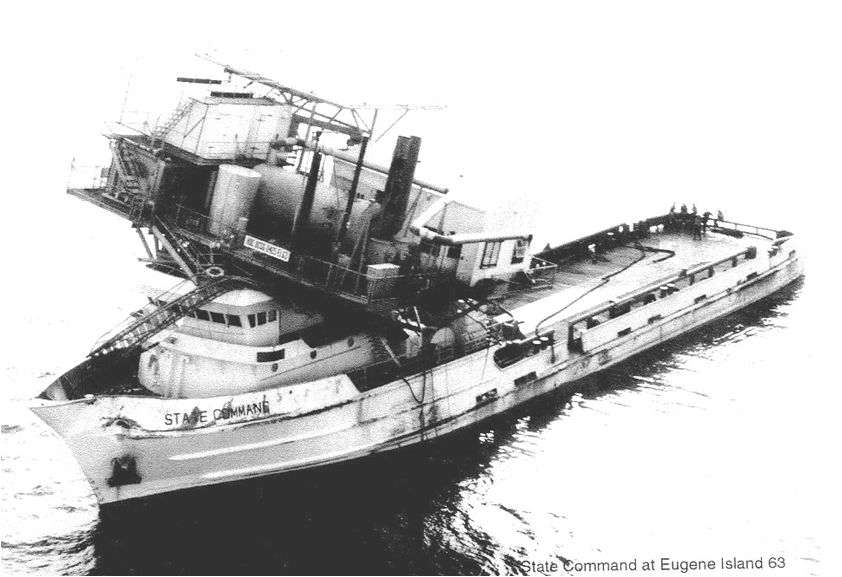
This comment by the late John Borne, an outstanding USGS and MMS engineer/philosopher, reflects on the persistent vessel allision incidents over the years. The reporting of these incidents was spotty, but some could not be denied. Pictured below is the State Command arriving in Morgan City (~1973?) topped by a platform deck. Fortunately, the platform was unmanned and there were no injuries to vessel personnel. You could say this was the first floating production platform 😃

Read Full Post »

While the official BOEMRE-USCG and National Commission/Chief Counsel investigation reports were quite good and there are countless court documents and ad hoc reviews of the blowout, some important Macondo issues have not been fully addressed. BOE will touch on these issues periodically starting with the decision to terminate the top kill operation on 5/28/2010.

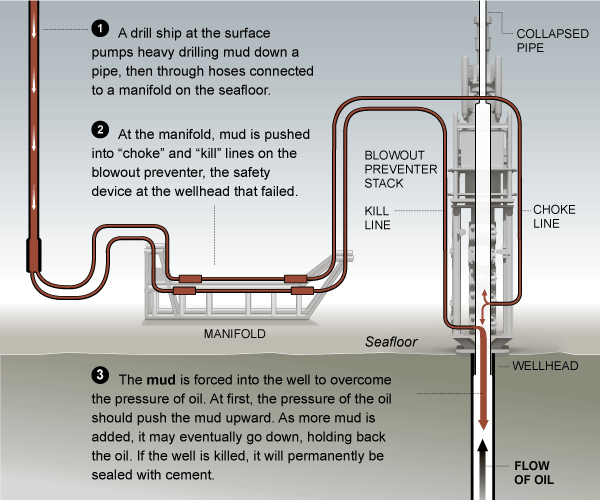
The top kill operation (see diagram above) was intended to overcome and halt the flow of oil by pumping heavy mud into the well bore.  The operation was not successful because the pumping rate and mud weight did not generate sufficient pressure.  Per an excellent paper by Dr. Mayank Tyagi and colleagues at LSU  (Analysis of Well Containment and Control Attempts in the Aftermath of the Deepwater Blowout in MC252):

It is very likely that if the top kill had been designed to deliver more than 109 bpm of 16.4 ppg drilling fluid below the BOP stack for a sustained period, the Macondo blowout could have been stopped between May 26-28, 2010. Given that the well was successfully shut-in with the capping stack in July, and that the subsequent bullhead (static) kill was successful, certainly a higher rate top kill would have been successful at that time.

The American Thinker, citing the New York Times, reports that Energy Secretary Chu stopped the top kill operation over the objections of some BP engineers. While it was reasonable to be concerned about possible casing leaks and the fracturing of subsurface formations, the subsequent (7/15/2010) closure of the capping stack demonstrated that the well had sufficient integrity to support the top kill operation. Questions regarding why a higher rate top kill effort was not attempted and how that decision was made are therefore important and merit discussion. Did the Macondo well flow unnecessarily into the Gulf for an additional 48 days (5/28-7/15)? Did the National Incident Command facilitate or delay source control?

Keep in mind that the NIC almost made a similar mistake in July. Even after the capping stack successfully shut-in the well on 7/15, Incident Commander Thad Allen (USCG) continued to call the closure of the capping stack a temporary test and threatened to require BP to resume flow from the well. Fortunately, informed input from experienced engineers prevailed. The well remained shut-in and the static well-kill operation was successful.

Read Full Post »

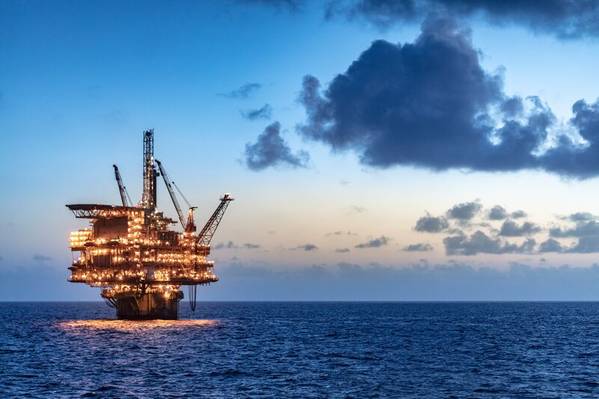
For illustration only - One of Shell's platforms in the U.S. Gulf of Mexico / Image by Stuart Conway - Photographic Services, Shell International Limited.

Attached is an outstanding presentation by Jason Mathews that reviews the latest Gulf of Mexico incident data and trends. The collection and analysis of incident data are critical to safety achievement and continuous improvement, and are among an offshore energy regulator’s most important functions. Kudos to BSEE’s Gulf of Mexico Region for their timely and comprehensive reviews and alerts.

Read Full Post »

Noble’s Aug. 29 statementNoble’s Sept. 2 statement
Each rig successfully secured its respective well in progress and took evasive actions to avoid the storm’s path.” (No mention of the delay in relocating the Globetrotter II or the rig, riser, and LMRP damage already reported on social media.)“several riser joints and the lower marine riser package separated from the rig during the storm and sank to the seabed.” (Confirms social media reports.)
“All personnel are safe and accounted for.” (No mention of the injuries alluded to in social media reports.)A small number of crew members were treated for minor injuries.” (The actual number was 9, i.e. not a small number, 4 of whom had to be transported to shore for further evaluation.)
“One of the ship’s cofferdams in the moonpool area sustained damage.” (Update: The storm broke part of the hull, which allowed water into some compartments. Per the ship’s master, the vessel was not in distress and not actively taking on water.)

In a proper safety culture, you don’t downplay serious incidents and you never declare victory. Spin control is for politicians, not safety leaders. The Globetrotter II, with 140 workers aboard, was slammed by a major hurricane, perhaps unnecessarily. After the frightening social media reports, Noble released an “all is well” statement that minimized the significance and potential consequences of the delayed rig relocation. Noble continued to downplay the incident when they update their statement 5 days later.

The Coast Guard and BSEE will be investigating the Globetrotter II relocation, and their findings will be of great interest. Noble has historically been a very good drilling contractor with a strong commitment to safe operations. Hopefully, they and others will learn and apply lessons from this and similar events that have occurred in the Gulf and elsewhere. Companies may also want to assess the compatibility of their messaging practices with their commitment to a robust safety culture and continuous improvement.

Read Full Post »

Divers identify broken pipeline as source of Gulf oil spill
satellite image provided by Maxar Techologies shows Port Fourchon and slicks on 9/2/2021
  • 12″ pipeline displaced by Ida
  • Approximately 2 miles south of Port Fourchon which took a direct hit from Ida. (Appears that the pipeline is in Louisiana State waters).
  • Water depth = 34′
  • Talos funding spill response, although the company said it was not their pipeline
  • Leak has slowed significantly; apparently production is not entering the line and the spill is limited to pipeline inventory
  • This type of incident is not surprising given the magnitude and track of Ida and the pipeline infrastructure that was exposed to major hurricane conditions

Read Full Post »

BSEE’s 8/29 update indicates that over 1.74 million BOPD have been shut-in by Ida. Based on the most recent EIA production data, this is essentially all Gulf of Mexico oil production.

There has also been some early noise on social media about offshore facility damage. None of these reports have been confirmed by the Coast Guard, BSEE, or the companies involved. The most credible reports relate to the Noble Globetrotter II deepwater drillship. Per the reports, allegedly from workers on the rig, the Globetrotter II was hit by Ida before the riser was disconnected and recovered. The rig is reported to have sustained significant damage and there may have been injuries. This type of incident has occurred in the past when dynamically positioned drillships have not successfully pulled their riser and relocated prior to the storm’s arrival. One report indicated 60′ waves and 140 mph winds at the rigs’s location.

Read Full Post »

This graphic update gives a better sense of the horrific tragedy that unfolded:

MEXICO CITY (AP)Mexico’s state-owned oil company said Tuesday the possible remains of two missing subcontractors had been found on one of its oil platforms in the Gulf of Mexico following a weekend fire.

Pemex Director Octavio Romero said the apparent remains were found in a control room on the platform where temperatures reached around 1,800 degrees (1,000 degrees Celsius). Such heat would have burned the bodies beyond recognition.

Given the magnitude of the event, the restart schedule seems pretty aggressive. Hopefully, the risks have been fully assessed and the resumption of production is not being rushed.

Pemex said that by Aug. 30 it hoped to restore all of the 421,000 barrels per day in production knocked out by the blaze.

AP News

Read Full Post »

the Mexican government’s recent decision to anoint Pemex operator of the billion barrel Zama field would seem to merit further scrutiny. Houston-based Talos Energy discovered the Zama field in 2017. The field underlies both Pemex and Zama acreage, and there are common reservoirs. Per Bloomberg:

Mexico’s energy ministry has designated Petroleos Mexicanos as the operator of the country’s largest oil discovery by private companies, in the latest sign of the government’s nationalist approach to the energy industry.

Talos said it was “very disappointed” with the decision and will explore “legal and strategic options” regarding Zama. The company added that the energy ministry had informed Talos of its “sudden” decision only three days after the driller received a letter directly from Pemex arguing for operatorship.

Bloomberg, 7/5/2021

The Mexican government’s decision is indicative of the Lopez Obrador administration’s commitment to rolling back the reforms that had encouraged private sector participation in Mexican offshore exploration and development.

Questions had already been raised about Pemex’s ability to fund Zama development and operate the field safely. This week’s deadly incident and a July pipeline fire add to those concerns. In light of the background political and financial issues, will it be possible to for Pemex and the Mexican regulators to conduct a fully independent investigation of the tragic fire that just occurred?

Read Full Post »

  1. 5 workers killed – 4 contractors and one Pemex employee
  2. 6 workers injured, one in critical condition
  3. 2 workers are missing
  4. The fire occurred in the power generation and compression area of the platform
  5. Contractors Cotemar and BMCI were performing maintenance at the time of the incident
  6. The fire has now been extinguished
  7. No reports of an oil spill
  8. Massive loss of production – 421,000 BOPD shut-in

Defensive and rather shameful comments by the CEO:

“There is not a problem of lack of investment, there is not a problem of lack of resources,” Romero said. “The oil industry is a risky industry. We have had accidents, which in numbers are less than in previous years.”

Reuters

Read Full Post »

Comprehensive and timely incident data are critical for risk assessments, preventing recurrences, training and safety management programs, assessing the performance of the industry and individual companies, and driving safety culture. The National Academies 2021 review of BSEE’s inspection program included a number of recommendations related to data management including this one:

Recommendation 2. To further its goal of increasing data transparency and facilitating its internal and external use, BSEE should invest in more advanced and creative data collection, analytic and visualization tools, and infrastructure; corresponding data management, analysis, and evaluation capabilities among its personnel; and an outward-facing, online data system that can be navigated with ease and kept current across all fields for the purpose of encouraging and facilitating safety analyses.

National Academies Report, 2021

Unfortunately, BSEE’s incident data are not updated and posted in a timely manner. As we approach September 2021, the 2020 incident statistics are still not publicly available. These incidents include at least one rig fatality that neither BSEE nor the Coast Guard announced at the time of occurrence one year ago today (8/23/2020) or subsequently. The only public information about this fatality is the following self-serving statement by the operator:

“This is a routine operation that was executed with no time pressure as the rig disconnection had been decided well in advance,” Total said.

Upstream

A 37-year old man died, but according to the operator there is nothing to see here. This is not the type of statement you would expect from a company with a leading safety culture.

The keystone of BSEE’s primary mission, protecting workers and the environment, is timely incident information that is regularly reviewed and updated. Continuous improvements in safety are dependent on continuous improvements in data management and analysis. BSEE can do much better, as can other regulators, the offshore industry, and those of us who are interested and concerned observers.

Read Full Post »
« Newer Posts - Older Posts »