Feeds:
Posts
Comments

Archive for the ‘accidents’ Category

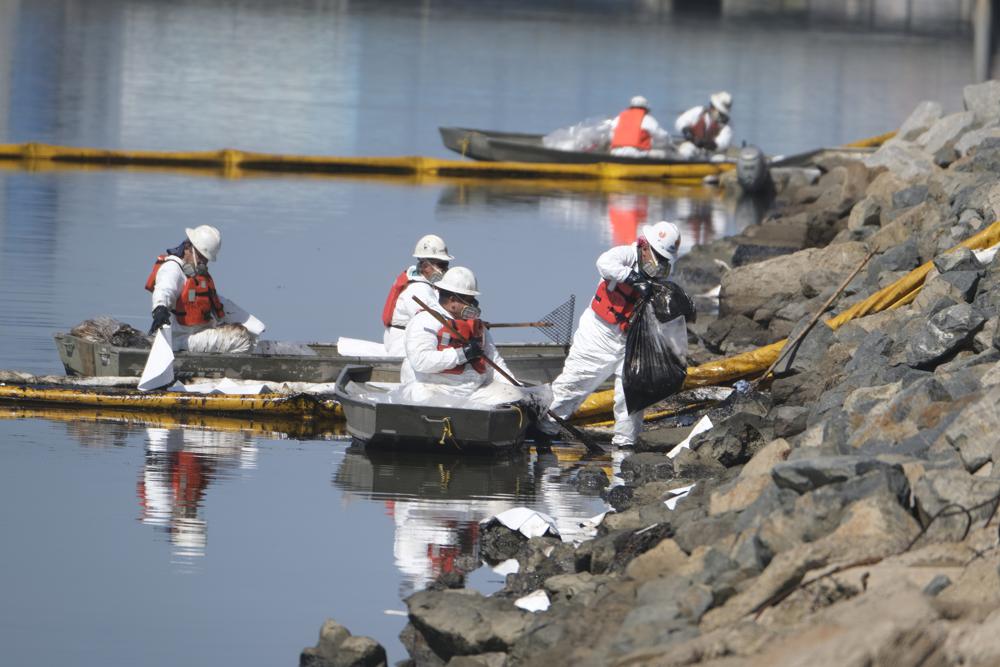
Divers identify broken pipeline as source of Gulf oil spill
satellite image provided by Maxar Techologies shows Port Fourchon and slicks on 9/2/2021
  • 12″ pipeline displaced by Ida
  • Approximately 2 miles south of Port Fourchon which took a direct hit from Ida. (Appears that the pipeline is in Louisiana State waters).
  • Water depth = 34′
  • Talos funding spill response, although the company said it was not their pipeline
  • Leak has slowed significantly; apparently production is not entering the line and the spill is limited to pipeline inventory
  • This type of incident is not surprising given the magnitude and track of Ida and the pipeline infrastructure that was exposed to major hurricane conditions

Read Full Post »

BSEE’s 8/29 update indicates that over 1.74 million BOPD have been shut-in by Ida. Based on the most recent EIA production data, this is essentially all Gulf of Mexico oil production.

There has also been some early noise on social media about offshore facility damage. None of these reports have been confirmed by the Coast Guard, BSEE, or the companies involved. The most credible reports relate to the Noble Globetrotter II deepwater drillship. Per the reports, allegedly from workers on the rig, the Globetrotter II was hit by Ida before the riser was disconnected and recovered. The rig is reported to have sustained significant damage and there may have been injuries. This type of incident has occurred in the past when dynamically positioned drillships have not successfully pulled their riser and relocated prior to the storm’s arrival. One report indicated 60′ waves and 140 mph winds at the rigs’s location.

Read Full Post »

This graphic update gives a better sense of the horrific tragedy that unfolded:

MEXICO CITY (AP)Mexico’s state-owned oil company said Tuesday the possible remains of two missing subcontractors had been found on one of its oil platforms in the Gulf of Mexico following a weekend fire.

Pemex Director Octavio Romero said the apparent remains were found in a control room on the platform where temperatures reached around 1,800 degrees (1,000 degrees Celsius). Such heat would have burned the bodies beyond recognition.

Given the magnitude of the event, the restart schedule seems pretty aggressive. Hopefully, the risks have been fully assessed and the resumption of production is not being rushed.

Pemex said that by Aug. 30 it hoped to restore all of the 421,000 barrels per day in production knocked out by the blaze.

AP News

Read Full Post »

the Mexican government’s recent decision to anoint Pemex operator of the billion barrel Zama field would seem to merit further scrutiny. Houston-based Talos Energy discovered the Zama field in 2017. The field underlies both Pemex and Zama acreage, and there are common reservoirs. Per Bloomberg:

Mexico’s energy ministry has designated Petroleos Mexicanos as the operator of the country’s largest oil discovery by private companies, in the latest sign of the government’s nationalist approach to the energy industry.

Talos said it was “very disappointed” with the decision and will explore “legal and strategic options” regarding Zama. The company added that the energy ministry had informed Talos of its “sudden” decision only three days after the driller received a letter directly from Pemex arguing for operatorship.

Bloomberg, 7/5/2021

The Mexican government’s decision is indicative of the Lopez Obrador administration’s commitment to rolling back the reforms that had encouraged private sector participation in Mexican offshore exploration and development.

Questions had already been raised about Pemex’s ability to fund Zama development and operate the field safely. This week’s deadly incident and a July pipeline fire add to those concerns. In light of the background political and financial issues, will it be possible to for Pemex and the Mexican regulators to conduct a fully independent investigation of the tragic fire that just occurred?

Read Full Post »

  1. 5 workers killed – 4 contractors and one Pemex employee
  2. 6 workers injured, one in critical condition
  3. 2 workers are missing
  4. The fire occurred in the power generation and compression area of the platform
  5. Contractors Cotemar and BMCI were performing maintenance at the time of the incident
  6. The fire has now been extinguished
  7. No reports of an oil spill
  8. Massive loss of production – 421,000 BOPD shut-in

Defensive and rather shameful comments by the CEO:

“There is not a problem of lack of investment, there is not a problem of lack of resources,” Romero said. “The oil industry is a risky industry. We have had accidents, which in numbers are less than in previous years.”

Reuters

Read Full Post »

Comprehensive and timely incident data are critical for risk assessments, preventing recurrences, training and safety management programs, assessing the performance of the industry and individual companies, and driving safety culture. The National Academies 2021 review of BSEE’s inspection program included a number of recommendations related to data management including this one:

Recommendation 2. To further its goal of increasing data transparency and facilitating its internal and external use, BSEE should invest in more advanced and creative data collection, analytic and visualization tools, and infrastructure; corresponding data management, analysis, and evaluation capabilities among its personnel; and an outward-facing, online data system that can be navigated with ease and kept current across all fields for the purpose of encouraging and facilitating safety analyses.

National Academies Report, 2021

Unfortunately, BSEE’s incident data are not updated and posted in a timely manner. As we approach September 2021, the 2020 incident statistics are still not publicly available. These incidents include at least one rig fatality that neither BSEE nor the Coast Guard announced at the time of occurrence one year ago today (8/23/2020) or subsequently. The only public information about this fatality is the following self-serving statement by the operator:

“This is a routine operation that was executed with no time pressure as the rig disconnection had been decided well in advance,” Total said.

Upstream

A 37-year old man died, but according to the operator there is nothing to see here. This is not the type of statement you would expect from a company with a leading safety culture.

The keystone of BSEE’s primary mission, protecting workers and the environment, is timely incident information that is regularly reviewed and updated. Continuous improvements in safety are dependent on continuous improvements in data management and analysis. BSEE can do much better, as can other regulators, the offshore industry, and those of us who are interested and concerned observers.

Read Full Post »

Continuous improvement has to be the primary objective of offshore safety leaders, and this independent blog is committed to recognizing initiatives that further reduce safety and environmental risks. Australia’s collaborative mental survey project is an interesting such initiative in its early stages. Two other important initiatives are noted below.

BSEE’s Dropped Object Risk-Based Inspection initiative: As has been the case for 50 years, most offshore fatalities and serious injuries are associated with falls or falling and moving objects/equipment. BSEE’s Dropped Objects initiative, as described in a presentation by Jason Mathews during a recent Center for Offshore Safety (COS) webinar is intended to draw further attention to and better manage these risks. In addition to BSEE’s focused inspections, the “Good Practices” being followed by some operators and contractors, as described on pages 40-50 of the presentation, are encouraging. These types of initiatives are necessary if we are to achieve the elusive “zero fatality” year on the US OCS.

IOGP process safety guidance, Report 456 v.2 : Contrary to some post-Macondo narratives, process safety and well control were always the primary focus of the US OCS regulatory program. In 1974, my boss Richard Krahl (known as “Mr. OCS” for his commitment to offshore safety) dropped a copy of the first edition of API RP 14C (Analysis, Design, Installation, and Testing of Safety Systems for Offshore Production Facilities) on my desk and told me it was an excellent document that I should read. RP 14 C and other process safety standards were incorporated into the USGS OCS Orders (regulations) in the 1970’s. For decades, the USGS and MMS were leaders in well control and production safety research and training. That said, better indicators and improved approaches to offshore facility process safety were needed, and the International Association of Oil and Gas Producers report has provided an excellent framework. Report 456 is comprehensive and technically sound, and provides excellent guidance and examples. Very well done!

Read Full Post »

Following the Piper Alpha tragedy (1988) and the Exxon Valdez spill (1989), the Minerals Management Service, under the direction of Dr. Charles Smith, embarked on new research to address the human and organizational factors that are fundamental to offshore safety. An important 1993 report, MMS project 167, Management of Human Error in Operation of Marine Systems by Robert Bea and William Moore, observed that:

High consequence accidents resulted from a multiplicity of compounding sequences of breakdowns in the human, organization, and system; often there are precursors or early-warning indications of the breakdowns that are not recognized or are ignored.” The human element is complex and “states” such as “fatigue, negligence, ignorance, greed, folly, wishful thinking, mischief, laziness, excessive use of drugs, bad judgement, carelessness, physical limitations, boredom, and inadequate.” Environmental factors such as weather conditions, time of day, smoke, and noise further complicate human performance.

Bea and Moore, 1993

COVID 19 has further complicated human performance and facility management. In an effort to better understand human factors during COVID, NOPSEMA (the Australian offshore safety regulator) has partnered with industry, and labor organizations, and universities to survey offshore workers.

Per the survey announcement:

Your unique insight on the impacts of the COVID-19 pandemic on members of the offshore workforce are vital to informing industry and the development of strategies that best support employee mental health and well-being.

BOE is looking forward to learning about the results of this survey and other efforts to better assess and understand mental health challenges facing offshore workers. The effective integration of mental health considerations into management systems is critical to safety achievement.

Read Full Post »

Phil Rae piece in Fuel Fix

  1. The well clearly had losses through the shoe during the initial displacement of the heavy spacer with seawater, immediately prior to the negative test.
  2. Allowing for, and accepting, losses of ~80 bbls during spacer displacement, explains ALL pressure and flow anomalies without the need to create or invoke undocumented and unsubstantiated valve closures or manipulations that contradict witness testimony of events. It also eliminates the need to adopt unrealistically-low pump efficiencies for the rig pumps, hypothetical washed-out tubing and ridiculously high viscosities for the drilling mud, in an effort to fit questionable computer models.
  3. Despite extensive examination by investigators and the publication of several reports, the fact that the well experienced losses, making it even more severely underbalanced than was planned, has been given little credence or has received little or no attention, despite several clear indications that this was the case. While this statement regarding losses may be self-evident, its significance on the outcome at Macondo merits closer examination since it explains many previous, apparently-contradictory aspects of the disaster.
  4. Under-displacement of heavyweight spacer, as a result of losses during displacement, caused U-tubing and partial evacuation of the kill line, the lower end of which was later refilled with heavyweight spacer, driven by pressure and flow from the formation. The vacuum, initially, and subsequent invasion of heavy fluid rendered the kill line useless for monitoring the well since the line was effectively blind to pressure changes in the well.
  5. While initial flow into the well was through the shoe, pressure above the casing hanger seal during the negative test was reduced to levels that could have allowed the casing to lift, compromising the seal and possibly also allowing flow from the external annulus.
  6. The well encountered further losses during the second displacement (to displace the riser), after completion of the negative test. These losses, which were perhaps as much as 200 bbls, effectively replaced heavy mud with sea water in the casing below the drill pipe. This further underbalanced the well to the point that it was being kept under control only by pumping friction pressure. As the pump rate was reduced prior to shut down for the sheen test, effectively reducing system backpressure, the now severely underbalanced well began to flow.

Read Full Post »


oil-eating bacteria

Woods Hole Oceanographic Institute scientists have published important new findings on the rapid bacterial degradation of the Macondo spill.

They found that bacterial microbes inside the slick degraded the oil at a rate five times faster than microbes outside the slick—accounting in large part for the disappearance of the slick some three weeks after Deepwater Horizon’s Macondo well was shut off.


Read Full Post »

« Newer Posts - Older Posts »