Feeds:
Posts
Comments

Archive for the ‘accidents’ Category

Presentations from the January 2023 HSAC meeting have now been posted. None of the presentations addresses the tragic crash in the Gulf of Mexico on 29 December. This is understandable given the ongoing investigation.

Attached is an update from the Helideck Committee which also addresses wind farm issues.

Read Full Post »

A group of international shipping companies and their subsidiaries tentatively agreed Wednesday to pay $96.5 million to Houston-based Amplify Energy Corp. to dismiss one of the last remaining lawsuits over the oil spill, which sent at least 25,000 gallons of crude into the waters off Huntington Beach in October 2021.

LA Times
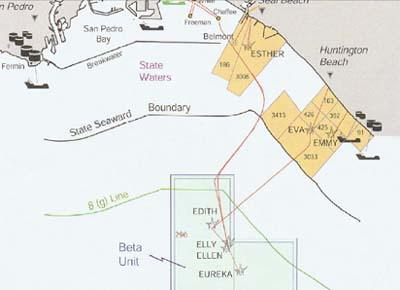
MSC Danit and Beijing were ID’d by Sky Truth as likely dragging anchors over the damaged Beta Unit pipeline

Although the Coast Guard’s investigation report has yet to be published, available information suggests that the pipeline was well maintained and that Amplify’s Beta Unit facilities had a good safety and compliance record. Absent the anchor dragging captured in the above image, a spill would have been highly unlikely. The large settlement in favor of Amplify is therefore quite understandable.

Read Full Post »

Whoever blew up the Nord Stream pipelines was not entirely successful in that one of the Nord Stream 2 lines was apparently undamaged. What is next for that line? Will the two Nord Stream 1 and the other Nord Stream 2 pipelines be repaired?

Read Full Post »

An international regulatory colleague brought this puzzling RigZone article to my attention. Quotes:

“From one perspective, one can look at the overall absence of risk – from this perspective, we can easily say that either the United Kingdom’s North Sea or Canada’s Nova Scotian continental shelf is the safest region for offshore oil and gas operations right now,” Robak told Rigzone.

“Canada’s offshore industry accounts for approximately one million barrels per day, and its geographic location along the Nova Scotian continental shelf has been a benefit in that there is little to no risk to its continued operation on a day-to-day basis,” Robak said.

Comments:

Scotian shelf

Read Full Post »

MSC Danit and Beijing were ID’d by Sky Truth as likely dragging anchors over the damaged Beta Unit pipeline

Per the LA Times, companies linked to the cargo ships accused of dragging anchors over Amplify Energy’s pipeline have agreed to pay $45 million to settle lawsuits. The ships were identified by Sky Truth (see above image) shortly after the spill (October 1, 2021).

Meanwhile, Amplify is suing the vessel owners for damaging the pipeline and failing to notify the authorities after the damage occurred. Amplify would seem to have a good case given that inspection reports indicate that the pipeline was in good shape prior to the anchor damage and that the Beta Unit platforms had a good safety and compliance record.

Finally, when will we see the investigation report for this spill? It has now been nearly 17 months since the incident.

Read Full Post »

41 years ago today, 84 men lost their lives on the Ocean Ranger. BOE’s 40th anniversary posts can be viewed here and here. The excellent 40th anniversary tribute video is embedded below. Remember these heroes.

Read Full Post »

Now that the 2021 US OCS incident spreadsheet has been posted and I have commented on the fatalities, I’ll be looking at some incidents by category starting with losses of well control (LWCs). Incident summaries and links to investigation reports follow the bullet points.

  • 4 LWCs incidents in 2021
  • None posed a significant threat to worker safety or the environment
  • All were deepwater wells
  • 3 were during exploratory drilling and 1 was during completion operations
  • All 3 drilling incidents involved water flows after setting 22″ surface casing.
  • The completion LWC was the result of the inadvertent opening of fluid control devices. The report on this incident provides important information for well completion risk assessments.

Incident summaries

Spreadsheet incident 19: Well completion operation. Inadvertent shearing and opening of the fluid loss control devices were not adequately assessed during the planning and review phases of the completion. While displacing the wellbore from 14.8 ZnBr to 14.8 packer fluid, the downhole equivalent circulating density sheared the upper and lower fluid loss control devices. The rig immediately began to experience fluid losses of 600 bph. A 50 bbl fluid loss pill was spotted and losses slowed to 345 bph. A second fluid loss pill was pumped which significantly decreased the losses eventually resulting in zero losses. After losses stopped, the rig experienced approximately a 14 bbl gain on the trip tank. The well was shut in on the annular and circulated out using the driller’s method. Oil was observed in the returns. While waiting on additional fluids and materials, wellhead pressure was managed by bullheading 14.8 brine when required. The well was killed via bullheading down the annulus followed by bullheading down the workstring with 3 CaCo3 pills. investigation report

BOE comment: While the cause of this incident is classified as “human error,” the failure to properly assess and plan for risks associated with the inadvertent shearing and opening of the fluid loss control devices is an organizational/management issue.

Incident 186: Shallow water flow during exploration drilling. Lost well. A shallow water flow was observed from one of the ports in the 38″ wellhead housing following cementation of the 22″ riserless casing string at Caramel Keg (GB 962 #1). Additional wireline logging (casing bond log and temperature log) runs were performed to gain additional insights into the potential source/location of the flow, as well as the quality and presence of cement behind the 22″ casing string. Approval from BSEE Lafayette district was received on April 1st to proceed with running the riser/BOP and continue with subsequent planned operations. Flow from the wellhead was monitored and a general reduction trend in flow from wellhead port was observed. Approval was received from BSEE on April 19th to install and close ball valves on two wellhead ports to isolate flow from wellbore. On April 20th, the ball valves were closed and flow from the wellbore ceased approximately 23 days after initial observation. Approval to temporarily abandon the well was received from BSEE on April 25, along with a monitoring plan of the wellbore and the surrounding area. TA operations concluded on April 27th. The ongoing monitoring program has since identified no indications of flow/broaching at or near the GB 962 #1 wellbore as of May 7th. No personnel were injured or evacuated as a result of this subsurface shallow water flow. report

Comment: The BSEE incident investigation team determined that salt contamination probably caused the cement to go under-balanced triggering flow and channeling behind the 22-in casing.

Incident 478: Exploration well – 7188′ WD; exploration. The 22″ casing cement job went as planned with positive cement returns to the mudline from dye and pH meter. The rig observed post cementing flow. Flow was predominantly gas. The flow started with a single source from the seabed, about 20 ft away from the wellhead. Within the next 2-3 hours, two other flow sources developed, one immediately adjacent to the jetpipe while another flow source surfaced about 10ft away from the wellhead. The rig continued to monitor the post cementing flow and completed multiple ROV wagon wheel surveys. No new seafloor anomalies or active flow points were identified away from the wellhead. Minor flow of water and gas continued at the wellhead. No investigation report.

Incident 507: Post Cement Flow Summary: The 22″ casing was cemented in place at 2:30 AM on August 18, 2021. At approximately 5:45 AM, a minor post cementing flow was observed by the ROV. The flow was only observed from 1 cement port/ball valve connected to the 28″x22″ annulus. The flow composition was predominately cement and absent hydrocarbons. The ROV continued to monitor the flow. No investigation report.

Read Full Post »

BSEE has posted the 2021 incident data for US OCS oil and gas operations. While the 13 month publishing lag is disappointing, the spreadsheet (below the table at this link and attached at the end of this post) appears to be comprehensive and complete.

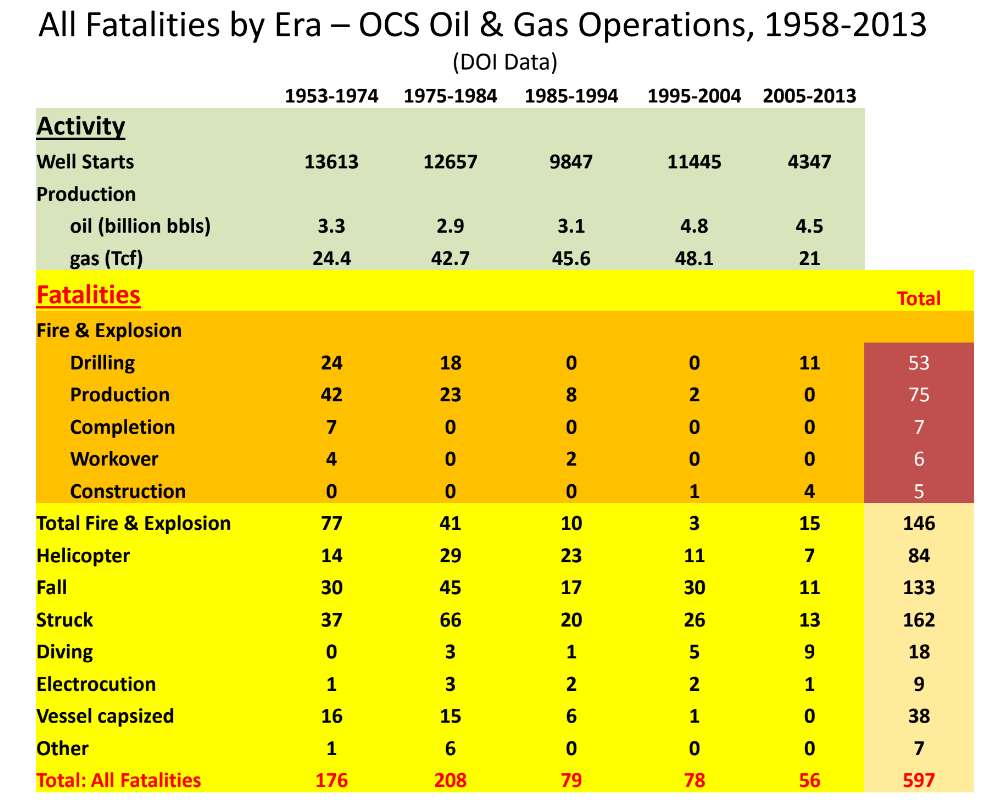
Of the 8 fatalities in 2021, 6 are classified as “non-occupational” and are thus not included in the 2021 fatality count (see table below).

The 2 occupational fatalities are the result of falling metal plates on a drilling rig and the release of casing pressure on a production platform. These fatalities are still being investigated.

The 6 non-occupational fatalities on OCS facilities also merit further attention. While historical data on health-related OCS fatalities are not readily available, 6 such fatalities seems high relative to past experience, particularly given that the total number of hours worked has declined by more than 50% since 2011. Are these and other health related questions being considered?

  • Were covid or covid related health issues a factor?
  • Are health screening programs sufficient, particularly for contractors? Contractors are 80% of the workforce but accounted for 100% of the 2021 fatalities?
  • Are offshore medical care and evacuation capabilities sufficient?

Read Full Post »

Details on the Santa Barbara blowout from last year’s BOE post.

Read Full Post »

The attached NTSB report includes details on the timing of the accident, observations from personnel remaining on the platform, condition of the helipad, nature and location of the debris, and the recovery of the fuselage and separated tail boom. The engine control unit (ECU) was recovered and sent to an NTSB lab for data extraction.

Link to previous posts on the crash.

Read Full Post »

« Newer Posts - Older Posts »