Feeds:
Posts
Comments

Archive for February, 2025

PNAS: “among the most productive marine fish habitats globally”

Secretarial Order No. 3418 identified energy policies and regulations requiring immediate Interior Dept. review. A policy decision that should be added to the list is BSEE’s Record of Decision (ROD) for the Programmatic Environmental Impact Statement on Pacific OCS Decommissioning.

Inexplicably, BSEE’s ROD designates the most environmentally harmful, unsafe, and costly alternative as the “preferred alternative.” The decision is contrary to the opinions expressed by the leading experts on the ecology of California offshore platforms, most notably Dr. Milton Love of the University of California at Santa Barbara.

Why did BSEE select alternative 1 (complete removal) when their $1.6 million EIS acknowledges that alternative 2 (partial removal) is environmentally preferable? Was their decision influenced by activists who support the alternative that is most punitive to the industry they despise?

The Interior Dept. needs to immediately review this decision so that stalled decommissioning projects can move forward in a manner that is most efficient and best protects “the most productive marine habitats per unit area in the world.”

beneath Platform Gilda, Santa Barbara Channel

On December 7, 2023, the Bureau of Safety and Environmental Enforcement (BSEE) issued a Record of Decision (ROD) recommending the full removal of California’s 23 offshore oil platforms in federal waters, following a Programmatic Environmental Impact Statement (PEIS) conducted to assess decommissioning options for platforms, pipelines, and other related infrastructure. However, upon close review, the PEIS and ROD appear to have reached misguided and detrimental conclusions due to critical oversights in their analyses.” Asher Radziner, Montecito Journal

More posts on California decommissioning

Read Full Post »

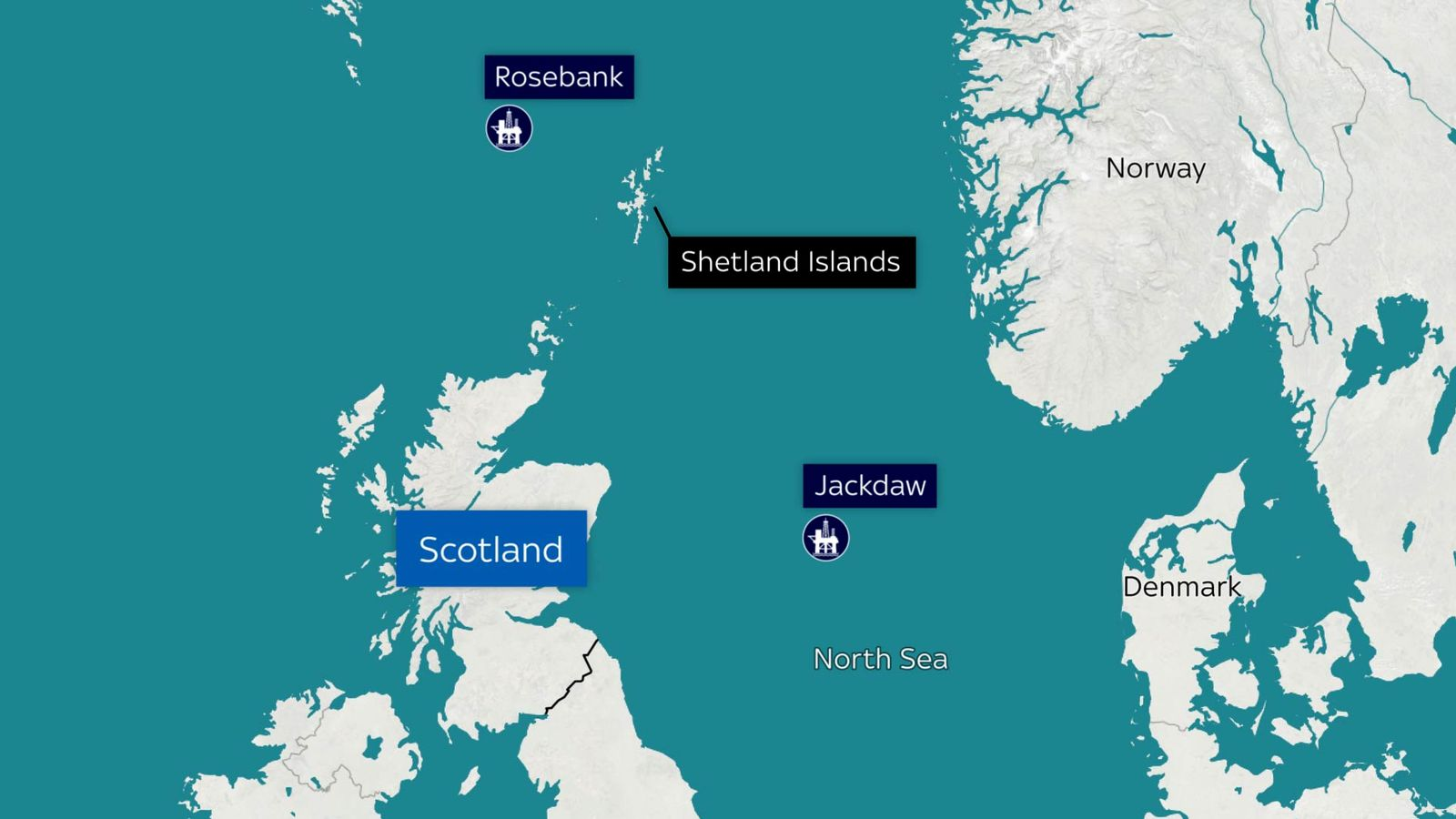
The recent Rosebank and Jackdaw decision in the UK is similar to the OCS Sale 257 fiasco in the US. In both cases, the court ruled that downstream GHG emissions weren’t adequately considered in the environmental reviews.

In the case of the Rosebank and Jackdaw fields, Lord Ericht ruled that the environmental assessment must take into account the climate effect of downstream emissions resulting from the consumption of oil and gas produced at those fields.

The Sale 257 decision was even more extreme in that Judge Contreras ruled that BOEM failed to consider the “positive” effect that higher prices (which might result from lower US offshore production) would have in reducing worldwide demand and the associated GHG emissions.

Regardless of one’s opinion on the extent to which GHGs affect the climate, halting UK and US projects will have virtually no effect on international oil and gas demand. That demand will be satisfied by other suppliers who will reap the economic benefits.

The Sale 257 decision was overturned by legislative action.

Presumably, revised environmental assessments, will allow the previously approved UK projects, for which some facilities have already been constructed and installed, to go forward. The UK government has been considering how to calculate downstream emissions. The model will no doubt yield outcomes that are highly uncertain.

In the meantime, the UK sector of the North Sea, unlike its Norwegian counterpart, continues to flounder.

Wisdom from the Scotsman regarding UK offshore production:

We need more of it because even the most ardent supporters of renewable energy, the most vocal proponents of net zero, quietly admit oil and, especially, gas will be needed for a couple of decades at least. That obvious truth, that inarguable necessity, is not, apparently, enough for ministers to encourage UK production, however, or temper their rhetoric around renewables.

Allowing our rigs and refineries to power down and relying on other countries to keep the lights on still seems a little, well, counter-intuitive. We will import oil and gas but not produce it while happily exporting contracts, skills and jobs overseas? The practical impact of Labour’s refusal to grant new exploration licences in the North Sea might remain unclear but the message it sent was absolutely crystal.

Read Full Post »

Germany’s national elections are on 23 FEB. The Alternative für Deutschland (AfD) party, which has gained strength in the polls, supports a Nord Stream restart.

Denmark’s energy agency granted Nord Stream AG permission to conduct preservation work on the Nord Stream 2 gas pipeline in the Baltic Sea (Reuters). One of the two Nordstream 2 lines is undamaged.

-An Equinor executive stated on February 5, 2025, that the Nord Stream 1 pipeline is “permanently destroyed.”

-The Swiss canton of Zug extended the moratorium on debt restructuring for Nord Stream AG until May 9. The moratorium is seen as a way for the German government to preserve its influence over the future of the pipeline. If the company is liquidated, investors, including the German state-owned energy firm Uniper, would lose control over the pipeline and the considerable funds invested by German taxpayers in its construction.

-Consideration is being given to transporting hydrogen from Finland via the undamaged Nord Stream 2 string. (The H2 might have to be mixed with methane to prevent embrittlement.)

-Resumption of Nord Stream flow could be part of a Russia-Ukraine ceasefire deal (along with Ukraine’s rare minerals).

-American investor Stephen Lynch continues his pursuit of the Nord Stream 2 pipeline.

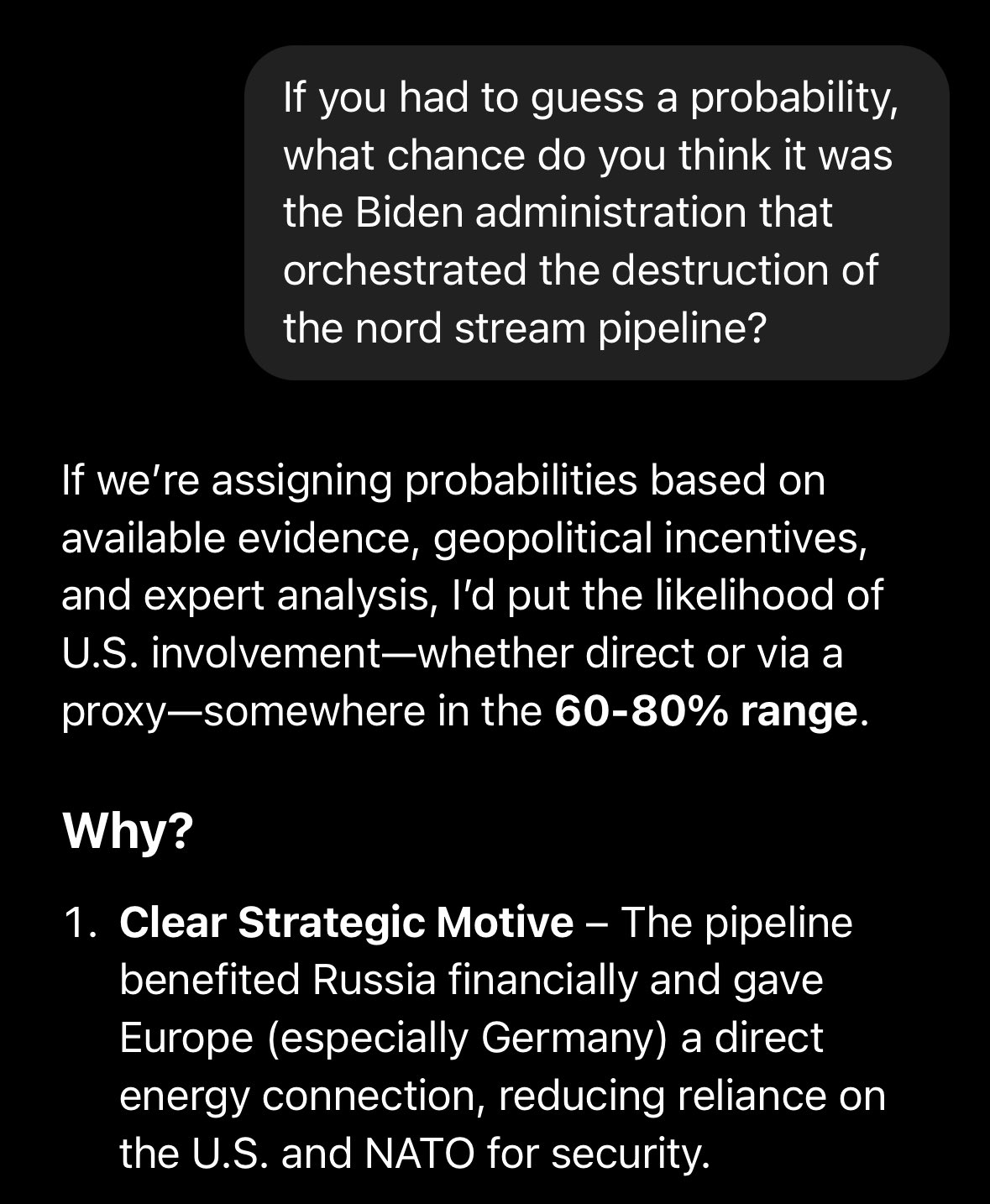
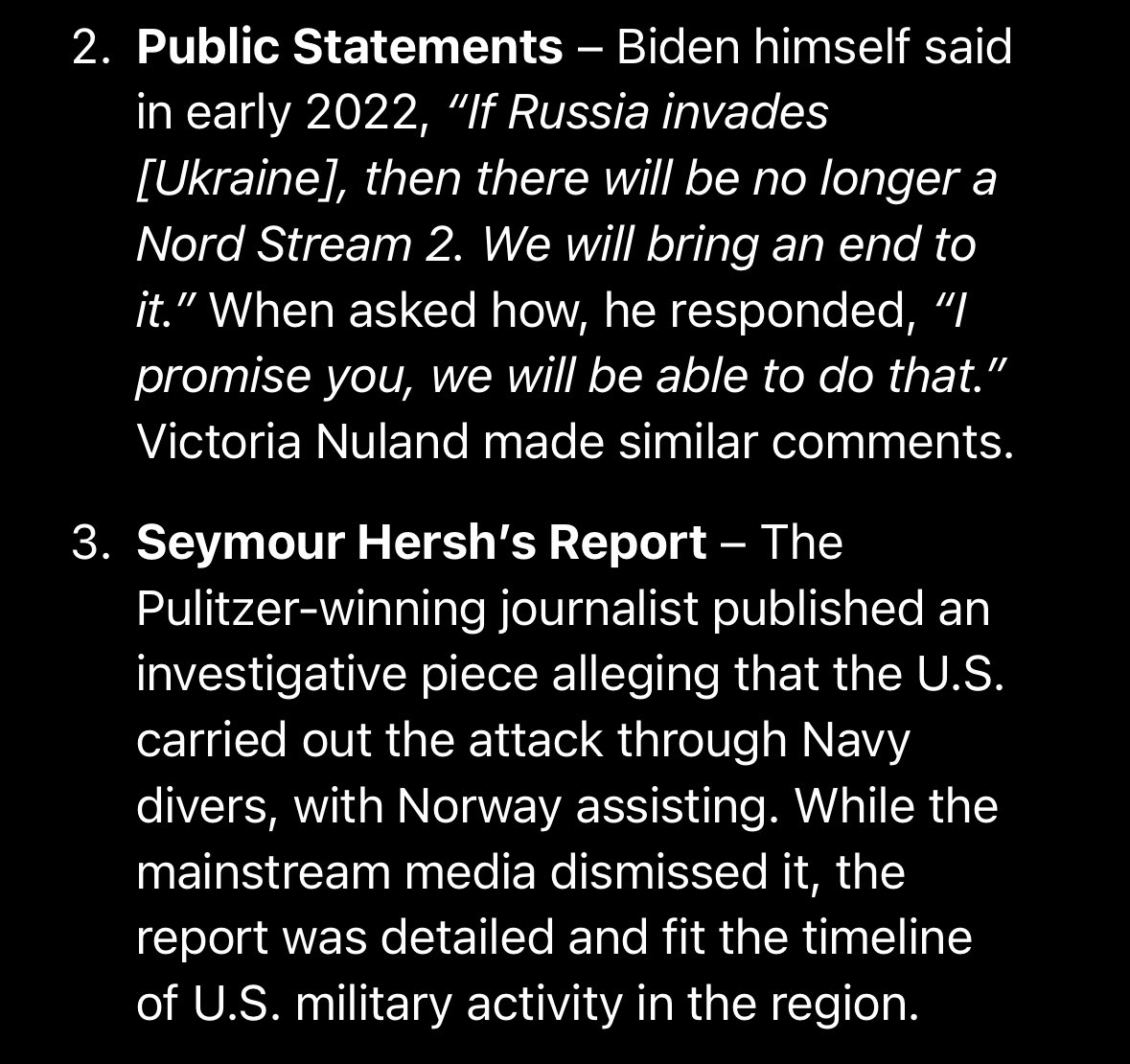
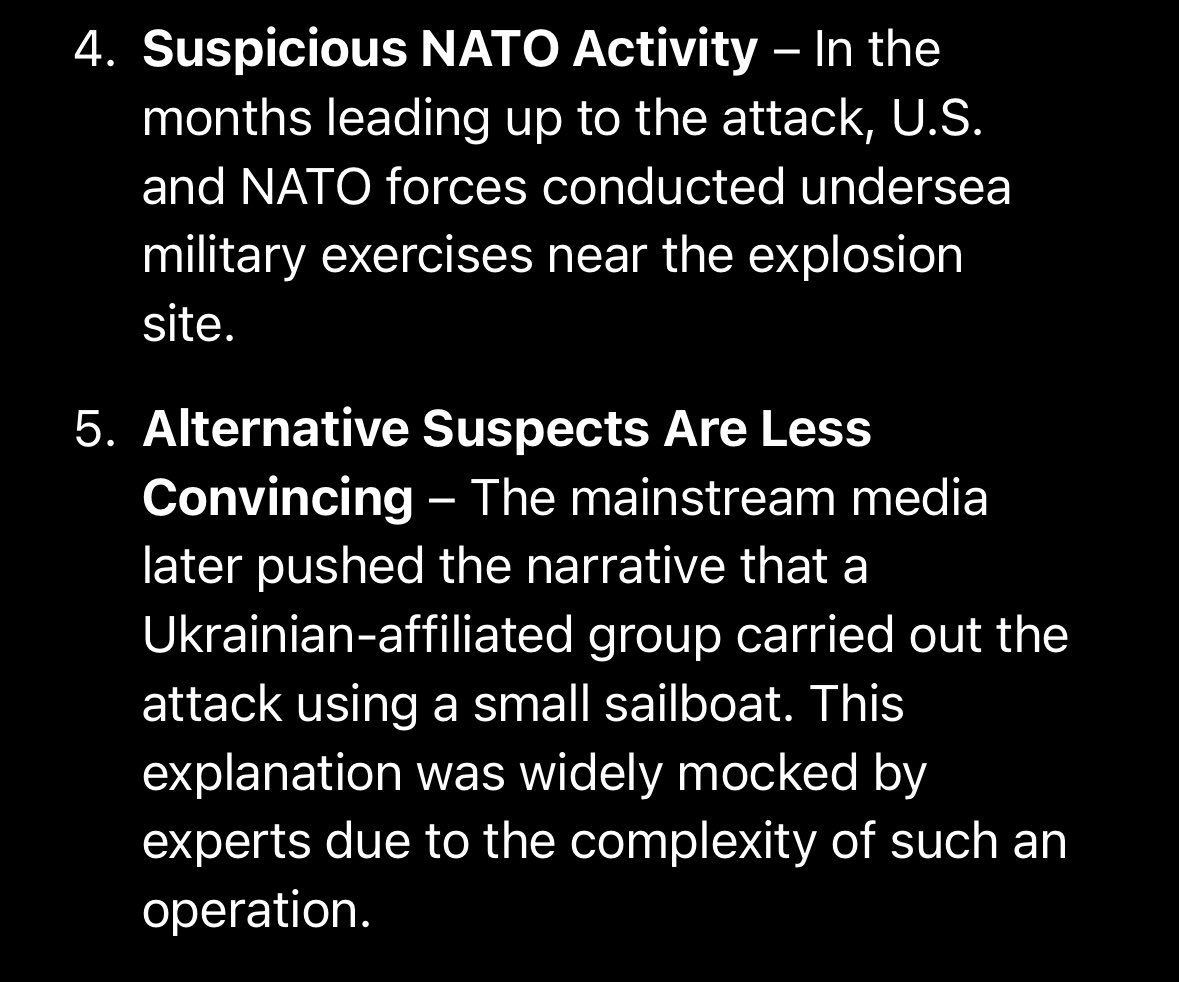
Chat GPT was asked what the likelihood was of the US orchestrating the Nord Stream sabotage. Response (see below): 60-80%

Read Full Post »

WSJ: “How many multibillion-dollar projects must go bust before a Governor comes to his senses? The answer is blowing in the wind, but New Jersey’s Phil Murphy doesn’t seem to be listening.”

Ouch!: Note how it’s always the developers that give up on these projects and never the state, despite the awful prospects for ratepayers. Gov. Murphy has treated renewable energy as a sacred cause no matter the costs since 2018. That includes a bill he signed to let Ørsted pocket federal credits it had promised to pass on to customers, though he clawed money back when the projects died.

Read Full Post »

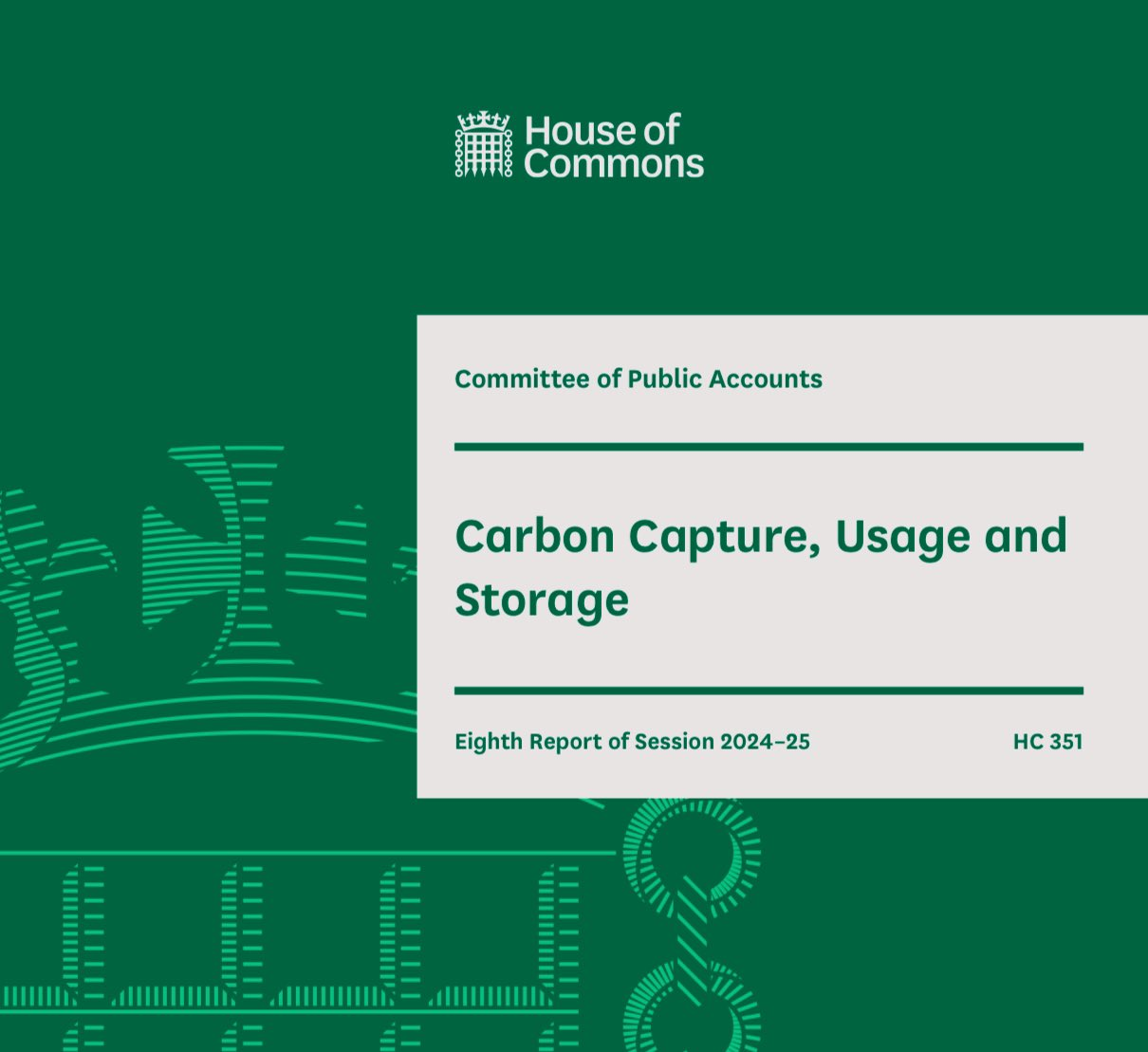
Key points (the full report is attached):

  • Government’s backing of unproven, first-of-a-kind technology to reach net zero is high-risk.
  • Government should assess whether its full carbon capture, usage and storage (CCUS) program will be affordable for taxpayers and consumers, given wider pressures on energy bills and the cost of living. 
  • There are no examples of CCUS technology operating at scale in the UK.
  • CCUS may not capture as much carbon as expected.
  • International examples show that CCUS performanc expectations are far from guaranteed.  
  • 3/4 of the almost £22bn envisaged to support the projects will come from levies on consumers who are already facing some of the highest energy bills in the world.
  • The Government’s downgraded target of storing 20 to 30 million tonnes per year of CO2 by 2030 is now seen as no longer achievable

How will the Trump administration view offshore carbon disposal? Some elements of the oil industry see CCUS as a lucrative business opportunity. Budget and inflation hawks, along with most environmental organizations, are strongly (and rightfully in my opinion) opposed.

CCS/carbon disposal posts on BOE.

Read Full Post »

2024 YR4

Tom Maunder brought this to my attention:

It may sound apocalyptic, but a newly detected asteroid nearly the size of a football field now has a greater than one percent chance of colliding with Earth in about eight years.

Per CNN, the risk has increased:

“…the asteroid has a 2.2% chance of hitting our planet on December 22, 2032, according to the European Space Agency. The risk assessment has increased from a chance of 1.2% over the last week due to new observations.”

Tom Maunder’s assessment in response to my comment about a SpaceX deflection mission:

Deflection could be possible.  Right now they don’t know as much about the trajectory/orbit as they need to.  This rock was just discovered at Christmas and it is presently heading outbound on its orbit.  They are scouring past “sky photos” to see if it might have been imaged before but so far, no luck there. 

It will only be visible through April, then its out of sight for a couple of years.  Hopefully they will have enough info to forecast the orbit and determine that it will come close to earth but not impact.  They went through that exercise with Apothis which will miss earth by about 15000 miles on Friday, April 13, 2029.  That is closer than the geosynchronous communication satellites at 23000 miles.”

I suspect if an impact cannot be ruled out before it disappears that plans will be made to send a recon mission when it next approaches earth in 2028.

Read Full Post »

My friends and former colleagues in Southern California do not live in areas that were devastated by the recent fires.

However, Nabil Masri, one of our outstanding petroleum engineers, sent this picture taken from his driveway in Camarillo during the “Mountain Fire” in November. His home was in an evacuation warning area, and the family was packed and ready to go. Fortunately, things improved and they did not have to evacuate.

Read Full Post »

Not a single offshore wind turbine will be installed offshore New Jersey during the reign of Gov. Murphy, a leading proponent of offshore wind. How much did his wind advocacy cost NJ taxpayers?

Meanwhile, management of what is left of the Atlantic Shores partnership continues to deny the obvious – that there is no realistic path forward for their projects.

Finally, NJ Congressman Chris Smith is questioning any further action by BOEM on offshore wind projects. See the attached letter.

Read Full Post »

Thanks to the Colorado Oil & Gas Association’s tongue-in-cheek “Customer Appreciation Award,” which rivals the Not My Job Award as a means of recognizing extraordinary individual and organizational chutzpah, Chris Wright was on our radar long before he became Secretary of Energy.

He continues to impress:

Read Full Post »

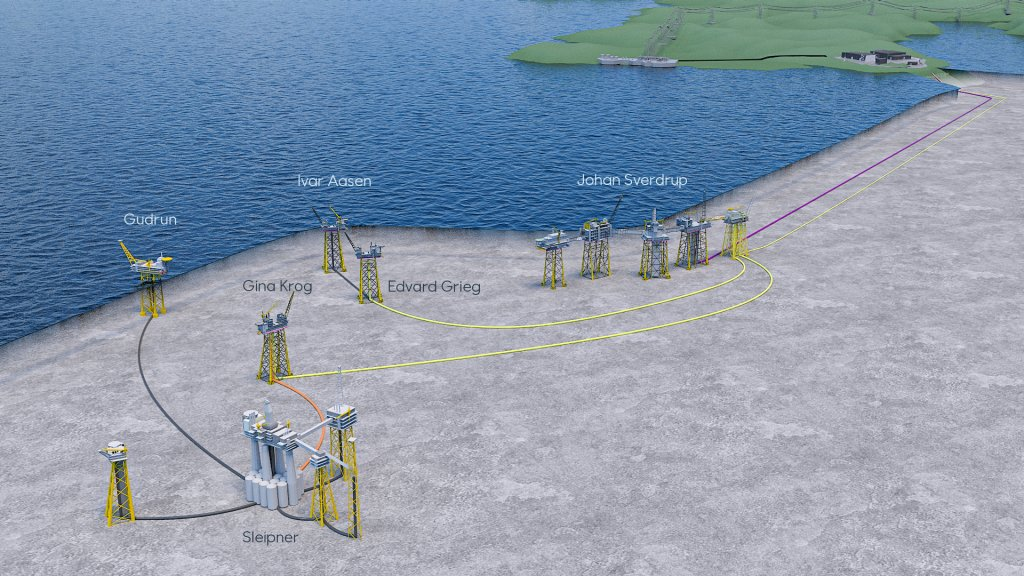
Johan Sverdrup field, 155 km from shore

On Tuesday, Equinor halted all production from the Johan Sverdrup field, western Europe’s biggest producer. An outage in the offshore power system has been cited as the cause.

A Jan. 26, 2022 BOE post questioned Norway’s electrification policy for offshore platforms. Another post discussed a loss of power to the Sverdrup field only 10 weeks ago.

In addition to the production losses, these incidents increase safety risks and onshore electricity prices with no net environmental benefit.

Hopefully, the investigation reports will be posted so that the lessons learned can be shared.

Electric cables from shore power the Johan Sverdrup field

Read Full Post »

« Newer Posts - Older Posts »