Feeds:
Posts
Comments

Archive for January, 2025

Most investors see Chevron and Hess emerging as victors in the case, Goldman analyst Neil Mehta said in an interview.”

This is consistent with the opinion previously expressed on this blog. How does a partner in a single Hess asset prevent Chevron from acquiring the entire company?

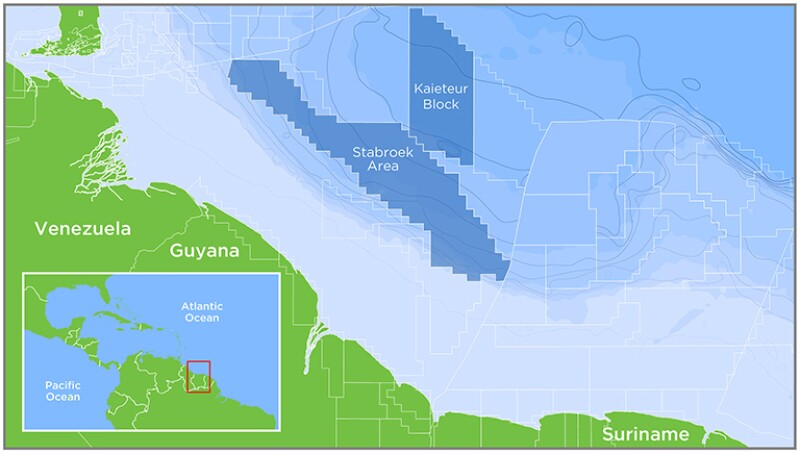
Chevron is not buying the Stabroek share; they are buying the company that holds that share. Hess is to be part of Chevron and there would be no change of control from the standpoint of the partnership.

As an offshore operator, Exxon has been highly responsible from a safety standpoint. However, the company is not reluctant to stretch the envelope when it comes to contract rights. The most recent example was their acquisition of 163 GoM oil and gas leases for carbon disposal purposes, contrary to the terms of the sale notice and lease contracts.

Interestingly, Exxon’s partner in this dispute is state-owned China National Offshore Oil Corporation. CNOOC acquired their 25% Stabroek share when they purchased Nexen, a Canadian company (sound familiar?). Both the Canadian and US governments had reservations about this acquisition and nearly nixed the deal. Would either government bless that acquisition today?

An International Chamber of Commerce arbitration panel will hear the Stabroek case in May 2025, and the final decision is expected by September 2025.
Read Full Post »

This confirms the second-hand information previously posted. The discussions and debate during the wind program review should be lively!

Read Full Post »

The U.S. Supreme Court has declined to hear the challenge of the Vineyard Wind project brought by the Nantucket-based nonprofit ACK For Whales. This is not surprising given that the odds of the SCOTUS hearing the case were extremely low, tantamount to the completion of a “Hail Mary” pass.

Perhaps Nantucket should have added Jayden Daniels to their team! πŸ˜‰

Although the SCOTUS declined to hear their challenge, the Nantucket group may still achieve their objective, at least in part, given the looming changes in Federal policy and the financial and operational challenges facing the offshore wind industry.

Read Full Post »

Read Full Post »

Katherine (Kate) MacGregor has been appointed Deputy Secretary of the Interior, the position she held under the previous Trump administration. She was highly regarded by DOI staff and advocates for responsible offshore energy development.

DOI is the most important Federal department from the standpoint of energy production on Federal offshore and onshore lands.

Also important from a policy perspective is the appointment of James Danly as Deputy Secretary of Energy. Danly is a former Army officer and Chairman of the Federal Energy Regulatory Commission

Read Full Post »

Given the absence of industry and government data on wind turbine incidents, Scotland Against Spin (SAS) has done yeoman’s work in filling the void. SAS gathers information from press reports and official releases. A PDF of the latest SAS update summary (through 2024) is attached. You can view their complete incident compilation (324 pages) here. Kudos to SAS for their diligence.

Be sure to see the introductory text at the top of the attached table. Some key points:

  • The table includes all documented cases of wind turbine incidents which could be found and confirmed through press reports or official information releases.
  • SAS believes that this compendium of accident information may be the most comprehensive available anywhere.
  • SAS believes their table is only the β€œtip of the iceberg” in terms of numbers of accidents and their frequency:
    • On 11 March 2011 the Daily Telegraph reported that RenewableUK confirmed that there had been 1500 wind turbine incidents in the UK alone in the previous 5 years.
    • In July 2019 EnergyVoice and the Press and Journal reported a total of 81 cases where workers had been injured on the UK’s windfarms since 2014. SAS data includes only 15 of these (<19%).
    • In February 2021, the industry publication Wind Power Engineering and Development admitted to 865 offshore accidents during 2019. SAS data include only 4 of these (<0.5%).
    • SAS includes other examples supporting their “tip of the iceberg” claim.

Although SAS is committed to reforming the Scottish government’s wind energy policy, their incident data summaries are credible. It’s disappointing that the wind industry is unwilling to publish comprehensive incident data that would help protect lives and the environment, and improve the performance of all participants.

Read Full Post »

After a zero fatality year in 2023, the first in at least 60 years, Jason Mathews of BSEE advises that one worker was killed during US OCS oil and gas operations in 2024.

The fatality occurred during decommissioning operations on the Helix D/B EPIC HEDRON at Talos Energy’s Ship Shoal Block 225 “D” platform in the Gulf. The platform was to be reefed in Eugene Island Block 276.

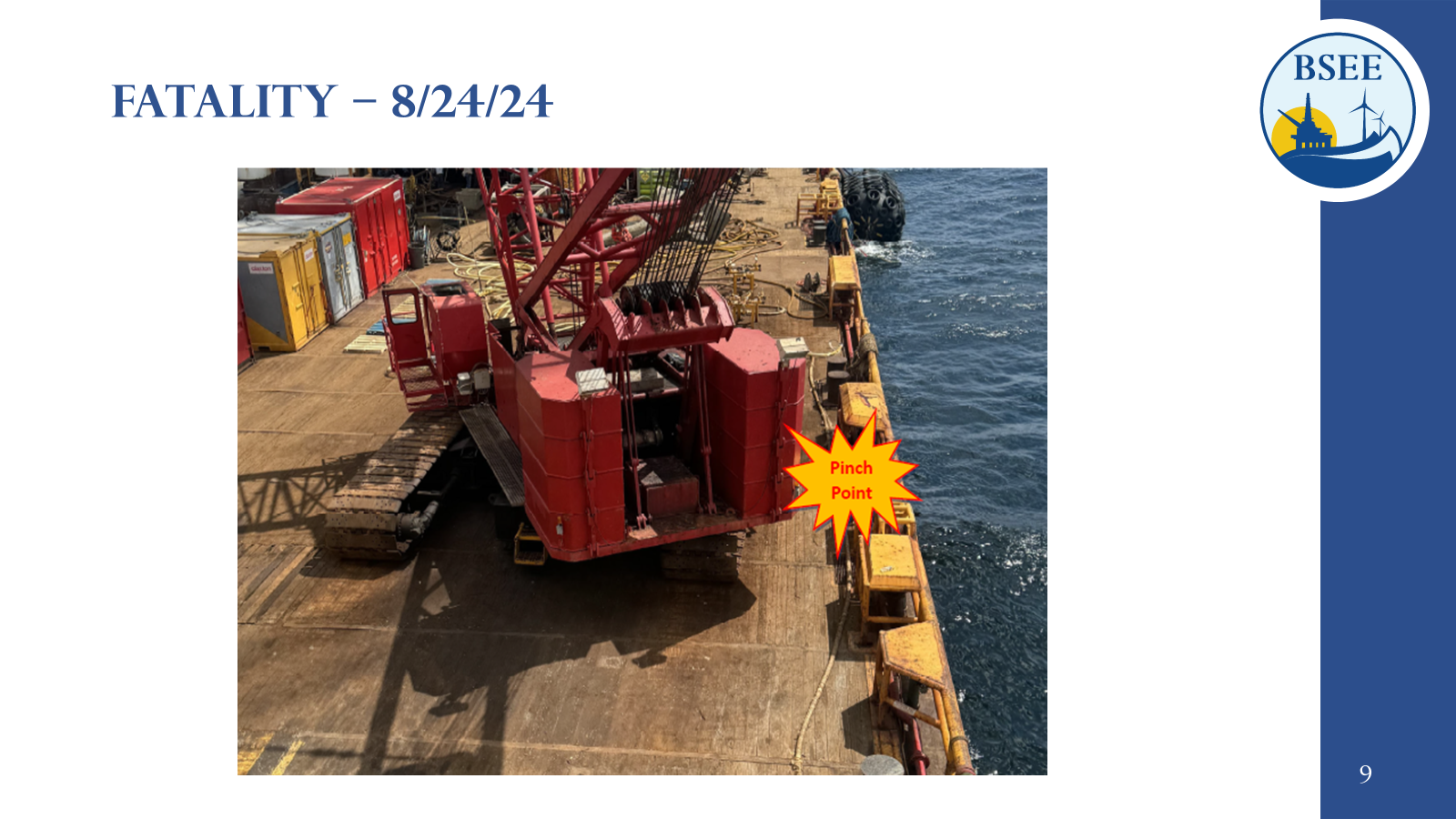
The victim, who worked for Triton Diving Services, was moving hoses on the port side of the barge and got caught between the bulwark and counterweight of the crawler crane (see picture below).

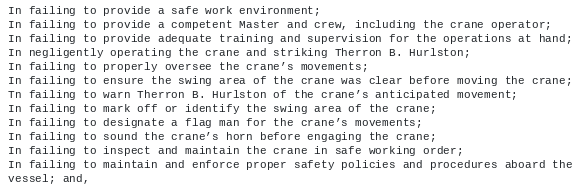
The victim’s family have filed a wrongful death lawsuit against Helix Energy Services and Triton Diving Services. The plaintiffs assert that prior to the crane movement the crane operator and crew had not undertaken measures to assure that the crane’s swing area was clear of other crew members. Per their filing, Triton and Helix were negligent as follows:

They further assert that:

The incident remains under investigation by BSEE.

Read Full Post »

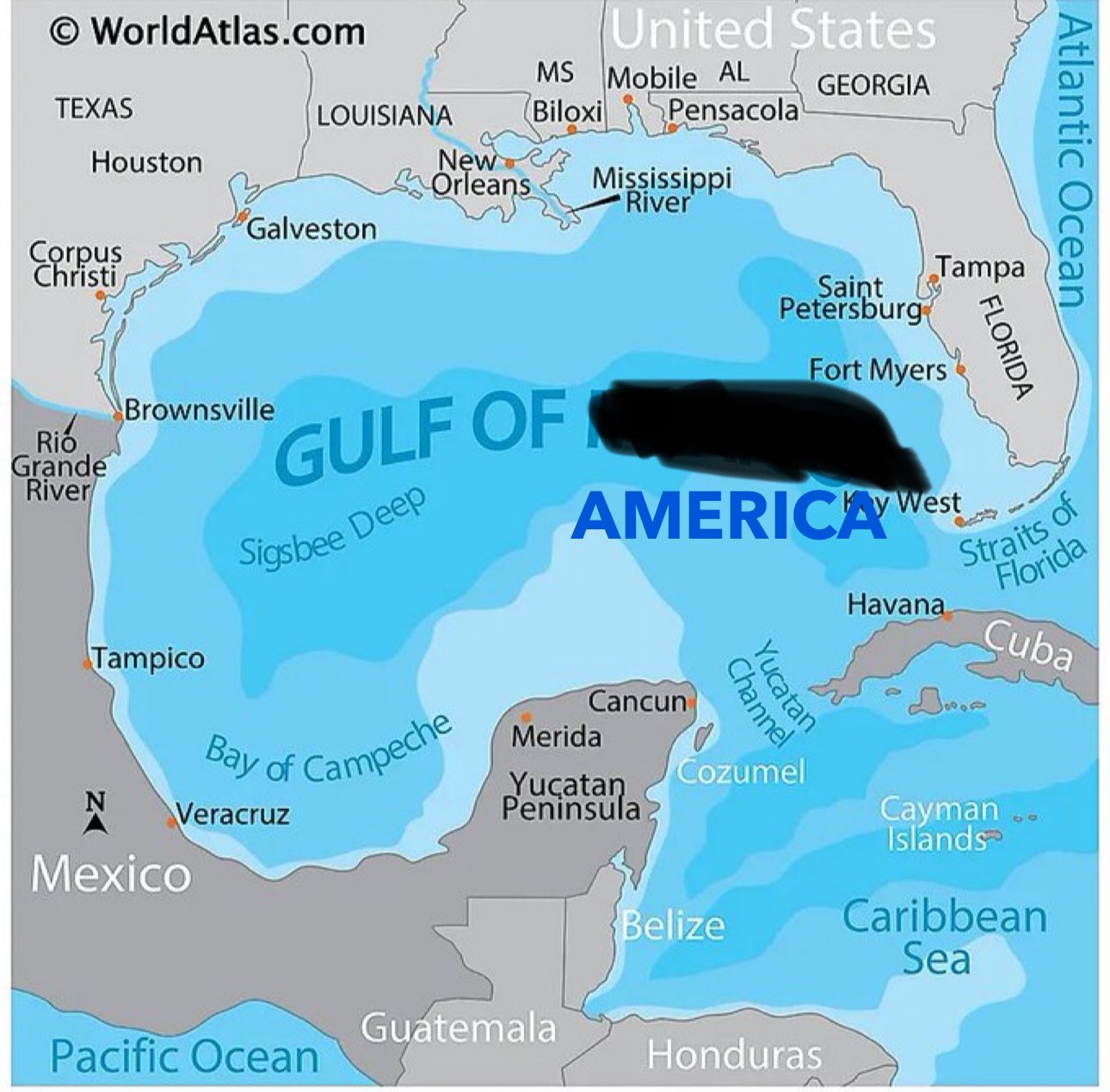
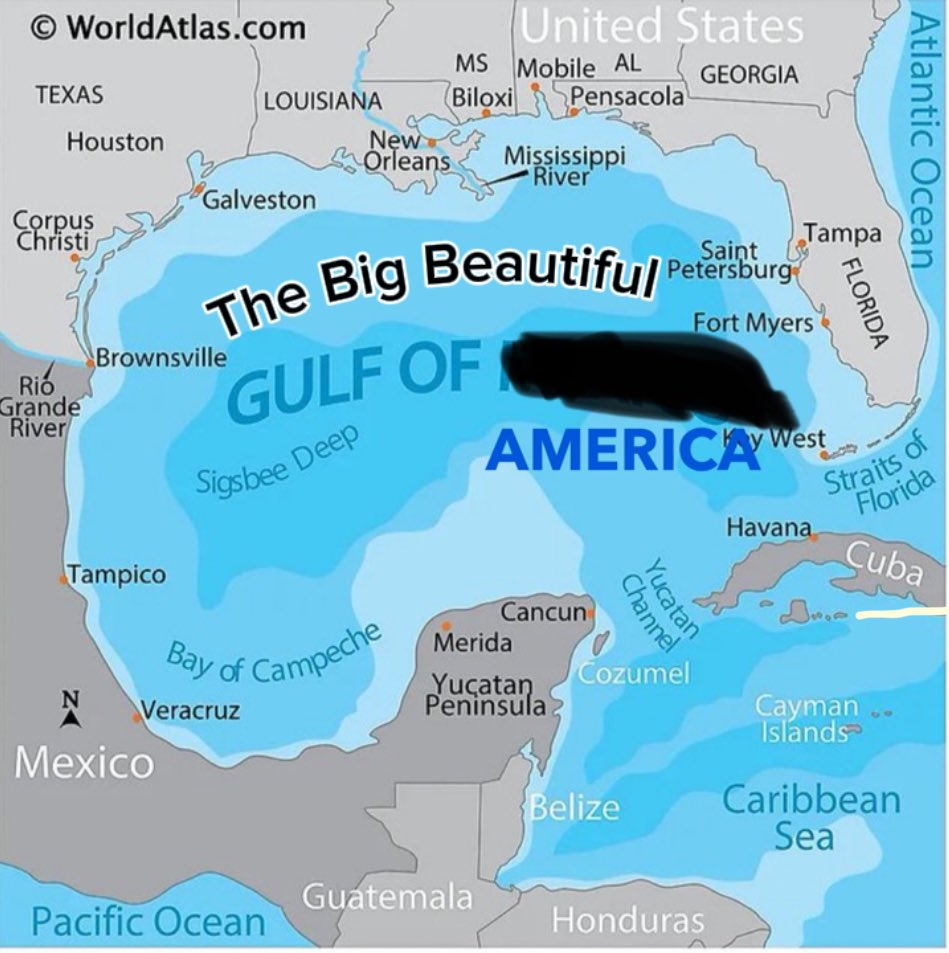
New name, short form:

full name:

This may be a bit of an adjustment for us older folks. πŸ˜‰

Also, keep in mind that Greenland is geographically part of North America. Just sayin’ πŸ˜‰

Read Full Post »

As expected, the White House announced the largest ever permanent ban on offshore oil and gas leasing in the US, and to the best of my knowledge, anywhere in the world.

The sheer magnitude of the ban makes other such withdrawals appear modest by comparison. It’s amazing how bold Presidents (and their handlers) become when they are about to leave office.

The permanent ban includes:

  • The entire Atlantic Outer Continental Shelf (OCS): While there are no current oil and gas leases in the US Atlantic, the region is highly prospective and could contain more than 20 billion barrels of oil equivalent (BOE).
  • The Eastern Gulf of Mexico: This is the OCS area that many petroleum geologists find most attractive. The best prospects are >100 miles from shore which minimizes coastal risks, and the high natural gas potential aligns with Florida legislation supporting the use of gas for power generation.
  • The entire Pacific OCS: While the resources are substantial, their loss has been a foregone conclusion for 25 years. When you can’t even decommission old platforms or restore production on important existing facilities (i.e. the Santa Ynez Unit), how can you possibly expect to issue new leases?
  • The remainder of the OCS offshore western Alaska. The wishes of the majority of Alaskans, who support offshore exploration and development, have been largely ignored for decades.

President-elect Trump has vowed to reverse President Biden’s leasing ban, but that may not be so easy. This is not a matter of simply reversing an executive order. Sec. 12(a) of OCSLA grants the authority to withdraw lands to the President and does not provide for reversal by future Presidents. The attached NYU Law brief concludes that “a subsequent president lacks authority to restore previously withdrawn lands to the federal oil and gas leasing inventory.”

The new Administration will no doubt have a different view than that expressed in the NYU Law brief, but any reversal decision will likely be challenged in court.

Those who wrote and approved Sec. 12(a) should have had more foresight. However, 72 years ago the authors presumably thought Presidents would only use the authority to remove small, especially sensitive areas from leasing consideration, and never thought that a President would remove both of our oceans and much of the Gulf of Mexico!

Congress could of course reverse the Biden bans, but given the complexity of offshore energy issues, such legislation may be difficult to pass.

Read Full Post »

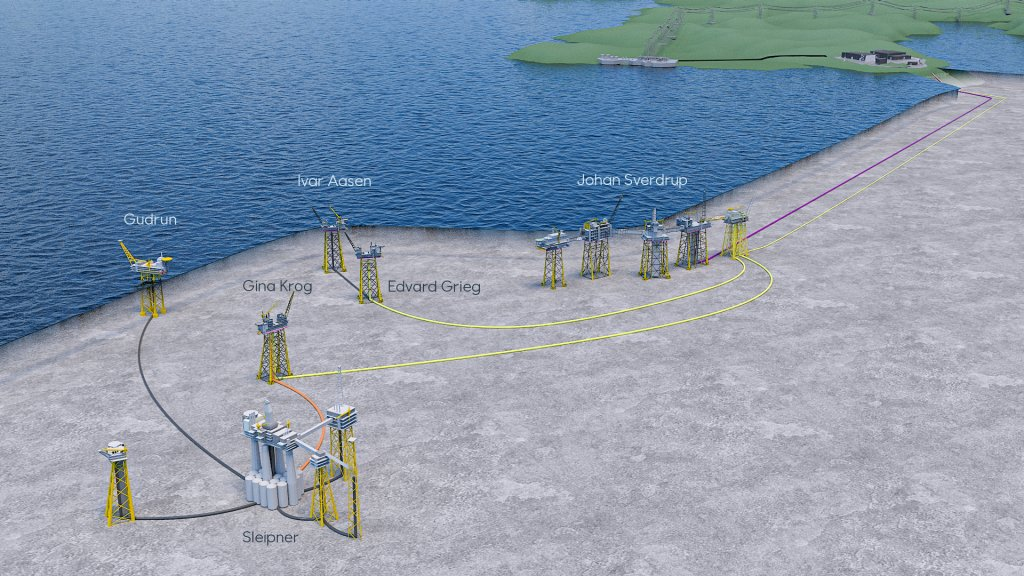
Equinor diagram: power cables from shore to Johan Sverdrup field

β€œIt’s an absolutely sh*t situation,” said Norway’s energy minister Terje Aasland reacting to electricity prices in the country that are six times that of the EU average.

The two ruling parties in Norway want to cut the two power inter-connectors that link the country with Denmark when they come up for renewal in 2026. The smaller coalition party, the Center Party, wants to revisit similar energy links with the UK and Europe.

A related matter is Norway’s push to power offshore platforms with electricity from shore. This policy makes neither economic nor environmental sense, and introduces new safety and operational risks.

This BOE post cites the obvious (per NPD): “The power from shore projects will lead to an increase in electricity prices in Norway.” The post also presents seven other reasons why powering those facilities from shore is not a good idea.

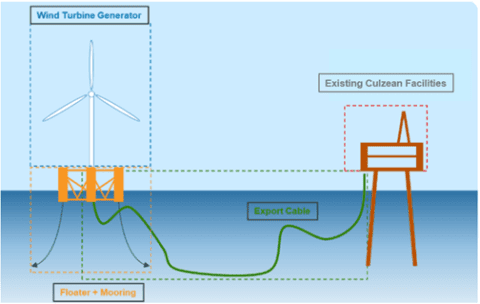
Meanwhile, Total’s plan to partially power the Culzean field (UK) with a floating turbine is similarly irrational. The scheme adds costs and risks with no apparent benefit.

Read Full Post »

« Newer Posts - Older Posts »