As anticipated, the increase in royalty and rental rates appears to have further weakened interest in leases in the shallow waters of the Gulf of Mexico continental shelf. Note the sharp declines in both the number of blocks receiving bids and the bid amounts.
Green Canyon 79 received a bid of $3.6 million at Sale 257, but no lease was ever issued. No explanation was provided and there were no bids for this block at Sale 259.
There was actually a second bidder, Focus Exploration, for one of the 69 “CCS blocks,” that Exxon seeks to acquire (see below). Exxon’s bid was higher. Does this mean that Focus, a company that is presumably interested in exploring for oil and gas, will lose the block to a company that bid on the block for purposes not authorized in the Notice of Sale?
Exxon doubled down on their strategic CCS bidding; their only bids (69 in total) again appeared to be solely for carbon sequestration purposes. As previously noted, acquiring tracts for CCS purposes is not authorized in an oil and gas sale. Arguably, these bids should be rejected.
The other super-majors, BP, Chevron, and Shell, were active participants as were many independents.
It was good to see BOEM Director Liz Klein announcing bids. This shows respect for the OCS oil and gas program.
15 years ago the Minerals Management Service pushed hard for better offshore medevac capabilities. Harlan King, the father of an offshore worker whose injuries were exacerbated by the delayed medical response, was the main impetus behind this effort. The industry responded favorably and Mr. King, BP, and Petroleum Helicopters Inc received Offshore Leadership Awards in 2009 for their initiatives. This 2009 article describes PHI’s dedicated medevac capabilities at the time.
The number of “non-occupational” fatalities (at least 6) at US OCS facilities in 2021 suggests that medical care and evacuation capabilities are once again a concern. BSEE is therefore applauded for their medical evacuation assessment initiative. Their recent presentation is attached.
BSEE’s presentation describes 6 more “non-operational” fatalities in 2022, and raises concerns about CPR training deficiencies, evacuation challenges posed by stairways, and the absence of medics at some facilities. BSEE’s findings (pages 14-21 of the presentation) are eye-opening and merit the attention of all operators, contractors, and others interested in offshore facility safety.
While historical data on health-related OCS fatalities are not readily available, 12 such fatalities over the past 2 years seems high relative to past experience, particularly given that the total number of hours worked has declined by more than 50% since 2011. As suggested in our 2 February post, further investigation into this disturbing trend is warranted. Given the sensitivity of the topic, it would seem best for the Coast Guard and BSEE, with appropriate medical assistance, to conduct this review.
The bill neither repeals nor amends the massive land withdrawals by Presidents Obama, Trump, and Biden that have fenced the OCS program into portions of the central and western Gulf of Mexico. Worse yet, the bill tacitly endorses those withdrawals by specifically stating that they are not affected in any way (Sec. 20114).
Sec. 20107 mandates that at least 2 lease sales be held annually in the GoM. The certainty would provide some incremental benefit, but is unlikely to stem the decline in GoM reserves. We are becoming increasingly dependent on the 4% of our OCS that may be leased, about 3/4 of which is not prospective or has limited production potential.
Sec. 20601 lowers the revenue to the US Treasury and increases the revenue to Gulf producing states. This would garner further support from those states, but will have little effect on production.
Sec. 20106 requires DOI to publish information and report to Congress on the processing of drilling permits. However, delayed drilling permit approvals do not seem to be a significant issue on the OCS.
What a completely pointless exercise! £20 Billion on a Carbon Capture Storage Plan. I wonder which private companies and individuals are being awarded these insane contracts I really do feel like Alice at times like these, except this is no Wonderland! 1984 more like…. pic.twitter.com/PCVTgETM1W
“I don’t want to go and give news now before it is ready to be given, but let us say the prospectivity is highly regarded,” he told a local academic forum in the Eastern Caribbean tourism paradise.
“Let’s be frank: All of the oil producers of the world, including Canada, speak the language of climate change and putting a stop to that, which is now being done by small entities or like those of us in Barbados who are contemplating finding natural gas, but the reality is, none of them is saying ‘I will not continue to produce the oil that I produce’ or ‘I’m shutting down all my wells,’” he said. “The Americans are not going to tell you that that’s what’s going to happen in Texas. The British, for all their partnership value, will not tell you that the North Sea will not be full of Brent crude. They’re not going to do that because they intend to produce for the next 50 years. Nobody is coming forward to say we are prepared to pay you to keep the natural gas and the oil in the ground.”
The OCS Orders were the foundation for the current operating regulations in the US and many states and other countries. They were logically organized, easily updated, and published for public comment prior to being finalized.
I have an email message indicating that the first OCS Order No. 1 (Identification of Wells, Platforms, and Structures) was signed on 1/31/1957 and the first OCS Order No. 2 (Drilling) dates back to 2/3/1958! (If anyone has access to the actual documents, please let me know.) The orders were developed much further in the 1970s and 1980s.
Contents of the 1/1980 Atlantic Orders:
OCS Order No. 1: Identification of Wells, Platforms, Structures, Mobile Drilling Units, and Subsea Objects
OCS Order No. 2: Drilling Operations
OCS Order No. 3: Plugging and Abandonment of Wells
OCS Order No. 4: Determination of Well Producibility
OCS Order No. 5: Production Safety Systems
OCS Order No. 6: Well Completions and Workover Operations
OCS Order No. 7: Pollution Prevention and Control
OCS Order No. 8: Platforms and Structures
OCS Order No. 9: Oil and Gas Pipelines
OCS Order No. 10 (reserved)
OCS Order No. 11: Oil and Gas Production Rates, Prevention of Waste, and Protection of Correlative Rights
OCS Order No. 12: Public Inspection of Records
OCS Order No. 13: Production Measurement and Commingling
There has been much discussion, particularly since the 1988 Piper Alpha tragedy, regarding the optimal approach to offshore safety regulation be it prescription, goal setting, safety cases, management systems, or some combination, and how to best influence facility, company, and industry safety culture.
My personal view is that the quality and type of regulations are not nearly as important as the people implementing them. My take:
Good regulators are more important than good regulations and are the key to a successful regulatory program.
Regulatorsmust understand and be committed to their organization’s mission and the strategy for achieving that mission.
While they should have a good understanding of the activities that they regulate, their focus is on challenging operators, not directing them.
Regulators should audit operator activities and carefully review incident and performance data. They should identify problems and concerns, but should not direct solutions.
Safety leaders should be applauded and poor performers should be penalized.
The quality of regulators is more important than the quantity.
Internal and external communication and collaboration are critical to their success.
Management should ensure that regulators are able to focus on their mission and that organizational distractions are minimized.
The agency did its job and, with the help of German intelligence, concocted and planted stories about an ad hoc “off the books” operation that had led to the destruction of the pipelines. The scam had two elements: a March 7 report in the New York Times citing an anonymous American official claiming that “[n]ew intelligence…suggests” that “a pro-Ukrainian group” may have been involved in the pipeline’s destruction; and a report the same day in Der Zeit, Germany’s most widely read weekly newspaper, stating that German investigative officials had tracked down a chartered luxury sailing yacht that was known to have set off on September 6 from the German port at Rostock past Bornholm island off the coast of Denmark.
“It was a total fabrication by American intelligence that was passed along to the Germans, and aimed at discrediting your story,” I (Hersh) was told by a source within the American intelligence community.
The comments following the “SHEERPOST” re-posting of the Hersh update piece are also interesting.
Untested ultra-deep potential hydrocarbon resources are located in the BOEM play area 8, termed the BCT Structural Belt Jurassic-Cretaceous Interior Shelf. Thus, significantly more risked recoverable reserves, due to 1) Two salt ridges penetrating Middle Jurassic age sediments identified in seismic records located to the north of the Schlee Dome, analogous to the ultra-deep salt related Norphlet Formation, offshore Gulf of Mexico and the onshore East Texas, Pearsall Field and 2) stratigraphic plays including below a 60 m thick and 7500 km square evaporitic feature in Early Jurassic rocks flanking the Schlee Dome.
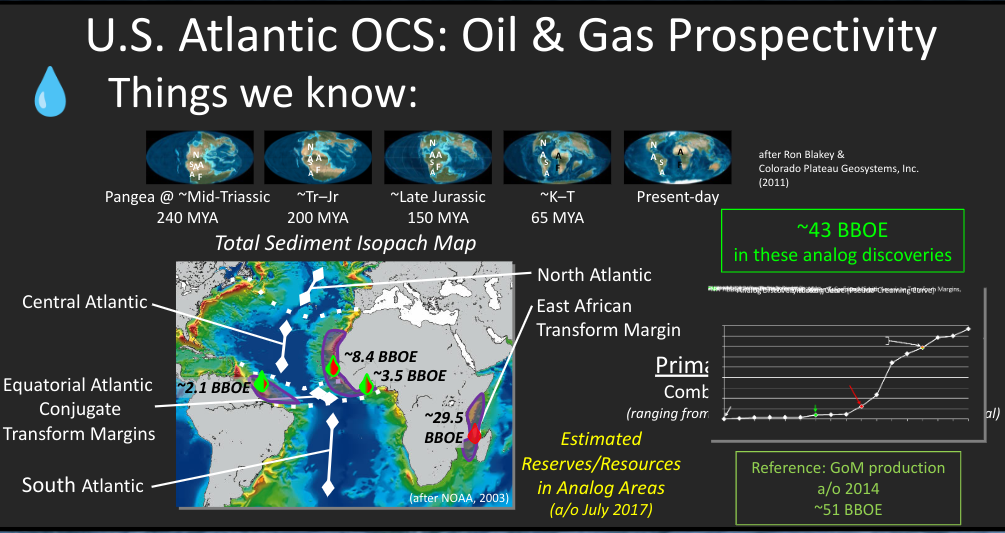
Looking more broadly at Atlantic resource potential, Paul Post had estimated that the US Atlantic could contain 21.4 billion BOE with the major caveat that the presence of a working petroleum system was required and that could only be determined through drilling. Per Paul:
The US Atlantic stands out. It has not been explored in paleo deep- and ultra-deepwater using exploration concepts proven successful in similar settings.



 Bud's Offshore Energy (BOE)