
Feeds:
Posts
Comments

Posts Tagged ‘Signal Hill’

Background: On February 12, 2024, the bankruptcy court approved the sale of certain Cox Operating assets to Natural Resources Worldwide LLC (NRW), a company that “does not mine, drill, or produce minerals, has no operations, and conducts business solely in an office environment.”

NRW contracted with Array Petroleum to operate the former Cox Assets. Array subsequently sued NRW, asserting that NRW received $78,000,000 in revenue, but disbursed only about $48,000,000 to pay Array’s invoices and those of the subcontractor.

The court filing claimed that NRW failed to pay Array $2.5 million, the subcontractors $10.7 million, and the United States $12 million. A large share of the subcontractor costs were probably for well operations given that 21 Array workover applications were approved in 2024 and 2025. The $12 million due to the Federal government is reportedly for royalty payments. Were any revenues set aside for decommissioning liabilities?

Array’s lawsuit was dismissed by the court on January 3, 2025, after a joint motion to dismiss was filed by the defendants. Information on the reasons for the dismissal is not publicly available.

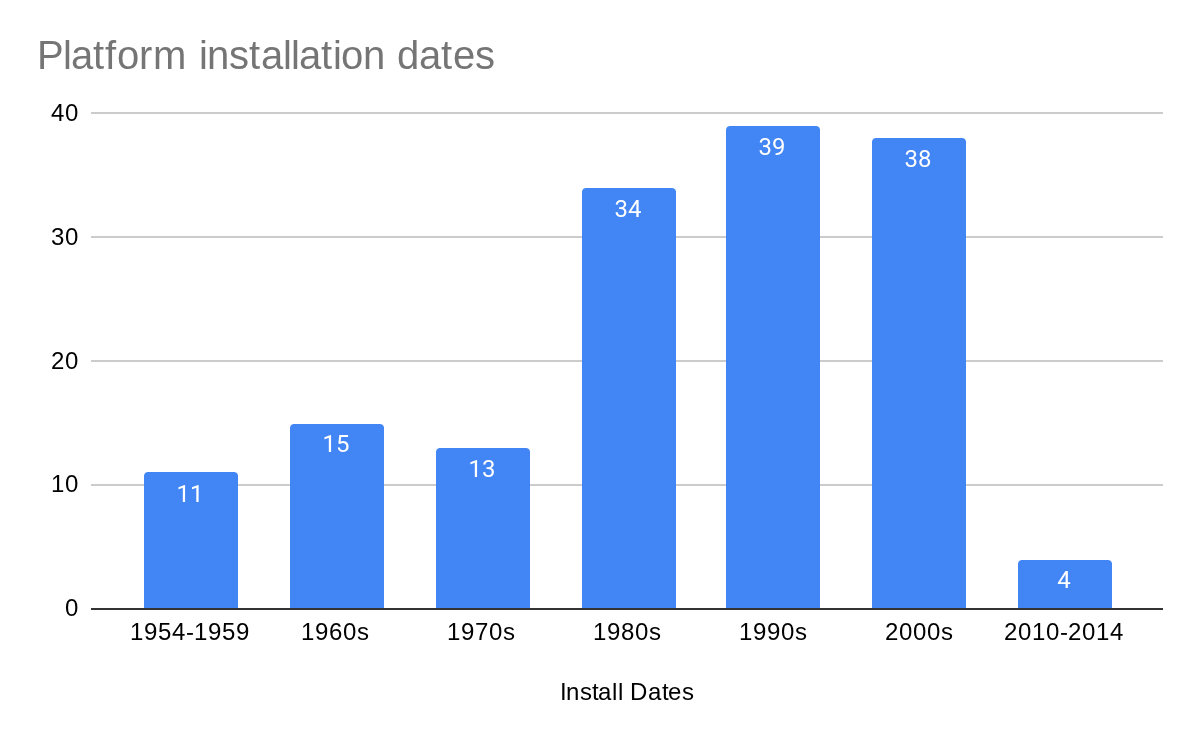
Old platforms: According to BOEM records, Array operates 154 platforms previously owned by Cox. These platforms are in the Ship Shoal, South Marsh Island, and West Delta areas of the Gulf of America. Most are >30 years old and four are more than 70 years old (see chart below). 41 are classified as major structures including 15 of the 26 platforms installed in the 1950s and 1960s. 44 are manned on a 24 hour basis. 79 have helidecks. Massive decommissioning liabilities loom.
Violations: NRW/Array ranks 37th out of 42 companies in GoA oil production (2025 YTD) and 36th out of 42 companies in gas production, but leads the pack in Incidents of Noncompliance (INCs):

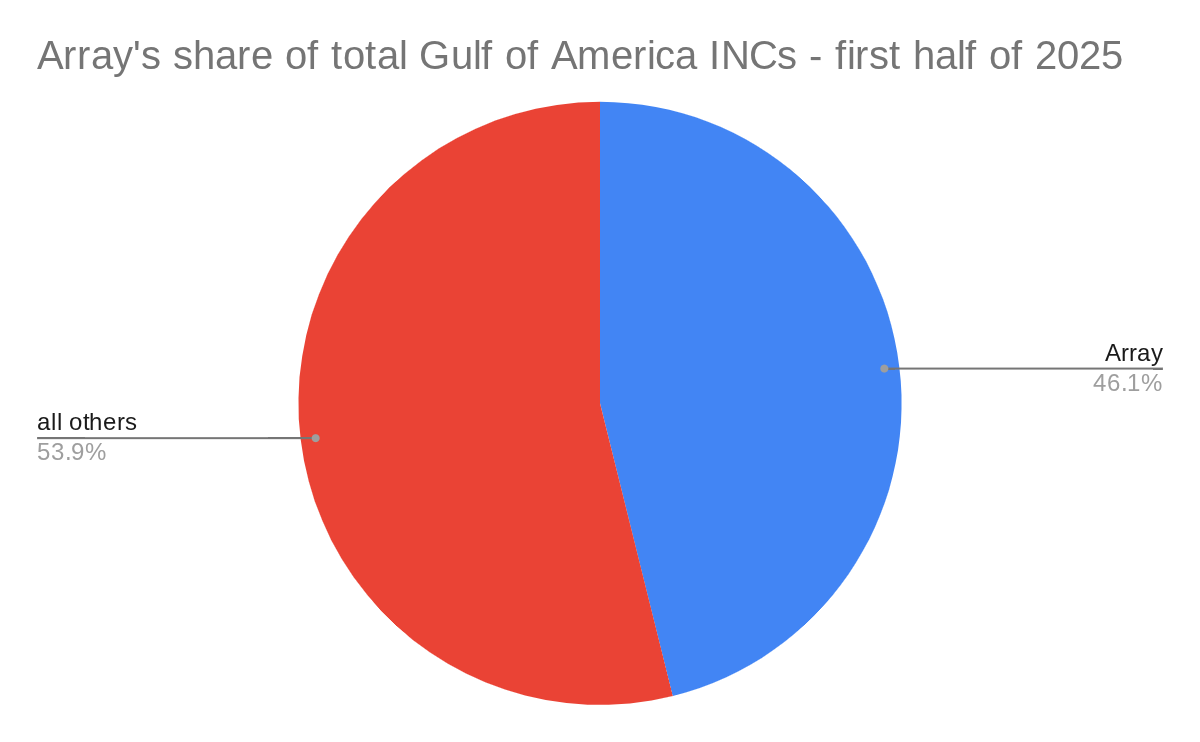
  • Array accounted for nearly half of all GoA INCs issued in the first half of 2025 (chart below).
  • Array was issued 9 times more warning INCs (311) than any other operator. Apache was second with 34.
  • Array had more component shut-in INCS (46) than any other operator. W&T, another operator of Cox legacy platforms, was second with 32.
  • Array had more facility shut-in INCs (6) than any other operator. W&T was again second with 5.
  • Array averaged 2.0 INCs/facility inspection vs. a combined average of 0.3 INCs/facility inspection for all other operators.
violation typewarningscomponent shut-insfacility shut-ins
Array311466
all others21116449

Lessons that should have been learned from the Cox, Fieldwood, Black Elk, Signal Hill, and other bankruptcies dating back to the Alliance Operating Corp. failure in 1989:

  • There are many small and mid-sized companies that are responsible operators. Their participation in the OCS program should be encouraged. However, others have demonstrated, by their inattention to financial and safety requirements, that they are not fit to operate OCS facilities.
  • The growth of Fieldwood, Cox, Signal Hill, and Black Elk was in part facilitated by lax lease assignment and financial assurance policies. 
  • Operating companies should have to demonstrate that they can operate safety and comply with the regulations before they are approved to acquire more properties.
  • Despite ample evidence of the importance of compliance and safety performance in determining the need for supplemental financial assurance, BOEM’s 2024 rule dropped all consideration of these factors.,
  • Expect the ultimate public cost of the Cox bankruptcy, in terms of decommissioning liabilities and the need for increased oversight, to be large.
  • The Federal govt (Justice/Interior) should strongly oppose bankruptcy court asset sales that increase public financial, safety, and environmental risks.

Read Full Post »

Offshore facility decommissioning is a frequent target of Federal auditors given the complex financial and regulatory challenges. Unfortunately, the reviews have done little to better protect the public interest. As have previous inquiries, the new GAO report (attached for your convenience) calls for improved regulations and enforcement practices. That, of course, has been the objective for decades, but the problems have only worsened.

While the GAO recommendations are unsurprising, the body of the report is informative. Most notably, GAO (p. 29) raises a significant inconsistency on a key provision in the proposed decommissioning financial assurance regulations published last year:

One of the five criteria BOEM would no longer use under the proposed rule is demonstrated reliability, as shown by record of compliance with laws, regulations, and lease terms, among other factors. BOEM’s June 2023 regulatory analysis concluded this criterion is not a good predictive indicator of default on decommissioning obligations. However, BOEM and BSEE officials we spoke with told us that poor compliance records—such as safety and maintenance issues or delayed decommissioning obligations—can be an indicator of potential decommissioning noncompliance or financial stress.

Why was there such a disconnect between the opinions of BOEM and BSEE officials (who are directly involved with decommissioning) and BOEM’s decision not to include a company’s compliance record among the factors to be considered in determining the need for supplemental financial assurance? As pointed out here and here, safety performance is arguably the most important predictor of financial failure and decommissioning noncompliance.

The GAO report correctly acknowledges the difficulties in disqualifying operating companies. However, the regulations at 30 CFR § 250.135 specifically provide for disqualification for poor performance. While the regulations could be tighter, enforcing disqualifications regulations is dependent on persistence and strong support from management and DOI attorneys. Given the political risks associated with disqualifying operators, that support is often lacking.

Disqualification difficulties make it imperative that BOEM carefully consider past performance before approving lease assignments or determining financial assurance amounts. Provisions in 30 CFR §585.408 and §585.107 could have been used to disapprove assignments to Signal Hill, Fieldwood, Cox, and other problem operators. The failure to do so has significantly delayed decommissioning and increased public exposure to financial risks.

In some cases, lease assignments to unqualified companies have not only been approved but they have been facilitated by BOEM/MMS. The case of Platforms Hogan and Houchin, in the Santa Barbara Channel, is a particularly good example. (Did GAO inquire about the Inspector General report on this matter or ask why that report has still not been released?)

Most operating companies are responsible about planning for and fulfilling their decommissioning obligations. The problem is the exceptions, and they are not difficult to identify if you look at compliance data and obtain input from BSEE inspection personnel.

Other important decommissioning questions that need to be considered:

Additional comments on the GAO report from decommissioning specialist John Smith will be posted tomorrow.

Read Full Post »

In a draft rule published on June 29, 2023, BOEM proposes to discontinue using a company’s record of compliance in determining the need for supplemental financial assurance for decommissioning. BOEM’s full explanation for this surprising change is pasted at the end of this post.

Opposing view:

  • BOEM should be more attentive, not less, to safety performance and compliance data. If they were, taxpayers would have been better protected from the risks associated with the lease acquisitions by Fieldwood, Cox, Black Elk, Signal Hill, and others, and their subsequent bankruptcies.
  • Safe operations, as reflected in compliance and performance data, are critical to a company’s financial success.
  • BOEM wrongly infers that Incidents of Noncompliance (INCs) are solely dependent on the number and complexity of facilities. Decades of normalized compliance data have told us that there are marked differences among operators in terms of compliance and safety performance. Companies at the bottom of the performance table don’t usually survive.
  • Accidents are not mere matters of chance; management and culture matter.
  • Honor Roll companies, large and small, have superior compliance records, and in 2022 these companies had 50-90% fewer INCs/facility-inspection than the Gulf of Mexico average.
  • Does BOEM expect noncompliance leaders to be concerned about decommissioning obligations? The record shows that they are not.
  • Cox’s 2023 bankruptcy was predictable given their past safety performance. In 2022, Cox was a violations leader by any measure, and was responsible for 9 of the 30 safety incidents that were significant enough to require investigation by BSEE.
  • Fieldwood’s terrible 2021 safety performance has been discussed, and there was ample evidence of performance problems prior to their bankruptcy declaration in 2018. In 2016 and 2017 Fieldwood was, by far, the GoM violations leader with 818 INCs, 401 of which required a facility or component shut-in.
  • Ironically (or maybe not), the only other company that was even in the same noncompliance ballpark as Fieldwood in 2016 and 2017 was future Cox affiliate Energy XXI GOM. Energy XXI earned 465 INCs (240 shut-ins) during that 2 year period. Did BOEM object to or otherwise comment on the 2018 Cox-Energy XXI merger?
  • Black Elk Energy was new in 2007 and quickly became a violations leader. Between 2010 and 2012, BSEE cited Black Elk 415 times. 218 of these violations were serious enough to require facility or component shut-ins. On November 16, 2012, explosions at Black Elk’s West Delta 32 platform killed 3 workers, and 2 others suffered severe burns. Criminal charges and a complex bankruptcy followed. BSEE records show 1107 INCs during the company’s short history, 464 of which required facility or component shut-ins.
  • The rapid growth of Fieldwood, Cox, and Black Elk was in part facilitated by lax lease assignment and financial assurance policies. Operating companies should have to demonstrate that they can operate safety and comply with the regulations before they are approved to acquire more properties.
  • The Signal Hill saga was documented nearly 2 years ago, and none of the questions raised in that post have been answered. Violations data and inspector feedback predicted the Signal Hill/POOI failure. Nonetheless, and despite the objections of regional staff, Signal Hill was allowed to tap into its decommissioning account to cover operating expenses. Responsibility for decommissioning Platforms Hogan and Houchin is still uncertain.
  • Bankruptcy has been used to avoid or transfer decommissioning obligations. In that regard, Chevron’s comprehensive objection to Fieldwood’s restructuring plan is telling.
  • Given that BSEE, not BOEM, is responsible for safety and compliance, I sincerely hope that regulatory fragmentation was not a factor contributing to BOEM’s decision to discontinue the use of compliance data in determining financial assurance needs.

BOEM’s explanation for the proposal to eliminate the record of compliance criterion:

BOEM also proposes to eliminate the existing “record of compliance” criterion found in the current version of § 556.901(d)(1)(v). BOEM has determined that the number of INCs a company receives correlates with the number of OCS properties it owns, not its financial stability, and therefore, BOEM has concluded that it is not an accurate predictor of its financial health. BOEM reviewed BSEE’s Incidents of Non-Compliance (INCs) records and its Increased Oversight List, which represent BSEE’s cumulative records of violations of performance standards on the part of OCS operators and lessees and determined that the number of incidents of non-compliance typically increases with the size and complexity of the operator’s or lessee’s operations, including the ratio of incidents to number of components. Because larger companies (regardless of credit score) tend to have more properties and components and therefore more INCs, BOEM determined that record of compliance criterion does not accurately predict financial default. BOEM’s review of this information confirmed the feedback BOEM received in response to the 2016 NTL, namely that companies with a large number of properties and facilities tended to receive a large number of INCs and had more individual properties on the Increased Oversight List. BOEM specifically requests comments regarding the use of fines and violations as a criterion in the determination of a company’s ability to fulfill decommissioning obligations, and any data or analysis addressing any correlation between the number of violations and the risk of financial default. BOEM also requests comments on whether the elimination of the INC’s criteria would create a disincentive to comply with regulations. BOEM also requests comment on whether or not the cost of decommissioning is likely to increase based on the type, quantity, and magnitude of previous violations.

On a related note, BOEM/BSEE should consider a followup to the John Shultz thesis which found that INCs are a very good predictor of accidents and spills.

Read Full Post »

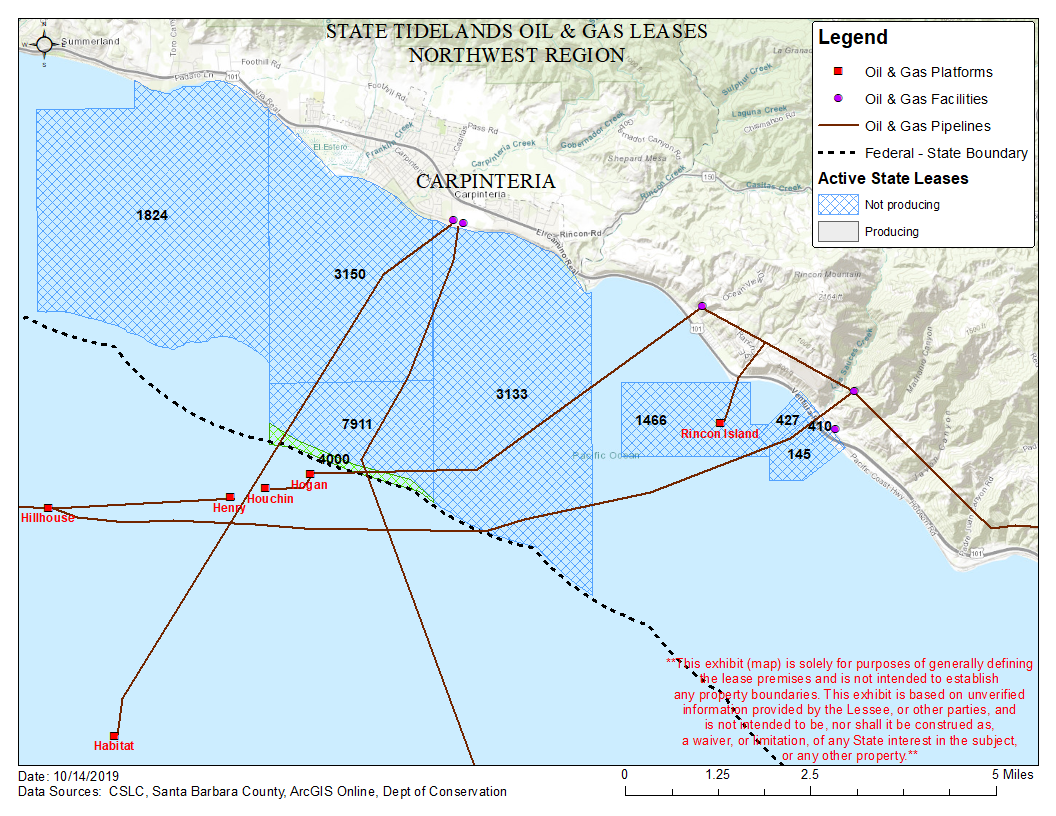
The troubled past of Platforms Hogan and Houchin extends into California State waters. In the 1990’s, Signal Hill and affiliates launched plans to drill directionally from Hogan into adjacent State leases 4000, 7911, and 3133 (see map above). These plans were dubious from the outset given MMS (Federal regulator) concerns about Hogan’s structural integrity. The planning process was never successfully concluded and the 3 State leases were terminated in 2019. For full details see this California State Lands Commission report:

In a related action, the State is suing Signal Hill for unpaid rentals on the pipeline lease that carried production from Hogan to shore. The amount due is approximately $287,000.

Read Full Post »