
PSA release and link to report:
The direct cause of the incident was that the container being lifted began swinging too much and got caught up in another container. A deck worker standing in an unsecured area was struck and injured.
This incident could potentially have killed the person concerned. Substantial material damage could also have been caused.
Read Full Post »
Posted in accidents, well control incidents, tagged accidents, blowouts, bp, Deepwater Horizon, drilling, Gulf of Mexico, macondo, offshore oil, oil spill, safety, trial, well control on May 17, 2011|
Leave a Comment »
Hundreds of witnesses expected.
The trial won’t proceed quickly, if the parties call all the witnesses on their lists.
Transocean’s roster of 304 included 82 of its own employees, 87 from oil company BP, and 18 from cement contractor Halliburton.
BP listed 71 witnesses from Halliburton, 110 others, plus anyone else who has been or will be deposed.
The United States listed 56 from BP, 32 from Halliburton, and 76 others.
Read Full Post »
Posted in accidents, offshore, Offshore Energy - General, Regulation, well control incidents, tagged accidents, blowouts, BOP, Deepwater Horizon, drilling, GIRG, Gulf of Mexico, macondo, Montara, offshore drilling, OGP, oil spill, safety, well control, well planning on May 16, 2011|
Leave a Comment »
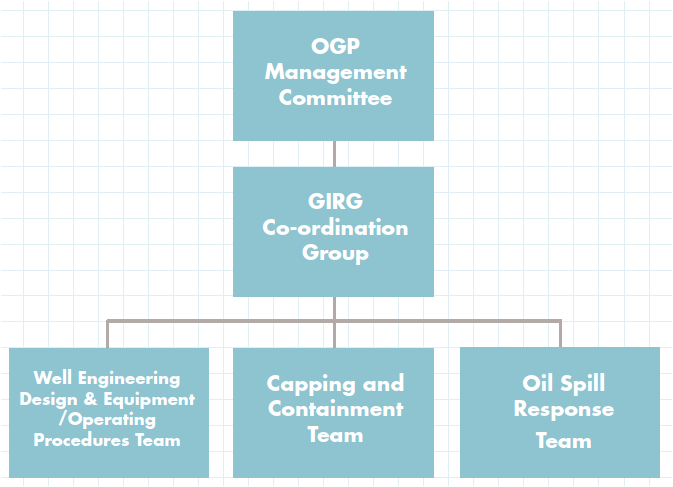
Today, the International Oil and Gas Producers (OGP) released the Global Industry Response Group (GIRG) reports. GIRG was formed last July with the goal of better managing offshore safety risks. The organizational structure is illustrated below.
Deepwater Wells: Lessons and Recommendations focuses on the critical prevention programs, and is perhaps the most important of the GIRG reports. Since Macondo, the GIRG team and other industry committees have worked diligently on well planning and integrity issues, and are commended for their outstanding efforts. However, the recommendations presented in the GIRG report are surprisingly modest, and do not reflect the technological and management innovation that industry has demonstrated in pioneering offshore development. The recommendations fail to break new ground, lack specifics, and, in some cases, appear to be a step backward. In short, the oil and gas industry is capable of much more. Initial comments follow:
- Incident data (problem): The absence of comprehensive and verified incident data is one of the “systemic” industry weaknesses identified by the National Commission. OGP has tried to address this problem for years, but has not had the industry-wide support needed to develop a credible program. GIRG has wisely recommended a Wells Expert Committee (WEC) to review selected incident data. However, the recommended program suffers from the same weaknesses that constrain existing OGP reporting programs. OGP must rely on “encouraging” its members to participate voluntarily, and non-members are not included. This type of voluntary program was not good enough before Macondo/Montara, and is certainly not good enough now.
- Incident data (solution): Industry and regulators need an ironclad commitment that all operating companies will submit incident data in accordance with defined protocols. Contractor data must be included. Companies should execute binding agreements with OGP, or some other entity, to provide this information. The data must be managed by a completely independent entity that cannot, in any way, be directed by an industry advocacy group. Regulators and other independent representatives should be included on the management committee. Regulators should prohibit companies that don’t agree to submit these data from from operating within their jurisdictions. A comprehensive incident reporting and data management system is long overdue, and continued delays are not acceptable.
- Montara: While GIRG is supposedly in response to both Macondo and Montara, the latter seems to have been largely ignored. The deepwater theme does not apply to the Montara platform, which was in only 80m of water. Despite the post-Macondo focus on water depth, shallow water was arguably a more significant contributing factor to the Montara blowout (batched completions using a cantilevered jackup, mudline suspensions, and two-stage platform installation) than deep water was at Macondo. Also, well capping, which was feasible and ultimately successful at Macondo, could not even be attempted at Macondo because of the manner in which these platform wells were suspended. Finally, GIRG ignores the special gas migration and kick detection issues associated with horizontal completions like Montara, and the relief well rig availability and release issues that were never fully addressed during the Montara inquiry.
- Emergency worldwide notification system: In conjunction with the incident reporting system, industry needs an emergency notification procedure that goes beyond safety alerts and requires the immediate attention of every operator and wells contractor. During the Montara inquiry, worldwide attention should have been drawn to the inability of the Montara operator to identify a hydrocarbons influx through the shoe track and into the production casing. Could an effective notification system have prevented Macondo? No one can say for sure, but the probability of a blowout at Macondo would have been greatly reduced if key BP and Transocean personnel had participated in discussions about Montara and the importance of proper negative pressure tests.
- Dependence on regulator: On page 21 of the report, GIRG recommends that a company “carry out a more extensive programme of self-audit” when there is a lack of competent regulatory oversight. An operator should never depend on the regulator to verify its well or management programs, and should never relax its programs regardless of the level of regulation. Detailed regulatory reviews of specific drilling or management programs are never a substitute for operator diligence. Did the operators at Montara and Macondo rely on the regulator to protect them from themselves? Read the official investigation reports and make your own judgement.
- Best practices: GIRG recommends “refraining from using the term ‘best industry practice’ until this definition is clarified; we prefer ‘good oilfield practice’ for the time being.” Isn’t the clarification of best practices the role of groups such as this and industry standards committees? This attitude explains some of the technical recommendations in this report which may be “good oilfield practices,” but fail to raise the bar for safety achievement. Would you be satisfied with “good” if family members were working on rigs or if operations were conducted off your coast? While “best practices” vary depending on the conditions and circumstances, it’s industry’s responsibility to identify those practices, and industry and regulators must set the bar high and keep raising it.
- GIRG recommends established practices: Some of the GIRG recommendations, such as the “two-barrier” policy have been standard practice for most operators for years.
- API RP 75: There are numerous endorsements of RP 75 as an important reference for management systems covering the design of wells and other activities. RP 75 was a reaction to an MMS regulatory initiative 20-years ago to impose safety management requirements on offshore operators. BP, Transocean, and PTTEP had management systems that were generally consistent with the guidance in RP 75. GIRG needs to go beyond RP 75 and focus on improvements that will make safety management systems more effective.
- API Bulletin 97, Well Construction Interface Document (WCID): Despite the complete absence of public attention, this is perhaps the most important post-Macondo initiative. It’s thus particularly disappointing that this document is now five months late. How does GIRG recommend the use of a document that is not complete and has not yet (to the best of my knowledge) even entered the balloting process? Another recommended and highly important document, updated RP 96 – Deepwater Well Design, has also yet to be finalized.
- BOP recommendations: Nothing new or innovative is offered by GIRG. The report calls for 2 shear rams, but only one need have sealing capability, which means that the Deepwater Horizon stack met the GIRG specification. While many BOP advances require additional study, some (such as real-time function and pressure monitoring systems) already exist. Other GIRG technology recommendations are rather timid and generally in the form of suggestions for future study (e.g. study cement bond log technology).
- Training: This section of the report is good, but doesn’t address deficiencies identified in the Montara inquiry and reviews of historical blowout data. Montara and other accidents have demonstrated that senior rig personnel may have limited understanding about well planning and construction practices. These topics are not covered in well control training programs. How does industry plan to address this major deficiency? While well planning is the responsibility of the operator (often a separate group than is represented on the rig), well control decisionmaking requires a fundamental understanding of well construction practices. Also evident in the Montara testimony was the total absence of understanding on the part of operator, drilling contractor, and cementing personnel about the historical causes of blowouts. The cementers at Montara were unaware that gas migration/influxes during cementing operations were a leading cause of blowouts. Training programs need to be expanded to provide for the discussion of past accidents and how they could have been prevented.
Read Full Post »
Reuters article
“For us, the major goal is to prevent these major accidents from happening,” said Fidel Ilizastigui Perez, an official of Cuba’s Office for Environment and Nuclear Safety Regulation.
“The companies must show that they meet all international standards,” he told the conference in Port of Spain.
Perez said Cuban officials had studied and already implemented oil industry safety practices from Britain and incorporated others from the United States.
Mr. Perez participated in the 2005 International Regulators’ Offshore Safety Conference in London and made a very favorable impression.
Dan Whittle, a senior attorney at the U.S.-based Environmental Defense Fund, said the Cuban government appeared to be taking the safety issue seriously because of the potential economic benefit of the project.
“Cuba has a lot at stake,” he said. “They’re doing the best they can with limited resources and with obstacles to access those resources.”
“I think we’re seeing the beginning of a more international dialogue on what the Cubans are planning,” he added.
Sensible comments from the EDF.
Also, Cuba and the Bahamas have agreed on a maritime boundary.
Read Full Post »
The U.S. House of Representatives has voted to impose deadlines on the Obama administration to issue offshore drilling permits, as Republicans renew calls for greater amounts of domestic oil production amid rising gasoline prices. Dow Jones
Don’t you have to decide how you are going to regulate before setting deadlines? Now that the House has spoken and the bill is likely to die in the Senate, can we engage in a substantive discussion about how to regulate most effectively and efficiently? Congressional hearings?
Read Full Post »
While US politicians continue to gnash their teeth or express outrage, the International Association of Drilling Contractors (IADC) has been busy promoting constructive dialogue about Cuban exploratory drilling. IADC has overcome major administrative obstacles and arranged for the participation of Cuban regulators in the Environmental Conference which begins tomorrow in Trinidad.
“This will pretty much be the first time the Cuban deepwater drilling project managers will make a presentation of what their regulatory requirements are going to be for the companies that drill in Cuban waters,” said Lee Hunt, president of the Houston-based International Association of Drilling Contractors, which is organizing the conference. Reuters
The Cuba session is scheduled for tomorrow afternoon. I look forward to seeing the news reports and posted presentations.
Read Full Post »
Posted in accidents, Norway, Offshore Energy - General, Regulation, UK, tagged accidents, gas leaks, HSE, Norway, safety, UK on May 10, 2011|
Leave a Comment »
The HSE has told Shell to submit a revised safety case for the Brent Charlie platform after gas was detected on its topsides following leaks on 12 January this year and 27 September 2010, Upstream can reveal.
Shell, which took the decision itself to close the platform after the January incident, has been battling for some time to resolve technically complex issues related to the venting of gas from inside one the platform’s huge concrete legs — Column 1 (C1) — and dispersing it effectively away from the platform.
The operator now expects the ageing Brent field to remain shut down for several more months.
Read Full Post »
The following are significant accidents (based on the consequences or potential for consequences) that have been discussed on BOE, but for which no official company or governmental report has been released. These accidents happened from 8 months to 3 years ago. I’m sure there are many others that we didn’t hear about or discuss. How do you effectively prevent accidents when reports are either not prepared, not released, or not completed in a timely manner?
The following accidents are are too recent (6 were just last month) to expect reports. BOE will publish links to the reports as soon as they become available.
If you are aware of other accidents that you think should be added to these lists, please let me know.
Read Full Post »
Posted in accidents, well control incidents, tagged Deepwater Horizon, drilling, macondo, offshore drilling, offshore oil, oil spill, safety, well control on May 7, 2011|
Leave a Comment »
…. and gleeful.
“Is there likely to be litigation over new drilling permits? You bet there is,” said David Petit, a senior attorney with the Natural Resources Defense Council.
“We’ll definitely litigate it,” Kieran Suckling, executive director of the Center for Biological Diversity, said of the federal approval of Shell’s plan. “It’s patently illegal.”
Environmental Suits Threaten Gulf Drilling- Wall Street Journal
Read Full Post »
Congratulations to the many dedicated professionals who contribute to the success of this important conference. 
Attendance at the 2011 Offshore Technology Conference (OTC) reached a 29-year high of 78,150, up 8% from last year, as offshore energy industry experts from around the world came together at the world’s largest event for offshore resources development. OTC was held 2-5 May at Reliant Park in Houston.
Read Full Post »

 Bud's Offshore Energy (BOE)